




If your business handles foods covered under the FDA Food Traceability List, FSMA 204 compliance requires more than simply maintaining records. Companies need a clear process for capturing traceability data, connecting information across their supply chain, and producing required records quickly when requested.
The FDA enforcement deadline for FSMA 204 is July 20, 2028. While businesses have additional time to prepare, the compliance requirements remain unchanged. Food manufacturers, processors, packers, distributors, and other covered entities need to use this time to identify issues and align suppliers to build traceability processes that support faster response during food safety investigations.
In this guide we will see what FSMA 204 requires, who it applies to, what data businesses must capture and how organizations can get ready for compliance without disrupting daily operations.
Last updated: November 2026.
What is FSMA 204- The Food Traceability Rule
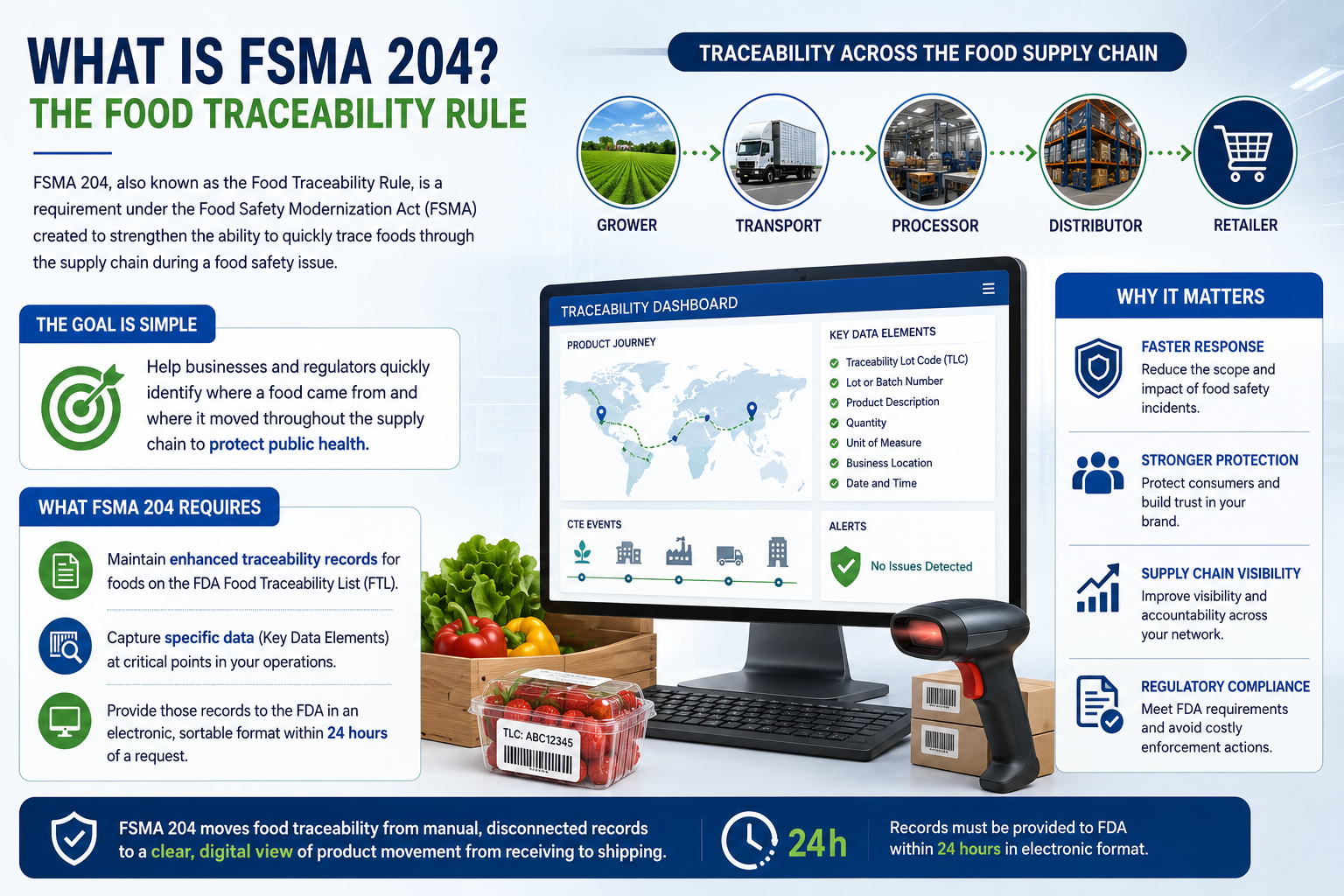
FSMA 204 — the Food Traceability Rule under the Food Safety Modernization Act
FSMA 204 is also known as the Food Traceability Rule, which is a requirement under the Food Safety Modernization Act (FSMA) focused specifically on improving food traceability. It is the FSMA rule whose compliance date is July 20, 2028.
The aim of FSMA 204 is simple: to help organizations and regulators quickly identify where a food product came from and where it moved throughout the supply chain during a food safety issue.
Also under this rule, businesses handling certain high-risk foods must maintain enhanced traceability records, capture specific data at important points in their operations and provide those records to the FDA in an electronic, sortable format within 24 hours of a request.
Unlike the old record keeping system that depends on disconnected spreadsheets or manual documentations, FSMA 204 requires businesses to maintain a clearer view of product movement from receiving to shipping.
FSMA 204 Compliance Deadline- July 20, 2028
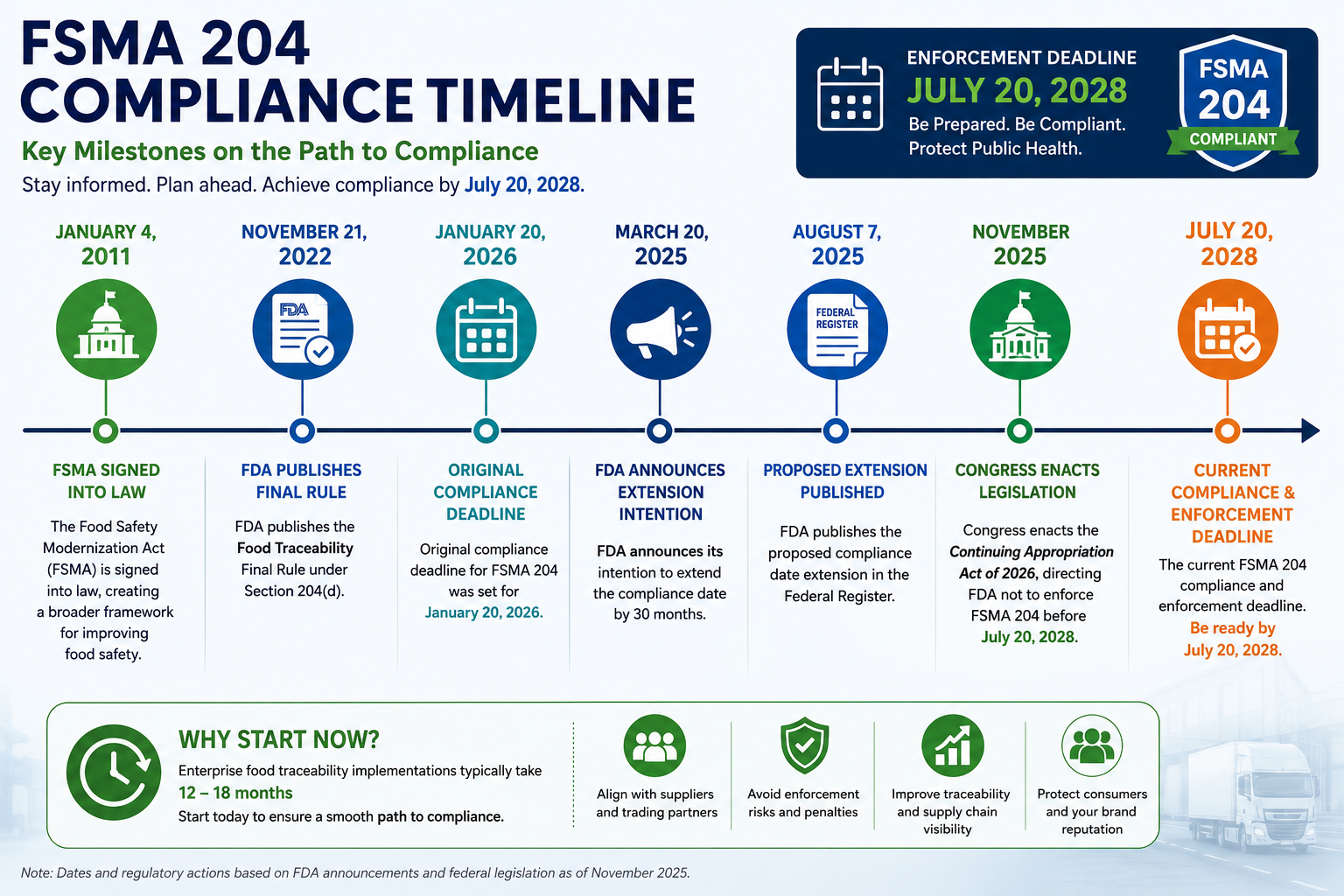
FSMA 204 timeline — from the 2011 FSMA law to the July 2028 enforcement deadline
The FSMA 204 compliance date is July 20, 2028, which is the FDA enforcement deadline for FSMA 204 compliance. The FSMA 204 deadline gives food manufacturers, processors, distributors, and other covered entities additional preparation time but the rule requirements themselves remain unchanged.
Here's the FSMA 204 timeline:
- January 4, 2011: FSMA was signed into law, creating a broader framework for improving food safety practices.
- November 21, 2022: FDA publishes the Food Traceability Final Rule under section 204(d), with an original compliance date of January 20, 2026.
- March 20, 2025: FDA announces its intention to extend the compliance date by 30 months.
- August 7, 2025: FDA publishes the proposed compliance date extension in the Federal Register.
- November 2025: Congress enacts the Continuing Appropriations Act, 2026, directing FDA not to enforce FSMA 204 before July 20, 2028.
- January 20, 2026: The original compliance date passes without enforcement.
- July 20, 2028: Current FSMA 204 compliance and enforcement deadline.
The extension is not a reprieve. Enterprise food traceability implementations typically run 12 to 18 months for a mid-sized operation, and that assumes clean data, willing supply chain partners and a clear implementation plan.
Businesses starting preparation in mid-2026 face similar urgency as organizations that were preparing for the original January 2026 deadline. Many major food retailers and foodservice distributors have already incorporated FSMA Rule 204-style traceability requirements into supplier expectations and sourcing standards, with some deadlines arriving before July 2028.
Latest FSMA 204 Updates (November 2026)
- The July 20, 2028 date stands. Congress has directed FDA not to enforce the Food Traceability Rule before then, and FDA has said it intends to comply.
- FDA has continued to publish implementation help in 2026, including additional FAQs, a report on traceability readiness tabletop exercises, and a discussion paper on more flexible ways to meet the lot-level tracking requirement.
- FDA held a public meeting on June 15, 2026 on continued implementation of the rule, with a focus on lot-level tracking.
Why do some sources still show January 20, 2026? Most FSMA 204 guidance published before March 2025 uses the original date. For the current position, check FDA's Food Traceability Rule page, which is the official source for the 2028 date.
Which FSMA Rule Has a 2028 Deadline, and Which Do Not
The July 20, 2028 date belongs to one rule only: the Food Traceability Rule (FSMA 204). The other major FSMA rules have their own compliance dates, and most of those have already passed. If someone mentions an "FSMA 2028 deadline", they almost always mean FSMA 204.
| FSMA rule | What it covers | Compliance status |
|---|---|---|
| Food Traceability Rule (FSMA 204) | Additional traceability records for foods on the Food Traceability List | Compliance and enforcement date: July 20, 2028 |
| Preventive Controls for Human Food | Hazard analysis and risk-based preventive controls | Already in effect |
| Produce Safety Rule | Growing, harvesting, packing and holding produce | Already in effect; some agricultural water dates are phased by farm size |
| Foreign Supplier Verification Programs (FSVP) | Importers verifying their foreign suppliers | Already in effect |
| Sanitary Transportation | Safe transport of human and animal food | Already in effect |
| Intentional Adulteration | Food defense against deliberate contamination | Already in effect |
Check FDA's FSMA rule pages for the exact dates that apply to your facility size. FSMA 204 does not replace your HACCP or Preventive Controls plan: it adds traceability records on top of the food safety plans you already have, so update both together.
Who Does FSMA 204 Apply To- Covered Entities and Exemptions
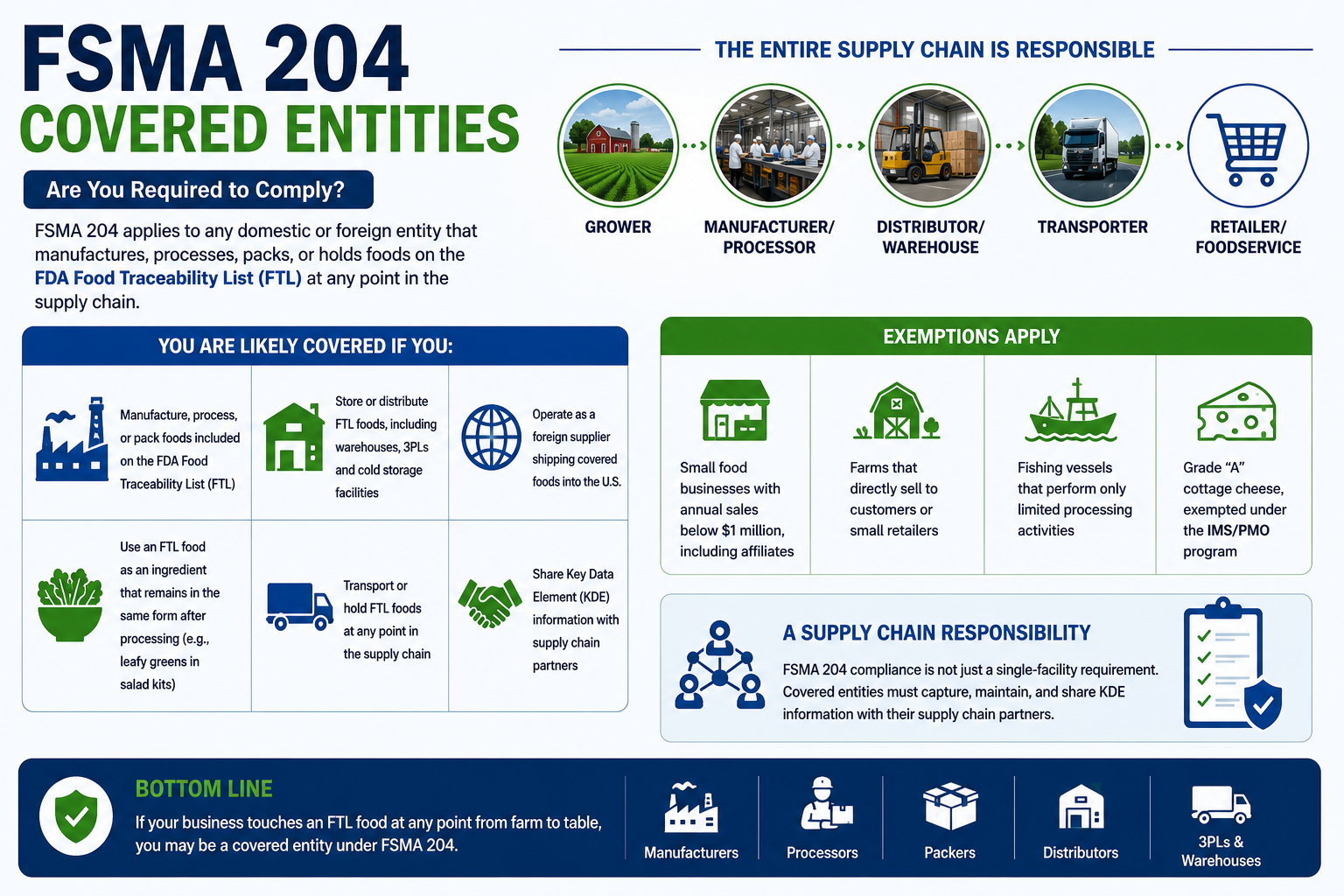
FSMA 204 covered entities across the food supply chain — manufacturers, processors, packers and distributors
FSMA Rule 204 applies to any entity, domestic or foreign that manufactures, processes, packs or holds foods that appear on the FDA Food Traceability List (FTL). If your operation handles an FTL food at any point in the supply chain, you may be subject to FSMA 204 compliance requirements.
You are likely covered if your business:
- Manufactures, processes, or packs foods included on the FDA Food Traceability List
- Stores and distributes FTL foods, including warehouses, third-party logistics providers (3PLs) and cold storage facilities.
- Operates as a foreign supplier shipping covered foods into the US
- Uses an FTL food as an ingredient and the food remains in the same form after processing, such as fresh leafy greens used in a salad kit.
However, not every business is subject to the same FSMA 204 compliance requirements. Certain exemptions apply, including:
- Certain small producers and small food businesses that fall under the size-based thresholds in the rule (for example, produce farms with average annual produce sales of $25,000 or less)
- Certain farm sales made directly to consumers
- Certain fishing vessels
- Grade "A" cottage cheese, which FDA exempted under the IMS/PMO program.
One of the essential points a lot of businesses miss: FSMA 204 compliance is a supply chain responsibility, not only a single-facility requirement. The covered entities must share Key Data Element (KDE) information with supply chain partners.
The exemptions are detailed and depend on your role and size, so check them against FDA's rule page and exemptions tool before deciding you are out of scope. Small and very small produce farms in particular should confirm their status there, since some are fully exempt and others have reduced requirements.
Importers and Foreign Suppliers
Foreign facilities that manufacture, process, pack or hold FTL foods for the US market are covered in the same way as domestic ones. US importers and private-label brand owners depend on those suppliers for KDEs, so supplier agreements should spell out which records are shared, in what format and how quickly. This is separate from FSVP, which already requires importers to verify the food safety of their foreign suppliers.
Restaurants and retail food establishments that handle FTL foods are also covered, with some size-based exemptions. Check FDA's page for any enforcement discretion that may apply to them.
FSMA 204 Food List- Which Foods Are Covered
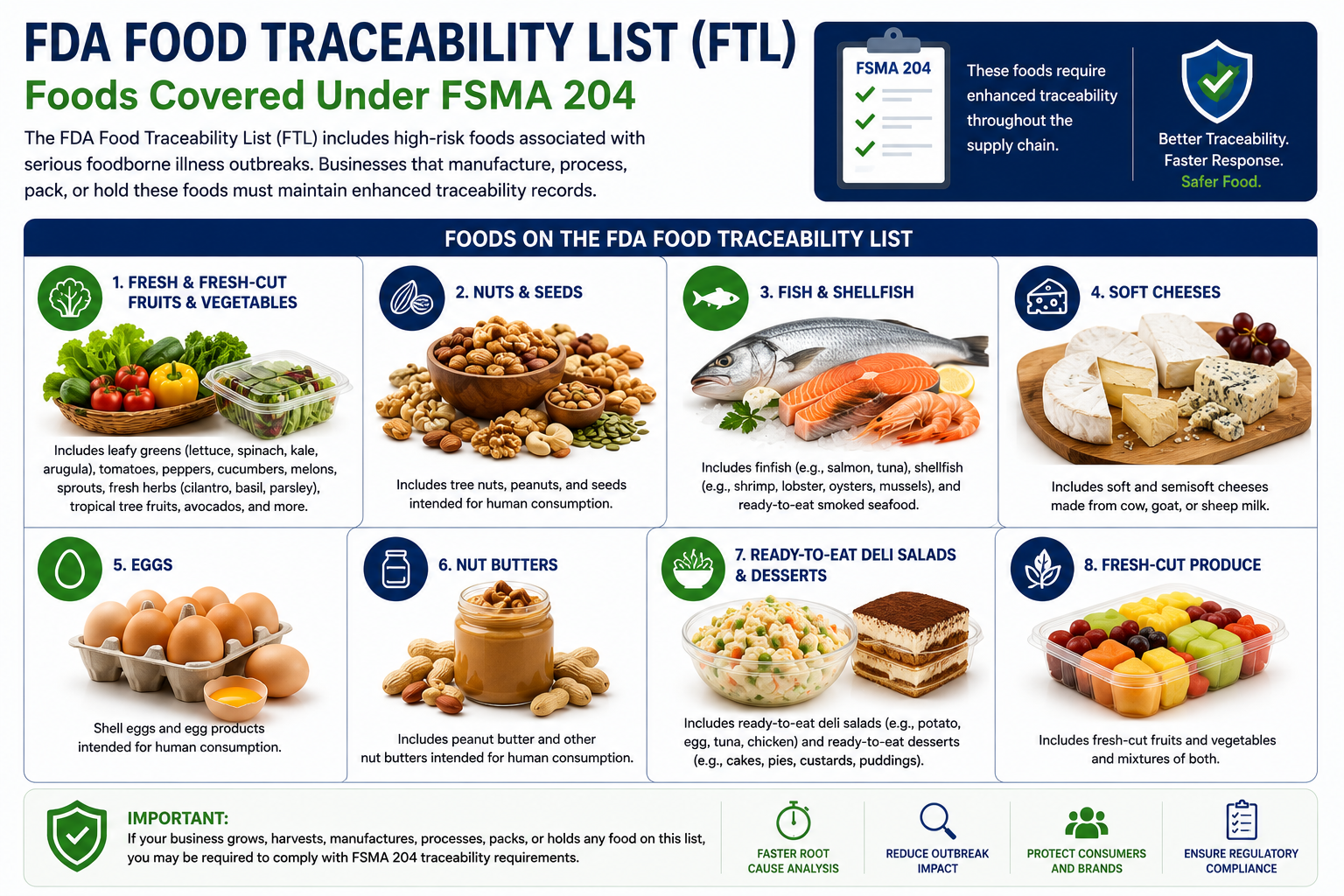
The FDA Food Traceability List — high-risk foods requiring enhanced recordkeeping
The FDA Food Traceability list (FTL) identifies the specific foods subject to FSMA Rule 204's enhanced record keeping requirements. These foods are considered higher risk based on public health history and have been connected with critical food borne illness outbreaks where faster traceability could have reduced harm.
The FSMA 204 food list includes specific categories of foods that require additional traceability records throughout the supply chain. Businesses reviewing the FSMA 204 list should first determine whether they handle any of these covered food categories:
| Food Traceability Lists | Description |
|---|---|
| Fresh and fresh-cut fruits and vegetables | Includes fresh-cut fruits and vegetables, tomatoes, leafy greens such as lettuce, spinach, arugula, and kale, fresh herbs such as cilantro, basil and parsley, melons, sprouts, peppers, cucumbers, tropical tree fruits, avocados and others. |
| Nut and seed butters | Includes all nut butters and seed butters covered under the Food Traceability List FSMA. |
| Fresh shell eggs | Includes fresh shell eggs requiring enhanced traceability records. |
| Cheeses other than hard cheeses | Includes soft cheese and cottage cheese. Grade "A" cottage cheese was exempted in 2026 under the IMS/PMO program |
| Ready-to-eat deli salads | Includes deli salads manufactured at processing facilities. |
| Seafood | Includes fresh and frozen finfish, smoked finfish, crustaceans, mollusks and raw bivalve mollusks |
One important FSMA 204 traceability rule businesses should understand: if an FTL food is used as an ingredient and remains in the same form, the finished product is generally still subject to the rule. For example, fresh leafy greens added to a salad kit remain covered. But if the ingredient is transformed during processing, like leafy greens cooked into a soup, the by-product is generally not covered.
This is how products that are not on the list themselves come into scope. A refrigerated ready-to-eat product with fresh-cut produce, or a snack that uses a nut butter, may carry covered ingredients. Always check the current list on FDA's Food Traceability List page, since FDA can update it.
FSMA 204 Requirements- KDEs, CTEs and 24-Hour Rules
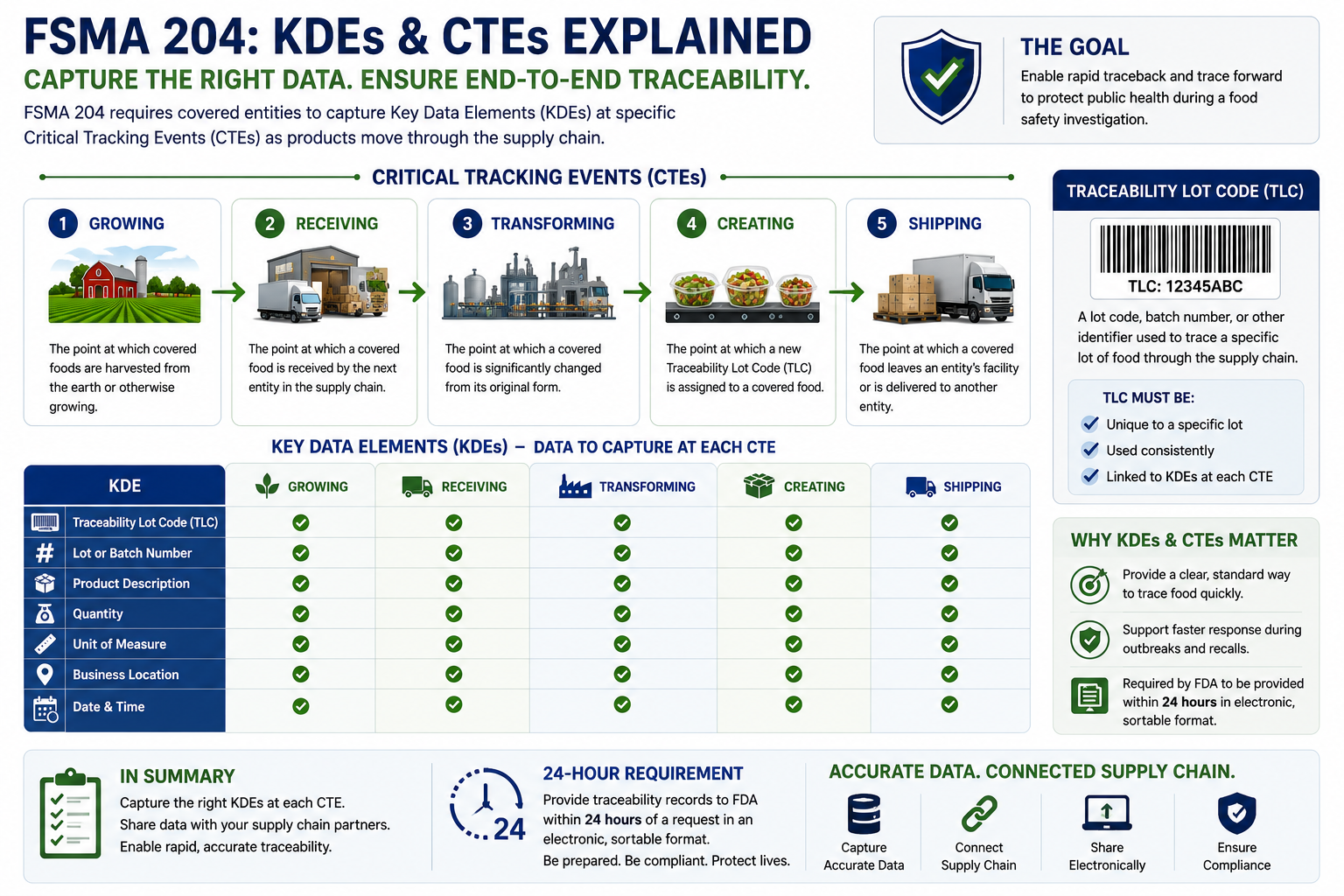
Critical Tracking Events and Key Data Elements required under FSMA 204
The FSMA Rule 204 has three core technical requirements: assign a Traceability Lot Code (TLC) at the right events, capture Key Data Elements (KDEs) and produce all required records to the FDA in an electronic, sortable format within 24 hours of a request.
Understanding these requirements is essential for businesses preparing for FSMA 204 compliance because the rule is about creating a complete traceability record that shows where a covered food came from, how it moved through the supply chain, and who handled it at each step.
Critical Tracking Events (CTEs): When You Need to Capture Data
Critical Tracking Events are the key points where businesses must record information under the FSMA traceability rule.
These events include:
- Harvesting: For farms producing foods on the FDA Food Traceability List, information must be captured when the food is harvested.
- Cooling: When a raw agricultural commodity is cooled before initial packing, the cooling must be recorded.
- Initial packing: When a raw agricultural commodity is packed for the first time, the initial packer records it and assigns a Traceability Lot Code.
- First land-based receiving: When seafood from a fishing vessel is received on land for the first time.
- Shipping: When a covered food leaves a facility, businesses must capture shipment-related information to maintain visibility across the supply chain.
- Receiving: When a facility receives a covered food from a supplier, it must record details about the product, supplier and receiving location.
- Transformation: When a covered food is manufactured, processed, commingled, repacked or relabeled, businesses must capture traceability information.
Example: Processing fresh tomatoes into salsa.
For most food manufacturers, the events that matter day to day are receiving, transformation and shipping.
Key Data Elements (KDEs): The Information You Must Record
KDEs, or Key Data Elements under FSMA 204 requirements, are the specific details businesses need to capture at each Critical Tracking Event.
The required information includes:
- Traceability Lot Code (TLC): A unique identifier assigned to a specific lot of covered food that allows businesses to track its movement.
- Product description: These include details like product name, quantity, unit of measure, commodity and variety.
- Location description: The facility names and address where the tracking event occurred.
- Date of the event: When the harvesting, cooling, packing, receiving, transformation or shipping activity happened.
- Supplier or receiver information: It contains the details of the company providing or receiving the product, including name, address and phone number.
- Shipping information: For shipping events, businesses must record the TLC for each covered food in the shipment along with reference document type and number.
Altogether these KDEs create a traceable record that allows businesses and regulators to follow a product's journey through the supply chain.
Assigning a Traceability Lot Code: a new TLC is assigned only when a food is initially packed, received for the first time on land from a fishing vessel, or transformed. Other events, such as shipping, must carry the existing TLC forward rather than create a new one. If your current system cannot capture every KDE, add the missing fields where the data is created, in your ERP, WMS or production software, rather than in a separate spreadsheet that has to be reconciled later.
The 24-Hour Rule: Why Digital Traceability Matters
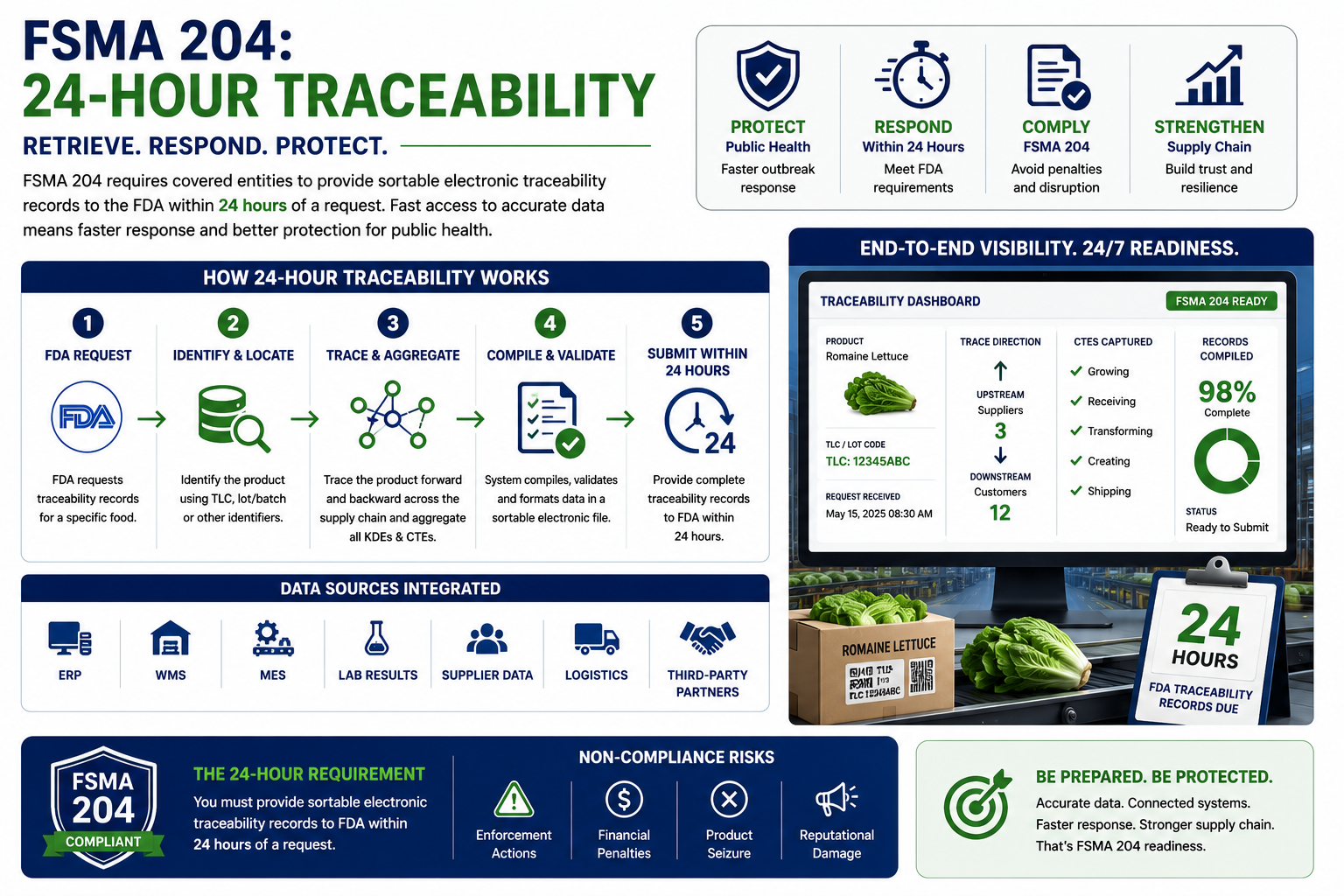
How 24-hour electronic traceability response works under FSMA 204
One of the most challenging parts of the FSMA 204 regulation is the requirement to provide traceability records quickly when requested by the FDA.
If the FDA requests records during an investigation or inspection, businesses must provide them in an electronic, sortable format within 24 hours. While the rule technically allows paper records, this requirement makes paper-based systems and disconnected spreadsheets difficult for most operations.
In operational terms: every time a covered food moves through your facility, when it arrives, when it is processed, and when it ships, you need a documented record of what it was, how much moved, where it happened, when it happened, and who sent or received it. That record needs a unique code, and all information must be easy to find and export within 24 hours.
Building effective FSMA 204 traceability processes helps businesses meet regulatory requirements while improving supply chain visibility and recall readiness.
FSMA 204 Traceability Plan — What You Must Document
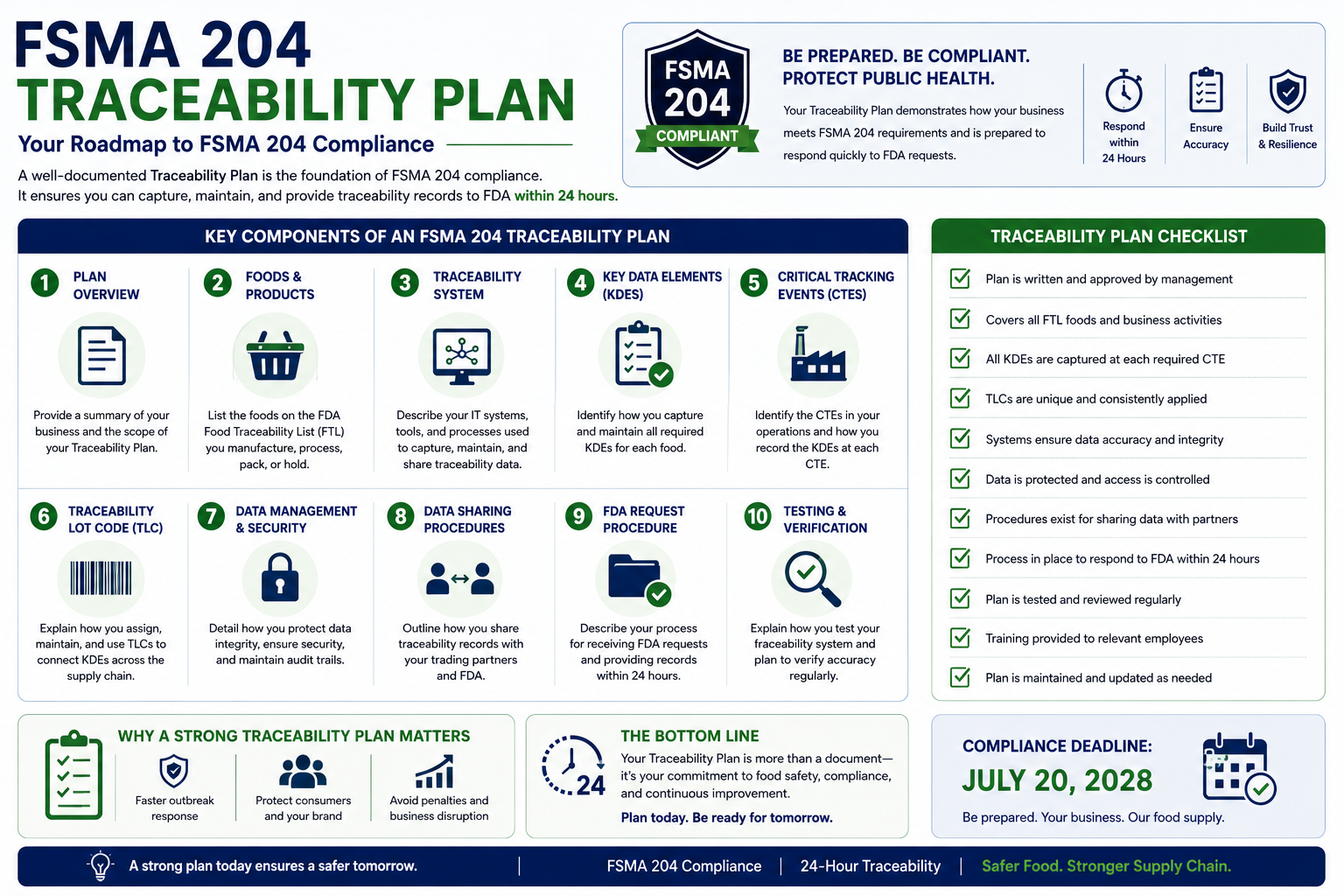
The written Traceability Plan — often the first document an FDA inspector requests
Beyond capturing KDEs at CTEs, FSMA Rule 204 requires covered entities to maintain a written Traceability Plan, a document that explains how your operation implements the rule's requirements. Maintaining this plan is a key part of FSMA 204 compliance and is separate from keeping traceability records.
A compliant Traceability Plan should include:
- A description of the foods your business handles that appear on the FDA Food Traceability List (FTL)
- The Critical Tracking Events (CTEs) that occur within your operation for each covered food
- The Key Data Elements (KDEs) you capture at each CTE
- A description of how your business assigns Traceability Lot Codes (TLCs)
- A designated point of contact for FDA traceability inquiries
Take this document as your operational FSMA 204 checklist. It should clearly explain how your business meets the FSMA 204 requirements and support your broader FSMA food safety plan.
The Traceability Plan must be kept current. If your product mix, processes, or supply chain partners change, the plan should be updated to reflect those changes.
Most importantly, the FSMA 204 Traceability Plan is often the first document an FDA inspector will request. If your operation cannot produce a current, written plan during an inspection, you may be considered non-compliant even if your traceability records are otherwise complete.
Why the 2028 Extension Is Not a Reason to Wait
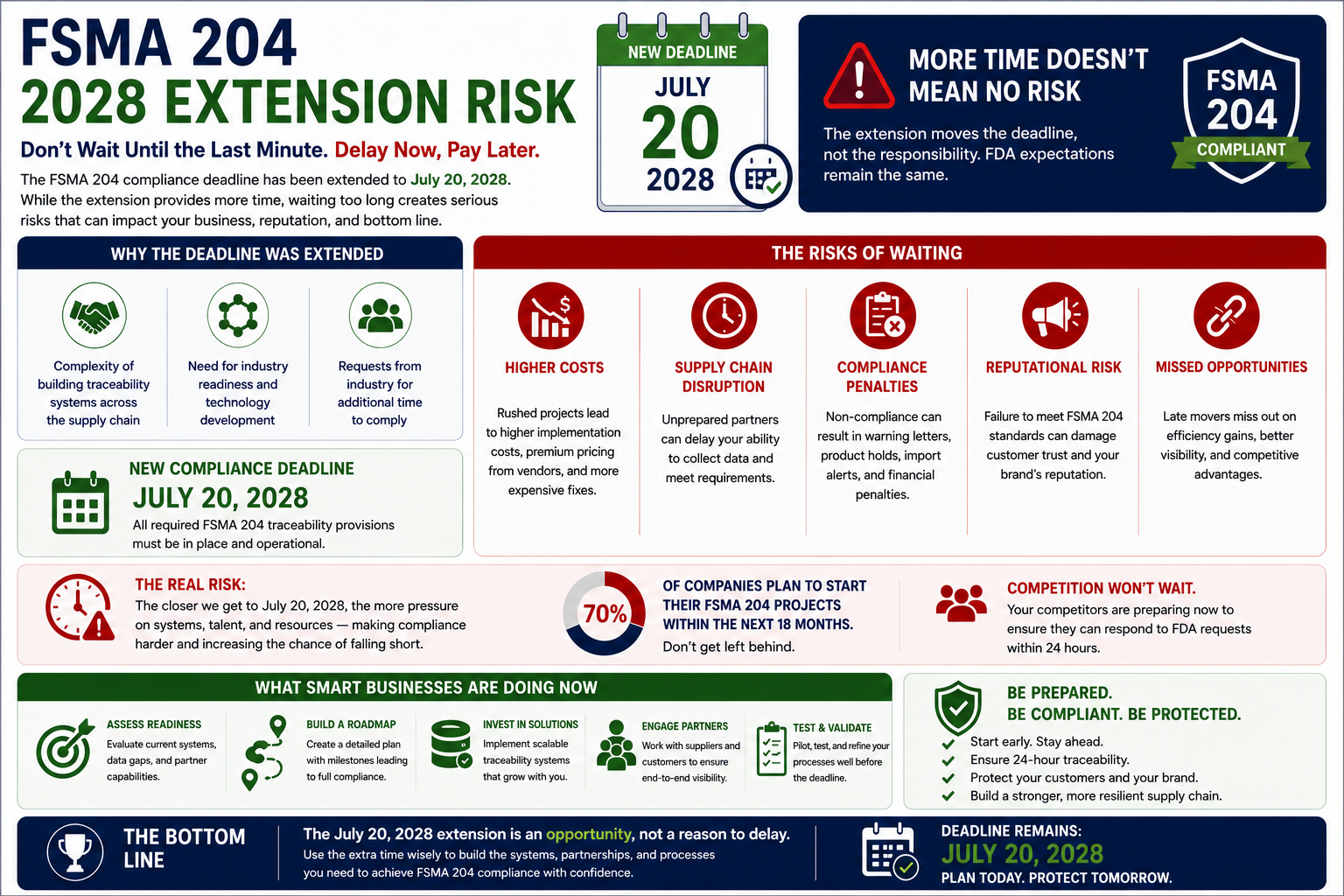
Implementation timelines make the 2028 extension less generous than it looks
A 12 to 18 month implementation timeline for a mid-size food manufacturer means operations starting FSMA 204 implementation in mid-2026 have approximately the same urgency as businesses preparing for the original January 2026 deadline. Companies that wait until 2027 will be implementing new traceability processes under significant time pressure, leaving little room for the supply chain coordination that FSMA 204 compliance requires.
Here are three reasons businesses should not treat the deadline extension as a reason to delay:
Implementation Takes Longer Than Expected
Building a compliant traceability system involves more than updating software. Supply chain partner alignment, data standardization, ERP integration, process changes, and employee training all take time. Even one missing Key Data Element (KDE) from an upstream supplier can prevent an otherwise complete traceability record from meeting FSMA 204 requirements.
Retailers and Foodservice Customers Are Not Waiting for 2028
Many major food retailers and foodservice distributors have already incorporated FSMA 204 traceability requirements into supplier contracts and sourcing standards, with implementation timelines that begin well before July 2028. Suppliers that cannot provide compliant Traceability Lot Codes (TLCs) and KDE records risk losing business long before FDA enforcement begins.
The Rule Has Not Changed
The extension affects only the enforcement date, not the rule itself. The requirements for KDEs, CTEs, Traceability Plans, and the 24-hour response remain exactly the same. Starting early gives businesses time to improve processes, test systems, and strengthen FSMA readiness without rushing implementation.
The manufacturers most likely to achieve FSMA 204 compliance by July 2028 are those that began preparing in 2025 or 2026. Businesses that treat the extension as a pause may find themselves trying to compress 18 months of implementation work into just a few months in 2027.
Early compliance also pays off before any inspection: faster and narrower recalls, fewer hours spent assembling records by hand, and a stronger position with retailers who already ask for traceability data. For most companies, building the full capability once is cheaper than a minimal update now followed by a second project later.
How to Implement FSMA 204 Compliance — A Practical Starting Framework
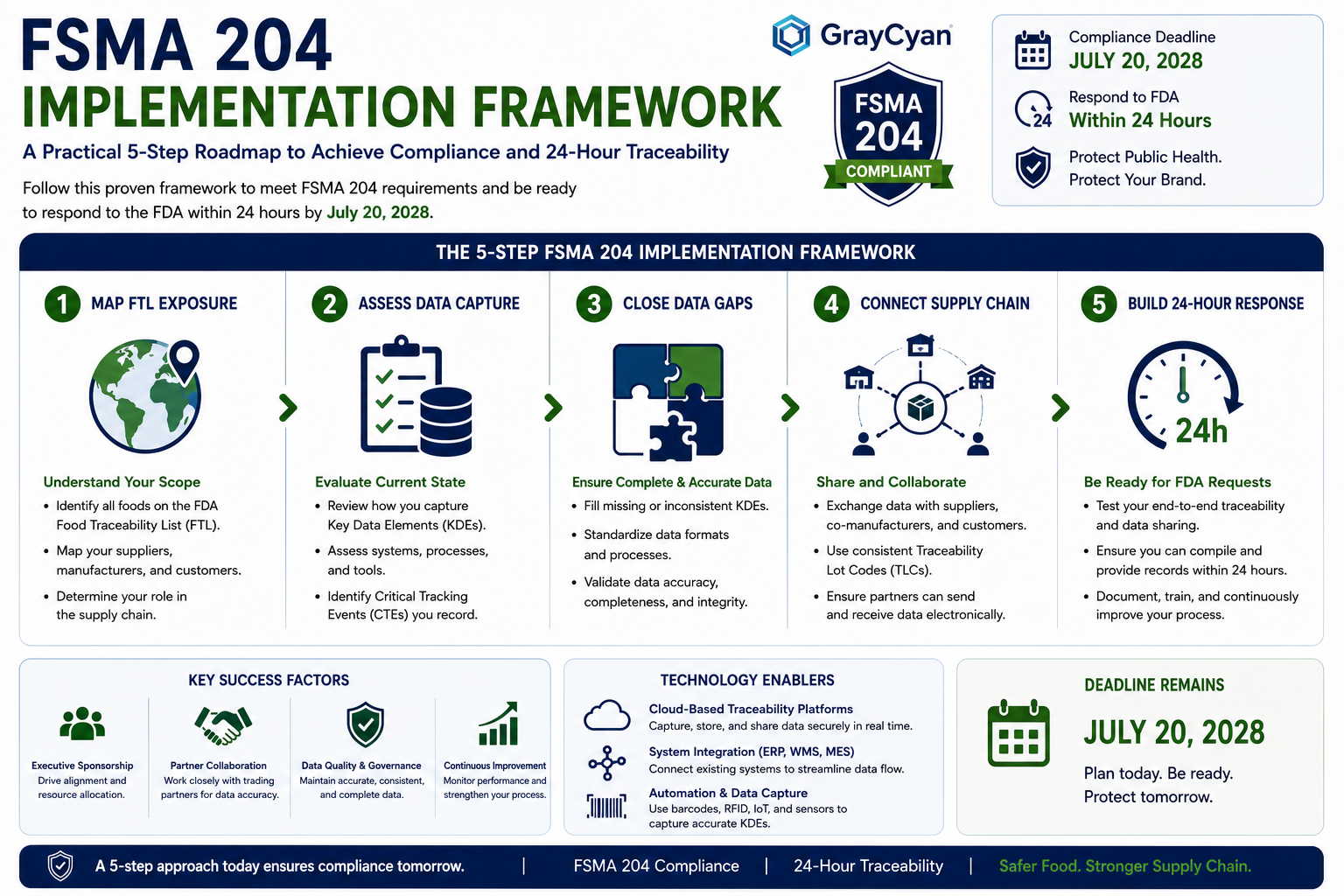
A practical five-step framework for FSMA 204 implementation
FSMA Rule 204 compliance is a data management project, not just a regulatory checklist. The core challenge is not understanding what the rule requires. The requirements are well defined. The challenge is building a system that captures the right data at the right moments, connects it across supply chain partners, and makes it retrievable in an electronic, sortable format within 24 hours.
A practical FSMA 204 implementation framework includes five key steps:
Identify every product you handle that appears on the FDA Food Traceability List. For each covered food, map the Critical Tracking Events (CTEs) that occur within your operation, including receiving, transformation, and shipping.
Review whether you're capturing all required Key Data Elements (KDEs) at each CTE. Most businesses already record information such as lot codes and quantities but often miss details like reference document numbers, location identifiers, or designated points of contact required for FSMA 204 compliance.
Evaluate whether your existing ERP, warehouse management system (WMS), or production software can capture the missing KDEs. For most manufacturers, FSMA 204 software doesn't mean replacing existing systems which means extending them. The goal is to capture traceability data within the tools your teams already use instead of building a separate compliance database.
Your traceability records are only as complete as the KDE data your suppliers provide. Work with upstream suppliers and downstream customers to align data-sharing processes before compliance gaps become operational issues. Train the people who create the records, in receiving, production, shipping and QA, and refresh that training whenever processes change.
Run regular traceability drills by selecting a lot and generating a complete electronic, sortable report within 24 hours. If your team cannot produce the required records during a practice exercise, they are unlikely to meet FDA expectations during an actual investigation.
For most mid-market food manufacturers, FSMA 204 implementation does not require replacing an ERP. It requires connecting traceability data with existing lot tracking and inventory records while adding the KDE fields that current systems may not capture.
GrayCyan supports this approach through middleware integrations with platforms such as NetSuite, SAP, Epicor, Acumatica, Fishbowl, and Odoo, helping manufacturers move through the FSMA 204 compliance checklist without disrupting existing operations.
FSMA 204 Readiness Timeline: 2026 to July 2028
Finish Steps 1 and 2: confirm your FTL foods, map your CTEs, list the KDEs you already capture and the ones you do not. Draft the Traceability Plan and name an owner for the program.
Close the data gaps in your ERP, WMS and production systems, agree data-sharing terms with suppliers and customers, and train the teams who create the records.
Run regular 24-hour drills, fix what they expose, and finalize the Traceability Plan well before July 20, 2028.
Readiness checklist: FTL foods identified; CTEs mapped for each food; KDE gaps closed; TLC procedure written; Traceability Plan current with an FDA contact; supplier data agreements in place; staff trained; drill completed within 24 hours. If you already run SQF or BRCGS, add these items to that program rather than running FSMA 204 as a separate system.
How to measure readiness: the share of FTL lots with complete KDEs, the time it takes to produce a full electronic report in a drill, and the number of suppliers sending complete data.
How Much Does FSMA 204 Compliance Cost?
The cost depends less on the rule than on your starting point. The main drivers are:
- The number of FTL products and facilities in scope
- How many required KDEs your current systems already capture
- The integration work needed in your ERP, WMS and production software
- Supplier onboarding and data-sharing setup
- Training, drills and ongoing record maintenance
When budgeting, plan for the system work and the supplier work separately: the system can often be built faster than suppliers can be brought on board. The return comes from narrower recalls, faster audits and keeping customers who already require traceability data. At one USDA-regulated meat processor, automated compliance records cut audit response time from 2 to 3 days to under 60 seconds.
What Happens If You Miss the FSMA 204 Deadline?
After July 20, 2028, FDA can enforce the rule. A business that cannot produce complete records within 24 hours of a request may face inspection findings and further FDA action. The commercial risks often come first: retailers and distributors that already require traceability data may stop buying, and without precise lot records a recall can be wider and more expensive than it needs to be.
Legal and compliance teams should keep a dated record of the compliance plan, key decisions, supplier communications and drill results. If timelines or interpretations change before 2028, that record shows good-faith progress. Report status to leadership on a regular schedule, and have counsel review your approach for your specific products and facilities.
How GrayCyan Helps Food Manufacturers Prepare for FSMA 204
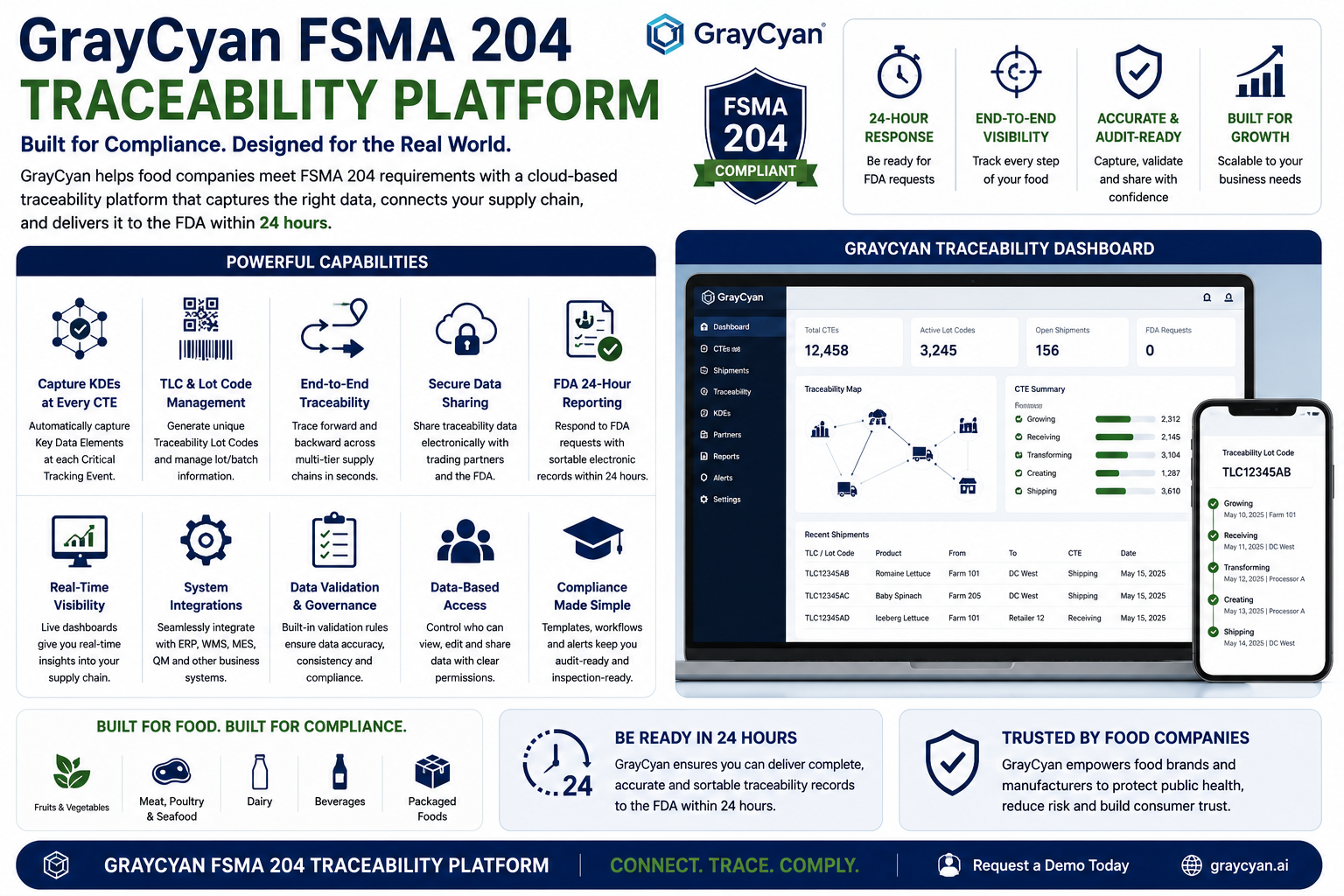
GrayCyan's ERP-integrated compliance automation for FSMA 204 traceability
FSMA 204 compliance is not just about collecting more data; it is about capturing the right data automatically as products move through production. GrayCyan does not sell off-the-shelf FSMA 204 software. Instead, we build custom traceability systems for food manufacturers and CPG brands that integrate with existing ERP platforms and generate FSMA 204 traceability records during normal operations. See our lot traceability software and food and beverage WMS pages for how these systems are built.
This means:
- KDEs are captured automatically at each Critical Tracking Event (CTE) during production instead of being entered manually afterward.
- Traceability records are written back to existing ERP systems such as NetSuite, SAP, Epicor, Acumatica, Fishbowl, and Odoo through API-based middleware without replacing your current platform.
- The 24-hour response requirement is built into the workflow, allowing compliant electronic reports to be generated in minutes rather than assembled from multiple spreadsheets during an audit.
- Compliance documentation is created during production, not reconstructed before an FDA inspection.
- Supplier KDE data is taken in and checked as it arrives, so gaps are found at receiving rather than during an investigation.
GrayCyan has already deployed compliance automation for a USDA-regulated meat processor, where batch records, smoker logs, and lethality evidence are generated automatically during each production run. As a result, audit response time dropped from 2–3 days to under 60 seconds.
FSMA 204 compliance requires the same data infrastructure as operational traceability. Manufacturers that invest now gain stronger supply chain visibility, faster recall response, and improved retailer confidence regardless of when FDA enforcement begins.
Frequently Asked Questions- FSMA 204 Deadline 2028
Ready to Start Your FSMA 204 Compliance Implementation?
If your operation handles foods on the FDA Food Traceability List, the July 20, 2028 deadline is closer than it appears once implementation timelines are considered. Building compliant traceability systems requires time to align suppliers, configure existing ERP systems, capture missing KDEs, and validate your 24-hour response process.
GrayCyan's AI Readiness Assessment helps identify where your traceability data currently resides, which KDE gaps need to be addressed, and the most practical implementation path based on your existing ERP and operational workflows.
Schedule a Strategy Call