STAGE 2:
Operational Intelligence
AI that executes workflows and makes operational decisions within your system.

AI Is Now Running Inside Your Operation. Handling the Work. Freeing Your Team.

Stage 2 puts AI to work inside that structure.

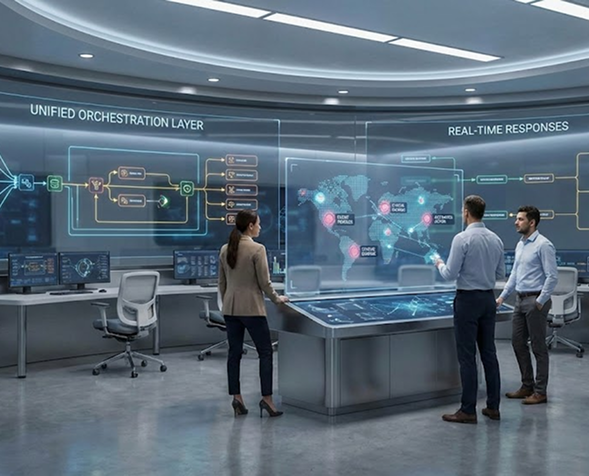
Not as a tool your team opens manually. As an active layer inside your operation — processing inputs, handling exceptions, routing decisions, and delivering information without waiting to be asked.
What Changes at Stage 2
What Stage 2 Looks Like In Practice
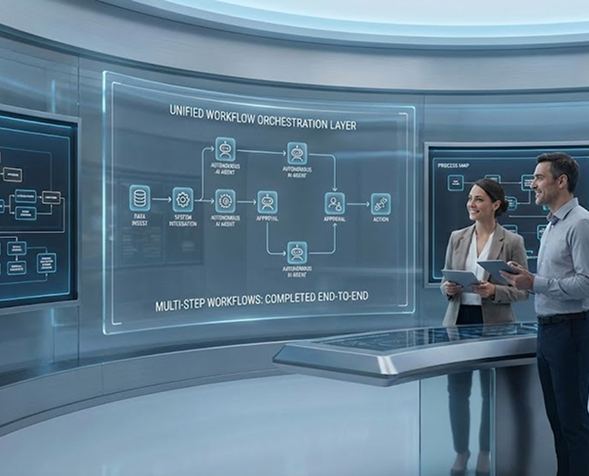
At Stage 2, AI moves beyond assistance and begins making decisions within a defined system.
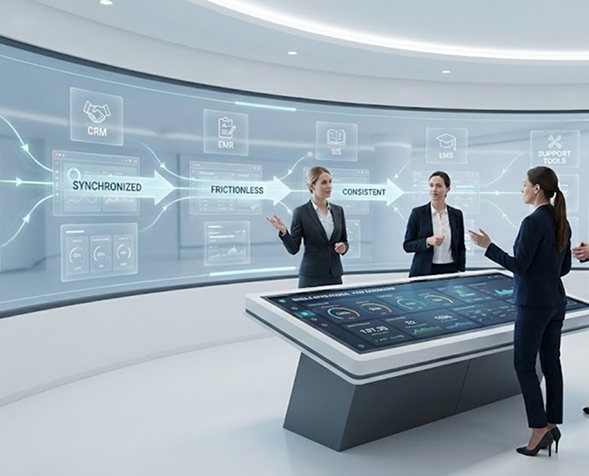
Workflow AI Agents gather inputs, validate information, apply rules, and trigger the next step automatically — inside ERP, CRM, EMR, SIS, or another single platform.
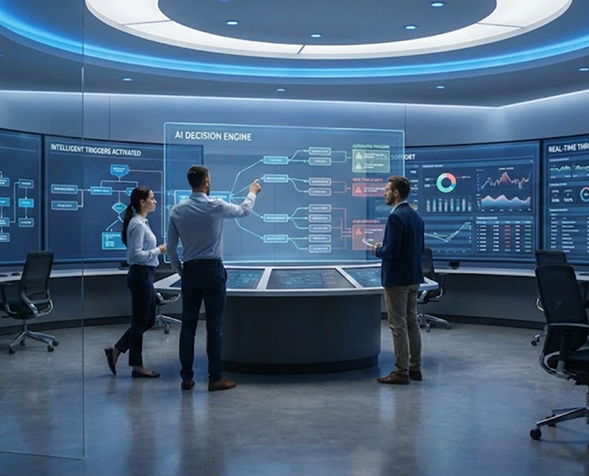
AI now evaluates conditions and acts within guardrails.
Manufacturers
- Generate RFQs when thresholds are met.
- Reconcile PO → GRN → Invoice flows with validation.
- Schedule production or maintenance based on usage signals.
AI applies predefined logic and moves workflows forward automatically.
B2B Services
- Draft onboarding documents.
- Route tickets to the right teams.
- Trigger invoice creation and CRM updates after service completion.
Routine operational decisions are automated inside the system.
Healthcare
(Administrative Only)
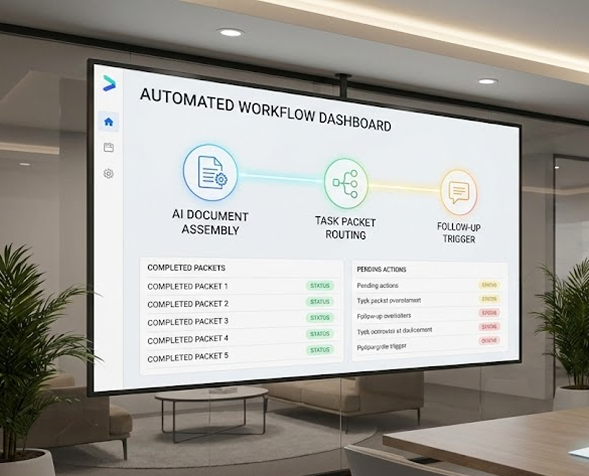
- Assemble prior-authorization packets.
- Cross-check revenue cycle data.
- Trigger status updates automatically.
- AI evaluates and advances workflows within defined boundaries.
Education
- Validate enrollment documents.
- Sync SIS and LMS records.
- Trigger onboarding communications automatically.
- AI now owns structured processes inside the system.
At this stage, your teams are no longer the bottleneck. AI moves the work forward with minimal handholding.
What Stage 2 Actually Does
RAG Systems Over Your Own Documentation
Your operation has accumulated years of documentation, manuals, records, and institutional knowledge. At Stage 2, we build a Retrieval-Augmented Generation (RAG) system on top of that corpus.
Your team stops searching through folders and starts asking questions.
- “What was the batch yield on this product line last quarter?”
- “What does our SOP say about this exception?”
- “What’s the maintenance history on Line 3?”
The system retrieves the answer from your own data — accurately, instantly, and without pulling a human into the loop.
AI Agents Handling Operational Workflows
Routine operational work — triaging inputs, routing decisions, drafting responses, flagging exceptions — moves to AI agents that execute continuously inside your connected systems.
An order comes in outside normal parameters. The agent flags it, categorizes the exception type, and routes it to the right person with context already attached. Your team makes the call — they just aren’t spending time figuring out what they’re looking at first.
Automated Exception Handling
Exceptions are where most operational time gets lost — catching the problem, figuring out what type it is, deciding who handles it, communicating it.
AI handles the triage layer — catching, classifying, and routing exceptions with context already assembled. Your team spends their time on the decision, not the legwork that precedes it.
Information Delivered, Not Retrieved
At Stage 1, your data became searchable. At Stage 2, the system stops waiting to be searched.
Relevant information is surfaced automatically — shift reports, inventory alerts, compliance flags, production anomalies — pushed to the right person at the right time without a human assembling it.
What This Looks Like in Practice
Food & Beverage — Regional Processor
Batch records, COAs, and CCP monitoring logs are connected and structured from Stage 1. At Stage 2, a RAG system is deployed over the full compliance and production record archive. QA managers stop manually assembling SQF or BRC audit packages — the system surfaces every relevant batch record, deviation log, and supplier COA by product line, lot number, or date range, in seconds. An AI agent monitors incoming supplier documentation, flags COAs that fall outside spec or are missing required fields, and drafts the follow-up request for your team to review and send. Supplier compliance that previously lived in someone’s inbox becomes a managed, documented workflow.
Manufacturing — Industrial Equipment Supplier
Maintenance history, NCRs, and technician notes are structured and searchable from Stage 1. At Stage 2, an AI diagnostic agent is deployed over the full operational record corpus. Field technicians query the system on-site — describe the symptom and asset ID, receive back a ranked list of likely failure modes, historical precedents from similar equipment, and past corrective actions that resolved the issue. Work order generation is pre-populated with relevant history. Senior technician time stops being consumed by questions the system can now answer, and MTTR starts coming down without adding headcount.
Distribution — Mid-Size Wholesaler
PO and ASN records are normalized across all intake channels from Stage 1. At Stage 2, AI agents handle inbound exception triage — flagging SKU-level quantity discrepancies, mismatched ASNs, and POs that fall outside approved supplier parameters, then routing each exception to the right person with context already attached. Credit hold decisions and carrier discrepancy resolutions that consumed hours of coordinator time daily become a review-and-approve step. The WMS stays clean because exceptions are caught before they enter it, not after.
Trusted by business leaders across manufacturing
Trusted by Industry Leaders
We help small and mid-sized teams automate daily work, improve accuracy, and reclaim time, without changing their existing systems.
Automate daily operations. Improve accuracy. Save time. All within your existing systems.
90%
faster reporting
Engineering proposals automated
Access Industrial cut proposal prep from 8 hrs → 30 mins, improving accuracy and client trust.
2X
client growth
SaaS scalability achieved
Kaizenify doubled its customer base after full-stack rebuild and AI integration.
80+
hours saved / month
Manual work eliminated
United City Yachts automated lead assignments, reclaiming staff time and reducing missed deals.
5M+
content items indexed
AI knowledge agent deployed
LivingLies transformed a static site into a searchable legal intelligence hub.
100%
system uptime
Post-migration stability restored
Family Office Access overcame failed builds and launched a secure investor-founder platform.
85%
reduction in manual data entry
ERP middleware automation
Fishbowl ERP cut daily manual entry from ~12 hrs to under 2 hrs, created a unified data workflow, and accelerated order processing with automated PO imports, syncing, and reconciliation.
3X
higher perceived response quality
Emotion-aware AI governance layer
LovingIs.ai aligned multiple LLMs with ethical safeguards to deliver safer, family-friendly AI interactions.
What You Walk Away With
A RAG system deployed over your operational documentation and records
Proactive information delivery — alerts, reports, and flags without manual assembly
AI agents running inside your connected workflows
Reduced operational overhead across your core workflows
There’s friction in keeping systems updated in sync
A Stage 3 readiness assessment — what your operation needs to move toward autonomous systems
What Stage 2 Requires
Stage 2 only works on a Stage 1 foundation.
The RAG system is only as accurate as the data it retrieves from. The AI agents are only as reliable as the records they process. The exception handling is only as consistent as the documentation behind it.
If your systems aren’t connected and your data isn’t clean, Stage 2 produces noise — not intelligence.
Who This Is For
Stage 2 is for organizations that:
- Have completed Stage 1 or have an existing clean, connected data foundation
- Are spending significant team time on routine operational work that follows consistent patterns
- Want AI handling the execution layer while their team focuses on decisions
- Are ready to move from AI as a tool to AI as an operational layer
How We Implement Stage 2
- Audit your Stage 1 foundation for Stage 2 readiness
- Identify the highest-leverage workflows for AI agent deployment
- Build and tune your RAG system over your existing documentation corpus
- Deploy AI agents into your connected operational workflows
- Establish exception handling logic and escalation paths
- Train your team to govern the system, not operate it manually
- Deliver your Stage 3 readiness assessment