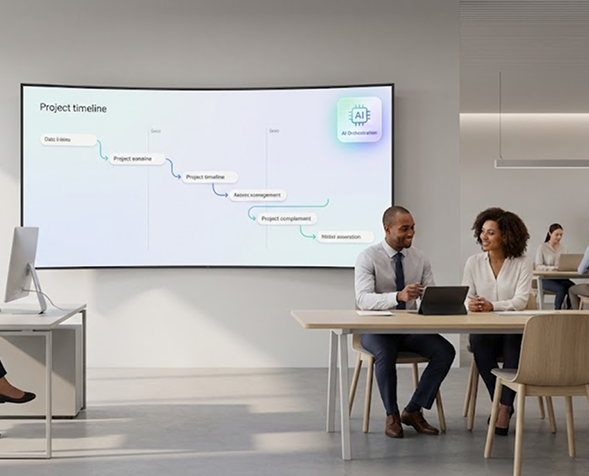
AI Runs the Operation. Your Team Makes the Calls That Matter.
Stage 1 built the foundation. Stage 2 put AI to work.
Stage 3 is where the operation becomes intelligent — and your team finally gets out of the weeds.
Not AI as a tool. Not AI as an assistant. AI as the operational layer that handles execution, surfaces decisions, and keeps your team focused on the work only humans should be doing.
This is the AI-first factory — with your people firmly in control.
What This Actually Means
In a traditional operation, your best people spend most of their time on coordination — chasing information, managing exceptions, reconciling systems, assembling reports.
At Stage 3, AI handles all of that.
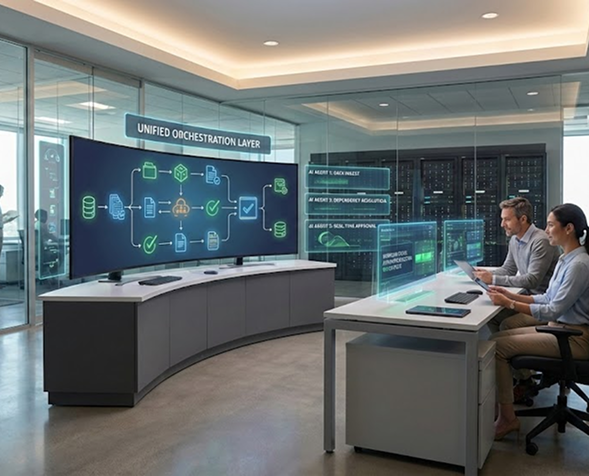
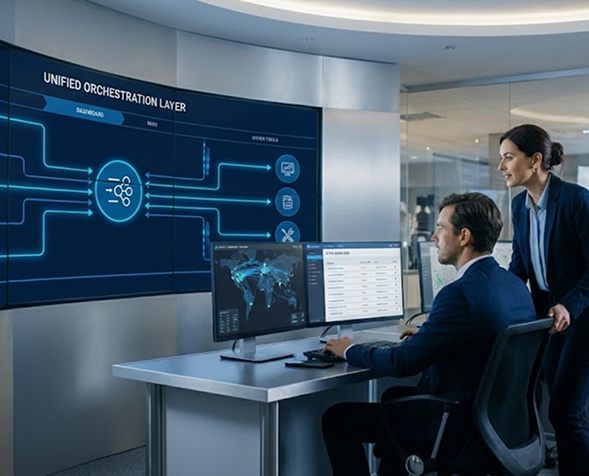
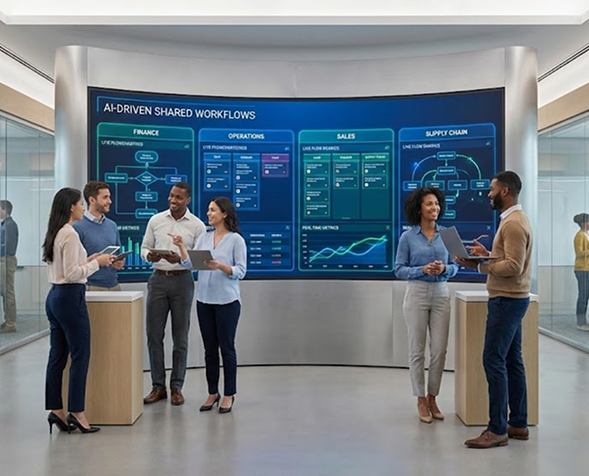
It monitors your systems continuously, connects signals across the operation, and brings your team the decisions that need a human — not the noise that doesn’t.
Your people stop reacting to the operation. They start leading it.
What Stage 3 Actually Does
Real-Time Production Visibility and Recommended Adjustments
Production schedules no longer wait for a weekly planning meeting or a manager’s morning review.
AI monitors demand signals, current inventory levels, supplier status, and line capacity simultaneously — and surfaces recommended adjustments to your planning team in real time. When a supplier delivery is delayed, the system flags it and proposes a schedule shift. When a demand spike is detected, your team sees the recommendation and approves the reallocation. The decision still belongs to your people — they just have the full picture in front of them before the problem reaches the floor.
Predictive Equipment Intelligence
Equipment doesn’t fail without warning. It degrades — and that degradation leaves a pattern in the operational data.
At Stage 3, AI reads that pattern continuously across every connected asset and flags emerging issues to your maintenance team before they become failures. Your team sees the alert, reviews the equipment history the system has already assembled, and schedules the work proactively. Maintenance decisions still belong to your people — they just stop being made in response to a breakdown that already happened.
AI-Assisted Quality Management
Quality exceptions are caught and surfaced before they advance to the next production stage.
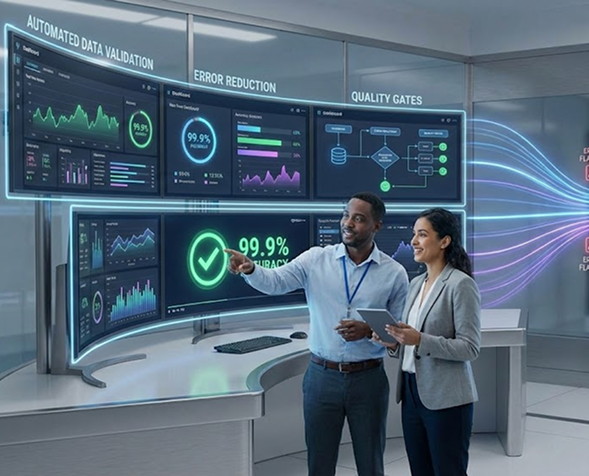
AI monitors inputs and outputs at each checkpoint and flags deviations against your established standards — automatically, continuously, without someone manually reviewing the line. When a deviation is detected, your QA team receives it with the deviation type, affected lot, and relevant history already attached. They make the call. The system handles the documentation and routes the outcome to the right place.
Cross-System Pattern Recognition
No human can hold the full operational picture in their head simultaneously — production, quality, procurement, logistics, maintenance, demand.
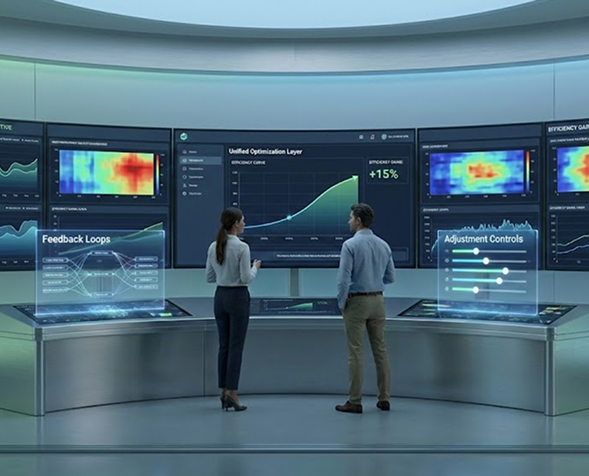
AI connects signals across every system, identifies correlations no human would catch manually, and surfaces them as clear recommendations your leadership team can act on. Not dashboards full of raw data. Specific, contextualized intelligence delivered to the right person at the right time — with enough context to make a decision, not just to be informed.
Smarter Procurement and Logistics Coordination
Reorder points aren’t static thresholds anymore. AI calculates dynamically — factoring in current consumption rates, supplier lead times, demand forecasts, and storage constraints — and surfaces procurement recommendations to your purchasing team automatically. For routine, low-risk reorders within defined parameters, it can execute. For anything outside those boundaries, a human reviews and approves first.
Logistics aligns with production schedules in real time. Your team makes fewer calls chasing updates because the system already has the answer.
What This Looks Like in Practice
Food & Beverage — Large Processor
With Stage 2 in place, AI is already handling compliance documentation retrieval and supplier COA validation workflows. At Stage 3, AI becomes the operational layer. Production schedules adjust against live demand signals, current inventory positions, and raw material availability — your planning team reviews and approves the recommended schedule each day rather than building it from scratch. Incoming raw material quality exceptions are caught at receipt, classified by deviation type against your HACCP and SQF specs, and surfaced to QA with full lot history attached. FSMA 204 lot traceability becomes continuous — every ingredient, every batch, every finished SKU traceable in real time. The operations team shifts from managing the floor to leading the business.
Manufacturing — Industrial Equipment Manufacturer
With Stage 2 in place, AI is already diagnosing equipment failures from structured maintenance records. At Stage 3, it prevents them. Sensor data from every connected asset feeds into a continuous condition-monitoring model. When degradation patterns emerge — vibration anomalies, thermal drift, pressure variance outside FMEA thresholds — your maintenance team receives an alert with the asset health score, likely failure mode, and recommended PM action already assembled. Spare parts are flagged for reorder before stock runs out. Technician time reallocates from emergency response to planned, proactive work. OEE improves not because you pushed harder, but because unplanned downtime stops being the default.
Trusted by business leaders across manufacturing
Trusted by Industry Leaders
We help small and mid-sized teams automate daily work, improve accuracy, and reclaim time, without changing their existing systems.
Automate daily operations. Improve accuracy. Save time. All within your existing systems.
90%
faster reporting
Engineering proposals automated
Access Industrial cut proposal prep from 8 hrs → 30 mins, improving accuracy and client trust.
Fishbowl ERP cut daily manual entry from ~12 hrs to under 2 hrs, created a unified data workflow, and accelerated order processing with automated PO imports, syncing, and reconciliation.
Autonomous production scheduling connected to live demand, inventory, and supplier signals
Cross-system operational intelligence surfaced as decisions, not raw data
Predictive maintenance across all connected equipment assets
Autonomous procurement and logistics coordination within defined parameters
Leadership receives proactive visibility into performance and risks
A governance framework — the human oversight layer that defines what AI decides and where humans remain in the loop
Continuous operational visibility at the leadership level without manual reporting
What Stage 3 Requires
Stage 3 is built on the full foundation of Stage 1 and Stage 2.
The data layer must be clean and connected — Stage 1
The AI operational layer must be running and trusted — Stage 2
Leadership must be ready to govern an AI-led operation, not just manage one
This is not a system you deploy in month one. It is the destination a structured, disciplined implementation reaches.
Human in the Loop — By Design
Autonomous does not mean unsupervised. It doesn’t mean AI deciding things your team hasn’t agreed to.
At Stage 3, your team defines what AI handles and what it escalates. Routine, pattern-based execution happens automatically — within boundaries your leadership sets. Anything outside those boundaries comes to a human with full context already assembled, so the decision takes minutes instead of hours.
AI handles the volume. Your team handles the judgment.
The goal isn’t to remove humans from the operation. It’s to remove humans from the work that shouldn’t require them — so their expertise goes where it actually matters.
Have completed Stages 1 and 2 or equivalent foundations
Operate at a scale where manual coordination is a genuine constraint on growth
Are ready to make the cultural shift from managing operations to governing intelligent systems
Want to compete on operational efficiency at a level traditional organizations structurally cannot match
How We Implement Stage 3
Audit your Stage 2 systems for Stage 3 readiness
Map every operational decision currently made by humans that follows a consistent, data-driven pattern
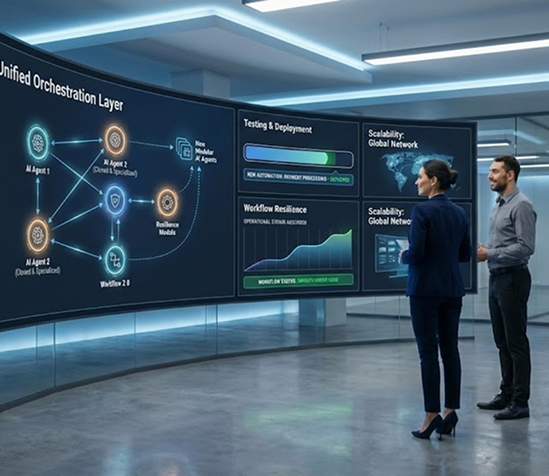
Build the autonomous decision and execution layer across connected systems
Establish the governance framework — human oversight, exception escalation, system parameter controls
Deploy predictive intelligence across production, quality, maintenance, procurement, and logistics
Train leadership to govern an AI-led operation
Establish continuous improvement protocols so the system learns and improves over time
This Is the Destination
Most organizations are still at Stage 0 — fragmented tools, manual processes, unreliable data.
Stage 1 fixes the foundation. Stage 2 puts AI to work. Stage 3 is where operations become a genuine competitive advantage — one that compounds over time and that organizations without the foundation structurally cannot replicate.
The question isn’t whether your industry gets here. It’s whether you lead it or follow it.
See Where You Are in the Journey→ Assess Your Readiness for Autonomous Operations