
RAG AI for Manufacturing: Turn Decades of Engineering Knowledge Into an Intelligent, Queryable System
Every answer comes from your documents. Every answer is cited.
GrayCyan builds RAG AI systems for manufacturers and industrial companies, turning scattered documents, OEM manuals, and ERP records into a searchable, cited knowledge base your engineers can query in seconds.
Book a Discovery Call

















RAG AI in Manufacturing: Turn Decades of Engineering Knowledge Into an Intelligent, Queryable System
RAG AI is a type of AI system that answers questions using the information that is available from your own documentation and data. It is basically a way to make AI answers more reliable by combining the search for relevant data and then generating a response accordingly.
Instead of relying solely on what it has learned during training, it first searches for relevant information in your own organisation's knowledge base and then uses the same information to generate an answer. Hence, the outcome is an AI assistant that can provide responses based on the information your business already trusts.
This is what differentiates RAG from a standard AI chatbot. A standard AI chatbot uses training data to generate its answers. However, a RAG system uses YOUR documents to generate the answers, and it cites every source that it has used to create the response.
Therefore, RAG holds significant importance in the manufacturing space. For manufacturers and industrial companies, decades of engineering knowledge such as technical manuals, specifications, maintenance records, OEM documentation, quality reports and historic project logs become instantly queryable by any engineer on the team.
What Separates a RAG System From SharePoint Search or Copilot
Breaking Down "Retrieval-Augmented Generation"
Retrieval
Finding relevant information from manuals, databases, documents or knowledge repositories.
Augmented
Adding that information to the AI's context before generating a response.
Generation
The AI using links or citations to create a structured answer, showing where the information was taken from.
Three Problems RAG AI Solves for Manufacturers
After building AI knowledge systems for industrial and engineering companies, the same patterns emerge in every first conversation.

Tribal Knowledge Is Walking Out The Door
- Tribal knowledge leaving with retirees: Experienced employees retire with years of practical knowledge that was never fully documented.
- Critical specs undocumented: Material specifications, supplier quotes, and OEM guidance often exists in scattered notes or personal files.
- Knowledge locked in employee memory: Too much operational knowledge lives in people's memory instead of being stored in ERP systems, SharePoint, or engineering documentation.
- 6 to 12 months for new hires to ramp: New engineers and operators often need six to twelve months before they can work confidently without constant guidance.
- Institutional knowledge is hard to transfer, and hard to scale: As the business grows, transferring institutional knowledge becomes slower, more expensive, and increasingly difficult to manage.
It often happens that the vast knowledge that manufacturers carry never really makes it to the system. It continues to live on in the heads of experienced engineers, estimators, technical specialists and project managers.
A senior applications engineer with 25 years of institutional knowledge retires. Their successor spends 6 to 12 months trying to rebuild context that could have been indexed, captured and queried on day one.
As experienced employees leave, valuable information about customer requirements, OEM specifications, materials, pricing history, and project decisions becomes extremely challenging to access, transfer, and scale across the organisation.
"If I have to stay two months and just ask the right questions to train it, I'll do that."President, Food ManufacturingKnowledge Loss

Inquiry Volume Is Outpacing Your Team
- RFQs and application inquiries increasing monthly: The number of RFQs and technical application inquiries continues to grow each month, placing more pressure on your team.
- Manual cross-referencing: Employees spend hours manually cross-referencing OEM manuals, historical quotes, pricing records, and engineering standards.
- Data spread across manuals, bids, systems: The information needed to answer customer questions is scattered across manuals, bid documents, spreadsheets, and business systems.
- 2 to 3 days per complex inquiry: Complex customer inquiries can take two to three days to research and prepare before a response is ready.
- Revenue targets rising, headcount not: Revenue expectations continue to increase, but hiring additional technical staff is not always a practical or affordable solution.
While revenue targets rise, headcount doesn't. Every complex RFQ that takes 2 to 3 days is a deal that moves either very slowly or not at all. As the volume of enquiries increases, teams end up spending more time manually on cross-referencing OEM documentation, pricing records, historical quotes, technical standards and application data spread across several systems.
The lack of demand isn't the challenge; it's the growing effort that goes into answering each request accurately. As a result, manufacturers are expected to support higher revenue goals without adding more labour, making efficiency a critical reason behind the lack of growth.
"I was able to do this revenue two years ago with the same people. Now you're telling me I'm understaffed. I need them to be more efficient."CFO, Regional DistributorCapacity Ceiling

Your Documents Are Everywhere and Nothing Works
- Engineering data scattered across systems: Engineering drawings, manuals, specifications, and technical documents are stored across multiple disconnected systems.
- Drawings, manuals, specs hard to locate: Teams often spend valuable time searching for the right drawing, manual, or specification instead of completing the work.
- Past project insights buried in logs: Useful lessons and technical decisions from past projects are buried in emails, project folders, and historical records.
- SharePoint, ERP and email lack true searchability: They store information, but they are not designed to provide fast, meaningful search across all content.
- Generic AI finds files, not contextual answers: Generic AI tools may locate a file, but they often cannot understand the engineering context or provide accurate, cited answers from your documents.
Information and knowledge on engineering is often spread across ERP systems, SharePoint folders, email archives, network drives, manuals, specifications, and historical project records.
One should know where to look in order to find the right information. While SharePoint finds the file, Copilot summarizes the file. Yet both don't answer the question across 40 years of engineering information.
As a result, valuable project knowledge remains very difficult to access, forcing engineers to waste their valuable time searching through multiple systems instead of solving problems. Though the information exists, it becomes increasingly challenging to find the answer.
"Engineers have to open every CAD file to find info. Need a RAG AI that searches across DWGs."Sr. Solutions Architect, ManufacturingSearch Failure
Sound familiar? You're not alone and this is solvable.
How RAG AI Works: The Technical Process in Plain English
Understanding how a RAG system works can come across as super technical. However, it's easier than most people think. At a high level, Retrieval Augmented Generation combines document search with Generative AI. This allows users to ask questions in natural language and receive answers that are backed by their own data. Instead of relying on existing training data, the RAG system searches through external sources for relevant information based on the query put in by the user.
Step 1: Ingestion
All your documents, including PDFs, DWGs, SharePoint files, ERP exports, project logs, and OEM manuals, are processed and broken down into sections that are manageable.
They are also stored in a searchable index. This, in turn, creates a knowledge base that the RAG system can access when answering questions. Nothing leaves your environment.
Step 2: Query
Simply put, an engineer types in a question in natural language. Suppose it is "What's the torque spec for the Series 4 valve in the Acme project?"
Rather than simply matching the words, the system clearly understands the question and the intent behind it.
Step 3: Retrieval and Generation
In this process, queries put in by users are converted into a mathematical representation of data such as text, audio, video, and are matched against the already stored data to generate an accurate response.
Using the retrieved information, the system generates a structured answer and cites the sources it has used. Engineers even have room to verify every response rather than relying simply on memory and assumptions. Every query and response is logged for audit and traceability.
What RAG does not do is generate answers from the internet or from generic AI training data. Every answer comes from your documents.
RAG AI for Manufacturing: Your Entire Knowledge Base, One Question Away
GrayCyan's AI is designed to work across the full spectrum of manufacturing knowledge. It can retrieve and reason over information stored in various documents, including SharePoint libraries, OEM manuals, ERP records, engineering drawings (PDF and DWG), pricing files, project logs, and industry standards such as CSA, ASME, ISO, NADCAP, and USDA requirements.
Users are not limited to a single repository. Instead, the system connects information across these sources to provide answers that are rich in context. This therefore allows engineers, estimators and operations teams to access the knowledge they need without manually searching across multiple systems for answers.
"The difference is not AI versus no AI. It is generic retrieval versus manufacturing-specific intelligence."VP of Operations, Enterprise Manufacturer
Where RAG AI Delivers in Manufacturing Operations

An AI Assistant Over Decades of Application History
RAG AI acts as an intelligent assistant across product catalogues, OEM manuals and decades of application history, making information easily accessible to engineering and sales teams.
An AI assistant over product catalogues, OEM manuals, and decades of application history. Instant answers to complex application questions covering materials, specifications and standards compliance. Historical precedent search across project logs and pricing data. Guided selling support so junior engineers handle unfamiliar product lines with confidence.
The system helps answer complicated application questions that are related to materials, specifications and standard compliance while also surfacing historical precedents from project logs and pricing data. Junior engineers handle challenging application questions with the confidence of a 20-year-old veteran, as the knowledge base is behind them.
Impact: Complex inquiries answered in hours instead of days. New hires reach productivity in weeks instead of months. The business scales without proportional hiring.
DWG and PDF Drawings, Searchable by Natural Language
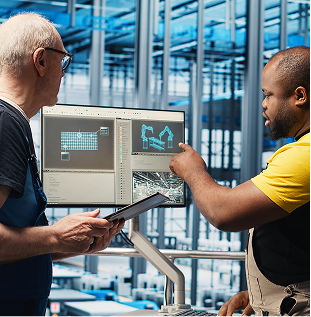
RAG AI enables engineering drawings in both the PDF and DWG formats to become searchable through natural-language queries. This therefore makes it easier for teams to access critical information without having to go through several files.
It can extract and compare specifications across products and revisions, surface relevant drawings and procedures for troubleshooting and identify known constraints that may impact decision-making. The system also provides engineering change awareness, helping teams understand who and what is impacted when a drawing is revised.
What's remarkable is that engineering drawings, PDF and DWG, are now searchable by natural language for the first time. Now, instead of the file just being found, the answer from inside the file is given too. This allows engineers to promptly access the information they need, identify relevant constraints, compare revisions and make decisions with more confidence.
Impact: Engineers find the right drawing in seconds, not hours. Specifications are compared automatically. Every interaction is auditable.

Standards Searchable, Every Query Logged
A retrieval-augmented generation system makes industry standards such as CSA, ASME, and ISO searchable and even cross-referenced with your products. This therefore helps teams find compliance-related information quickly and accurately.
It provides compliance-ready audit logging, ensuring that every query, answer and source is documented for traceability. The system also supports interactive onboarding by allowing new joinees to learn from standard work instructions and the organisation's collective knowledge. Deployed natively within Teams, ERP or Salesforce, it fits into existing workflows without having to require new tools.
Every query, resource and answer is documented. This AI is not just productivity oriented but is compliance-ready. At the same time, new employees can learn about the organisation's accumulated knowledge through onboarding experiences that are interactive and are delivered within the tools they are familiar with and already use.
Impact: Standards compliance answers are instant and cited. New hires learn faster. Every interaction is traceable.
Why GrayCyan Is Different from Copilot, Enterprise Vendors and Dev Shops
We've Been Building Manufacturing AI Since Before ChatGPT Existed
Our founder built his first RAG system in 2022, before most people had heard of retrieval-augmented generation.
He holds MIT Sloan AI certifications earned in 2018, when AI was still an R&D curiosity. GrayCyan didn't pivot to AI when it became trendy, we in fact started here.
We Understand Operational Friction, Not Just Technology
Most AI initiatives in manufacturing fail because they are layered onto broken workflows and undocumented processes. That's why we developed the AI Maturity Model, a framework designed to evaluate operational AI readiness that was independently reviewed by IT Brew along with TDWI and Avanade.
We assess coordination readiness, not just data readiness. That's why our systems actually get adopted as they help manufacturers move from pilot projects to measurable operational outcomes.
Chemical Engineers Who Build AI, Not Developers Learning Your Industry
Our founder is a chemical engineer with oil and gas experience and a background supporting industrial infrastructure proposals. We understand valve specifications, torque values, DWG files, and ASME standards.
We have seen engineering teams lose hours searching for information that already exists. We are well aware of the operational realities that manufacturers face on a daily basis. We don't need three months to understand your operation. That translates into faster deployment, quicker adoption, and measurable productivity gains for engineering as well as operations teams.
Custom AI That Reasons, Not a Generic Chatbot
Off-the-shelf RAG surfaces linguistically relevant excerpts. However, manufacturing environments require more than keyword-level relevance. Our systems understand context across equipment hierarchies, revision histories and structured enterprise data relationships.
They resolve conflicting sources, cite everything and flag edge cases for human review. Engineers verify, never guess. The result therefore, is faster access to trusted engineering knowledge, more consistent decision-making and reduced risk when answering complex technical and operational questions.
Phased Delivery That De-Risks Every Dollar
Every phase has a go/no-go gate. Reducing the risk and ensuring value is demonstrated before additional investment is made. Manufacturers start with a fixed-fee architecture phase rather than committing to a large multi-year implementation from the very beginning.
If it doesn't deliver value, you walk away owning a complete blueprint. This phased approach helps organisations validate use cases, align stakeholders and build a clear roadmap before scaling AI initiatives across engineering, operations or technical sales teams.
You Own Everything
Everything we build belongs to you; the platform, the data, and the code. There are no ongoing licensing fees and no vendor lock-in that limits your control.
We're a building partner, not a landlord. Our role is to build, optimise, and improve your AI systems for as long as you want us involved. This gives manufacturers the flexibility to scale, modify, or manage their AI infrastructure independently as business needs evolve.
Sound familiar? This is solvable.
Start with a fixed-fee architecture phase, not a multi-year commitment. If it doesn't deliver value, you walk away owning a complete blueprint.
How GrayCyan Delivers a RAG AI System: Phased, De-Risked Engagement
Every phase has a go/no-go gate. You never commit to the full engagement upfront.
Architecture and planning runs 4 to 6 weeks, pilot 6 to 10 weeks, then expansion over 3 to 12+ months. You own everything we build. No vendor lock-in. No recurring platform fees.
Architecture & Planning (4-6 weeks)
We map your document landscape, define priority use cases with senior engineers and operational stakeholders, design the technical architecture and establish measurable success criteria before a single line of code is written.
The focus is on validating feasibility, aligning requirements and identifying opportunities of the highest value for deployment.
Deliverable: You own a complete blueprint, including use-case definitions, architecture recommendations, implementation roadmap, and success metrics. This phase concludes with a go/no-go gate, ensuring you only move forward if the business case is clear.
Pilot Ingestion & Prototype (6-10 weeks)
We ingest your highest-value document libraries, build a working RAG system, deploy it within your existing tools and workflows and validate outputs with subject matter experts.
The focus is on proving accuracy, usability, and operational value using real-world scenarios. There are real engineers, real questions and real cited answers.
Deliverable: A functioning prototype connected to prioritised knowledge sources, validated response accuracy, user feedback and performance benchmarks. This phase concludes with a go/no-go gate, ensuring the solution demonstrates measurable value before broader deployment.
Expansion & Optimization (3-12+ months)
Once the pilot is proven, we scale the system across your broader document ecosystem and operational workflows. We onboard additional document libraries, incorporate continuous feedback cycles and refine performance based on real-world usage. We ensure that quality is maintained at every stage, and not just at the launch stage.
Deliverable: Expanded knowledge coverage across the full document corpus, ongoing accuracy improvements, governance controls, auditability, and established accuracy gates that ensure trusted performance as adoption grows across the organisation.
Organisational Rollout & Stewardship (Ongoing)
We deploy the system across the broader organisation, train internal champions, and provide ongoing stewardship to support long-term adoption. A RAG knowledge base is a living system containing new documents, revised standards, engineer feedback and needs continuous care in order to stay accurate.
Deliverable: Organisation-wide access, trained power users, governance processes, content maintenance workflows and ongoing performance monitoring. This ensures that the system remains trusted, current and aligned with the evolving engineering, operational and compliance-related requirements.
Measurable Impact: What Manufacturers See After RAG Deployment
These are not projections, but outcomes that we have measured across manufacturing, industrial distribution, and engineering services engagements. While the results may vary by organisation, the impact consistently comes from reducing the time spent searching for information, accelerating decision-making, and enabling teams to do more with the resources that they already have.
RAG AI in Practice: GrayCyan
Case Studies
Real deployments across legal intelligence and engineering document automation, with full ownership transferred in both.

LivingLies, AI Knowledge Agent Deployed
Transforming a static site into a searchable legal intelligence hub.
GrayCyan built an AI knowledge agent that indexed over 5 million content items, making decades of legal commentary instantly queryable.

Access Industrial, Engineering Proposals Automated
Engineering proposal preparation reduced from 8 hours to 30 minutes.
GrayCyan extracted and structured engineering drawings and documents for Access Industrial, reducing proposal preparation time from 8 hours to 30 minutes, improving accuracy and client trust.
Is This The Right Fit? Who RAG Is Built For
GrayCyan's RAG AI systems are built for companies across industrial, engineering, and manufacturing domains with 50 to 500+ employees who face at least one of the following.
Retirement Cliff
An entire generation of senior specialists approaching retirement within the same 3 to 5 year window.
Siloed Knowledge
Knowledge siloed by product line, region, or department with only one or two people who deeply understand each domain.
Inquiry Overload
Hundreds of complex technical inquiries per month and not enough engineers to keep pace.
Unsearchable Volume
Terabytes of documents across SharePoint, file servers, and ERP systems that nobody can efficiently search.
Tools That Fell Short
Tried Copilot, SharePoint search, or other tools and found they find documents but can't answer questions.
Need an Exit Ramp
Need a phased, de-risked path to AI, not a $1M+ enterprise commitment with no exit.
Industries we commonly support
"The 'Quiet Advantage' really drove home what I've been saying to our leadership. The difference is not AI versus no AI. It is generic retrieval versus manufacturing-specific intelligence. When a line goes down, the organisation's full operational history stands behind the next decision."Senior Technical Analyst on our Forbes Feature
Frequently Asked Questions: RAG in Manufacturing
Ready to Preserve Your Institutional Knowledge and Make It Actionable?
Manufacturers and engineering companies that deploy GrayCyan's RAG systems recover $240K to $600K in annual engineering productivity.
Not sure if you're ready? Take our AI Readiness Assessment →