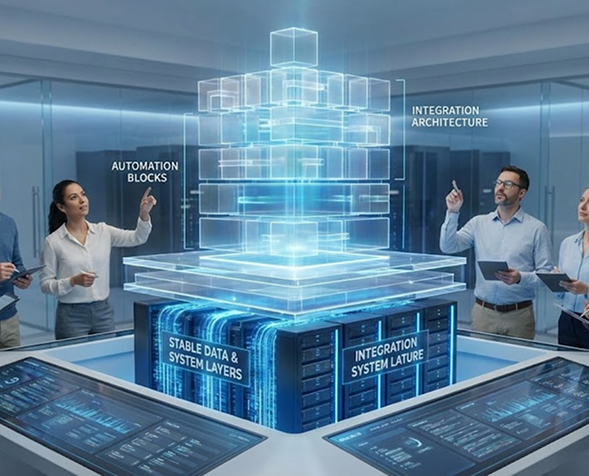
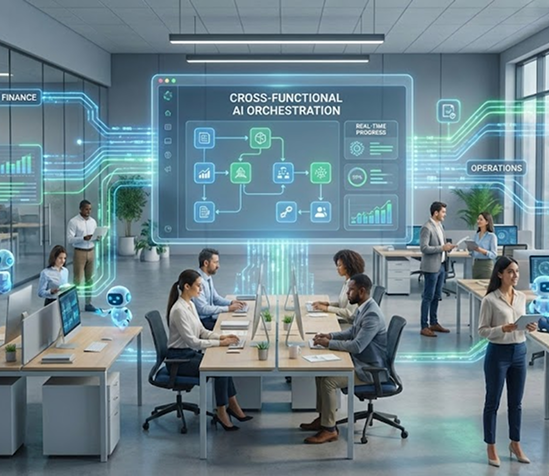
At this stage, AI reduces friction so your teams are no longer slowed down by documentation or scattered information.
What Stage 1 Actually Fixes
Stage 1 brings AI directly into everyday work to improve how teams access information, create outputs, and work with data.
AI enhances productivity and data reliability without taking ownership of workflows or decisions. Outputs are deterministic and bounded by predefined instructions. Human teams remain responsible for interpreting results, making judgments, and initiating next steps.
Stage 1 enhances productivity and data reliability.
AI extracts, structures, drafts, and flags inconsistencies — but it does not initiate workflows or make operational decisions.
This stage builds clarity and prepares you for Workflow Intelligence.
Disconnected Systems → A Unified Data Layer
Operational data lives across tools that don’t communicate — your ERP, your WMS, your MES, your QMS, your shared drive, your email. Each system holds a piece of the picture. None of them speak the same language.
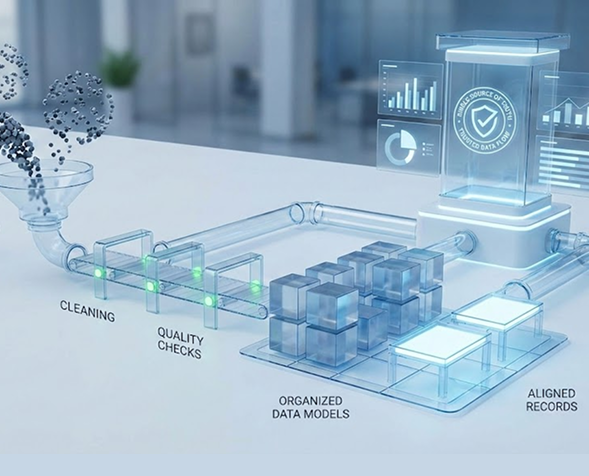
We build a middleware layer that sits between your existing tools, normalizes data into a consistent format, and pushes everything into a single structured record. No rip and replace. No disruption to what’s already working. Your ERP stays your ERP — it just finally talks to everything else.
Free-text technician notes. Supplier COAs arriving by email. Scanned batch records. Handwritten temperature logs. NCRs filled out inconsistently across shifts. These can’t be processed by a rule-based system — there’s no consistent structure to grab onto.
This is where AI assists. We use AI to read unstructured inputs and extract the relevant fields into your standardized record format — reducing the manual effort of interpretation and re-entry significantly. Your team reviews exceptions and edge cases; the routine volume is handled.
Inconsistent Documentation → Traceable, Searchable Records
When SOPs live in one place, HACCP plans in another, lot traceability records in a spreadsheet, and audit trails scattered across inboxes — finding anything means remembering where you put it. Regulatory audits become multi-day events. Recall readiness is a best guess.
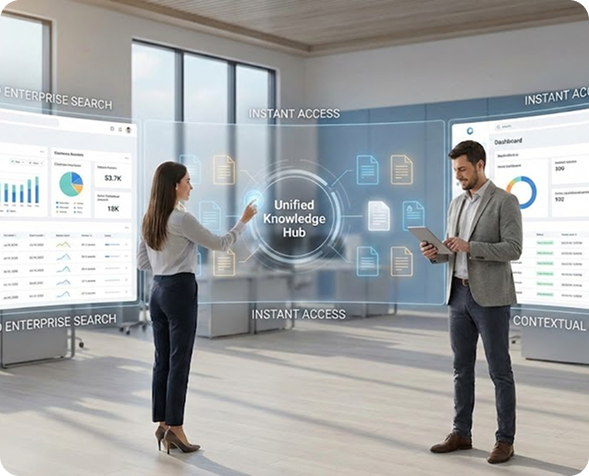
We standardize your documentation formats, embed metadata — lot numbers, timestamps, equipment IDs, product codes — and apply AI classification to historical records at scale. Every SOP, every batch record, every supplier document becomes retrievable by search, not memory. Lot traceability that once took hours takes seconds.
Reactive Operations → Predictable, Controlled Systems
Yield variance gets investigated after the fact. Quality exceptions surface at the end of the line. Compliance gaps show up during audits, not before them.
Stage 1 doesn’t solve these with AI — it structures the data so you can see them clearly for the first time. OEE starts becoming measurable. Variance patterns become visible. You move from fixing issues after they happen to operating with the clarity to catch them earlier.
We don’t introduce AI all at once. We bring teams in gradually, applying AI-assisted workflows where they create immediate, visible value — reducing manual effort and building confidence before the bigger changes come.
Stage 1 brings AI directly into everyday work to improve how teams access information, create outputs, and work with data.
AI enhances productivity and data reliability without taking ownership of workflows or decisions. Outputs are deterministic and bounded by predefined instructions. Human teams remain responsible for interpreting results, making judgments, and initiating next steps.
Stage 1 enhances productivity and data reliability.
AI extracts, structures, drafts, and flags inconsistencies — but it does not initiate workflows or make operational decisions.
This stage builds clarity and prepares you for Workflow Intelligence.
Food & Beverage — Regional Processor
Batch records live in Excel. Supplier COAs arrive by email. CCP monitoring logs sit in a paper binder. Temperature deviation records are in a separate spreadsheet. An SQF or BRC audit means two days of manually pulling records across four different places — and hoping nothing is missing.
Stage 1 builds a middleware layer connecting those inputs, standardizes the record format across batch, lot, and supplier documentation, and applies AI extraction to incoming COAs and deviation reports. Every record — tagged by lot number, product code, CCP checkpoint, and date — lives in one place. Lot-level traceability that once took hours meets FSMA 204 requirements without a dedicated audit prep scramble.
Work orders are in the ERP. Technician notes are free-text in a shared drive. NCRs are filled out inconsistently across shifts. BOMs are versioned in a separate system. Diagnosing a recurring failure pattern means cross-referencing four systems manually — and the answer still depends on who you ask.
Stage 1 builds a connected documentation layer across the ERP, drive, and NCR system, uses AI to extract structured fields from free-text technician notes — failure mode, asset ID, corrective action taken — and applies metadata tagging across the full maintenance archive. Operational history becomes searchable by asset tag, failure mode, and work order number. Root cause analysis that took a week of digging takes minutes.
POs arrive through email, an EDI feed, and a web portal — each channel producing a slightly different record format. The WMS sees one version. Accounting sees another. Receiving sees a third. SKU-level discrepancies don’t surface until someone manually reconciles at end of day.
Stage 1 standardizes the intake format across all channels and builds the middleware to normalize each PO into a single consistent record at the point of entry — with SKU, quantity, and supplier ASN data aligned before it reaches the WMS. Downstream reconciliation is eliminated. Receiving discrepancies are visible in real time, not at day’s end.
Fishbowl ERP cut daily manual entry from ~12 hrs to under 2 hrs, created a unified data workflow, and accelerated order processing with automated PO imports, syncing, and reconciliation.
A middleware layer connecting your existing systems
AI extraction applied to unstructured inputs
Standardized documentation templates and record formats
A historical record archive that is classified, tagged, and searchable
Embedded metadata across your document and operational records
A Stage 2 readiness assessment — a clear picture of where you are and what's next
What Stage 1 Enables
Once your systems and data are structured, you unlock:
Stage 2: Operational Intelligence — AI begins managing workflows, handling exceptions, and reducing operational overhead inside the structure you built.
Stage 3: Human-Led Autonomous Operations — The operation runs itself inside boundaries your team defines. AI monitors, surfaces, and recommends. Your team governs and decides.
Without Stage 1, these stages struggle. With it, they scale.
Who This Is For
Stage 1 is designed for organizations that:
Operate across multiple disconnected tools
Rely heavily on manual processes and reporting
Struggle with data consistency and visibility
Have tried AI tools that didn’t deliver because the inputs weren’t clean
Want to adopt AI but need a clear, honest starting point
If your operations feel fragmented or overly manual — this is where you begin.