
Manufacturing Software Development: Custom Software for Mid Market Manufacturers
Full ownership at completion. The ERP remains the system of record.
Custom WMS, ERP integrations, AI automation, compliance systems, and production dashboards, built on the systems already running in the facility.
Book a Discovery Call→ Featured ›
 Featured ›
 Client
 Featured ›
 Featured ›
 Featured ›
 Partner
 Member
 Featured ›
 Featured ›
 Featured ›
 Featured ›
 Featured ›
 Featured ›
 Featured ›
 Featured ›
 Featured ›
 Featured ›
 Featured ›
 Featured ›
What Manufacturing Software Development Means for a Mid Market Manufacturer
Manufacturing software development is not about building a new ERP from scratch. For mid market manufacturers with 50 to 500 employees, the most useful custom software connects the systems already running, including ERP, WMS, MES, production equipment, and compliance platforms. It adds inventory control, process automation, and practical AI that a standard platform cannot configure for one operation.
Custom WMS
Scan based receiving, directed putaway, wave picking, cycle counting, packing, shipping and ERP financial posting.
ERP Integration Middleware
Connects warehouse, production, carrier, EDI, commerce, and compliance systems through APIs.
AI Automation
Demand forecasting, inventory anomaly detection, document processing and controlled agentic workflows.
Compliance Systems
FSMA 204, 21 CFR Part 11, AS9100, METRC and other industry requirements.
Production Intelligence
Dashboards for WIP, cycle time, scrap and yield, plus quality and schedule performance.
The ERP remains the system of record. Custom manufacturing software connects to NetSuite, SAP, Epicor, Acumatica, Fishbowl, Odoo, Microsoft Dynamics, or Infor through API middleware. The added execution, integration, and intelligence layers solve gaps without forcing an ERP replacement or a new source of truth.
A useful project starts with the operational gap, not a list of technologies. That gap may be a receiver entering the same lot in three systems, a planner working from yesterday's inventory, a quality team rebuilding trace records during an audit, or a supervisor who cannot see WIP until the shift closes.
Start With the Gap, Not the Stack
The software should remove that specific delay or control failure and leave a transaction trail the business can support.
Seven Categories of Custom Manufacturing Software Development
These manufacturing software development services cover the operational gaps most often found between the ERP, warehouse, production floor, and compliance team. Each system is scoped around the actual data model, transaction rules, hardware, and controls in the facility.
Custom WMS Development
Connect receiving, putaway, picking, packing, shipping, and cycle counts directly to ERP inventory and financial events. Support manufacturers whose ERP warehouse module cannot handle their volume, workflow, or traceability needs.
Build against the installed ERP configuration, including NetSuite, SAP, Epicor, Acumatica, Fishbowl, Odoo, Dynamics, and Infor.
In one Fishbowl deployment, custom middleware reduced manual entry from 12 hours to under 2 hours a day, an 85 percent reduction, with no ongoing software license. See custom WMS development.
ERP Integration Middleware
Connect ERP to WMS, MES, carrier APIs, EDI, ecommerce, and compliance reporting through real time API middleware.
Replace nightly batch reconciliation and manual rekeying with event driven updates that write warehouse and production transactions to ERP within seconds.
Add error handling, retry logic, financial posting, and anomaly detection so failed or unusual transactions are visible before reconciliation. See ERP WMS integration architecture.
AI and Agentic Automation for Manufacturing
Use ERP history for demand forecasts that inform reorder points and purchasing decisions. Monitor transaction data for unexpected inventory movements, receiving variances, and consumption patterns.
Route orders, read bills of lading and invoices, retrieve technical documents and assemble compliance records with controlled AI workflows.
Train and deploy on the manufacturer's existing operational data without any requirement for platform migration. See manufacturing AI solutions.
Compliance and Traceability Software
Capture FSMA 204 key data elements at each critical tracking event and produce forward and backward lot traces.
Create 21 CFR Part 11 audit trails, AS9100 serial genealogy, METRC records, and controlled substance documentation around existing ERP transactions.
In a USDA regulated meat operation, automated traceability cut audit response from 2 to 3 days to under 60 seconds. Explore lot traceability software, WMS for pharmaceutical, WMS for aerospace or ERP inventory for cannabis.
Production Intelligence and MES Integration
Combine ERP work orders with barcode, RFID, equipment sensor and MES events for a live view of production.
Track WIP through production stages and report cycle time, scrap, yield variance, inspection results and schedule adherence.
Instead of relying on the prior shift or an end of day batch, give supervisors current floor status. Explore manufacturing AI and production intelligence.
Industry Specific ERP Inventory Development
For food and beverage operations, adding FEFO inventory and lot specific costing.
Support pharmaceutical serialization, aerospace serial genealogy and cannabis seed to sale controls. Extend the ERP for the operation's regulatory and inventory logic without replacing the core platform.
Food and beverage ERP inventory, pharmaceutical ERP inventory, aerospace and defense ERP inventory or cannabis ERP inventory.
Custom ERP Reporting, Analytics, and Dashboards
Report inventory accuracy, cycle count completion, operator pick performance, purchase order lead time variance and production schedule adherence.
Read live data through the ERP database or API, based on the access and control model already in place.
Provide focused operational visibility without requiring a separate BI platform, data warehouse, ETL pipeline, or license. See ERP inventory management services.
Across all seven categories, the implementation must account for users on the floor. Scan screens need large, unambiguous actions. Offline or unstable network conditions need defined behavior. Permissions must match job roles. Exceptions need a visible queue, an owner, and a safe retry path. These details determine whether software development for manufacturing companies improves the shift or creates another system employees work around.
Which of the seven is your actual gap?
Tell us which ERP you run and where the delay or control failure sits today. The scope follows the gap, not a feature list.
Book a Discovery Call→Why Custom Manufacturing Software Beats Off the Shelf for Mid Market Operations
| Decision factor | Off the shelf SaaS | Custom development |
|---|---|---|
| Upfront cost | Usually lower | Higher, scoped to the required capability |
| ERP integration | Generic connector and common configuration | Built for the installed version, modules, and transaction rules |
| Compliance | Common controls, with added configuration | Specified around the facility's exact evidence and audit needs |
| Ongoing license | Per user or per module fees | No recurring license for the software built |
| Data model | Often a second database with scheduled sync | ERP remains the system of record |
| Ownership | Vendor owns the platform | Manufacturer receives source code and documentation |
Custom software for manufacturing also lets compliance enter the specification before development begins. FSMA 204, 21 CFR Part 11, AS9100, NADCAP, and METRC controls can be mapped to scans, approvals, records, and exception handling. This is usually more predictable than adding required evidence after a generic platform is already live.
Ownership changes the long term cost and risk. The manufacturer receives the source code, API documentation, database schema, and training materials. The system can continue operating if a SaaS vendor changes its prices, product roadmap, or connector design.
Custom Does Not Mean From Zero
A sensible architecture uses stable cloud or on premises infrastructure, supported databases, the ERP's published interfaces, and well maintained libraries. Development effort stays focused on the workflows, integrations, records, and decisions that are specific to the operation. This keeps maintenance practical while preserving control of the finished application. Read the WMS build vs buy analysis.
How GrayCyan Builds Custom Manufacturing Software
GrayCyan uses a seven phase process designed for manufacturers that need clear acceptance criteria, safe ERP integration, and a controlled go live.
10 to 14 weeks for a single warehouse WMS, 4 to 8 weeks for ERP integration middleware, 6 to 10 weeks for a demand forecasting layer with 12 to 24 months of history, and 8 to 12 weeks for many compliance documentation systems. Scope and data readiness can change these ranges.
Discovery and Requirements
Map the current process, audit ERP data, document integrations, and define compliance evidence.
The approved requirements become the go live acceptance criteria.
Architecture and Specification
Design APIs, the custom data model, security controls and compliance records.
Plus any AI training data requirements.
Integration Build
Create ERP middleware, event handling and retry logic.
Along with financial posting, logging and anomaly checks.
Application Build
Develop scan interfaces and warehouse and production workflows.
Plus document generators and dashboards.
Testing
Run unit, integration, and user acceptance tests with live ERP data.
Using actual hardware and warehouse or production staff.
Go Live
Complete a parallel run, train users and reconcile transactions.
Then provide launch support.
Hypercare and Ownership Transfer
Tune performance and resolve early exceptions.
Then transfer source code, schemas, API documentation and training materials.
Discovery should also identify the people who approve transactions, maintain master data, support devices and own regulatory evidence. Their decisions affect roles, validation, exception routing and training. Before launch, the team should agree on reconciliation checks, rollback procedures, support ownership, and the measures that prove the system is working, such as entry hours removed, inventory variance, pick accuracy, audit response time or schedule adherence.
Manufacturing Software Development in Practice
Four deployments across ERP middleware, engineering retrieval, compliance documentation and air-gapped AI. Every one built on the system the client already ran.

Fishbowl ERP Manufacturer: Custom WMS Middleware
Challenge: 12 hours a day of manual entry across Fishbowl, warehouse workflows, and procurement. Inventory and lot genealogy were not current.
Built: API middleware that posted receiving, putaway, picking, and shipping events to Fishbowl in real time.
Outcome: manual entry fell 85 percent, from 12 hours to under 2 hours daily. Lot genealogy became traceable in minutes, with no ongoing license fee.
Access Industrial: Engineering Proposal Automation
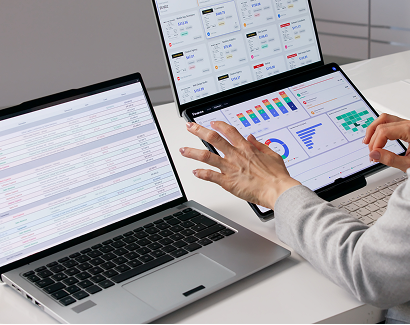
Challenge: each proposal required about 8 hours of manual lookup across drawings, specifications, and project history.
Built: retrieval augmented generation over the engineering library and past project records, with natural language search.
Outcome: proposal preparation fell from 8 hours to 30 minutes, a 90 percent reduction. Staff could search the drawing library without IT support.

USDA Regulated Meat Processor: Compliance Software
Challenge: batch records, lethality evidence, and FSMA 204 traceability were assembled after production. Audit response took 2 to 3 days.
Built: a documentation layer that generated required records during production scanning, including full forward and backward lot trace.
Outcome: audit response fell to under 60 seconds, with FSMA 204 controls active at go live.
Air Gapped Defense Manufacturer: On Premises AI
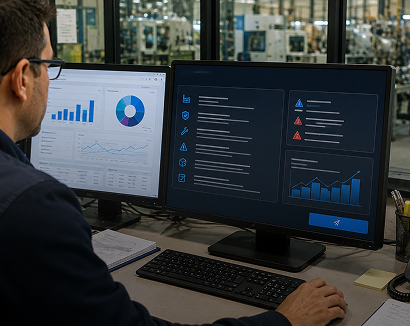
Challenge: 40 years of drawings, specifications, and revisions sat in disconnected archives. ITAR controls ruled out cloud processing.
Built: on premises retrieval augmented generation across engineering documents and ERP manufacturing history, with no external connection.
Outcome: lookup time fell from 30 to 45 minutes to seconds. No data left the facility.
Would you own the system at the end?
With a custom build you receive the source code, schemas, API documentation and training materials. No recurring license.
Book a Discovery Call→Manufacturing Industries Served
GrayCyan develops software for mid market manufacturers in regulated and operationally complex industries where a standard ERP configuration or generic SaaS platform leaves material gaps.
Food and Beverage
FSMA 204 lot traceability, FEFO inventory, shelf life controls, recall documentation and cold chain records. Explore ERP inventory for food and beverage.
Pharmaceutical
DSCSA serialization, 21 CFR Part 11 audit trails, quarantine and release workflows and controlled substance records. Explore ERP inventory for pharmaceutical operations.
Aerospace and Defense
AS9100 serial genealogy, NADCAP process cost capture, ITAR compliant on premises deployment and audit documentation. Explore WMS for aerospace.
Cannabis
METRC integration, package tag verification, transfer manifests, destruction accounting and 280E COGS support. Explore ERP inventory for cannabis.
Industrial Distribution and CPG
Custom WMS, ERP middleware, purchasing automation and demand forecasting.
Automotive and Oil and Gas
Production dashboards, MES integration, traceability and special process documentation.
Industrial manufacturing software development can also be deployed on premises or in an air gapped network when export controls, customer requirements, or data sovereignty rules prevent cloud processing. The architecture should define where application data, logs, model files, backups, and credentials live, as well as how updates are reviewed and moved into the controlled environment.
Why Manufacturers Choose GrayCyan
Manufacturing Focus
The work centers on warehouse, production, ERP, compliance and industrial data problems.
Existing ERP First
Integrations extend NetSuite, SAP, Epicor, Acumatica, Fishbowl, Odoo, Dynamics and Infor without forcing replacement or migration.
Full Ownership
Source code, API documentation, database schemas and training materials transfer at completion. There is no recurring license for the software built.
Specific AI Mechanisms
Proposals identify the data, model, workflow, control and measurable operational result. AI is not used as a label for ordinary automation.
Regulated Operations Experience
Deployments account for USDA, FDA, ITAR, AS9100, NADCAP, FSMA 204, 21 CFR Part 11, METRC and DEA requirements where relevant.
The best fit is an operation with a functioning ERP, committed process owners, accessible transaction history, and a measurable gap that packaged software has not resolved. If master data is unreliable or the process changes by shift, the first engagement may be a data and requirements project. That work prevents the build from automating inconsistent rules.
Frequently Asked Questions About Manufacturing Software Development
Ready to Build Software on Your Existing ERP?
Tell us which ERP you run, what the operation needs that the ERP does not provide, and whether compliance, AI automation, production visibility or warehouse execution is the most urgent gap.
GrayCyan will map a practical custom manufacturing software development path for your facility.
Not ready for a build? Start with the AI Readiness Assessment →