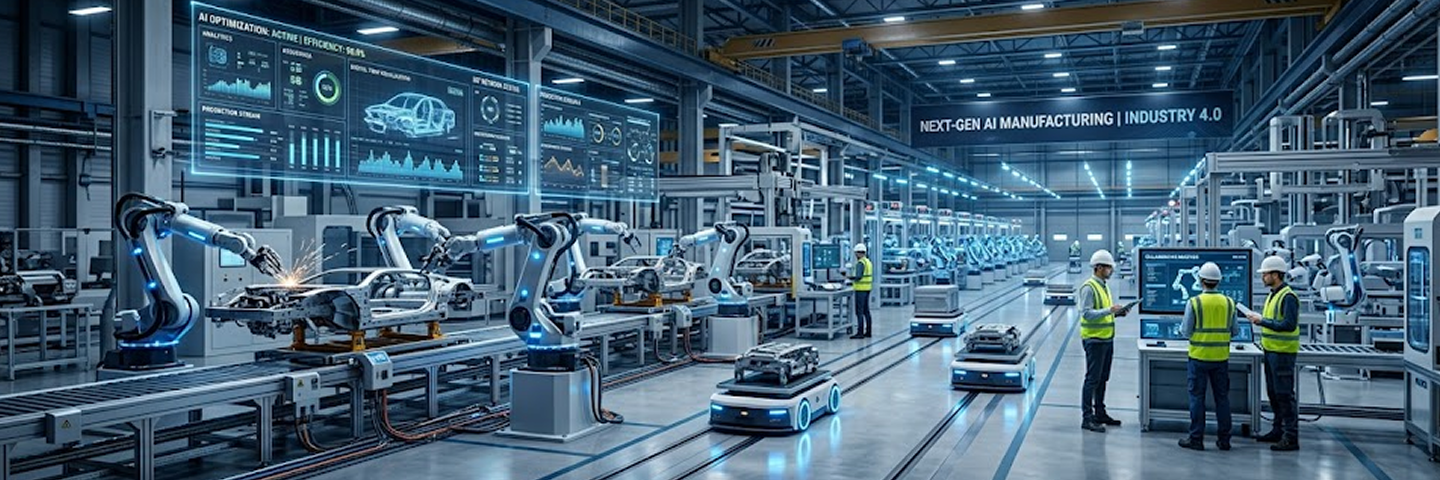




Manufacturing is entering a new phase of AI adoption. The focus is gradually shifting from AI that advises people on what to do to AI that can actually take action on their behalf. While Generative AI helps create content and answer questions, agentic AI goes a step further. It can plan, make decisions and execute multi-step workflows across multiple systems. This evolution of AI is grabbing attention across the industry, particularly as manufacturers face major shortages in labour, complexities in operations, and the growing pressures to improve productivity. According to a survey by the Manufacturing Leadership Council, 40% of manufacturers expect plants to operate without any human input by 2030.
GrayCyan helps manufacturers deploy practical agentic AI systems that coordinate work across business systems. This does not mean the deployment of robots or generic chatbots. Let's understand what agentic AI actually works in a factory today.
What is Agentic AI in Manufacturing?
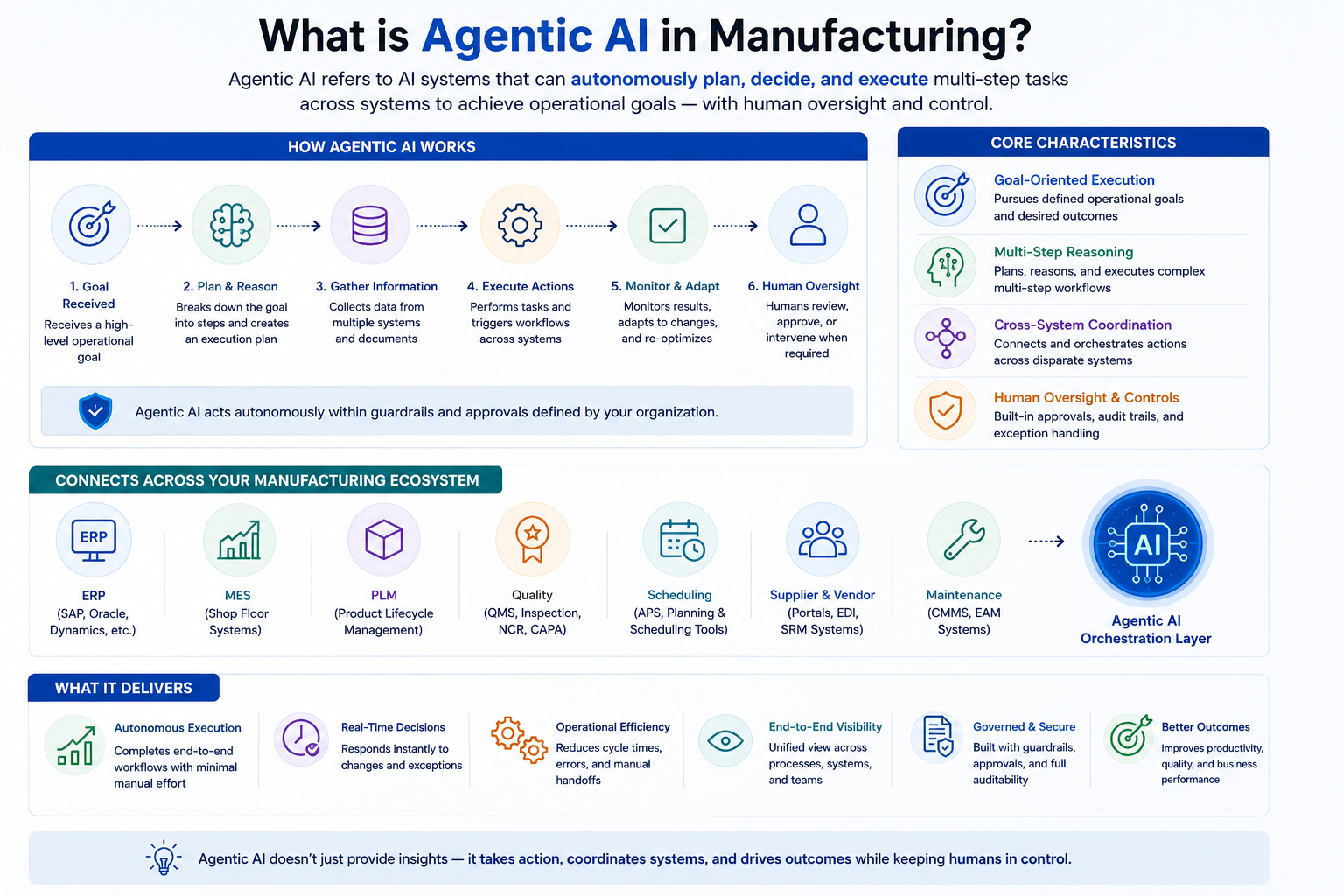
Agentic AI in manufacturing — autonomously plan, decide, and execute multi-step tasks across systems
Agentic AI in manufacturing refers to AI systems that can autonomously plan, decide and execute multi-step tasks across systems without the involvement of any human input at every step. Unlike traditional AI that can predict outcomes or generative AI that can create content, agentic AI goes beyond all this as it takes action towards achieving a specific operational goal while maintaining human oversight.
Simply put, agentic AI acts as a manufacturing AI agent that coordinates work across multiple systems. Instead of simply identifying a problem or generating recommendations, it can act as a catalyst for workflows, gather information from various sources, validate requirements and complete routine tasks automatically. These systems are designed around four core characteristics:
- Goal-oriented execution
- Multi-step reasoning
- Cross-system coordination
- Human oversight and approval controls
In manufacturing environments, agentic AI connects systems such as ERP, MES, PLM, quality management platforms, scheduling tools, supplier portals, and maintenance applications. This therefore results in a coordinated workflow that can move around information, make routine decisions, and execute actions across the operation without having employees work manually to bridge every system.
| Category | Traditional AI | Generative AI | Agentic AI |
|---|---|---|---|
| Primary function | Analyzes data and makes predictions, classifications, or recommendations | Generates new content such as text, summaries, reports or code | Pursues goals by planning, reasoning, and coordinating across systems |
| Manufacturing example | Predicts equipment failure based on sensor data | Creates a maintenance report from logs and technician notes | Detects a maintenance issue, creates a work order, gathers documentation, notifies stakeholders and updates systems |
| Level of autonomy | Low — provides insights for human decision-making | Low to moderate — generates outputs for human review | High — executes multi-step workflows with human oversight and approval controls |
GrayCyan's agentic systems act as a middleware between ERP, PLM, MES, scheduling, quality and vendor systems — validating inputs, assembling outputs, and triggering coordinated actions across operations while keeping humans in control of critical decisions.
AI Agents for Manufacturing vs Agentic AI — What's The Difference?
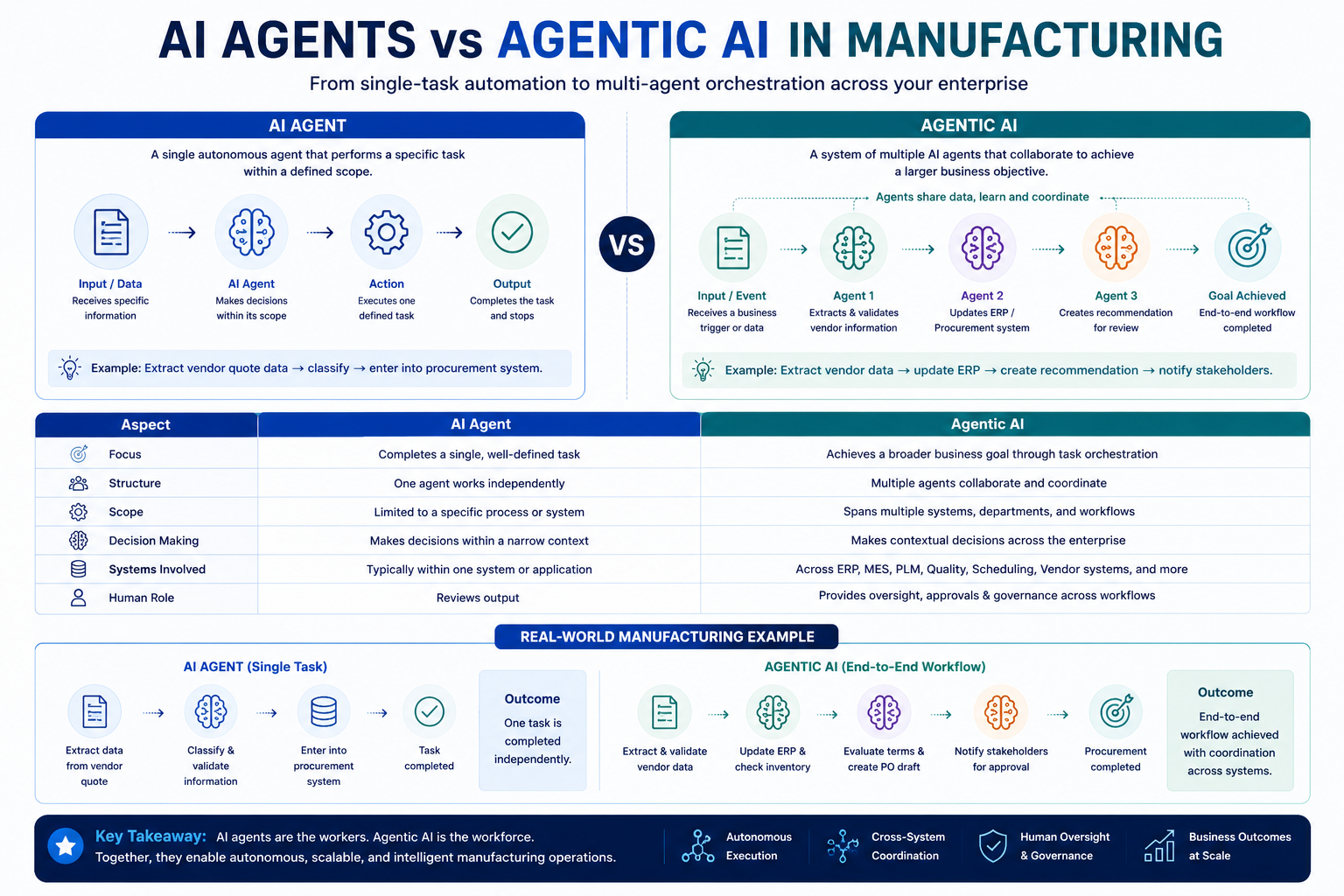
AI Agents vs Agentic AI — from single-task automation to multi-agent orchestration across your enterprise
The terms are often used interchangeably. However, it's important to understand that they are not the same thing. An AI agent for manufacturing is a single autonomous software entity that can perceive information, make decisions within a defined scope and take action. For example, an AI agent might extract data from a vendor quote, classify it, and enter it into a procurement workflow.
Agentic AI on the other hand is a broader system that coordinates multiple AI agents to achieve a larger business objective. In a manufacturing environment, one agent may extract vendor data, another may update the ERP and a third may draft a procurement recommendation for review. Therefore the AI agents work together to complete a workflow rather than focus on a single task.
At GrayCyan, workflow AI agents typically operate within a single system or process, while agentic systems coordinate actions across ERP, MES, PLM, quality, scheduling, and vendor platforms. This distinction becomes clearer when looking at real-world manufacturing use cases.
Agentic AI Use Cases in Manufacturing
Agentic AI use cases in manufacturing are moving beyond analysis and automation and transitioning towards autonomous execution. Instead of simply generating recommendations, AI agents are able to monitor conditions, make decisions, coordinate across systems, and complete workflows with minimal human intervention. Provided below are seven real-world applications of agentic AI in manufacturing that are delivering end-to-end operational outcomes today.
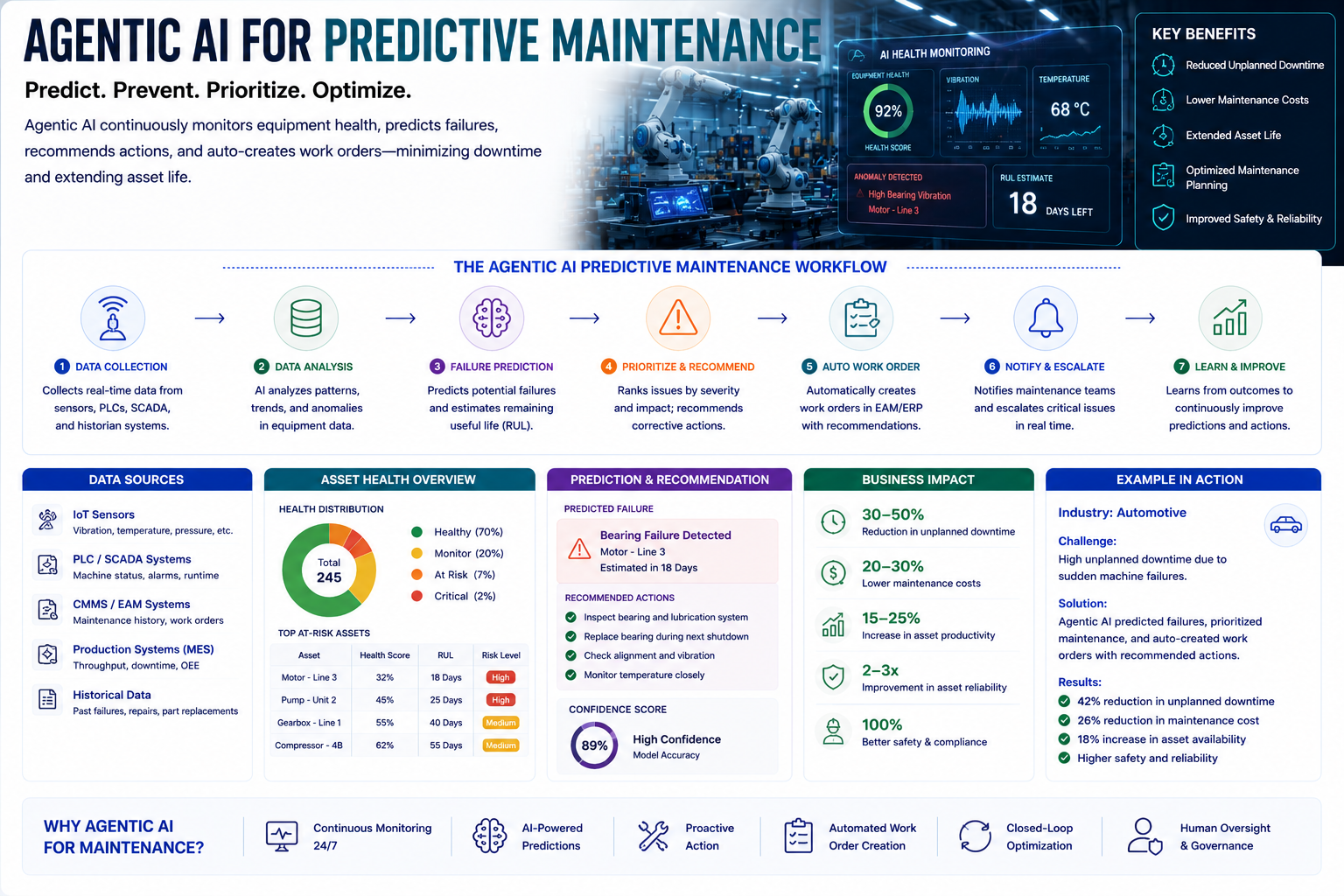
Agentic AI predictive maintenance — predict, prevent, prioritize and optimize across maintenance systems
Agentic Predictive Maintenance
Agentic AI improves predictive maintenance by continuously monitoring sensor data equipment performance metrics, and maintenance logs to identify emerging risks before failures occur. Rather than stopping at risk prediction, the agentic workflow scores equipment health, updates maintenance schedules, creates work orders, and alerts technicians with a diagnosis and recommended action plan.
GrayCyan's Maintenance Log → Risk Scoring → Schedule Update workflow automates this process across maintenance systems. A well-known example is Rolls Royce's Intelligent Engine program, which continuously monitors engine performance across fleets to optimize maintenance planning and reduce unplanned downtime.
Autonomous Quality Control and Defect Management
Quality teams spend a significant amount of time in manually reviewing inspection records, defect reports, and CAPA documentation. Agentic AI automated the entire workflow by extracting defect information from handwritten or digital QC notes, classifying issues against the quality standards, generating inspection reports, identifying recurring patterns, and triggering corrective-action workflows.
GrayCyan's QC Notes → Defect Classification → Inspection Report workflow removes manual data entry while improving traceability. Similar approaches can be seen in BMW's AIQX quality platform, which uses AI-driven inspection systems to identify defects and trigger corrective actions with extremely high precision.
Agentic Supply Chain & Procurement
Procurement processes often require employees to move information between vendor communications, pricing spreadsheets, ERP systems and sourcing documentation. Agentic AI can automate these workflows by extracting pricing data from supplier quotes, validating it against internal cost models, updating ERP cost sheets, preparing sourcing recommendations, and drafting follow-up RFQs.
GrayCyan's Vendor Quote → Cost Sheet → Sourcing Recommendation workflow reduces administrative effort while improving consistency. Because the agent operates across procurement systems, ERP platforms, and vendor communication channels simultaneously, sourcing teams can focus on strategic decisions rather than routine coordination tasks.
Autonomous Production Scheduling
Production scheduling requires constant coordination between work orders, material availability, labour capacity, and production priorities. Agentic AI continuously monitors WIP status, inventory availability, machine utilization, and capacity constraints. When bottlenecks emerge or work orders stall, the system recalculates priorities, updates schedules, synchronizes planning systems, and generates shift summaries for supervisor review.
GrayCyan's Work Order → Material Check → Schedule Update → Summary workflow helps manufacturers maintain production flow with less manual intervention. Hyundai's Metaplant initiative demonstrates how AI can monitor operations, identify issues, analyze root causes, and support operational decision-making in real time.
Engineering & BOM Synchronization
Engineering changes often create disconnects between drawings, specifications, BOMs and ERP records. Agentic AI helps maintain alignment by extracting structured information from engineering drawings, PDFs and technical documents, validating data against the ERP records, updating BOM versions, and maintaining change logs across systems. Agentic AI automatically flags any discrepancies for engineer review before they create downstream production issues.
GrayCyan's Engineering File → Structured Extraction → BOM Update workflow eliminates many of the manual rework loops that commonly occur between engineering and production teams, improving data consistency throughout the product lifecycle.
Multi-Agent Systems for Smart Factories
In smart manufacturing, the most advanced form of agentic AI involves multiple specialized agents working together under a coordinated orchestration layer. One agent may monitor production performance, another may track supply chain risks, while another manages quality and compliance workflows. An orchestrating system prioritizes actions, resolves conflicts, validates information, and maintains human oversight.
This aligns closely with GrayCyan's Stage 3 Connected AI systems vision, where AI becomes the operational layer connecting ERP, PLM, MES, scheduling, quality, and vendor systems. The outcome therefore is a more connected, predictable, and responsive manufacturing operation.
Agentic AI for Workforce & Shift Intelligence
Manufacturing leaders often spend considerable time gathering information from production logs, downtime reports, quality records and supervisor updates before fully understanding all that occurred during a shift. Agentic AI automates this process by collecting information from multiple operational systems, generating shift summaries, producing WIP updates, identifying downtime trends, and highlighting anomalies that require attention.
GrayCyan's production workflow AI agents generate operational insights instantly, providing managers with a unified view of factory performance. Leaders can focus on solving problems and improving operational outcomes instead of wasting hours and hours in compiling reports.
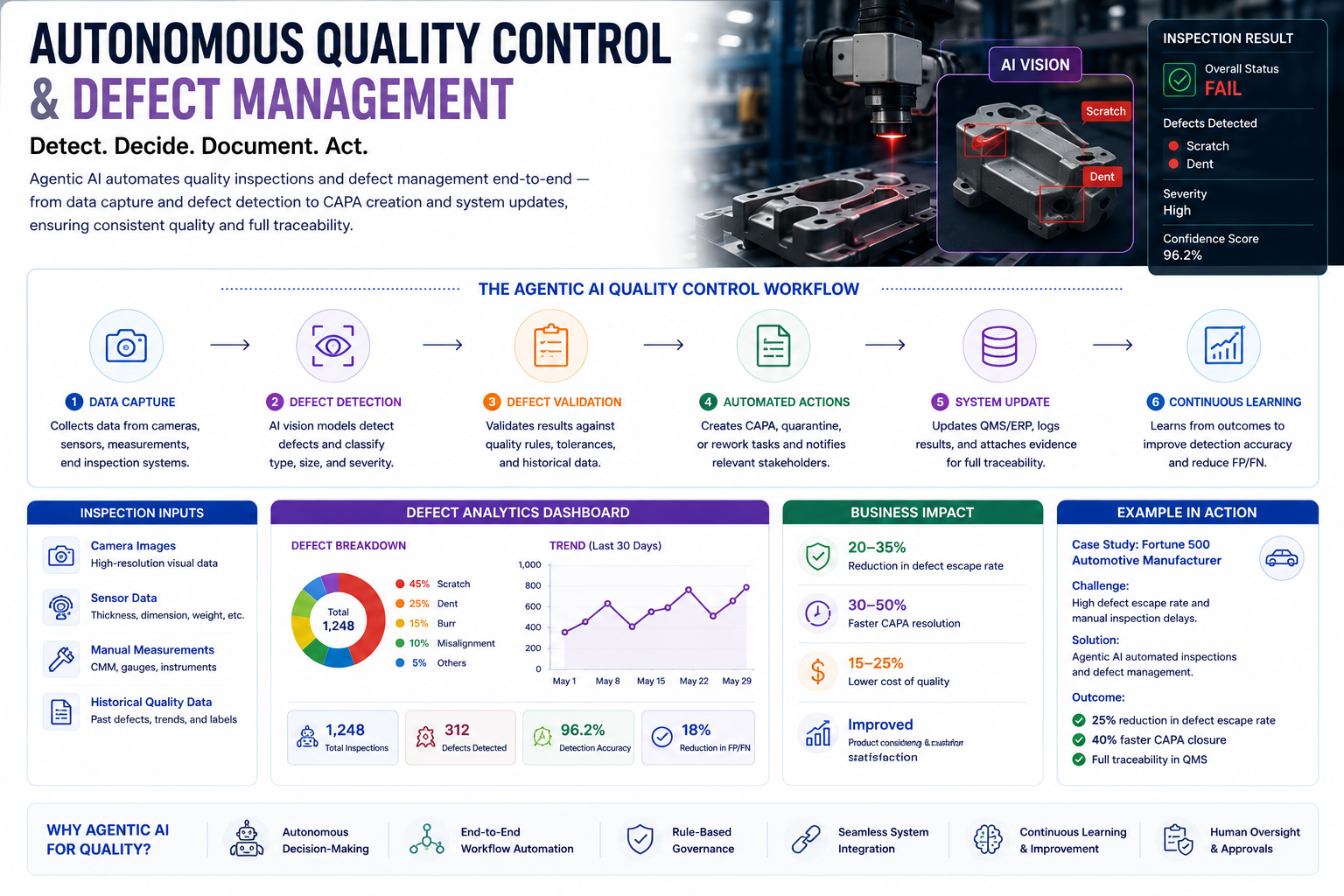
Autonomous quality control — detect, decide, document and act with AI-powered defect management
GrayCyan's Agentic AI for Manufacturing
GrayCyan's agentic AI for manufacturing is built specifically for industrial environments. It is not generic enterprise AI that is repurposed for factories. Our systems are designed to operate within the reality of manufacturing operations, connecting existing business systems, validating information, and coordinating actions across workflows. Rather than replacing technology investments, GrayCyan works inside existing ERP environments, including Oracle, SAP, Epicor, Infor, Microsoft Dynamics, Odoo and other manufacturing platforms. There's no new hardware, ERP replacements or disruption to production.
Instead of being completely automated, GrayCyan does have human oversight at every workflow as well as audit trails, data validation, and approval controls when required. Manufacturers remain in control while AI agents handle routine coordination and execution tasks.
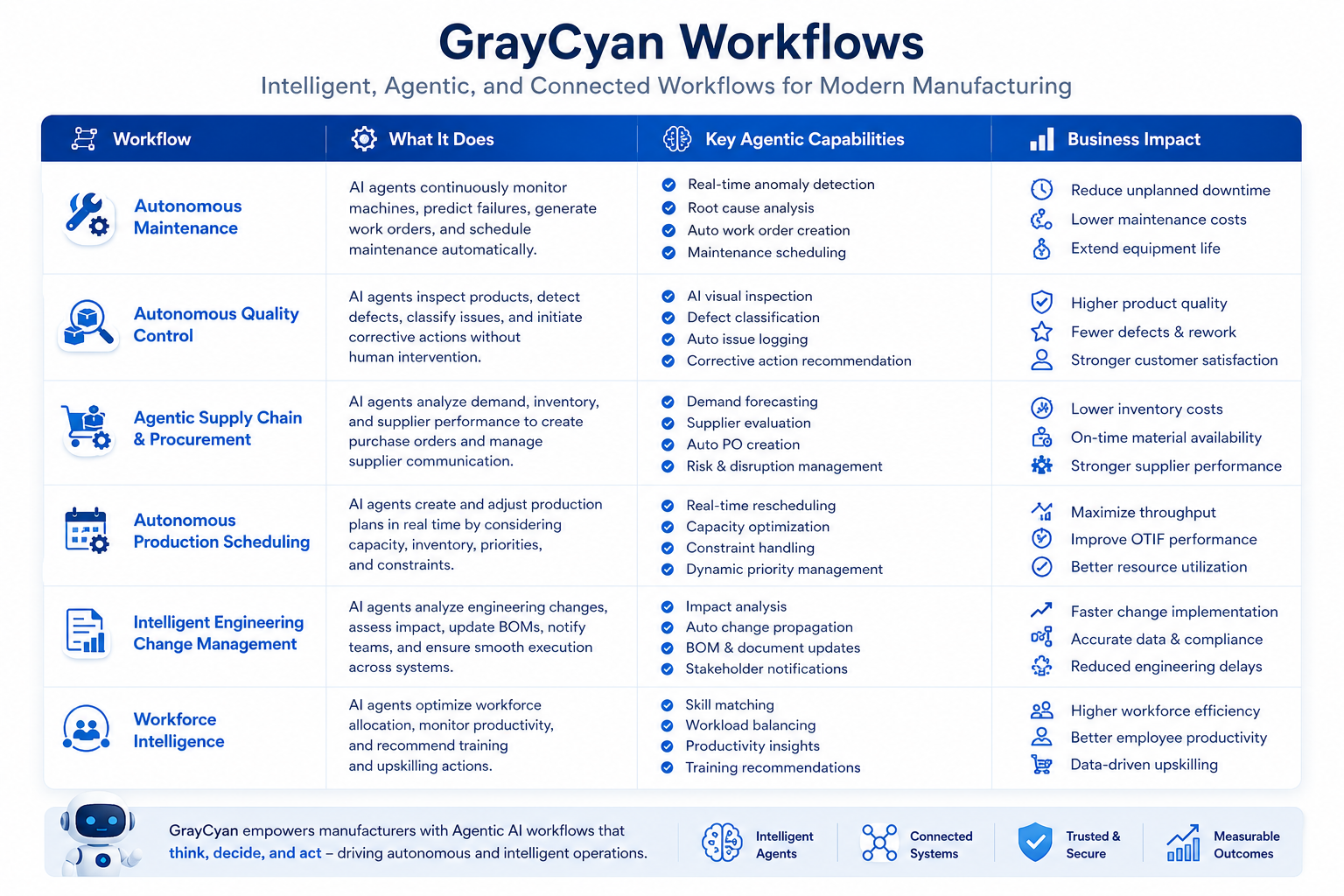
GrayCyan workflows — intelligent, agentic, and connected workflows for modern manufacturing
| Workflow Name | Systems Connected | What the Agent Does | Business Impact |
|---|---|---|---|
| Vendor Quote → Cost Sheet → Sourcing Recommendation | Vendor Systems, Procurement Platforms, ERP | Extracts pricing from vendor quotes, validates against cost models, updates cost sheets, prepares sourcing recommendations, and drafts follow-up RFQs. | Faster procurement cycles and reduced manual sourcing effort. |
| Engineering File → Structured Extraction → BOM Update | Engineering repositories, PLM, ERP | Extracts structured specifications from drawings and PDFs, validates against ERP records, updates BOM versions and flags discrepancies for review. | Improved engineering-to-production alignment and fewer data inconsistencies. |
| QC Notes → Defect Classification → Inspection Report | Quality systems, ERP, compliance platforms | Extracts defect information, classifies quality issues, generates inspection reports, identifies recurring patterns, and triggers CAPA workflows. | Reduced manual quality documentation and improved compliance readiness. |
| Maintenance Log → Risk Scoring → Schedule Update | Maintenance systems, ERP, CMMS | Evaluates maintenance logs and equipment risk, prioritizes issues, updates schedules, and alerts technicians with recommended actions. | Reduced unplanned downtime and improved asset reliability. |
| Work Order → Material Check → System Update → Summary | ERP, scheduling systems, inventory systems | Monitors work orders, checks material availability, updates production schedules and generates operational summaries. | Faster production decisions and improved scheduling efficiency. |
The GrayCyan roadmap typically progresses through these stages. Workflow AI agents automate tasks within a single system. Agentic Systems coordinate workflows across multiple systems. Connected AI Systems become the operational intelligence layer that links ERP, PLM, MES, scheduling, quality, and vendor platforms into a unified, governed manufacturing ecosystem. This is where AI moves from assisting operations to actively coordinating them.
Agentic AI Applications in Manufacturing
Agentic AI applications in manufacturing vary significantly by industry because each sector faces different operational constraints, compliance requirements, and production workflows. While the underlying technology is similar, the way AI agents are deployed depends on the problems they aim to solve. Let's have a look at how leading manufacturing sectors are using agentic AI today.
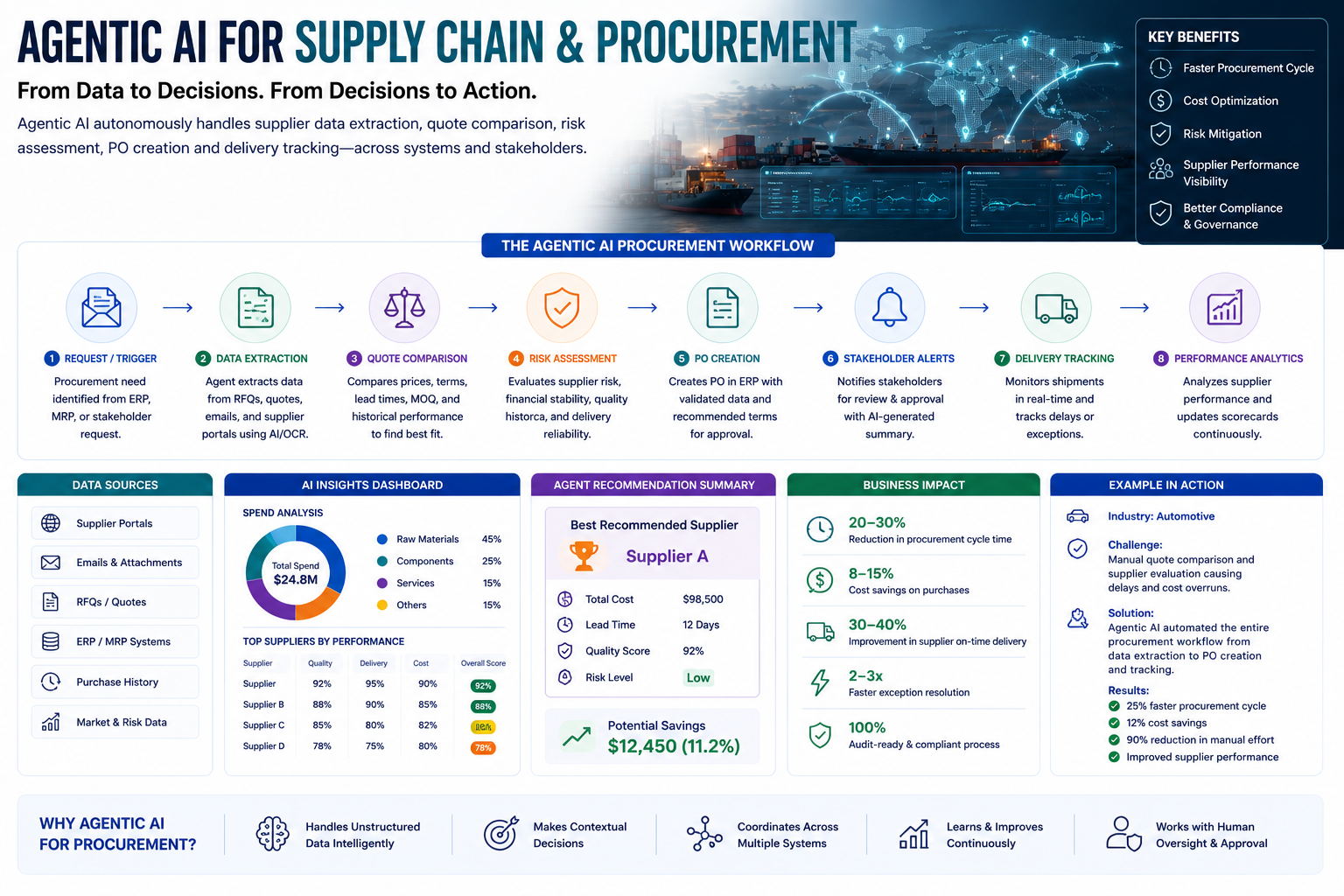
Agentic AI supply chain and procurement — from data to decisions, from decisions to action
Industry-Specific Applications
In the automotive industry, multi-agent systems coordinate assembly line scheduling, quality control, and supplier management all at the same time. Facilities such as Hyundai's Metaplant are demonstrating how AI can monitor operations, detect issues, analyze root causes, and support real-time operational decisions across production environments.
In semiconductor manufacturing, agentic AI supports precision-critical quality control processes. AI agents can identify sub-micron defects, autonomously classify quality issues, and trigger batch rejection workflows when production tolerances are exceeded, therefore helping reduce constant defects and rework.
In food and beverage manufacturing, agentic AI agents help manage inventory, demand planning and supplier coordination. These systems can automatically adjust replenishment plans based on seasonal demand patterns, inventory levels and supplier constraints while maintaining production continuity.
In industrial and heavy manufacturing, agentic maintenance systems continuously evaluate equipment health, score operational risk, generate work orders and coordinate technician dispatch. This enables maintenance teams to address issues proactively before they result in costly downtime.
| Industry | Primary Agentic AI Application | Key Outcome |
|---|---|---|
| Automotive | Multi-agent coordination of assembly scheduling, quality control, and supplier management | Improved production flow, faster issue resolution, and better supply chain coordination |
| Semiconductor | Sub-micron defect detection, autonomous defect classification, and batch rejection workflows | Higher yield rates and reduced quality-related losses |
| Food & Beverage | Autonomous inventory replenishment, demand adjustment, and supplier communication | Reduced stockouts and more responsive demand planning |
| Industrial and Heavy Manufacturing | Continuous equipment risk scoring, autonomous work order generation, and technician dispatch | Reduced downtime and improved maintenance efficiency |
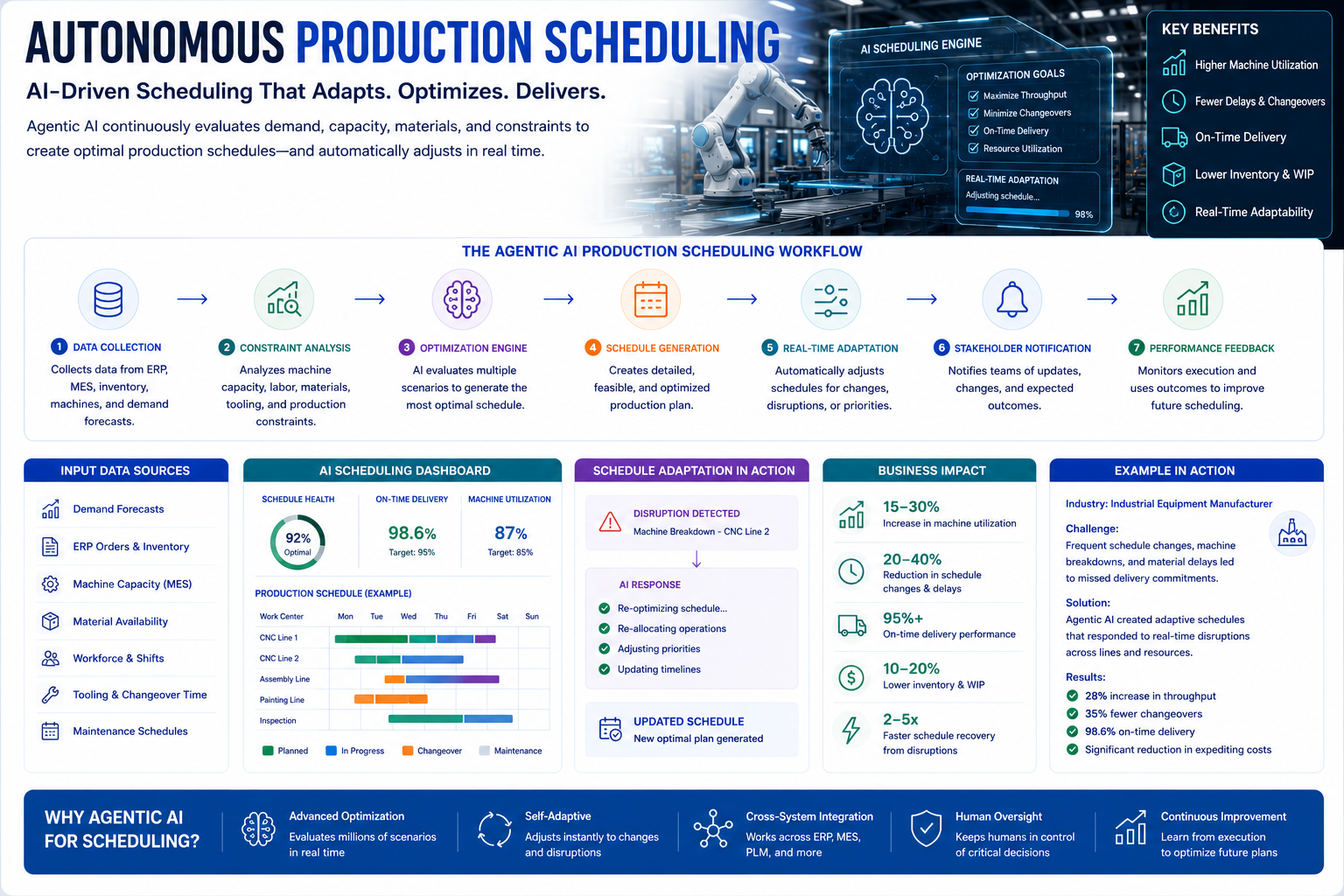
Autonomous production scheduling — AI-driven scheduling that adapts, optimizes and delivers
Benefits of Agentic AI in Manufacturing
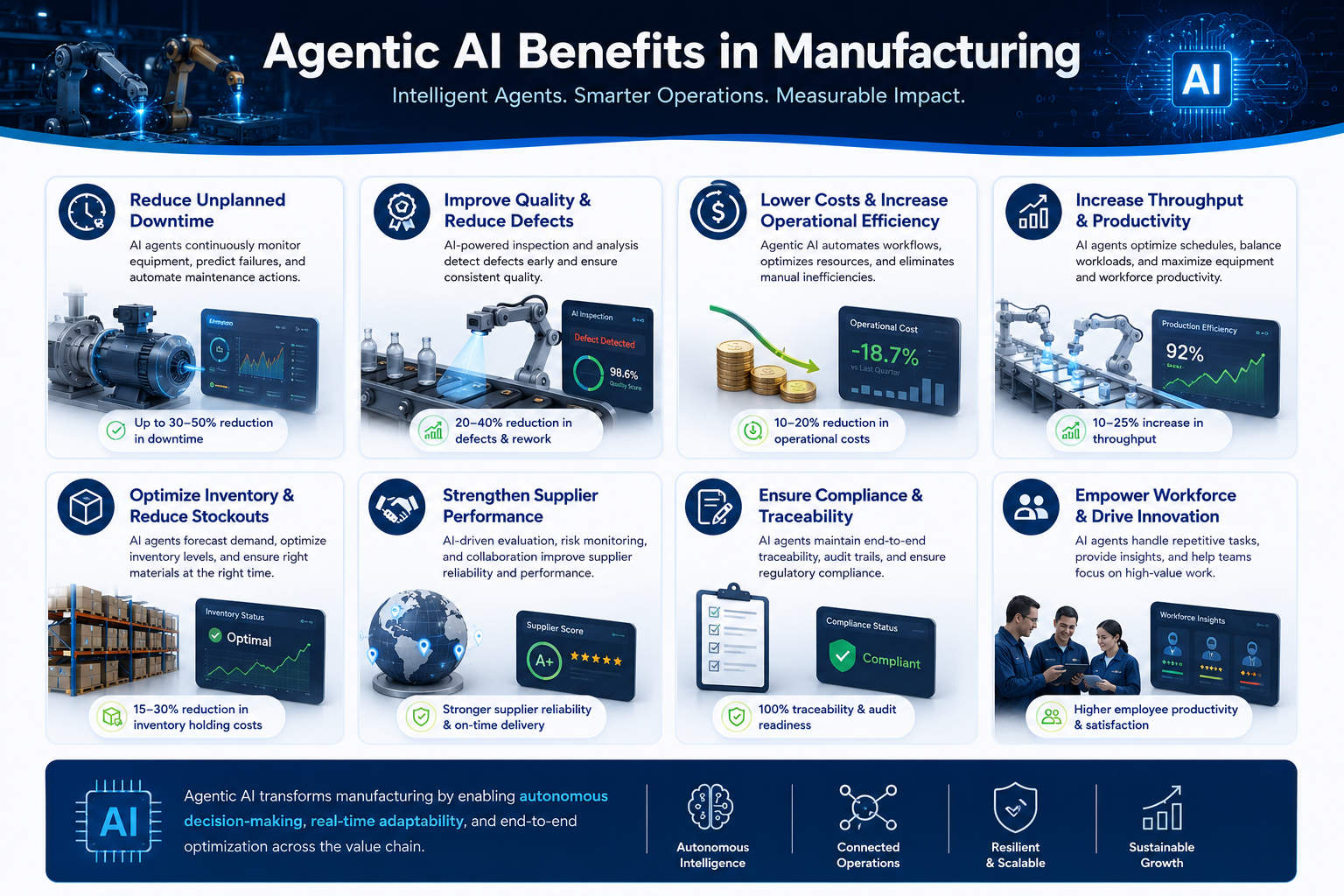
Agentic AI benefits — end-to-end workflow execution, real-time intelligence, and scalable automation
End-to-End Workflow Execution
Agentic AI executes complete workflows rather than isolated tasks. Information moves automatically between systems and departments, without requiring employees to manually coordinate every handoff.
Real-Time Operational Intelligence
AI agents continuously monitor operational data across production, quality, maintenance and supply chain systems. They identify risks, bottlenecks and anomalies as they emerge, often before humans would notice them.
Reduced Administrative Burden
Routine activities such as WIP updates, shift summaries, procurement recommendations, and inspection reports can be generated automatically. This allows engineers, supervisors and managers to spend less time on documentation and more time on operational decision-making.
Cross-System Data Integrity
Agentic systems validate information before updating ERP, PLM, MES, or quality platforms. This reduces manual entry errors and helps maintain consistency across business-critical systems.
Scalable Without Headcount Growth
As operations become more challenging, agentic systems can absorb increasing workflow volume without requiring proportional staffing increases. Manufacturers can improve throughput and responsiveness without continuously adding administrative resources.
Human Oversight Preserved
Agentic AI is designed to support, but not replace, human decision-making. Every action is explainable, auditable and reversible, ensuring that manufacturers maintain control over critical operational processes.
GrayCyan's clients have reported up to 90% faster reporting after deploying agentic workflow systems, demonstrating how autonomous coordination can improve productivity while maintaining governance oversight.
Challenges of Deploying Agentic AI in Manufacturing
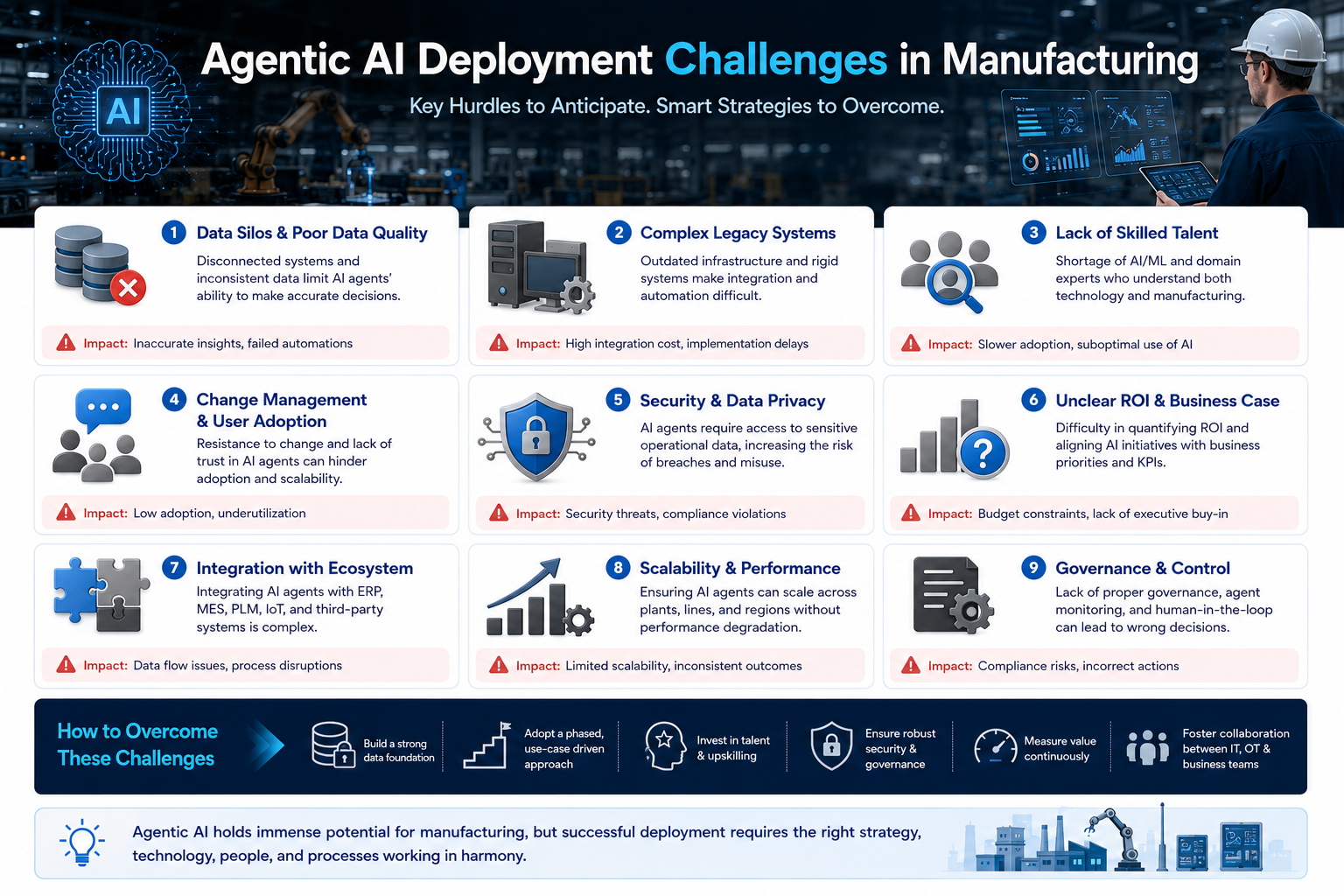
Agentic AI deployment challenges — data quality, legacy integration, governance, and change management
While the benefits of agentic AI are significant, successful deployment requires addressing several practical challenges that manufacturers face when introducing autonomous workflows.
Agentic AI coordinates actions across multiple systems, making data quality critical. Inconsistent, outdated or siloed information can create errors that propagate across workflows and systems.
Not every decision should be fully automated. Manufacturers must determine which actions agents can execute independently and which situations require human review or approval to avoid unnecessary risk.
Many manufacturers operate older ERP, MES and operational systems that were designed not for modern AI workflows. Connecting agentic systems often requires middleware, APIs and custom integration work.
Manufacturing environments operate under strict quality, safety and compliance requirements. Every agentic action must be traceable, explainable, and documented to support audits and operational accountability.
Factory teams need confidence in the recommendations and actions taken by AI agents. Transparency, explainability and visible validation processes are essential for building trust and driving adoption.
Agentic AI from Vision to Value in Manufacturing Transformation
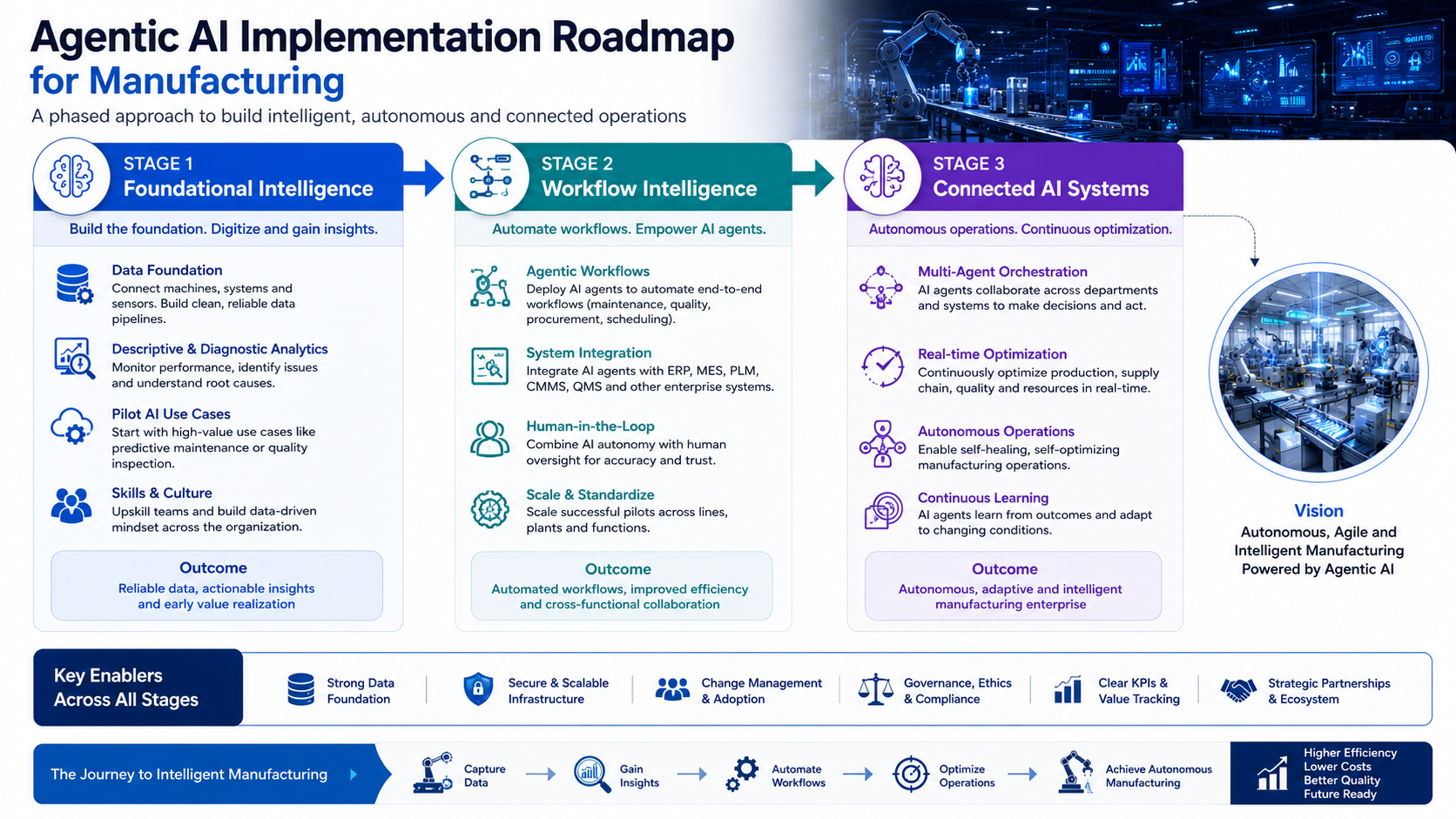
GrayCyan's 3-stage agentic AI roadmap — from foundational intelligence to connected AI systems
Many manufacturers understand the potential of agentic AI but struggle with a practical question — where do we start? The most successful implementations do not begin with fully autonomous operations. They progress through a structured maturity path that builds capability, trust, and measurable business value over time.
GrayCyan's implementation approach follows a three-stage roadmap that takes manufacturers from vision to value while minimizing risk and disruption.
| Stage | What it Includes | Who it's For | Time to Value |
|---|---|---|---|
| Stage 1: Foundational Intelligence | Document extraction, ERP updates, QC note structuring, procurement drafting, and data preparation. Builds the foundation that future agentic systems depend on. | Manufacturers who are beginning their AI journey and looking for low-risk operational movements. | Immediate operational value |
| Stage 2: Workflow Intelligence | Single-system AI agents automate multi-step workflows such as QC classification, production scheduling support, maintenance triggers, and operational reporting. | Manufacturers who are ready to automate repetitive processes and generate measurable ROI. | Measurable ROI |
| Stage 3: Connected AI Systems | Multi-system agentic coordination across ERP, PLM, MES, scheduling, quality and vendor systems. AI becomes the operational brain executing end-to-end workflows with human oversight. | Manufacturers seeking enterprise-wide operational coordination and scalable automation. | Transformational operational impact |
At stage 1, manufacturers establish the data foundation needed for future automation. Examples include:
- SOP summarization
- Analysis of maintenance logs
- Structuring of quality notes
- Extraction of engineering documents
These initiatives help manufacturers demonstrate value quickly while building confidence in AI adoption.
Stage 2 introduces AI agents that execute multi-step processes within individual systems. Examples include:
- QC Notes – Defect Classification – Inspection Report
- Vendor Quote – Cost Sheet – Sourcing Recommendation
- Maintenance Log – Risk Score – Schedule Update
Delivering measurable productivity gains across targeted workflows.
By stage 3, connected agentic systems coordinate actions across the organization, transforming fragmented processes into governed, end-to-end workflows across ERP, PLM, MES, scheduling, quality and vendor systems. AI becomes the operational intelligence layer coordinating people, processes, and systems across the factory environment.
The goal is not to automate everything at once. It is to build confidence, demonstrate value and expand autonomy where it creates the greatest operational impact. Assess Your AI Maturity Now →
Agentic AI in Manufacturing FAQ
Ready to Deploy Agentic AI in Your Factory?
GrayCyan builds agentic AI systems specifically for manufacturers — connecting ERP, PLM, MES, quality, scheduling and operational systems into coordinated, autonomous workflows with full human oversight. There's no new hardware, system replacement or disruption to production. Our solutions work inside the tools your teams already use, turning disconnected processes into governed, end-to-end operations.
From automated reporting and document intelligence to predictive maintenance and workflow automation, manufacturers are already achieving measurable results — including up to 90% faster reporting and significant productivity improvements.
Schedule a Strategy Call