- 2026 Comprehensive Guide
Generative AI in Manufacturing - Use Cases, Examples, Applications & Benefits
Explore the most impactful Generative AI use cases in manufacturing, the companies that have already deployed them, and a practical framework for implementation.




Executive Summary
Manufacturers are investing heavily in generative AI. However, many are still stuck at the experimentation stage and are finding it challenging to move beyond it. A report by Deloitte suggests that 87% of the manufacturers have already initiated a generative AI pilot. But only 24% have managed to deploy Gen AI use cases at their facility or at a network level. The challenge isn’t that manufacturers are not interested enough. They just don’t know how to translate AI ambitions into operational value.
AI tools such as chatbots, AI assistants and co-pilots have been tested by several organizations. However, very few of them have been able to successfully embed AI into workflows, quality-control processes, procurement functions, engineering operations, and workforce training. Therefore, what exists currently is a significant gap between AI pilots and business outcomes that are measurable.
Through this article, we explore the most impactful Generative AI use cases in manufacturing, the companies that have already deployed them, and the benefits that are being reaped by them. Additionally, this article provides a practical framework on how to implement AI in work processes.
GrayCyan bridges the gap for manufacturers who are stuck at the experimentation phase and want to reach the execution phase. We focus on operational Gen AI deployments that do not rely solely on theoretical proofs of concept but work with existing factory systems and workflows.
Manufacturing Generative AI Market Statistics
As evident from the statistics above, the concern is no longer whether manufacturing requires Generative AI. The question is whether the outcomes are measurable and how employers can deploy it successfully.
Let’s
Talk
Book your manufacturing AI strategy session
What is Generative AI in Manufacturing?
Simply put, Generative AI in Manufacturing is the use of artificial intelligence systems that can analyse manufacturing data and create outputs which include summaries, reports, recommendations, code, designs and responses. Traditional AI primarily identifies patterns and predicts outcomes. However, generative AI is different as it can generate content and provide insights that are easily understandable as they are in a human-readable format.
Generative AI is a subset of artificial intelligence that is trained on large volumes of data. Based on what it has learned, Gen AI generates entirely new outputs, an ability that goes well beyond simple pattern recognition. In manufacturing set ups, these outputs can range from recommendations for maintenance to engineering designs, to documentation for procurements.

This distinction is important because a very large amount of data and information is generated by manufacturers on a daily basis. These include records about quality control, production logs, histories of maintenance, engineering drawings, communications with suppliers, and compliance documents, that are often scattered across various systems. With such massive volumes of data, it is easy for it to be unstructured and difficult to access.
This is where Generative AI plays an important role as it helps manufacturers extract key outputs and value from this data through four key capabilities:
01 Extraction and Summarization of Data:
02 Conversational Assistance:
03 Content Generation:
04 Multimodal Intelligence:
Therefore Gen AI is particularly helpful for manufacturers that are buried under unstructured data that can include PDFs, drawings, emails, maintenance logs, quality control notes, engineering documentation and supplier communications.
GrayCyan’s Generative AI systems are designed specifically to work with such unstructured data. Manufacturers can make faster and more informed decisions, by converting haphazard information into structured data.
Generative AI v/s Traditional AI in Manufacturing
Artificial intelligence has been used by manufacturers for years to improve operational efficiency. By providing predictive maintenance models, forecasting systems on demand, anomaly detection and process optimization, AI has helped organizations make better decisions using large volumes of operational data.
Generative AI takes things to a new level by building on these capabilities as it makes AI more accessible, contextual and actionable for employees.
While traditional AI primarily does the job of identifying patterns, making predictions and supporting decision-making, generative AI can interpret information and generate human-capable outputs such as recommendations, summaries, reports, conversational responses and design concepts. It works alongside traditional AI, helping employees understand and act on insights more effectively.
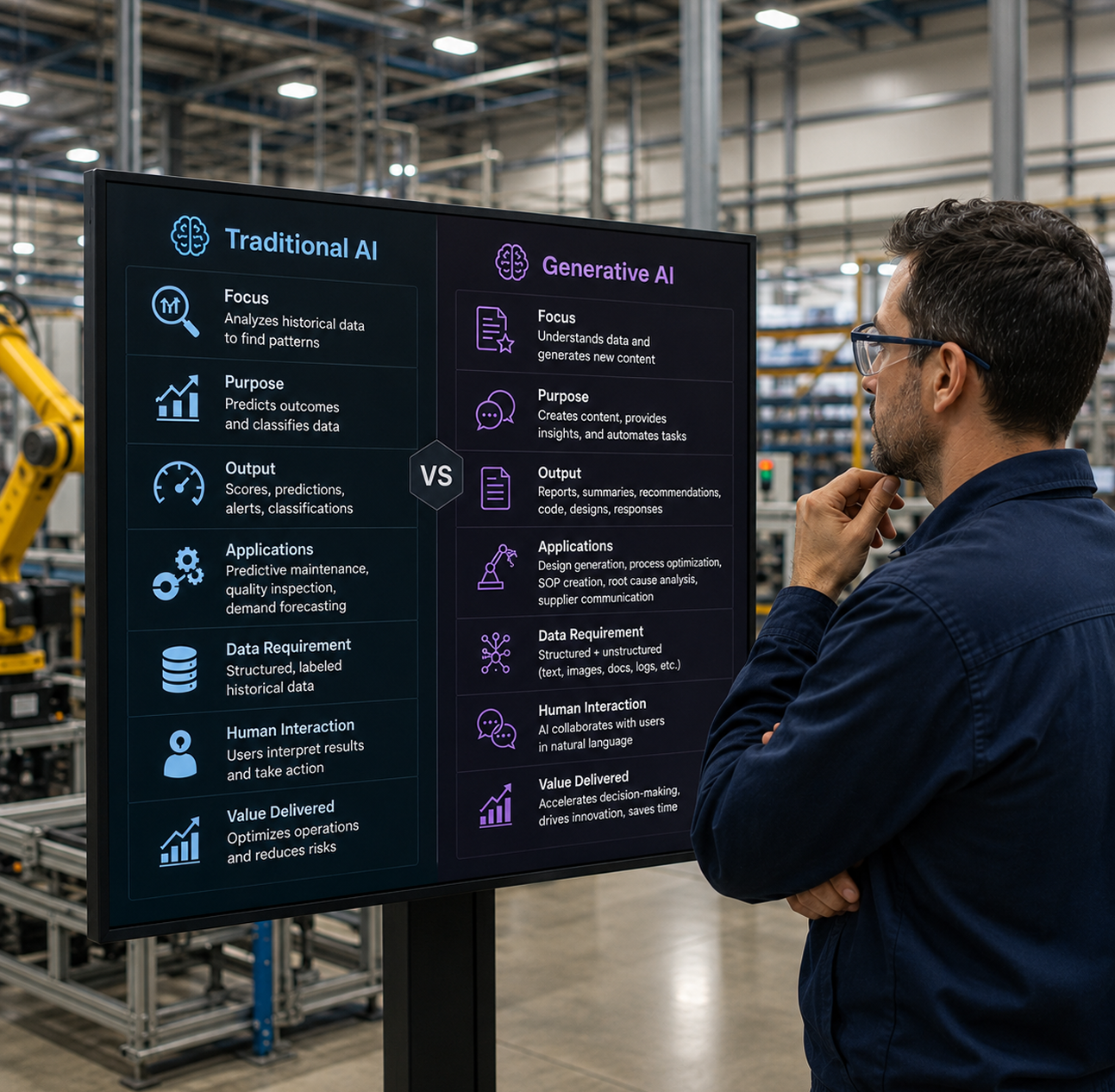
The difference becomes more apparent in a manufacturing setting. For example, a traditional AI model may predict that a machine has an 80% probability of failure in the next two weeks, based on sensor readings and historical performance data. A generative AI system on the other hand can build on this prediction by analyzing maintenance histories, technician notes, inspection records, operating conditions, and relevant documentation. It can then explain the likely causes of the risk, recommend corrective actions, summarise previous maintenance activities and present the information in a natural language that is easy to understand.
One of the key reasons why generative AI is gaining traction across the manufacturing industry is its ability to transform complex operational data into actionable insights. Generative AI goes a step further than prediction: it helps employees understand why it matters and what steps to take next to improve industrial processes.
| Category | Traditional AI | Generative AI |
|---|---|---|
|
Primary purpose |
Predict and classify |
Create and generate |
|
Data type |
Analyze data, identify patterns, make predictions and automate decisions |
Generate new content, recommendations, insights and responses based on learned patterns |
|
Typical data sources |
Primarily structured data such as sensor readings, production metrics, and ERP, though it is also capable of processing unstructured data |
Structured as well as unstructured data including emails, drawings, SOPs, images, and maintenance logs |
|
Output |
Predictions, anomaly detection, classifications, and optimization recommendations |
Reports, summaries, conversational responses, recommendations, design concepts and generated content |
|
User interaction |
This is typically done through alerts, dashboards, reports and embedded applications |
This often takes place through natural-language interfaces, chatbots, copilots and content-generation tools |
|
Manufacturing example |
It can predict that a machine has a high probability of failure within the next 7 days |
It can analyze maintenance history, summarize relevant records, explain likely causes of failure and recommend next steps and action to be followed |
The reason Generative AI is becoming so popular in the manufacturing industry is because it provides actionable communication rather than just predictions.
Let’s
Talk
Book your manufacturing AI strategy session
Three Types of Generative AI Implementation in Manufacturing
01 Conversational
Employees are able to interact with systems using natural language
02 Referential
AI retrieves, summarizes and explains information
03 Creative
SOP retrieval, document search, maintenance log analysis
Conversational Gen AI
Conversational systems enable workers to ask operational questions in simple, easy-to-understand language. For example:
- “Why did Line 3 experience downtime yesterday?”
- “What is the troubleshooting procedure for Error Code 107?”
- “Show me all the maintenance actions performed on this asset in the last six months”
The AI extracts information across systems and provides immediate responses.
Referential Gen AI
Referential implementations focus on making organizational knowledge easily accessible. Critical information by manufacturers is often stored across manuals, SOPs, engineering files, quality documents, and maintenance records. Generative AI can search, summarize, and explain this information in seconds, therefore reducing the time and effort that employees spend in searching for answers.
Creative Generative AI
Creative implementations generate outputs that are drastically different from the two above. The examples include inspection reports, design concepts, procurement documentation, supplier communications, synthetic data assets and training materials that are used to improve machine-learning models.
These three implementation models together create a framework that explains how manufacturing industries are getting transformed through generative AI. What’s even more interesting is that this technology is no longer limited to just data scientists and IT teams. It is increasingly becoming popular amongst engineers, quality managers, operators, maintenance technicians, procurement teams, and production leaders.
Generative AI Use Cases in Manufacturing
Generative AI is slowly beginning to transition from pilot projects to production environments. In the earlier stages, many manufacturers experimented with Gen AI through chatbots and productivity tools. However now, big companies are starting to deploy it across maintenance, quality assistance, procurement, training, engineering, and customer support.
Provided below is a list of some of the most impactful applications of generative AI in manufacturing today:
|
01 |
Knowledge |
Documentation summarization and knowledge retrieval |
|
02 |
Maintenance |
Predictive maintenance with Gen AI |
|
03 |
Quality |
AI-powered quality control |
|
04 |
Engineering |
Generative product design and development |
|
05 |
Supply Chain |
Supply chain and demand forecasting |
|
06 |
Workforce |
Workforce training and documentation |
|
07 |
Shop Floor |
Conversational shop floor assistance |
|
08 |
After-Sales |
Customer support and after sales service |
- Knowledge
01 AI-Powered Quality Control Documentation Summarization and Knowledge Retrieval
Manufacturers generate enormous volumes of data on a daily basis. These include Standard Operating Procedures, SOPs, maintenance records, engineering specifications, compliance documents, quality reports, and supplier communications. This data often sits across multiple systems, often making it very challenging for employees to access this information when they need it the most.
Generative AI solves this issue by allowing workers to use natural language that can help them retrieve information easily. Employers can receive immediate, context-aware answers instead of wasting hours in searching for hundreds of pages of documentation.
GrayCyan applies the same principle through AI-powered knowledge agents that answer internal questions using manuals, SOPs, quality documentation, engineering specifications, and PLM data. The outcome is faster-decision making and significantly reduced time that is spent in searching for information.
- Maintenance
02 AI-Powered Quality Control Predictive Maintenance with Gen AI
One of the most expensive problems in manufacturing is unplanned downtime. A single equipment failure can halt production, delay shipments, increase labour costs, and impact customer commitments.
Traditional predictive maintenance-systems rely heavily on sensor data and historical failure patterns. Generative AI enhances these systems by incorporating technician notes, inspection reports, and operational content. Instead of simply predicting a failure, Gen AI goes to the next level by telling you exactly why a failure is likely to occur.
BMW’s Regensburg plant uses AI-powered monitoring systems to track conveyor technology performance. It reportedly avoids more than 500 minutes of downtime annually.
- Quality
03 AI-Powered Quality Control
By combining computer vision, historical defect records, inspection reports and conversational interfaces, Generative AI strengthens quality-control. One of its most valuable capabilities is the generation of synthetic images to train inspection models effectively.
BMW’s AIQX platform supports automated quality assurance through anomaly detection and visual inspection. Ford has deployed AI powered inspection systems capable of identifying defects in vehicle body panels and seat materials.
- Engineering
04 AI-Powered Quality Control Generative Product Design and Development
Generative AI significantly expedites the engineering process by generating thousands of design possibilities based on predefined objectives and restrictions. Bosch has successfully accelerated MEMS sensor development by using AI-driven design techniques, therefore reducing engineering cycles from months to days.
GrayCyan extends support to engineering teams by automating the extraction of structured information from engineering-related documents, enabling workflows such as engineering-file analysis, bill of material updates, and design document management.
- Supply Chain
05 AI-Powered Quality ControlSupply Chain and Demand Forecasting
Generative AI incorporates both structured and unstructured information sources, therefore enhancing traditional forecasting. Gen AI can analyze supplier communications, customer requests, market signals, procurement records, inventory levels and operational data, all at once.
- Workforce
06 AI-Powered Quality Control Workforce Training and Documentation
Generative AI helps organizations capture institutional knowledge and turn it into scalable training resources. More than 50,000 employee interactions have been recorded by GE Aerospace’s AI Wingmate, which has helped workers access operational knowledge and documentation more efficiently.
GrayCyan aids workforce enablement through AI assistants that are capable of answering questions using operational documentation, quality manuals, engineering records, and internal knowledge repositories.
- Shop Floor
07 AI-Powered Quality Control Conversational Shop Floor Assistance
Generative AI helps democratize knowledge through conversational shop-floor assistants. Operators can ask questions about production output drops, issue resolutions, and overdue maintenance activities. GrayCyan’s AI copilots use manuals, specifications, SOPs, PLM data, maintenance histories and quality documentation to provide instant answers.
- After-Sales
08 AI-Powered Quality Control Customer Support and After-Sales Service
Generative AI can automate many support interactions related to warranty claims, product troubleshooting, spare parts, installation guidance, and order status inquiries while keeping intact a personalized customer experience. Measurable improvements in support-agent productivity have been reported by Lenovo through Gen AI-enabled support systems.
Let’s
Talk
Book your manufacturing AI strategy session
Generative AI in Manufacturing Examples - Real Companies
The most compelling argument for generative AI in manufacturing isn’t about the technology itself…it’s the measurable results being achieved by manufacturers already. These are not experimental pilot projects but are production deployments that are delivering promising results.

| Company | Industry | Gen AI Application | Measurable Result |
|---|---|---|---|
|
Bosch |
Industrial Manufacturing |
AI-powered engineering designs and enterprise knowledge assistants |
MEMS sensor design cycles reduced from months to days; AI assistants support more than 1.2 million enquiries annually |
|
BMW |
Automotive |
AIQX quality inspection and predictive maintenance |
Sub-millimeter defect detection and more than 500 minutes of downtime avoided annually |
|
Airbus |
Aerospace |
AI-assisted quality inspection using drone imagery and AR workflows |
AI Wingmate enterprise knowledge platform |
|
GE Aerospace |
Aerospace |
AI Wingmate enterprise knowledge platform |
More than 500,000 employee interactions across 52,000 workers |
|
Hyundai Metaplant |
Automotive |
AI-enabled smart factory and digital twin deployment |
AI embedded across a $7.6 billion advanced manufacturing facility |
|
Industrial Services |
Proposal automation and document generation |
Proposal preparation time reduced from 8 hours to 30 minutes |
Through these examples, it’s clear that successful AI adoption isn’t just limited to global manufacturers with billion-dollar budgets. Mid-sized manufacturers are equally reaping benefits by focusing on targeted operational workflows rather than attempting large-scale operations from day zero.
Benefits of Generative AI in Manufacturing
The primary reason manufacturers are investing in generative AI is to see measurable business outcomes. While use cases vary across various organizations, the benefits tend to fall into seven major categories.

01 Faster Knowledge Access:
02 Reduced Unplanned Downtime:
03 Faster Product Design Cycles:
04 Improved Supply Chain Resilience:
05 Lower Operational Costs:
06 Improved Quality Consistency:
07 Workforce Empowerment:
Several GrayCyan clients have reported up to 90% faster reporting and documentation workflows after having implemented operational Gen AI solutions.
Challenges of Generative AI in Manufacturing

Data Quality and Hallucination Risk:
Generative AI is only reliable as per the data it can access. Outdated documentation, inconsistent records, duplicate information and missing data can hamper accuracy and increase the risk of misleading outputs.
The solution to this is strong data governance, validation workflows and clearly defined ownership of operational data. In many cases, the highest-value first step isn't AI at all, it's cleaning up the underlying records so whatever gets built on top of them is actually trustworthy.
Integration with Legacy Systems:
Most manufacturers operate a complex ecosystem comprising MES, ERP, PLM, quality-management and procurement systems. Connecting Gen AI to these environments without disrupting existing operations can be challenging.
A phased implementation approach also helps organizations integrate AI slowly and gradually while minimizing operational risk.
Skills Gap and User Adoption:
Even the most advanced AI solution will struggle if employees have trust issues with it or don't understand how to use it effectively.
Therefore manufacturers who have invested in training, change management and practical demonstrations have been successful as they have successfully shown workers how AI improves their day-to-day tasks rather than replacing them.
Compliance and Data Privacy:
Manufacturing data often contains intellectual property, supplier agreements and engineering specifications as well as sensitive operational information.
Hence it's vital for organizations to implement strong security controls, governance frameworks, and access-management policies to ensure compliance and protect crucial business assets.
Overreliance on AI:
While generative AI can accelerate decision-making, it should never replace expert judgement in critical manufacturing environments. It is important for human oversight to remain essential, particularly in matters of safety, compliance, quality assurance and engineering decisions.
GrayCyan addresses these challenges through validation mechanisms that are built-in, audit trials, approval workflows and human-in-the-loop controls that ensure accountability throughout every process.
Let’s
Talk
Book your manufacturing AI strategy session
How to Use Generative AI in Manufacturing
Many manufacturers make the common mistake of pursuing large-scale AI transformation projects before establishing foundational capabilities. In practice, the most successful deployments follow a phase-by-phase maturity model that gradually expands the capabilities of AI over time.
GrayCyan as a three-stage AI maturity framework that provides a practical roadmap for implementation.

Stage
01
Foundational Intelligence
Extracts, summarizes, and structures information
Organizations beginning their AI journey
30-60 days
The first stage focuses on low-risk, high-impact use cases that deliver fast successes. Examples include:
- SOP summarization
- Analysis of maintenance logs
- Structuring of quality notes
- Extraction of engineering documents
These initiatives help manufacturers demonstrate value quickly while building confidence in AI adoption.
Stage
02
Operational Intelligence
Automates multi-step operational workflows
Manufacturers seeking efficiency improvements
2-4 months
At this stage, organizations begin to automate complete operational workflows. Examples include:
- QC Notes – Defect Classification – Inspection Report
- Vendor Quote – Cost Sheet – Sourcing Recommendation
- Maintenance Log – Risk Score – Maintenance Schedule Update
At this point, AI moves from producing isolated outputs to orchestrating entire business processes.
Stage
03
Human-Led Autonomous Operations
Connects enterprise systems through governed AI workflows
Organizations pursuing enterprise-scale transformation
4-12 months
This is the final stage that connects AI across ERP, MES, PLM, quality, procurement and maintenance systems. At this stage, Gen AI becomes an operational intelligence layer that is capable of supporting decisions across multiple departments while maintaining integrity and governance around data.
Future of Generative AI in Manufacturing
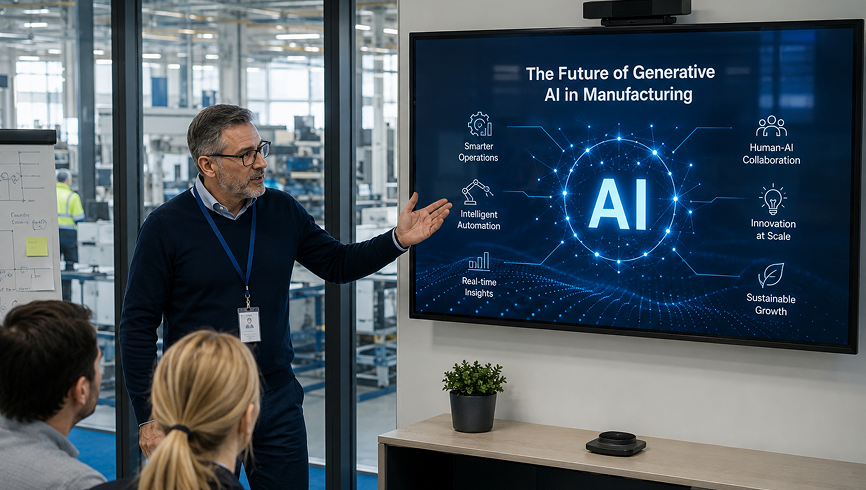
The next phase of manufacturing AI will be defined by what it can execute not by what it can generate.
01 Rise of Agentic AI:
02 Multimodal AI on the Shop Floor:
03 Gen AI + Digital Twins:
04 Human-AI Collaboration as Default
This shift from generative AI to agentic AI is already underway in manufacturing and represents the next stage of industrial transformation.
GrayCyan’s Stage 3 Connected AI Systems framework reflects this evolution, enabling validated and governed AI workflows that connect people, processes, and systems across the factory environment.
Generative AI in Manufacturing FAQ
What is generative AI in manufacturing?
Generative AI in manufacturing is a subset of artificial intelligence that creates new outputs such as summaries, recommendations, designs, reports and responses from existing manufacturing data. It helps manufacturers transform unstructured information such as maintenance logs, SOPs, engineering drawings, and quality records, into actionable insights that improve productivity and decision-making.
What are the most common generative AI use cases in manufacturing?
The most common generative AI use cases in manufacturing include predictive maintenance, quality control, document summarization, knowledge retrieval, supply chain optimization, workforce training, conversational shop-floor assistance, and generative product design. These applications help reduce costs, improve efficiency, and accelerate decision-making across manufacturing operations.
What is an example of generative AI in manufacturing?
BMW's AIQX platform is a renowned example of generative AI supporting manufacturing quality inspection. The system helps identify defects with high precision and improves production quality. Bosch has implemented AI-powered assistants that help employees access information and resolve operational questions more efficiently.
What big companies are using generative AI in manufacturing?
Many global manufacturers are actively deploying generative AI including BMW, Bosch, Airbus, GE Aerospace, Ford, Hyundai, Rolls-Royce, Lenovo, Toyota, and IBM. These companies are using Gen AI across maintenance, engineering, quality assurance, customer support, workforce training and supply-chain management.
What are the benefits of generative AI in manufacturing?
Generative AI helps manufacturers improve knowledge access, lower operational costs, reduce downtime, accelerate product development, strengthen supply-chain resilience, improve quality consistency, and empower employees. The technology allows organizations to automate repetitive processes while supporting faster and more informed decision-making.
What is the difference between generative AI and traditional AI in manufacturing?
Traditional AI focuses on prediction, classification, and optimization. Generative AI on the other hand goes further by creating content, recommendations, reports, summaries, designs and conversational responses. In manufacturing environments, Gen AI is especially valuable because it can work effectively with large volumes of unstructured information.
What is the generative manufacturing process?
The term "generative manufacturing process" often refers to generative design. Engineers provide objectives, constraints, performance targets, and material requirements. AI generates thousands of potential design alternatives. Teams can then evaluate these options digitally before selecting the most effective design for production.
Can generative AI help with predictive maintenance?
Yes it can. Generative AI can analyze sensor data, maintenance histories, technician notes and inspection records to identify patterns associated with equipment failure. It can also generate synthetic failure scenarios to improve predictive-maintenance models when real-world failure data is limited.
What are the challenges of using generative AI in manufacturing?
The most common challenges include poor quality data, integration with legacy systems, workforce adoption, compliance requirements and overreliance on AI-generated outputs. Manufacturers are successful when they address these issues through strong governance frameworks, employee training, data validation processes and human oversight.
How do I get started with generative AI in manufacturing?
The best starting point is focused operational use cases such as maintenance log-analysis, document summarization, procurement automation, or quality-control reporting. Manufacturers should assess their data readiness, identify high-value workflows and implement AI in phases to maximize adoption and minimize risk.
Ready to Deploy Generative AI in Your Factory?
Generative AI delivers the greatest value when it is embedded directly into operational workflows rather than deployed as a standalone tool. GrayCyan helps manufacturers implement practical Gen AI solutions that integrate with existing ERP, PLM, MES, procurement and quality-management systems without requiring expensive infrastructure changes.
From automated reporting and document intelligence to predictive maintenance and workflow automation, manufacturers are already achieving measurable results. This includes up to 90% faster reporting and significant productivity improvements.
Contributor:

Nishkam Batta
Editor-in-Chief – HonestAI Magazine
AI consultant – GrayCyan AI Solutions

Nish leads an applied AI company that helps manufacturing and related companies automate operations with human-in-the-loop AI that integrates into ERPs, WMS, CRMs, and other enterprise tools, with an emphasis on no black box AI (explainable AI), clear audit trails, driving efficiency, and measurable outcomes. His team builds agentic ERP systems that execute multi-step tasks inside approved guardrails so humans keep accountability, approvals, and override control.
As featured in