




Manufacturers produce large volumes of operational data each day. Most of it sits unused in ERP systems, MES platforms and quality logs. Machine learning in manufacturing changes that by turning existing data into predictions, alerts and recommendations that plant teams can act on immediately.
From predictive maintenance and defect detection to demand forecasting and ERP automation, the applications in this guide share one trait: each one starts with data the plant already collects. That makes machine learning in manufacturing less about buying new hardware and more about connecting, cleaning and modeling information that already exists across ERP, MES, CMMS and QC systems.
This guide is written for mid-market manufacturers with 50 to 500 employees who want to add machine learning to their existing operation without replacing platforms. It covers where ML creates measurable value on the shop floor, how it works in practice, and how to implement it without disrupting the systems teams already rely on.
What Is Machine Learning in Manufacturing?
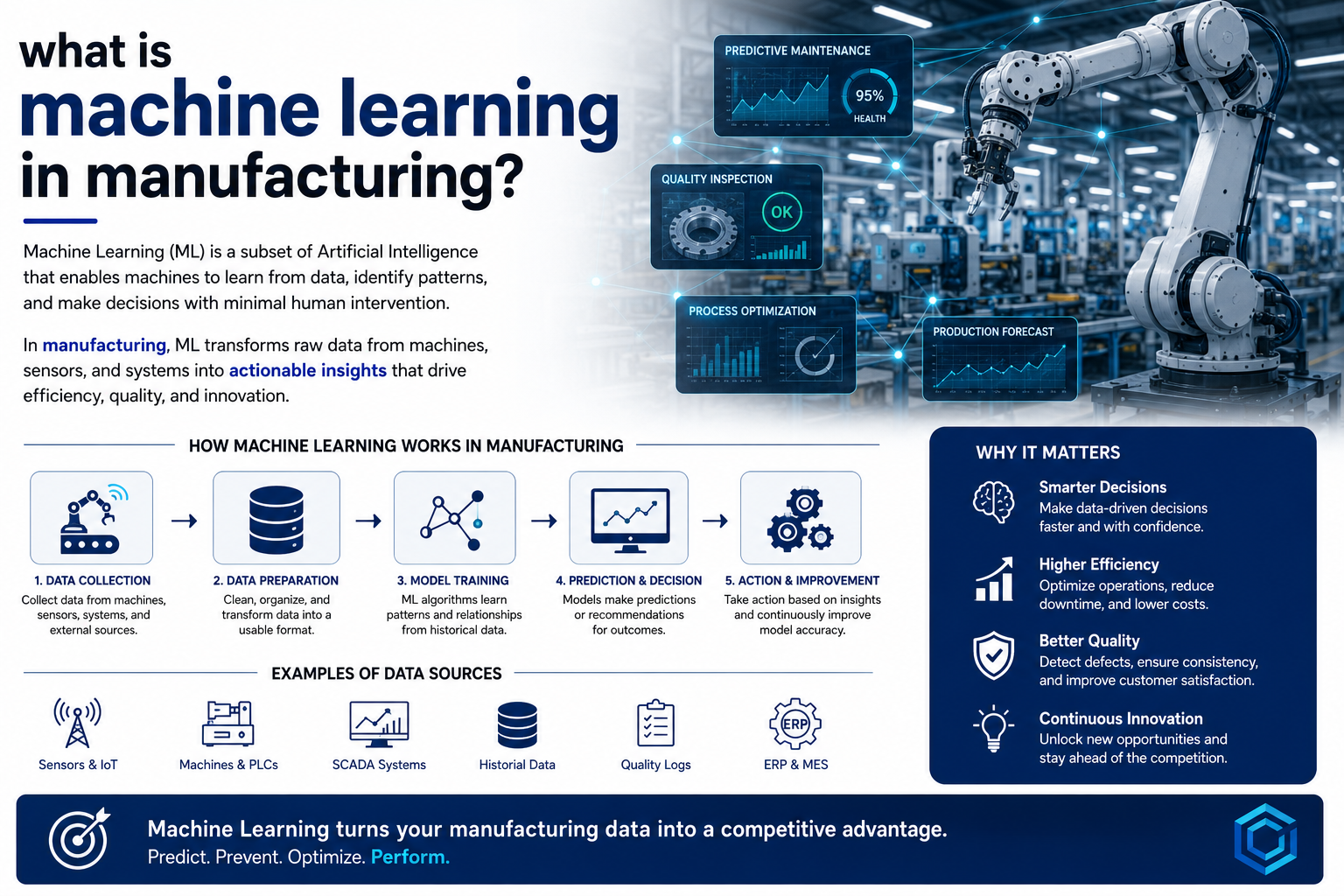
Machine learning turns existing plant data into predictions, alerts and recommendations
Machine learning in manufacturing is the use of algorithms trained on operational data, including sensor readings, quality logs, production records and ERP exports, to make predictions, detect patterns and automate decisions that previously required manual analysis. Instead of relying on a person to review spreadsheets or inspection sheets, a trained model continuously scores incoming data and surfaces the insights that matter.
The AI in manufacturing market is projected to reach $128.8 billion by 2034, growing at a 37.9% CAGR (Fortune Business Insights, 2026). Machine learning accounts for the largest share of that growth, driven by predictive maintenance, quality control and production optimization applications.
Traditional manufacturing automation follows fixed rules. Whenever a sensor crosses a threshold, it triggers an alarm. Machine learning systems work differently. They learn from past data and improve over time without being reprogrammed for every new scenario. This means they can catch failure patterns, defect types or demand shifts that were never explicitly coded into the system.
In a manufacturing context, machine learning differs from standard automation in three important ways:
- It trains on your own operational data rather than a generic rule set.
- It improves as it processes more inputs, so accuracy compounds over time.
- It surfaces patterns humans may miss across thousands of data points, especially subtle correlations across shifts, machines and material batches.
It is also worth being clear about what machine learning in manufacturing is not. It is not a replacement for skilled operators, engineers or maintenance technicians, and it is not a single piece of software that solves every operational problem at once. It is a layer of pattern recognition applied on top of the data your plant already produces, built to flag what deserves human attention sooner than a manual review cycle would.
GrayCyan builds machine learning systems for mid-market manufacturers using data already inside existing ERP, MES, CMMS and QC systems. No ERP replacement. No new data infrastructure. The first deployment typically goes live in 30 to 60 days.
Machine Learning Use Cases in Manufacturing — Where It Actually Works
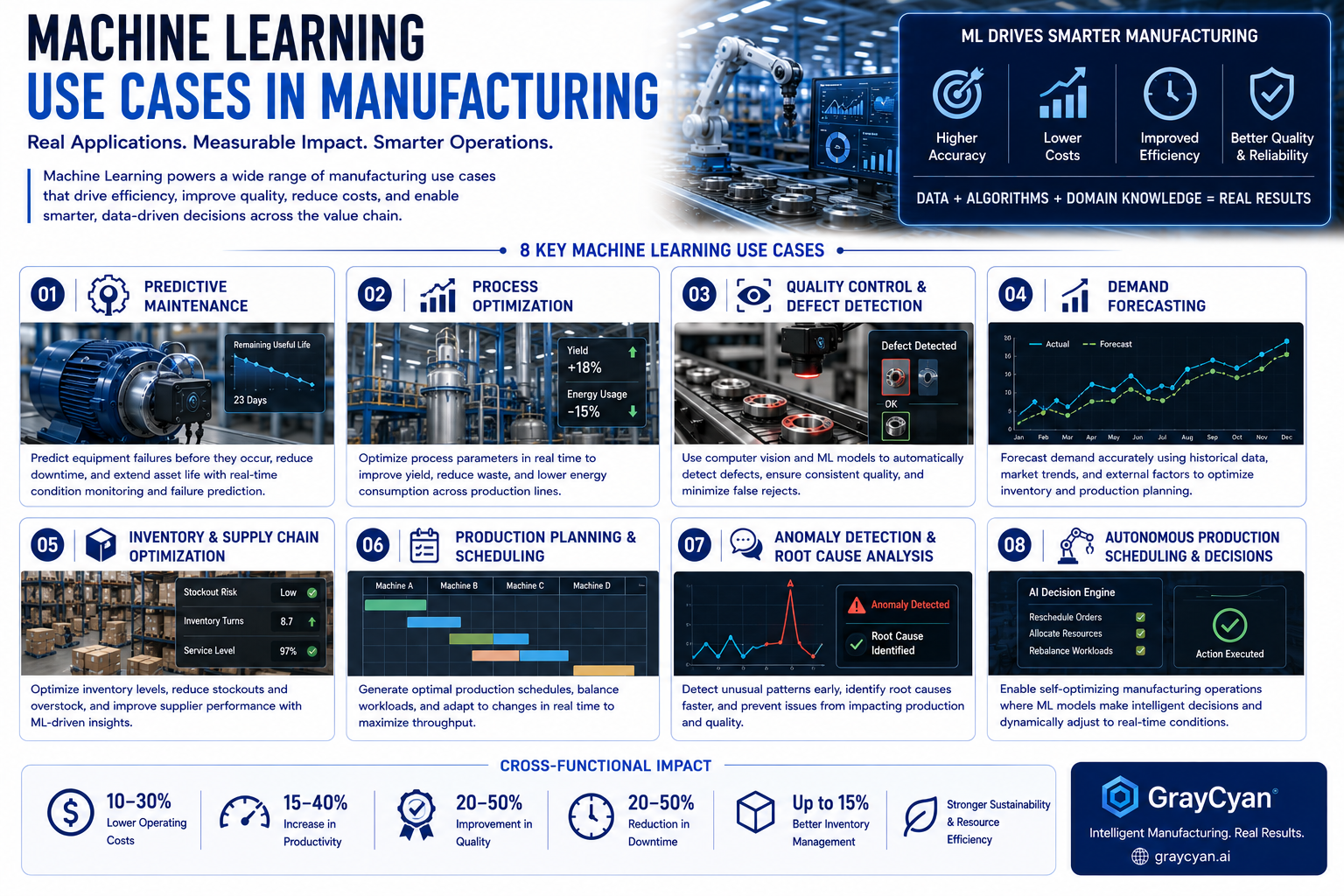
Eight machine learning use cases delivering measurable ROI on the shop floor
Machine learning is not a single tool. It is a set of techniques applied to specific operational problems. These are the manufacturing use cases where machine learning consistently delivers measurable ROI.
Predictive Maintenance
Machine learning models trained on equipment sensor data, maintenance logs and usage history detect failure patterns weeks before breakdowns occur. It replaces guesswork with a data-driven maintenance calendar.
Example: vibration sensor data from a CNC machine is analyzed continuously. A bearing failure is flagged 12 days before it would cause unplanned downtime, giving the maintenance team a window to plan the repair around scheduled production.
GrayCyan approach: predictive maintenance models built on data already inside your CMMS and MES. No new sensor hardware required for the initial deployment.
Quality Control and Defect Detection
Computer vision machine learning systems inspect products at production speed and detect defects, dimensional deviations and surface anomalies more consistently than manual checks can sustain across a full shift.
Example: an ML vision system inspects 1,200 units per hour and flags 0.3 mm dimensional deviations that pass manual inspection. Customer returns dropped 40% in the first quarter after deployment.
Process Optimization
Machine learning models analyze temperature, pressure, feed rate and cycle time to identify parameter combinations that maximize yield and minimize scrap.
Example: a food processing plant found that a 2 degree Celsius temperature reduction at one stage increased yield by 1.8% across 50 daily runs. That adjustment was invisible to manual process review but visible to the ML model trained on 18 months of production history.
Demand Forecasting
Machine learning demand models use order history, seasonal patterns, customer behavior and market signals to forecast demand more accurately than statistical methods.
Example: forecast accuracy improved from 72% to 91% after ML deployment. Excess inventory fell 18% and stockouts dropped 34%.
Supply Chain Anomaly Detection
Machine learning systems monitor supplier lead times, purchase order confirmations and logistics data to flag supply chain risks before they affect production.
Example: a model identified a supplier's repeated late confirmation pattern three weeks before it would have created a production shortage. Procurement reallocated the order in time. The line ran without interruption.
Yield and Scrap Reduction
Machine learning identifies the operational conditions linked to scrap events, including operator shifts, raw material batches and machine states, so root causes can be addressed rather than managed.
Example: scrap analysis revealed raw material batch variation as the primary driver of a 22% scrap rate. After supplier scorecard changes based on ML output, scrap fell under 4%.
Compliance Documentation Automation
For USDA-regulated food processors, pharmaceutical manufacturers and aerospace suppliers, compliance documentation is an ongoing administrative burden. Batch records, inspection reports and audit-ready production logs have to be accurate, complete and retrievable on demand.
Example: a USDA-regulated meat processor using GrayCyan's compliance automation generates batch records, smoker logs and lethality evidence automatically during each production run. Audit response time dropped from 2 to 3 days to under 60 seconds.
Compliance records built during production are more accurate than records reconstructed before an inspection. The audit dossier exists before the inspector arrives.
ERP Data Automation and Intelligent Document Processing
Many manufacturers still depend on manual data entry to bridge ERP, MES, procurement, inventory and supply chain systems. Machine learning extracts information from invoices, purchase orders, shipping documents and vendor forms before transferring validated data between systems automatically.
Example: Fishbowl ERP middleware reduced manual data entry by 85%. Daily entry time fell from roughly 12 hours to under 2 hours. No ERP replacement. The system connected to Fishbowl through API middleware and wrote results back as structured records.
GrayCyan has built ML middleware for NetSuite, SAP, Epicor, Acumatica, Microsoft Dynamics, Odoo and Fishbowl using the same approach.
Machine Learning in Manufacturing Examples — Real Applications from the Floor
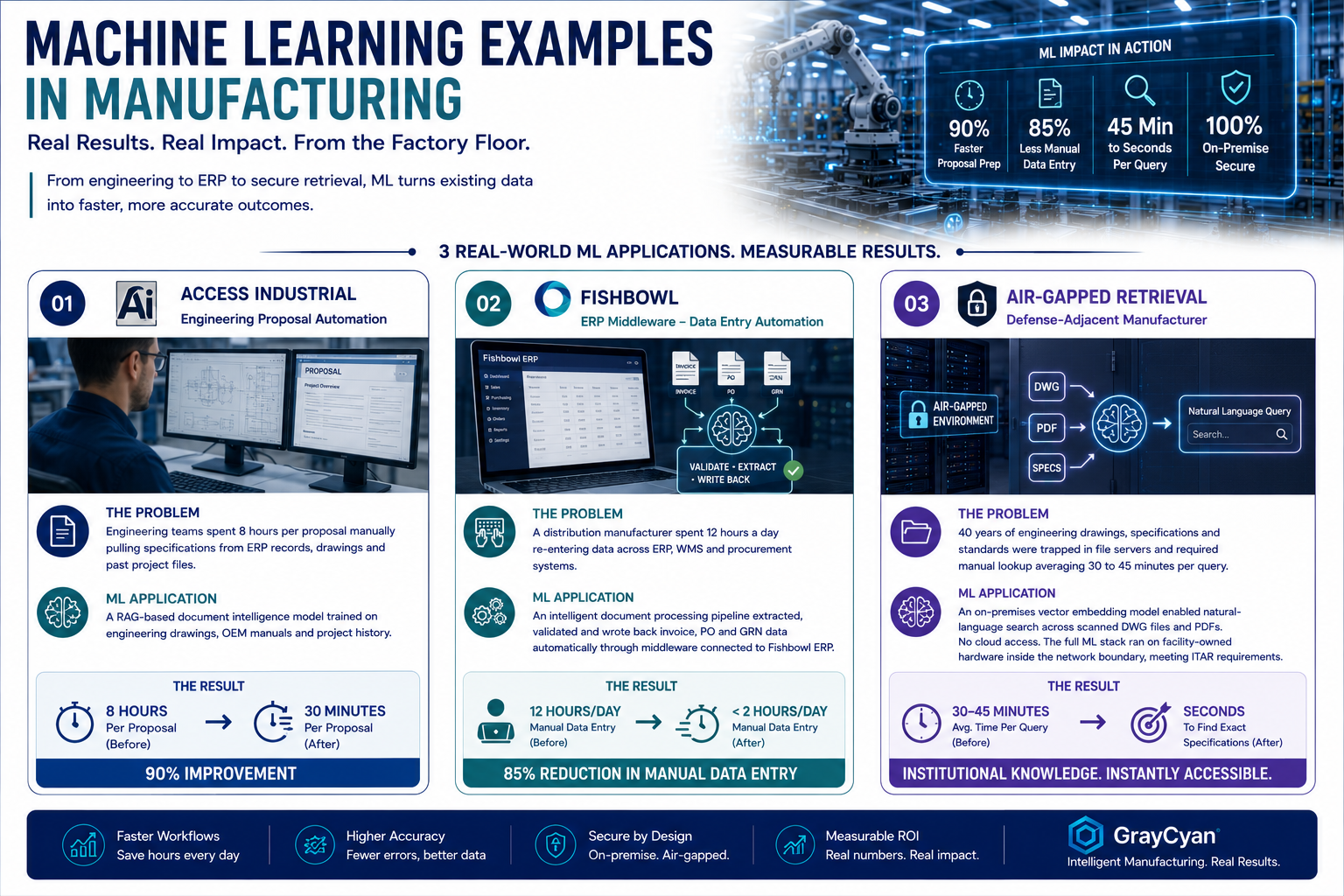
Real GrayCyan deployments — from proposal automation to air-gapped engineering retrieval
The most useful machine learning examples in manufacturing are operational changes that show results quickly. The following three examples show how machine learning turns existing data into practical business value.
Access Industrial — Engineering Proposal Automation
Problem: engineering teams spent 8 hours per proposal manually pulling specifications from ERP records, drawings and past project files.
ML application: a RAG-based document intelligence model trained on engineering drawings, OEM manuals and project history.
Result: proposal preparation time dropped from 8 hours to 30 minutes. A 90% improvement. Engineers now spend that time on engineering, not document search.
Fishbowl ERP Middleware — Data Entry Automation
Problem: a distribution manufacturer spent 12 hours a day re-entering data across ERP, WMS and procurement systems.
ML application: an intelligent document processing pipeline extracted, validated and wrote back invoice, PO and GRN data automatically through middleware connected to Fishbowl ERP.
Result: manual data entry dropped 85%. Daily workload fell from 12 hours to under 2 hours. No ERP replacement. No new infrastructure.
Air-Gapped Engineering Retrieval — Defense-Adjacent Manufacturer
Problem: forty years of engineering drawings, specifications and standards were trapped in file servers and required manual lookup averaging 30 to 45 minutes per query.
ML application: an on-premises vector embedding model enabled natural-language search across scanned DWG files and PDFs. No cloud access. The full ML stack ran on facility-owned hardware inside the network boundary, meeting ITAR requirements.
Result: engineers found exact specifications in seconds. The same institutional knowledge that took 45 minutes to surface is now accessible to any engineer on day one.
These examples show a consistent pattern: machine learning does not replace manufacturing operations. It reads the data those operations already produce and turns it into faster, more accurate outputs.
Machine Learning for Predictive Maintenance — How It Works in Practice
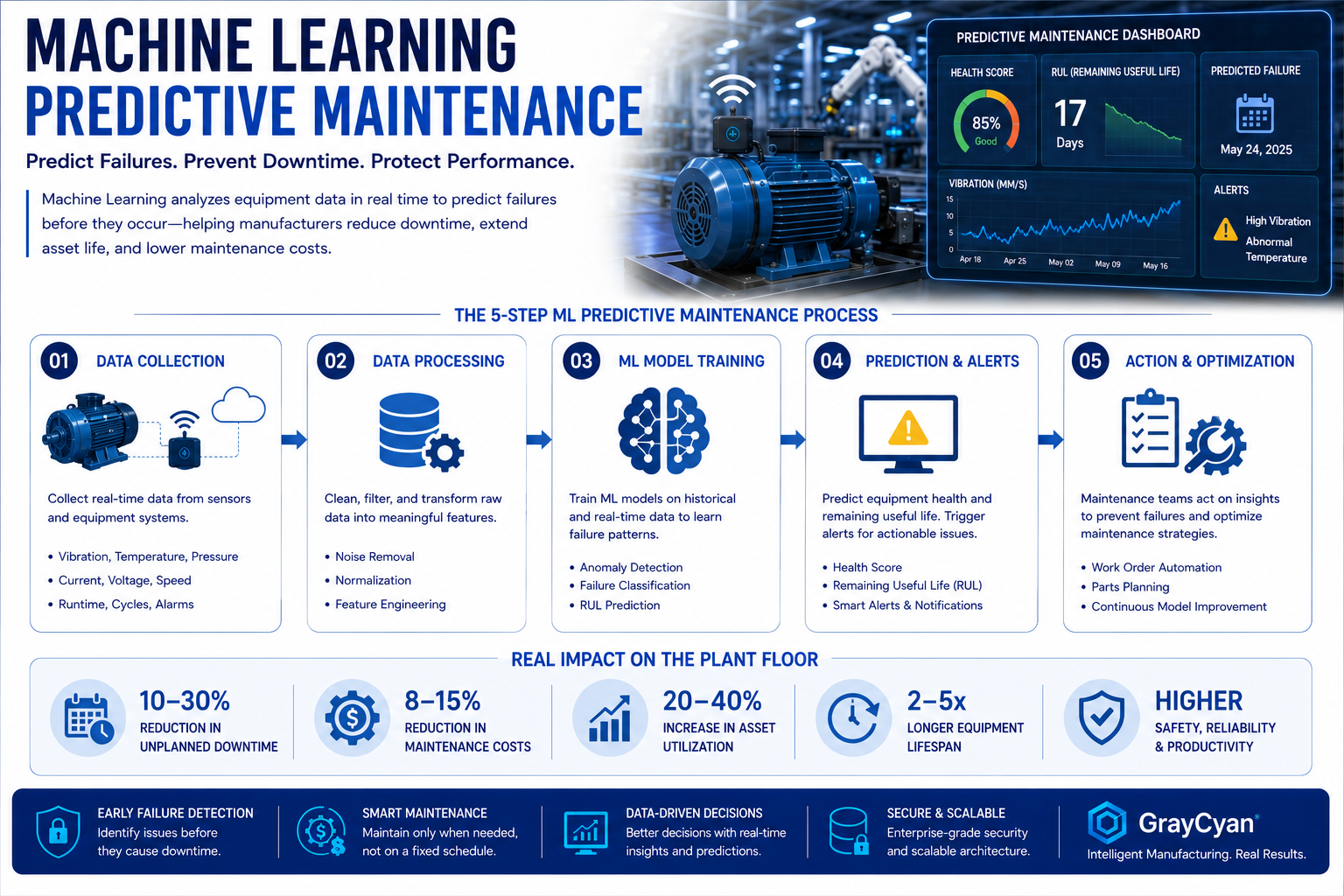
The four-step predictive maintenance process, from data collection to action
Traditional maintenance follows two approaches: scheduled maintenance and reactive maintenance. Machine learning creates a third option, maintain when the data says it is needed, rather than on a fixed calendar or after a breakdown.
The predictive maintenance process usually follows four steps:
- Data collection: sensor readings, vibration, temperature, pressure, acoustic data, runtime hours, maintenance history and operator logs from IoT systems or existing CMMS and ERP data.
- Model training: the model learns from historical failure events and the patterns that appeared before each breakdown.
- Inference: the model runs continuously on live data and generates a failure probability score and estimated time to failure for each monitored asset.
- Action: maintenance teams receive alerts with failure type, confidence score and recommended inspection steps before a breakdown occurs.
Many manufacturers assume predictive maintenance requires expensive new sensors. In reality, many first deployments begin with data already stored in CMMS, ERP and MES systems, which lowers the barrier considerably.
Well-trained models achieve 85 to 95% detection accuracy on failure patterns they have seen before (Deloitte Manufacturing AI Report, 2026). New failure modes still require retraining, so predictive maintenance should be treated as a living system rather than a one-time deployment.
A common rollout pattern starts with the single asset that causes the most unplanned downtime, since that is where a working model pays for itself fastest. Once the pipeline is proven on that asset, the same approach extends to similar equipment across the plant and eventually to multiple sites.
Machine Learning for Quality Control — Defect Detection in Manufacturing
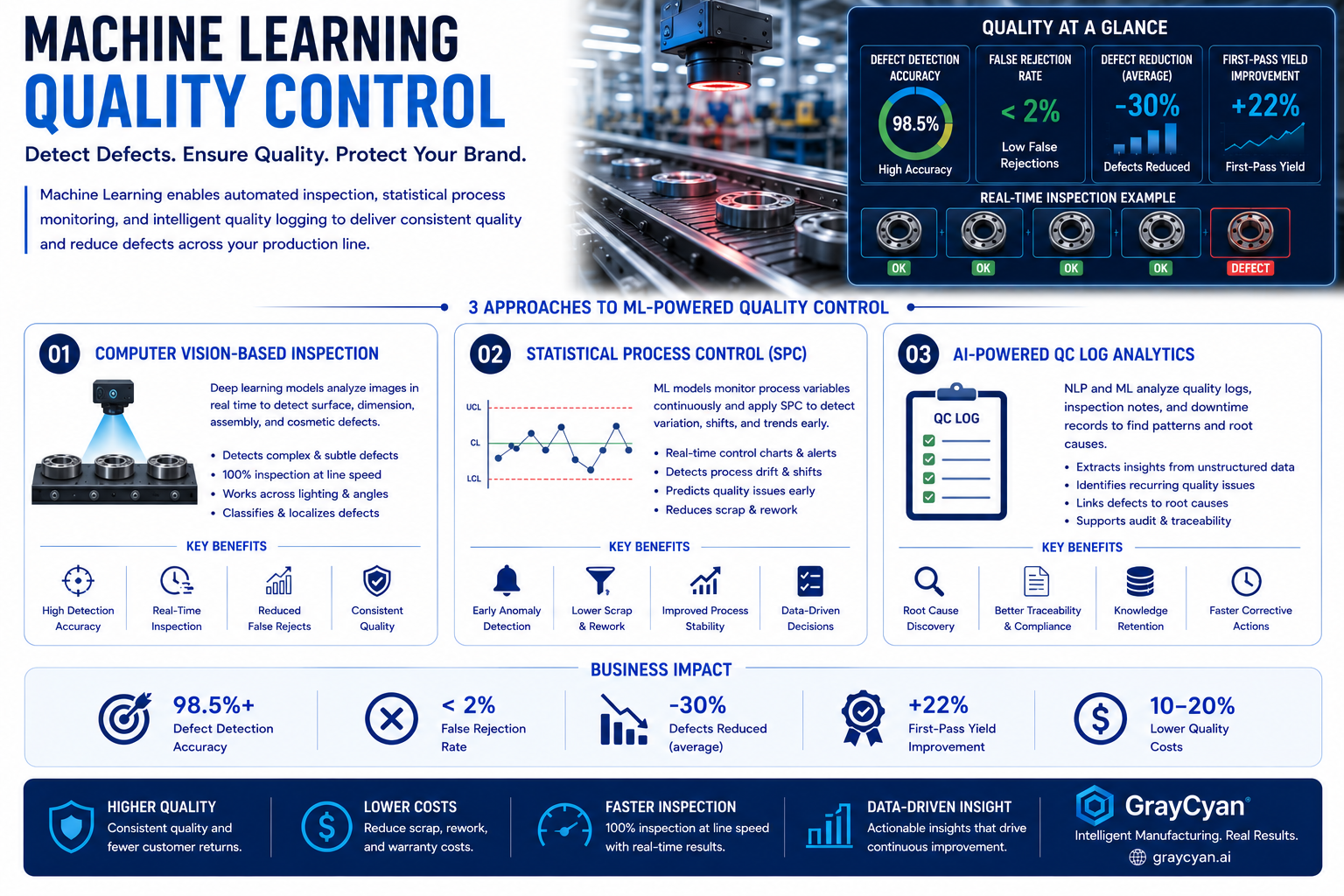
Computer vision defect detection running at production speed
Manual visual inspection has a natural ceiling. Even under controlled conditions, human inspectors often reach only 80 to 85% detection accuracy, and accuracy drops as line speeds increase. Machine learning quality control systems maintain 95 to 99% consistency at production speed.
Three useful machine learning approaches apply here:
- Computer vision defect detection: a model trained on labeled defect images runs at camera frame rate and flags individual units for rejection or rework in real time.
- Statistical process control with ML: models monitor temperature, pressure, feed rate and other variables to detect process drift before defective output is created.
- Anomaly detection on QC logs: machine learning scans structured inspection records to surface recurring defect patterns, root causes and material or shift correlations that manual review misses.
Not every quality-control project needs vision hardware at the start. Many manufacturers begin with machine learning applied to existing QC logs, then expand to camera-based inspection once the data pipeline and model performance are proven.
For regulated industries including food, pharma and aerospace, machine learning quality control also creates documentation ready for audit. Every inspection is timestamped, scored and traceable, which simplifies compliance reviews and customer audits.
Machine Learning for Manufacturing Process Optimization
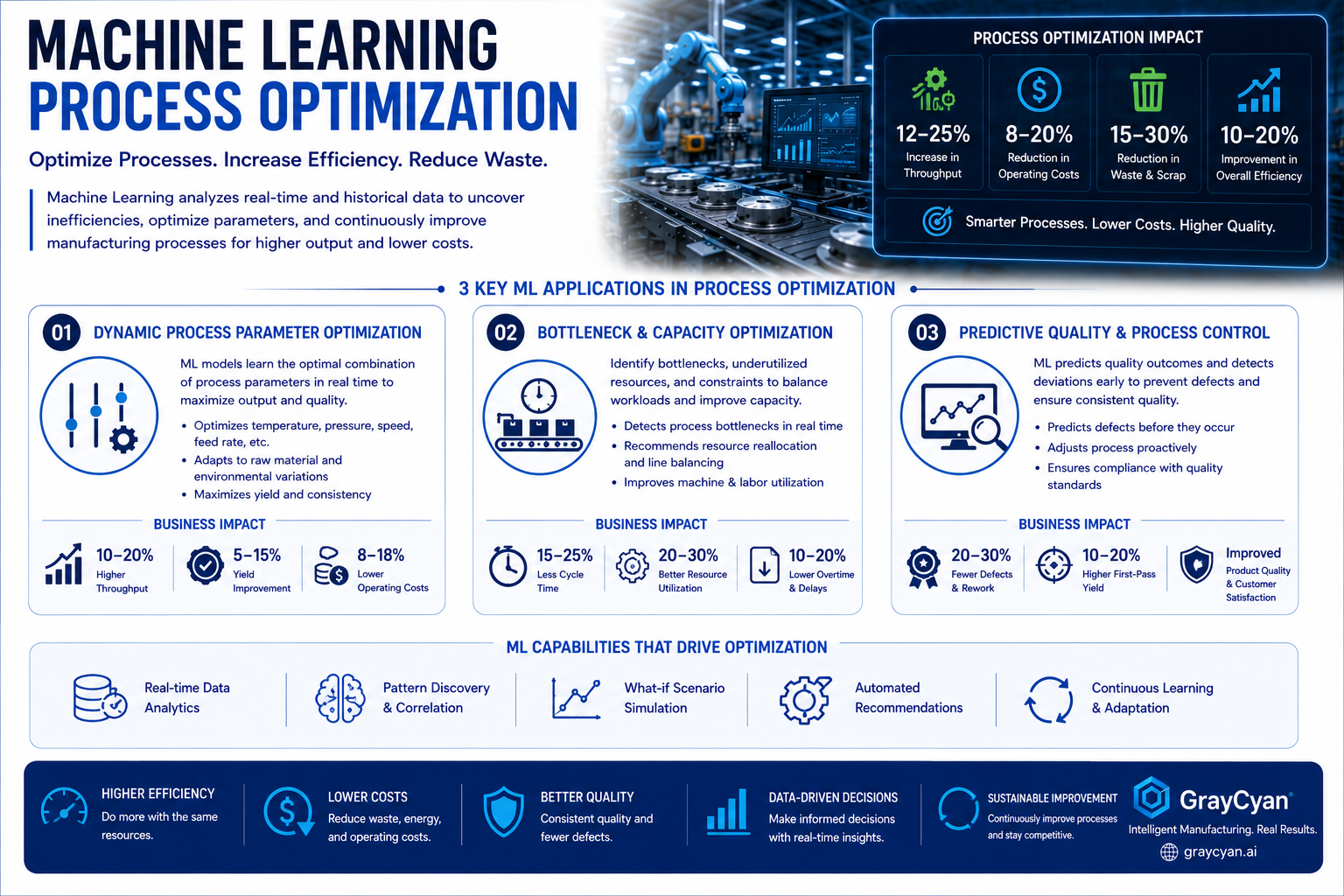
Parameter optimization, changeover sequencing and energy efficiency through ML
Machine learning process optimization means finding the operational settings, temperature, speed, pressure, material and sequence, that consistently maximize yield and throughput while minimizing energy, scrap and cycle time.
Three high-value applications stand out:
- Parameter optimization: machine learning analyzes thousands of historical production runs to identify the best combinations of process variables, then recommends settings for each product or material type.
- Changeover optimization: reinforcement learning sequences production runs to reduce changeovers by grouping compatible tooling, materials or colors.
- Energy consumption optimization: machine learning correlates energy use with production variables and highlights efficiency opportunities, especially in energy-intensive processes such as heat treatment, casting or compounding.
This kind of optimization depends on clean historical process data with outcome labels. Most manufacturers already have this information in ERP, MES and SCADA systems. It usually just needs to be connected and structured before a model can use it.
Machine Learning Demand Forecasting for Manufacturing
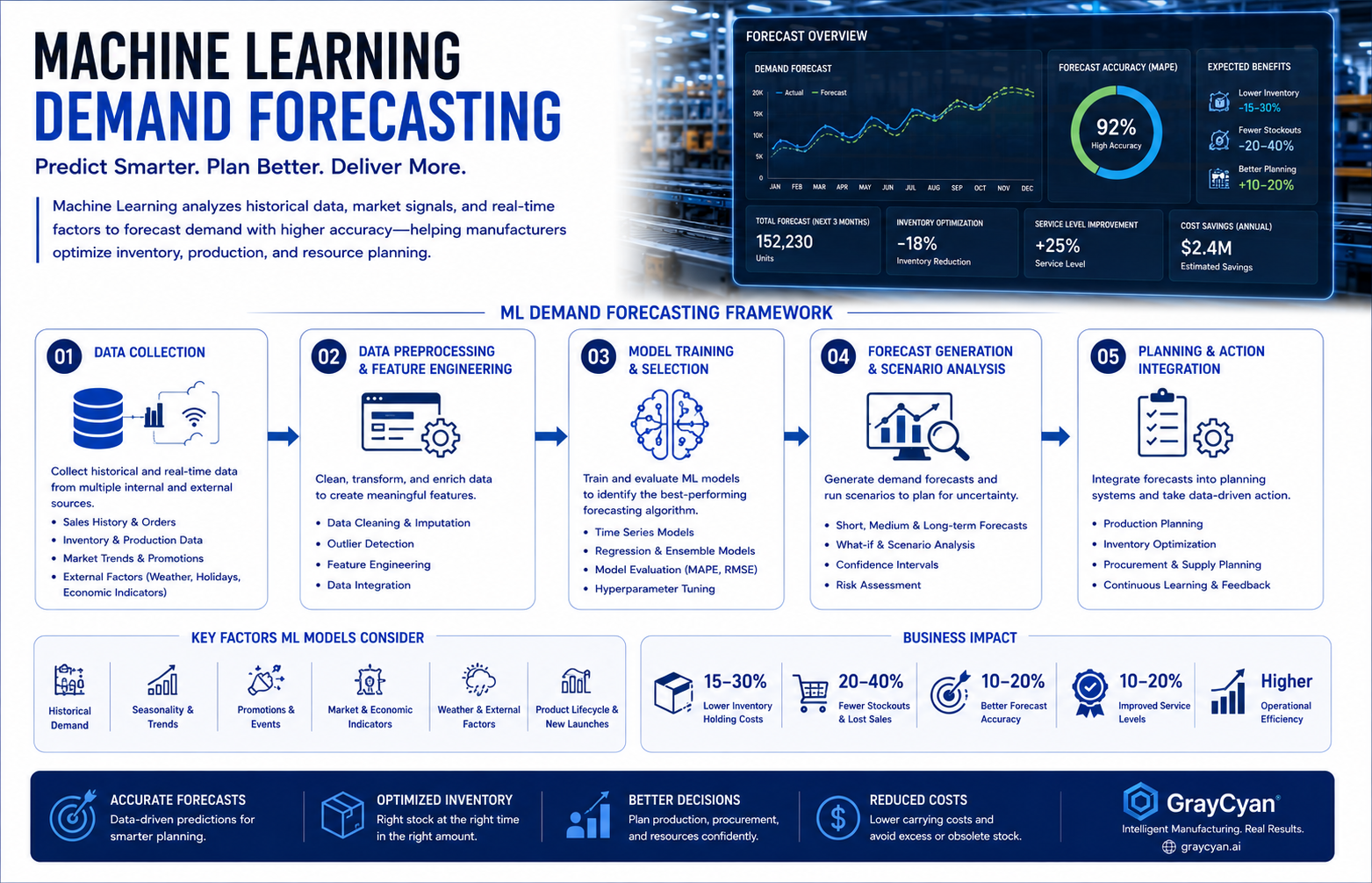
ML demand models combine order history with market signals for sharper forecasts
Traditional demand forecasting methods use spreadsheets, moving averages and historical seasonality. They fail when demand patterns change quickly due to new competitors, economic shifts or customer behavior changes.
Machine learning demand models go beyond order history. They consume market signals, customer order velocity, supplier lead time variance and seasonal patterns. That allows them to detect demand changes as they happen, rather than after the forecast has already missed.
The business benefits are direct:
- Reduced excess inventory: more accurate forecasts lower safety stock requirements and carrying costs.
- Fewer stockouts: earlier demand detection gives procurement more time to act.
- Improved production scheduling: better forecasts reduce last-minute schedule changes and line disruptions.
- Supply chain resilience: forecasts that include supplier risk signals surface disruptions before they affect production.
For manufacturers, forecasting is not just a planning task. It is a direct lever for stability, cost control and service performance across the entire production cycle.
Benefits and Challenges of Machine Learning in Manufacturing
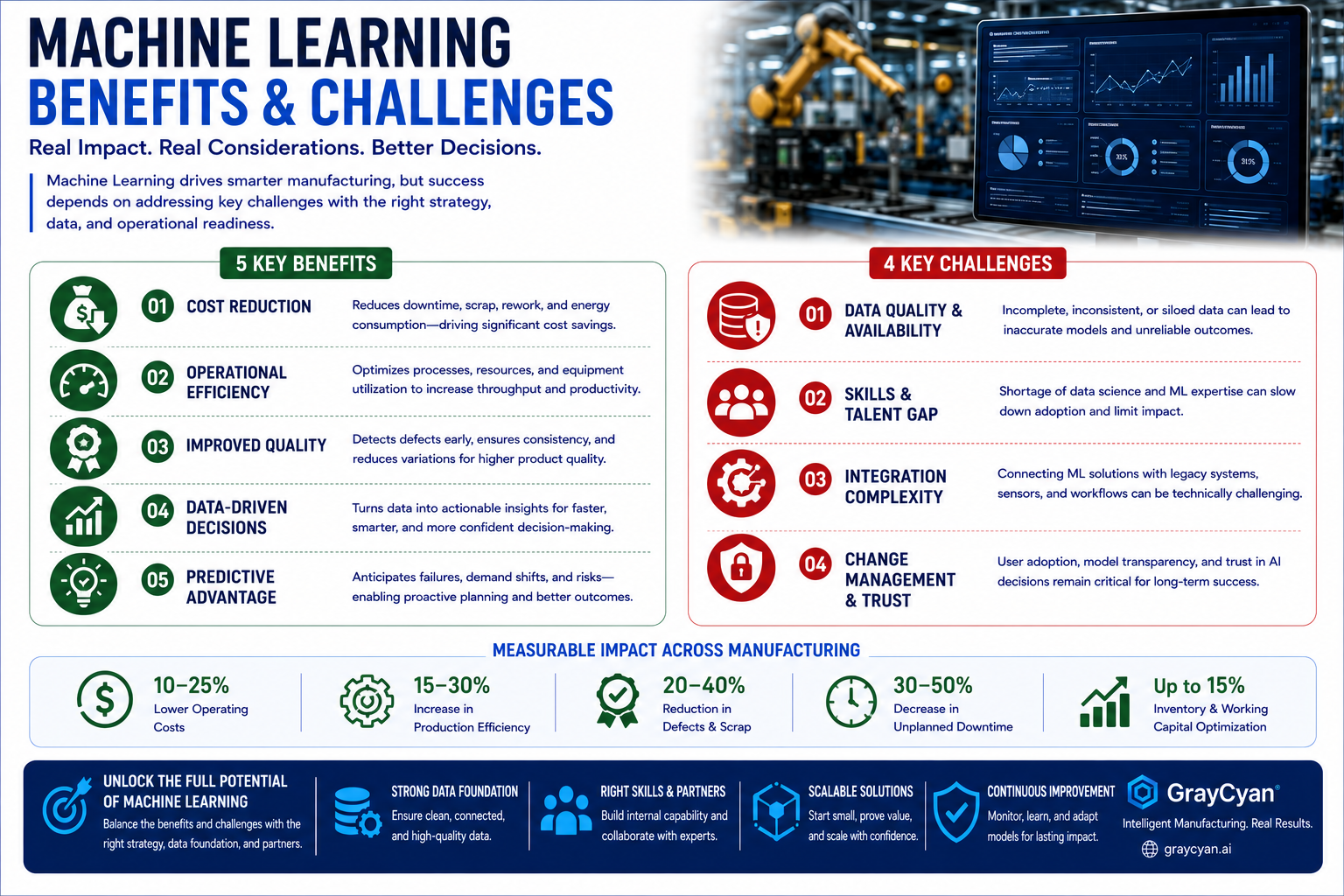
Where machine learning pays off — and what to plan for before scaling
Machine learning delivers real operational value in manufacturing but only when used against the right problems and supported by good data.
Benefits
Earlier Problem Detection
Machine learning can reveal equipment risks, quality shifts and supply chain issues before manual review would catch them.
Consistent Performance at Scale
Systems inspect and analyze without fatigue, which matters most at high volume or across multiple shifts.
Improves Over Time
As more data enters the system, the model gets better, so the deployment compounds in value without additional development cost.
Uses Existing Data
Most use cases begin with ERP, MES, CMMS and QC data rather than a major infrastructure rebuild.
Measurable ROI
Downtime, scrap and manual labor savings make outcomes straightforward to track against a baseline.
Challenges
Inconsistent units, missing records and duplicate entries weaken model output. The model is only as reliable as the data it trains on.
Some supervised models require enough historical examples to learn from. New failure modes or new product lines may not yet have sufficient history.
Connecting machine learning to ERP, MES and SCADA usually takes engineering work on data pipelines and middleware.
As production conditions change, models need monitoring and periodic retraining to stay accurate.
None of these are blockers. They are planning issues that should be addressed before scaling, and most can be managed with a narrow, well-scoped pilot.
The manufacturers who see the strongest results tend to treat their first machine learning deployment as a data project first and a modeling project second. Cleaning up unit inconsistencies, filling gaps in maintenance logs and standardizing QC records before training a model almost always shortens the path to a usable result.
How to Implement Machine Learning in Your Manufacturing Operation
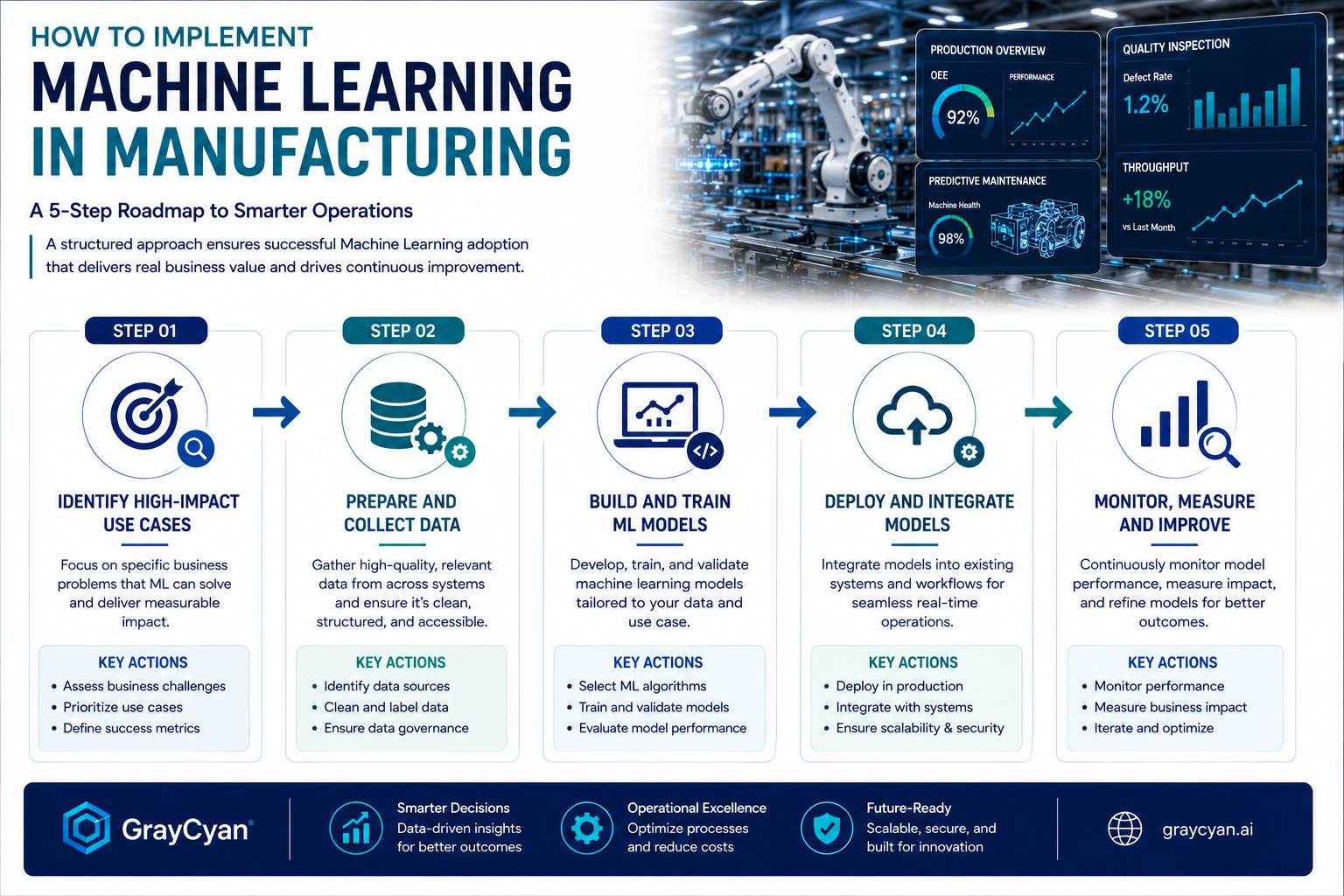
A five-step path that starts with the operational problem, not the technology
Most failed machine learning projects fail before the first model is trained. They begin with the technology instead of the operational problem. A practical five-step path avoids that.
Choose one measurable issue: downtime frequency, scrap rate, forecast error or manual labor hours. The problem definition determines which ML technique applies, not the platform or vendor.
Map the relevant data in ERP, MES, CMMS, SCADA and QC systems. Check for consistency, completeness and historical depth. Most manufacturers find 2 to 3 data quality issues in this step that need addressing before ML will produce reliable results.
Keep the first use case narrow so results are easy to measure. Predictive maintenance on one critical asset, anomaly detection on one bottleneck process, or ML applied to one product line's QC log data.
Build through APIs and middleware rather than creating parallel processes. ML that runs in isolation from ERP and MES creates new manual bridges, which defeats the purpose.
Track model performance against a holdout dataset. Set accuracy thresholds and retraining schedules. Scale to additional workflows only after the first deployment proves ROI.
When choosing a vendor, ask whether they can work with your specific ERP and operational stack, whether they have experience in your industry, and whether you retain full ownership of the data and model after the engagement ends.
It also helps to agree upfront on what success looks like. A pilot with a clear target, such as a 10% reduction in unplanned downtime or a 15% improvement in forecast accuracy, gives everyone involved a concrete benchmark before committing budget to a wider rollout.
How to Integrate Machine Learning with Your Existing Manufacturing ERP
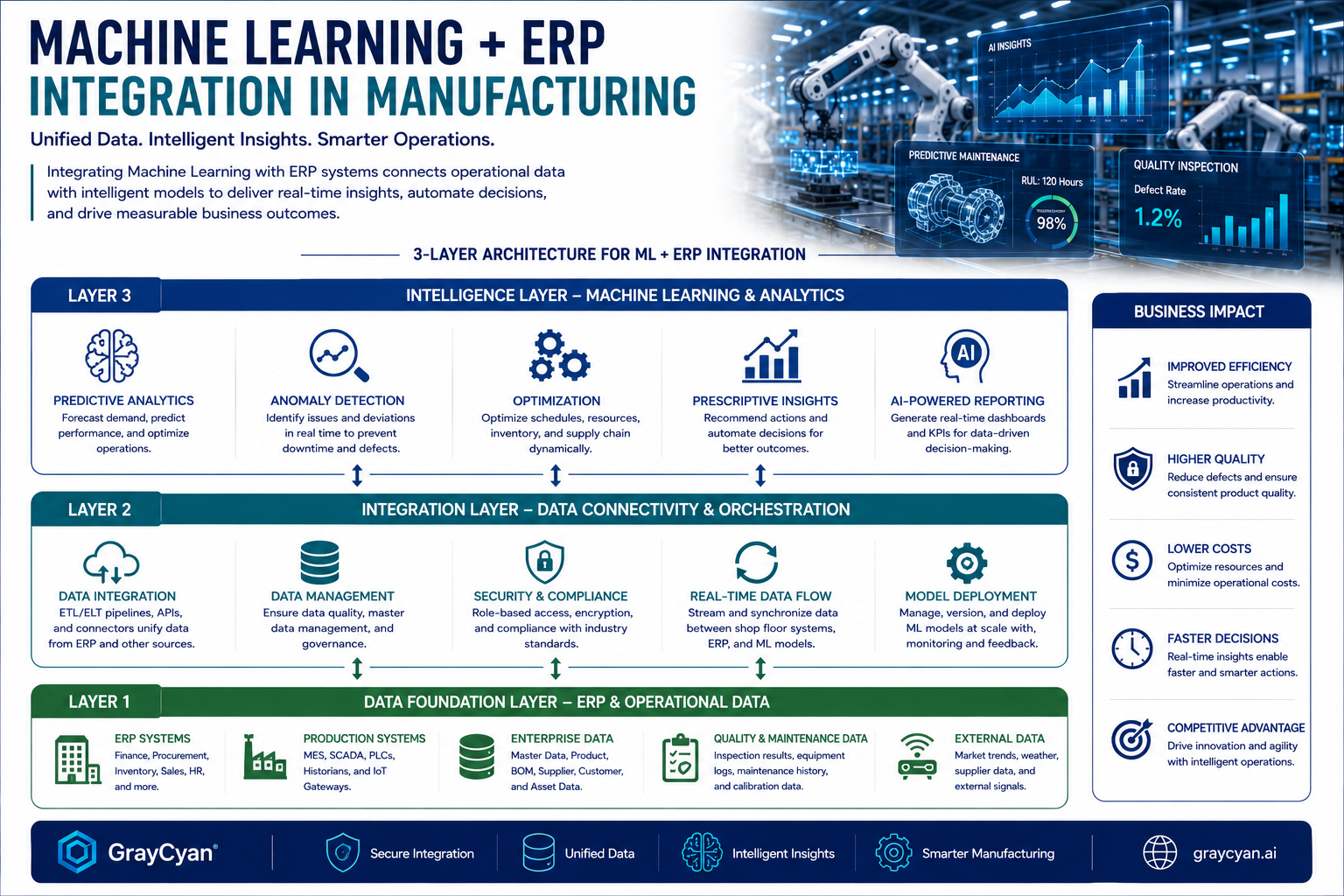
A three-layer integration model — ERP stays the system of record
ERP integration is where many machine learning projects stall. The common misconception is that machine learning requires replacing the ERP system. It does not.
A practical integration model works in three layers:
Existing transactions, inventory, production orders and financial records stay unchanged. Nothing about the ERP itself is modified.
A middleware layer pulls relevant operational data from the ERP through APIs or scheduled exports and feeds it to the machine learning model.
Predictions such as maintenance alerts, quality flags and demand forecasts are written back as structured records that planners and operators see inside the tools they already use.
This approach allows machine learning to enhance the ERP rather than disrupt it. Employees continue using tools they already know. Adoption is faster and training costs are lower.
GrayCyan has built ML middleware for NetSuite, SAP, Epicor, Acumatica, Microsoft Dynamics, Odoo, Infor and Fishbowl. The Fishbowl ERP deployment cut daily manual data entry from 12 hours to under 2 hours without changing a single ERP configuration.
Machine Learning for Regulated and Air-Gapped Manufacturing Environments
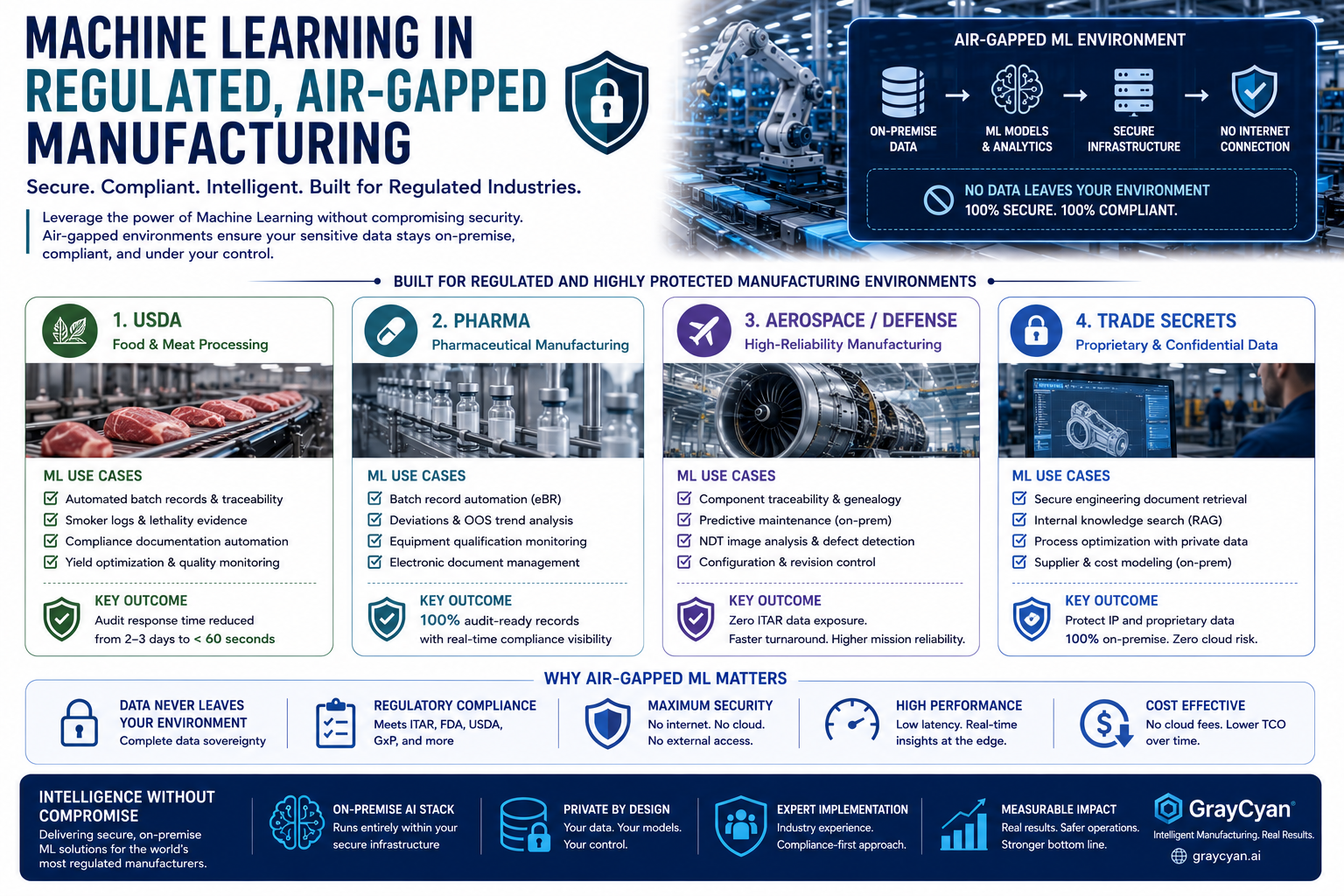
On-premises ML deployment for ITAR, FDA and trade-secret-sensitive operations
Most cloud-based machine learning platforms assume unrestricted data access. For regulated manufacturers, that assumption breaks quickly.
Manufacturers who need on-premises or air-gapped ML deployment include:
USDA-Regulated Food Processors
Proprietary recipes, formula data and production records that cannot be transmitted to external cloud platforms without compliance review.
Pharmaceutical Manufacturers
FDA 21 CFR Part 11 data integrity requirements restrict where production and validation data can be stored and processed.
Aerospace and Defense Contractors
ITAR-controlled technical data, including drawings, specifications and manufacturing processes, cannot reside on commercial cloud platforms.
Manufacturers With Trade Secrets
Proprietary process parameters and formulations that represent competitive IP the business cannot expose to external systems.
GrayCyan deploys the full ML stack on facility-owned hardware inside the network boundary. Model, inference engine, vector database and API layer all run on-premises. No production data, documents or query logs leave the facility. A single high-spec workstation handles inference for most mid-market use cases.
The air-gapped engineering retrieval deployment described earlier in this guide is an example of this approach. Forty years of ITAR-controlled engineering documentation became searchable in natural language without a single byte leaving the facility boundary.
Machine Learning in Manufacturing — Industry 4.0 and What Comes Next
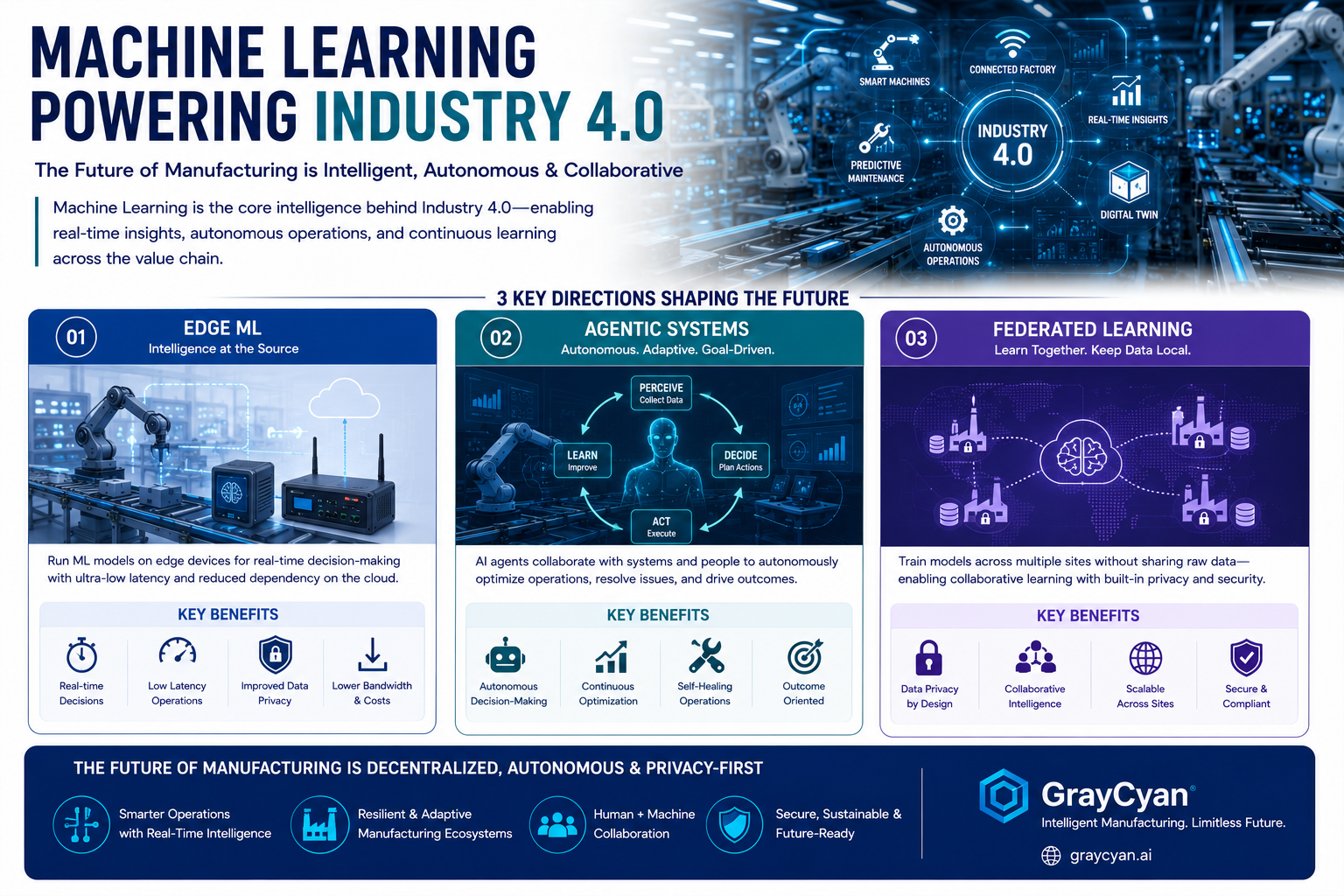
Edge ML, agentic systems and federated learning — where manufacturing ML is heading
Machine learning is one of the core technologies of Industry 4.0, where digital intelligence is applied directly to physical production. Sensors generate the data. Computing systems process it. Machine learning finds the patterns that make it useful.
Three directions are shaping where manufacturing ML is heading:
Edge ML Deployment
Models move closer to the machine itself to support real-time decisions without cloud latency. Critical for high-speed lines where a 200-millisecond cloud round-trip is too slow for defect detection.
Agentic Manufacturing Systems
Machine learning systems that not only detect problems but also carry out approved actions, such as adjusting process parameters or rescheduling production, with human oversight at exception points.
Federated Learning Across Facilities
Multi-plant companies training shared models without centralizing sensitive operational data. Each facility contributes to model improvement while data sovereignty is maintained.
Most mid-market manufacturers are not yet at full Industry 4.0 maturity. The practical starting point is solving one real problem with data that already exists, then building outward from that first proven win.
Frequently Asked Questions — Machine Learning in Manufacturing
Ready to Apply Machine Learning in Your Manufacturing Operation?
If you are evaluating machine learning for your manufacturing operation, the best starting point is understanding where your data lives, how clean it is, and which operational problem offers the best combination of readiness and business impact. That is exactly what GrayCyan's AI Readiness Assessment maps out.
GrayCyan works with mid-market manufacturers across food processing, aerospace, industrial distribution and engineered components. Every engagement starts with a data readiness assessment, not a platform sale. You retain full ownership of everything built.
Schedule a Strategy Call