
AI in Automotive Manufacturing: Use Cases, Generative AI and Practical Implementation
Built on the ERP, quality records and maintenance logs you already have.
A practical guide to quality control, predictive maintenance, robotics, generative AI for vehicle design, supply chain optimization, and how automotive manufacturers implement AI without disrupting production.
Book a Discovery Call



















What Is AI in Automotive Manufacturing?
AI in automotive manufacturing is the application of machine learning, computer vision, and intelligent automation to the production of vehicles and automotive components. It enables manufacturers to predict equipment failures, detect defects at production speed, optimize assembly processes, automate documentation, and improve operational decision-making using data that already exists throughout the factory.
AI in automotive manufacturing refers specifically to what happens inside production facilities. Typical applications include quality inspection, predictive maintenance, robotic welding, production scheduling, engineering documentation, and supply chain planning. This is different from AI used inside finished vehicles, such as autonomous driving or advanced driver assistance systems. This guide focuses entirely on manufacturing operations.
The market for AI in automotive manufacturing continues to expand as manufacturers respond to growing electric vehicle production, more demanding quality standards, supply chain volatility, and increasing pressure to improve productivity without adding significant headcount. AI allows manufacturers to identify patterns across production systems that would be impossible to detect manually, helping teams respond before small issues become costly disruptions.
Although companies such as Toyota, Ford, BMW, Volkswagen and other global OEMs have invested heavily in automotive AI, much of every vehicle is actually produced throughout an extensive supplier network. Tier 1, Tier 2, and Tier 3 suppliers manufacture stamped components, machined parts, electronics, plastic mouldings, wiring systems, castings, and assemblies that eventually become part of finished vehicles.
These manufacturers face many of the same operational challenges as OEMs but typically have fewer resources to dedicate to large digital transformation projects. As a result, practical AI deployments that build on existing ERP systems, quality records, maintenance logs, and engineering documentation often deliver the fastest return. For many suppliers, successful AI adoption begins with solving one operational problem at a time rather than attempting to modernize an entire facility at once.
AI for Quality Control in Automotive Manufacturing
Automotive production operates with extremely tight tolerances, complex multi-material assemblies, safety-critical components, and production volumes that can reach thousands of parts every shift. Maintaining consistent quality at that scale is difficult through manual inspection alone.
Defect Detection at Production Speed
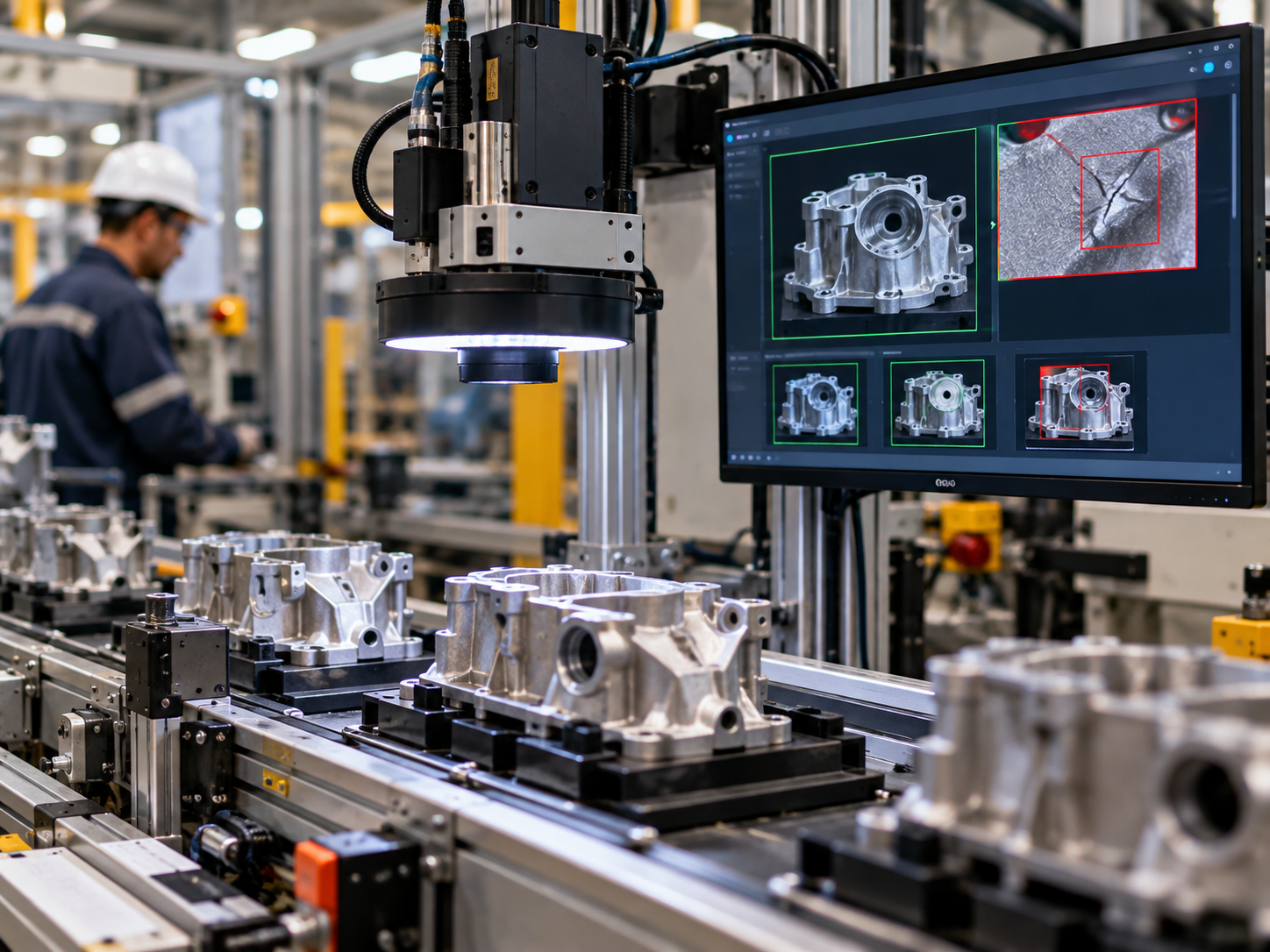
Computer vision systems trained with machine learning models can inspect welded joints, stamped components, painted surfaces, machined parts, and completed assemblies at production speed.
These systems identify scratches, cracks, incomplete welds, dents, dimensional inconsistencies, and other defects that may be difficult for human inspectors to detect consistently over long production runs.
Out-of-Tolerance Caught Before the Next Stage
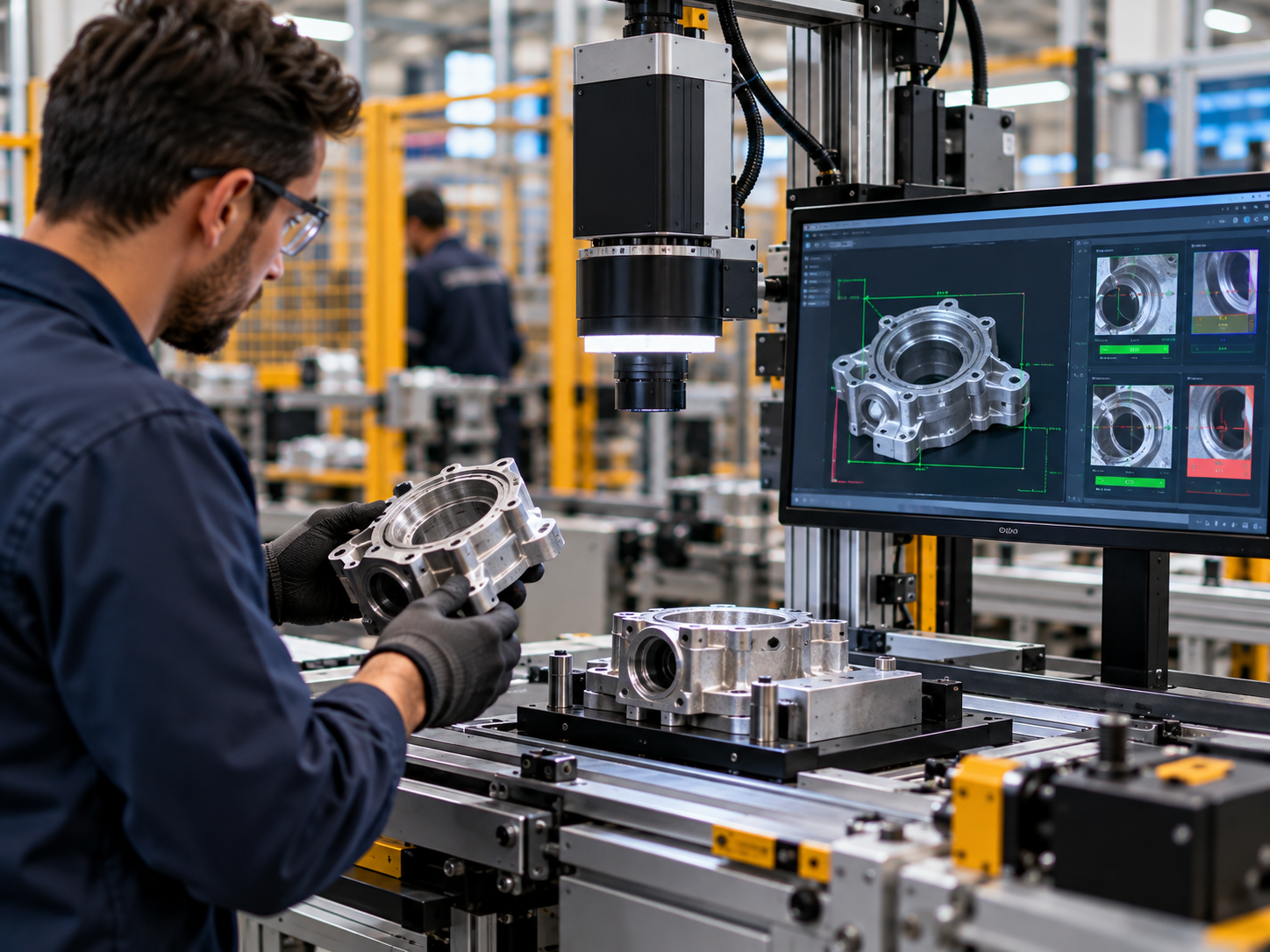
AI also improves dimensional inspection. Modern optical measurement systems combined with machine learning can evaluate complex component geometry and identify out-of-tolerance conditions before parts move to the next manufacturing stage.
Instead of discovering dimensional issues during final assembly, manufacturers receive immediate feedback while corrective action is still possible.

Every Fastener and Connector Confirmed
Assembly verification is another area where automotive AI provides measurable value. Camera systems positioned along the production line confirm that components have been installed correctly, fasteners are present, connectors are fully seated, and assemblies match engineering specifications.
This reduces the risk of incomplete or incorrectly assembled products progressing through production.

The Most Mature AI Inspection Application
Automotive welding has become one of the most mature applications of AI-driven inspection. Machine learning models analyze weld bead images, thermal signatures, and acoustic signals to identify porosity, cracking, incomplete fusion, and other defects that traditional inspection methods may miss. Detecting these issues immediately helps reduce scrap while preventing quality problems from reaching downstream processes.
Industry leaders continue to expand these capabilities. Audi, for example, has implemented AI models that identify weld splatter on vehicle bodies using cameras installed directly on production lines. The system alerts operators in real time, improving weld quality while also reducing workplace hazards associated with weld splatter.
Patterns Already Sitting in Your Quality Data
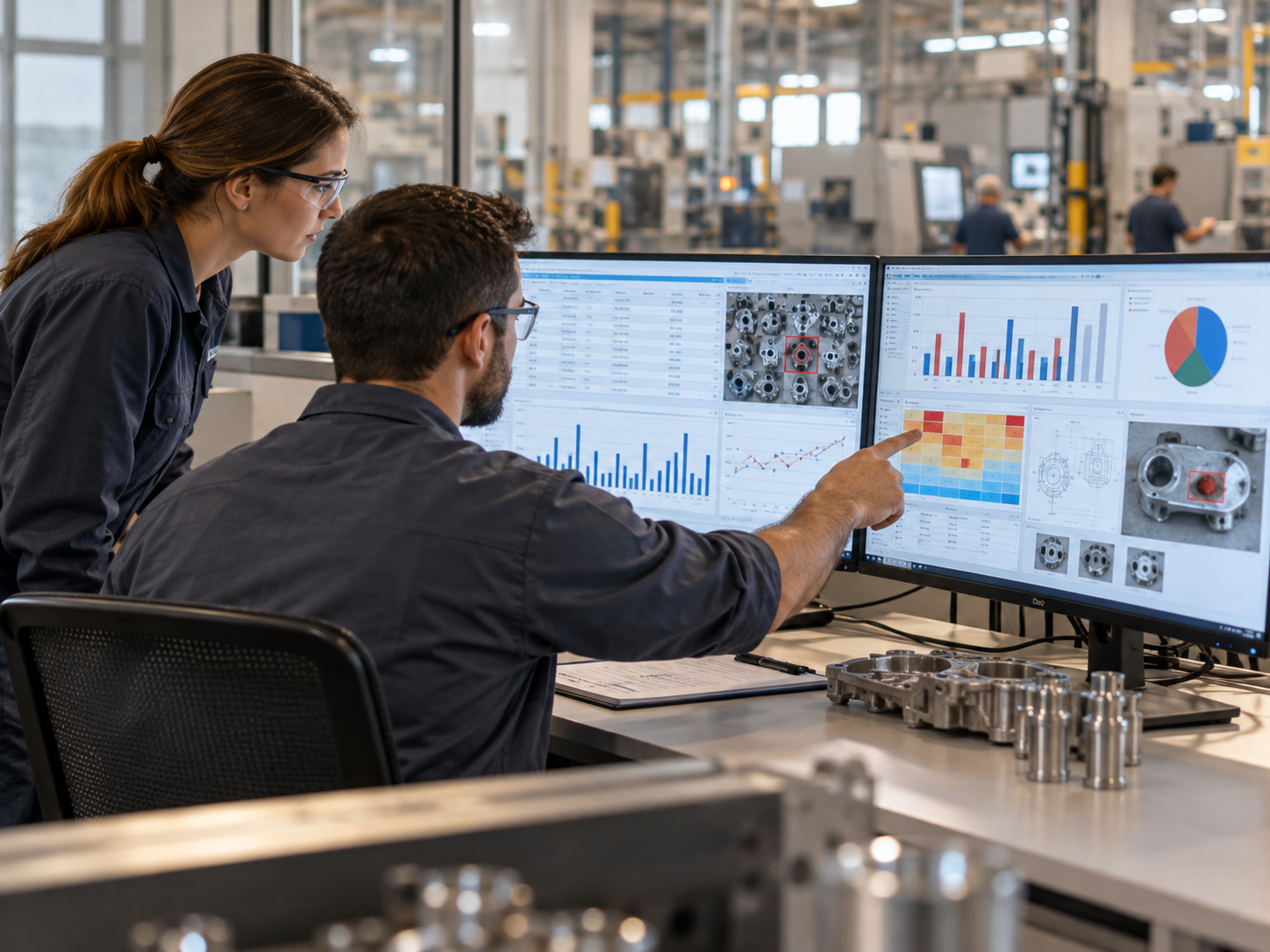
For many Tier 2 and Tier 3 automotive suppliers, however, the first opportunity is not purchasing entirely new inspection hardware. Valuable quality insights already exist inside inspection reports, non-conformance logs, scrap records, SPC data, and customer complaints.
Applying machine learning to these existing datasets often reveals recurring defect patterns, supplier issues, process variations, and root causes long before additional capital investment becomes necessary.
This practical approach aligns well with GrayCyan's manufacturing AI solutions, where AI is introduced using operational data that manufacturers already collect rather than requiring an immediate overhaul of production equipment.
AI for Predictive Maintenance in Automotive Manufacturing
Unplanned downtime in AI in automotive manufacturing is uniquely expensive. A line stoppage at a Tier 1 supplier can trigger production shortfall penalties from OEM customers within hours.
Automotive manufacturers have some of the highest financial exposure per hour of unplanned downtime of any manufacturing sector. This makes predictive maintenance one of the most valuable applications of automotive AI and machine learning in the automotive industry.
In AI in the automotive industry, the highest-value predictive maintenance applications focus on robotic welders, stamping presses, CNC machining centers, and transfer systems where failures can stop an entire production line. Paint booths and cure ovens also benefit from monitoring because thermal variation directly affects product quality.
For mid-market automotive suppliers, GrayCyan's approach uses data already available within existing CMMS and MES platforms, allowing predictive maintenance to be implemented without investing in new sensor hardware.
No New Sensors Required
Learn more about GrayCyan's predictive intelligence and automation.
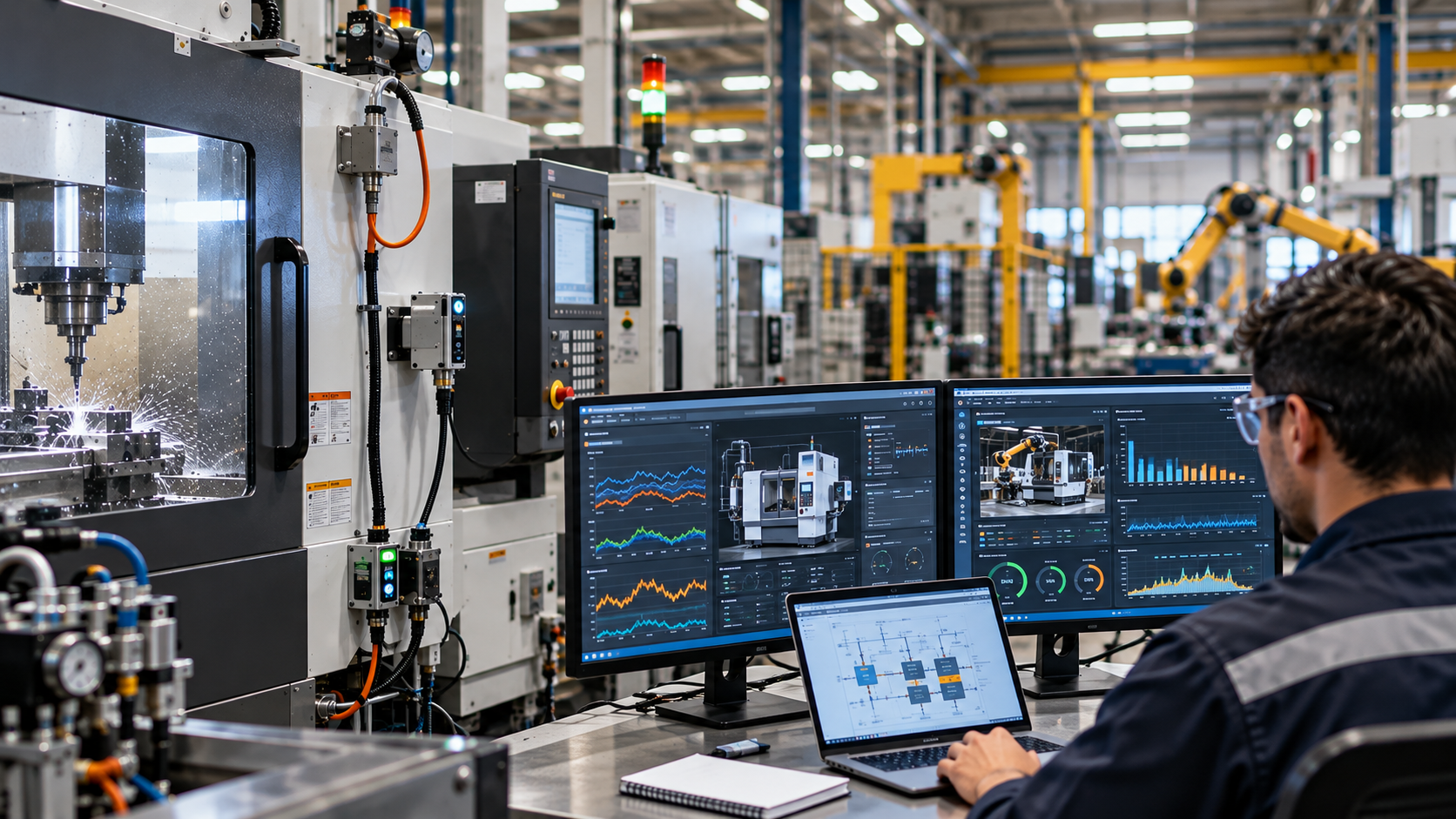
Collect From Systems You Already Run
AI-powered predictive maintenance begins by collecting operational data from existing systems.
Vibration, temperature, current draw, pressure, and cycle count information is gathered from CNC machines, stamping presses, robotic welders, conveyor systems, and other production assets using existing CMMS and production historian systems.
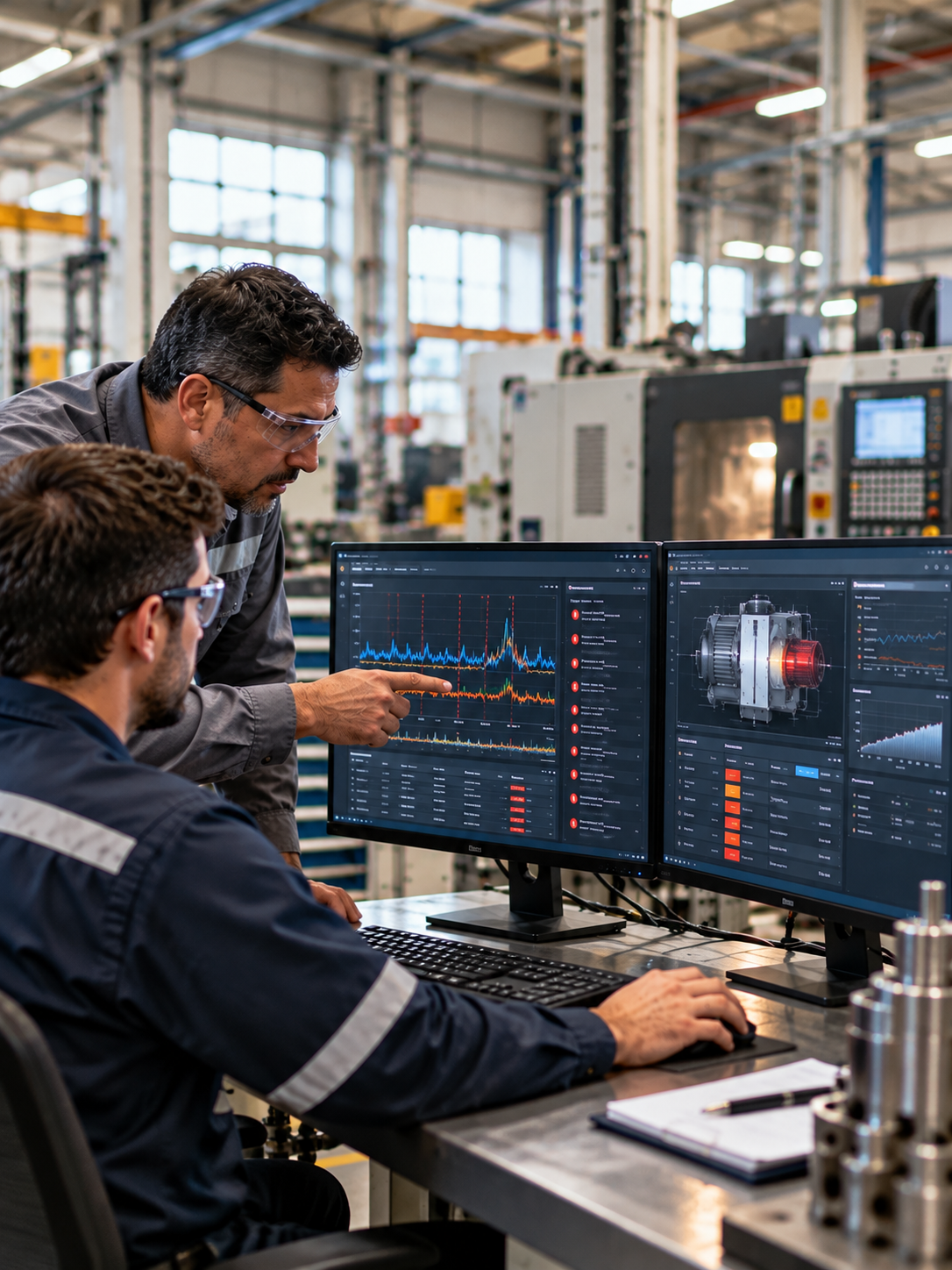
Train on Past Failures
Machine learning models are then trained using historical maintenance records and past equipment failures.
By comparing previous failure events with operational data, the models learn to recognize the patterns that typically appear hours or even days before a specific asset fails.
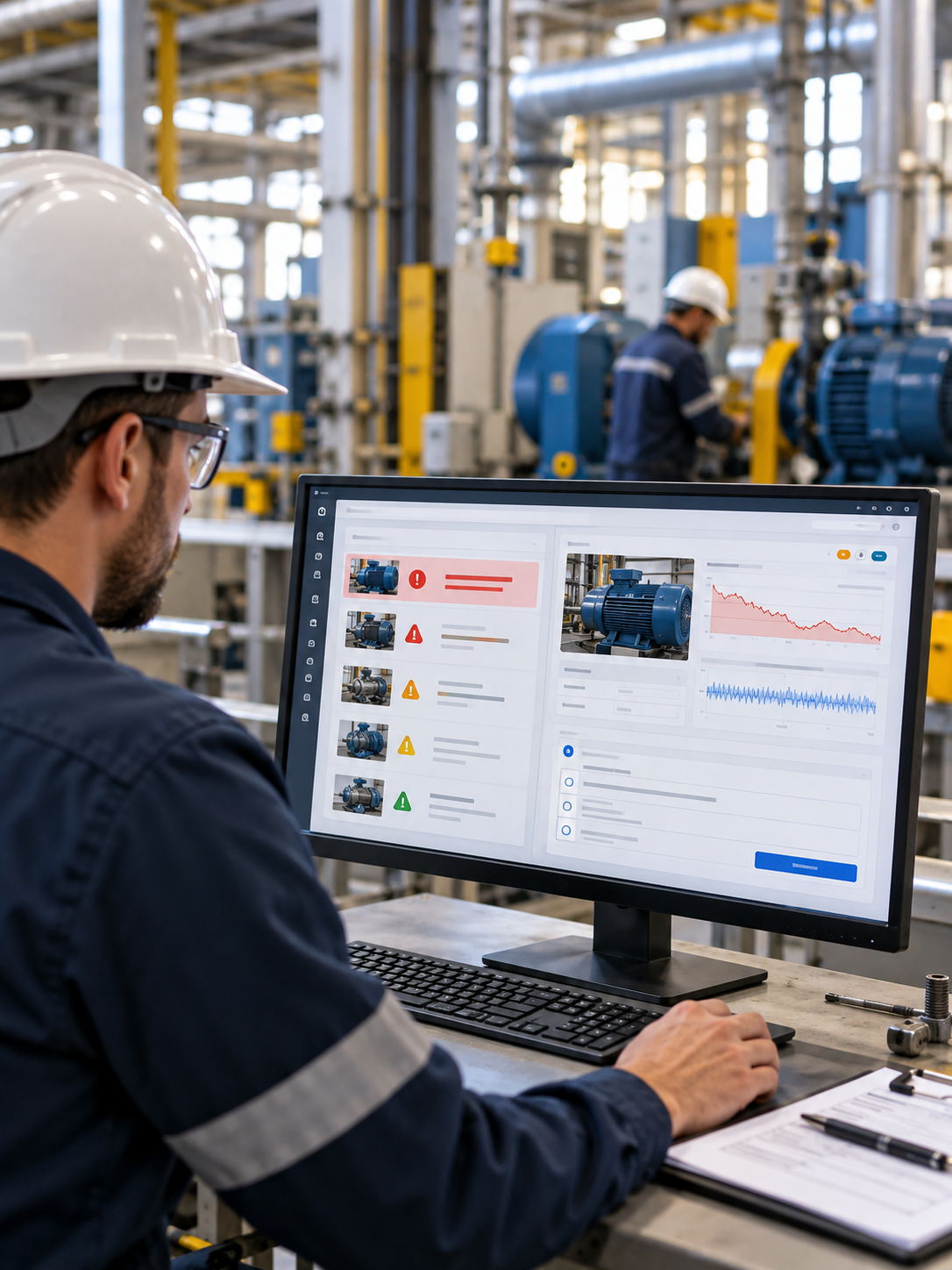
Prioritised Alerts Into Existing Work Orders
Once trained, the models continuously analyze live equipment data and generate failure probability scores together with estimated time-to-failure for every monitored asset.
Maintenance teams receive prioritized alerts based on the potential financial impact of downtime, allowing them to schedule inspections before production is interrupted. These recommendations integrate directly with existing CMMS work order workflows.
AI Robotics and Automation in Automotive Assembly
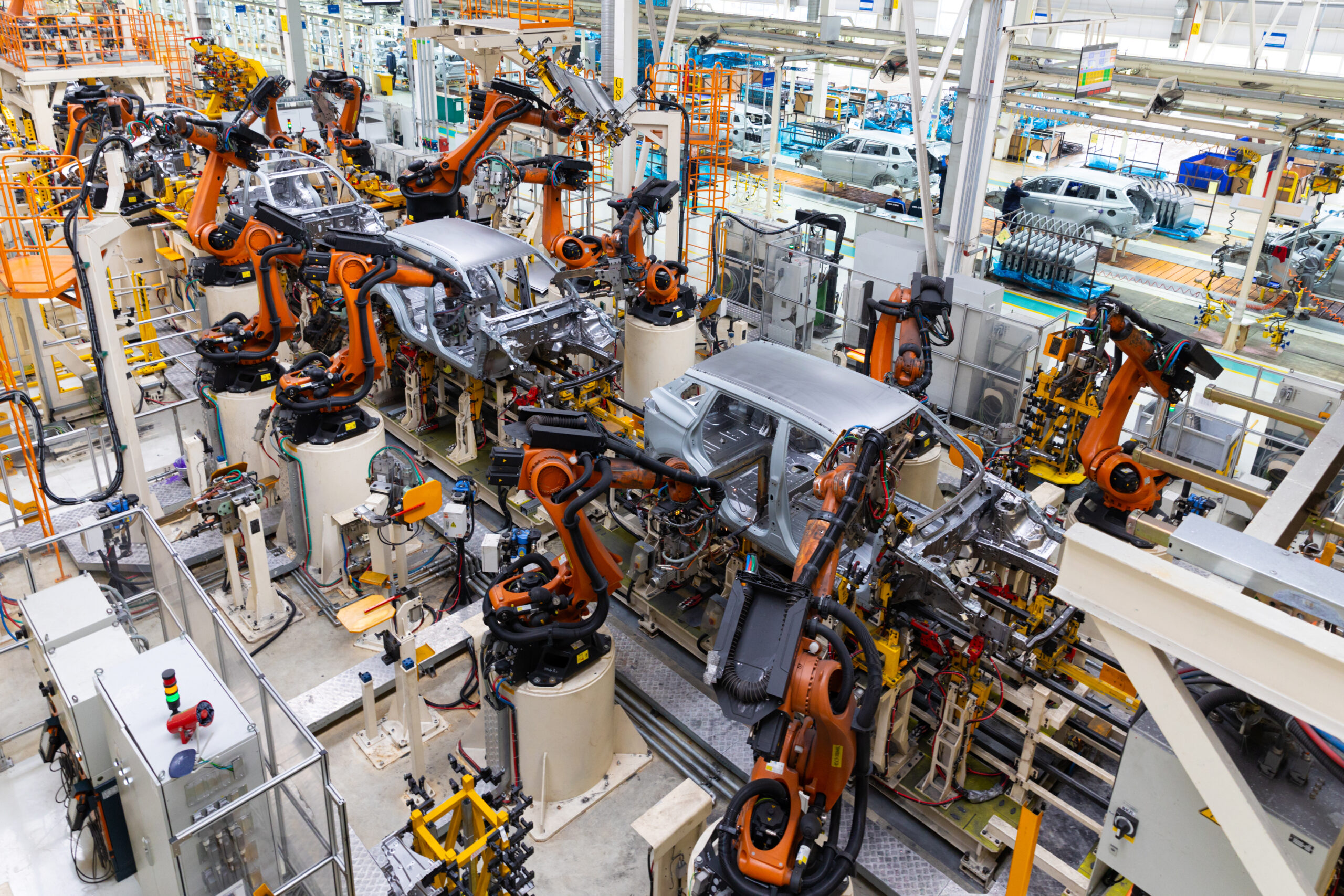
Automotive manufacturing was the first industry to adopt industrial robots at scale. Welding, painting, material handling, and assembly automation have been part of automotive production for decades. Today, AI adds an intelligence layer to these existing robotic systems by helping them adapt to variation, detect anomalies, and coordinate complex multi-robot workflows that traditional rule-based programming cannot manage efficiently.
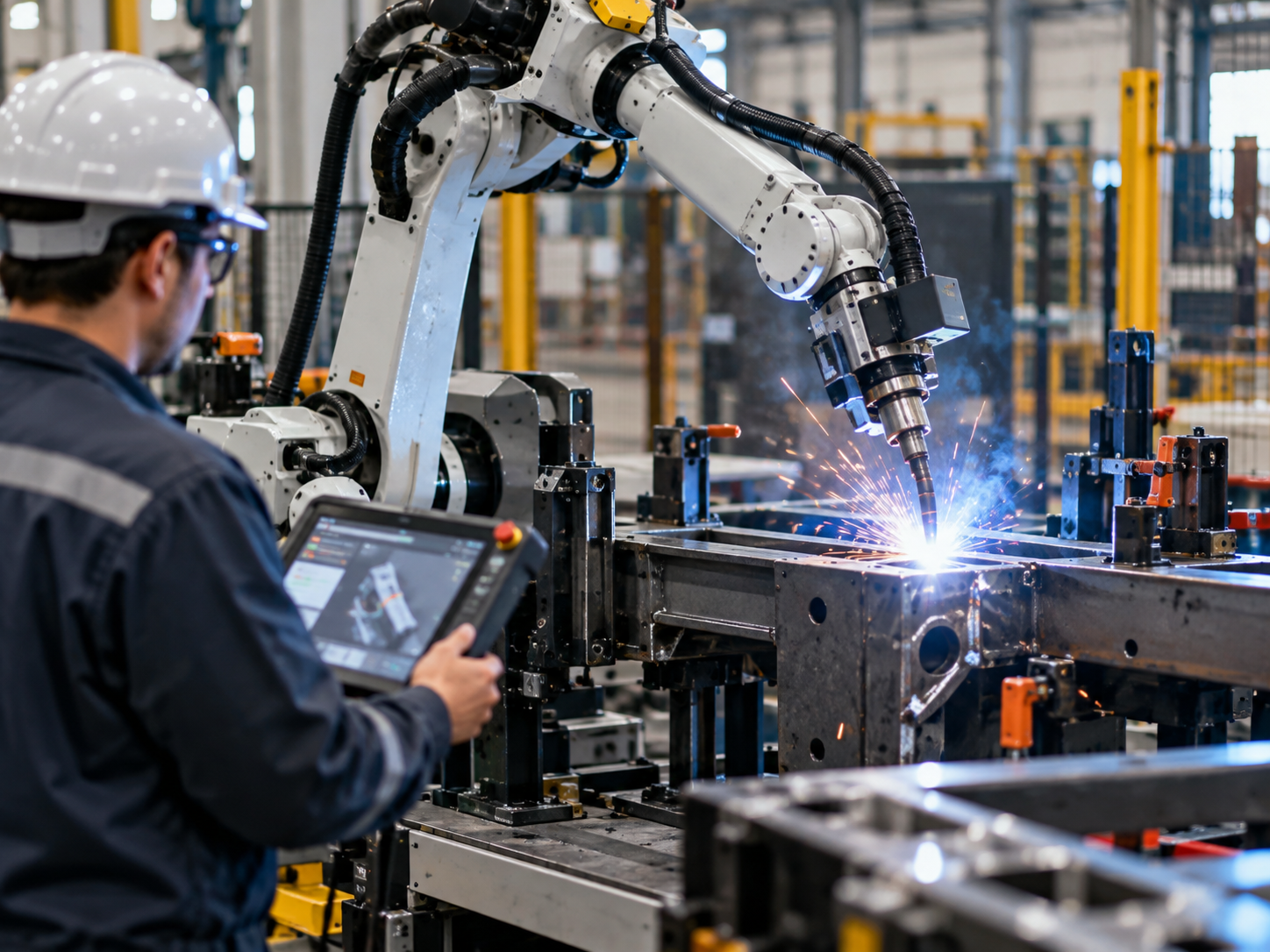
AI-Guided Welding Robots
Modern welding robots combine computer vision with machine learning to adjust weld parameters based on real-time variations in joint geometry and part positioning.
Instead of following a fixed program regardless of conditions, AI helps maintain consistent weld quality across components with minor dimensional differences that would otherwise increase scrap or require manual rework.
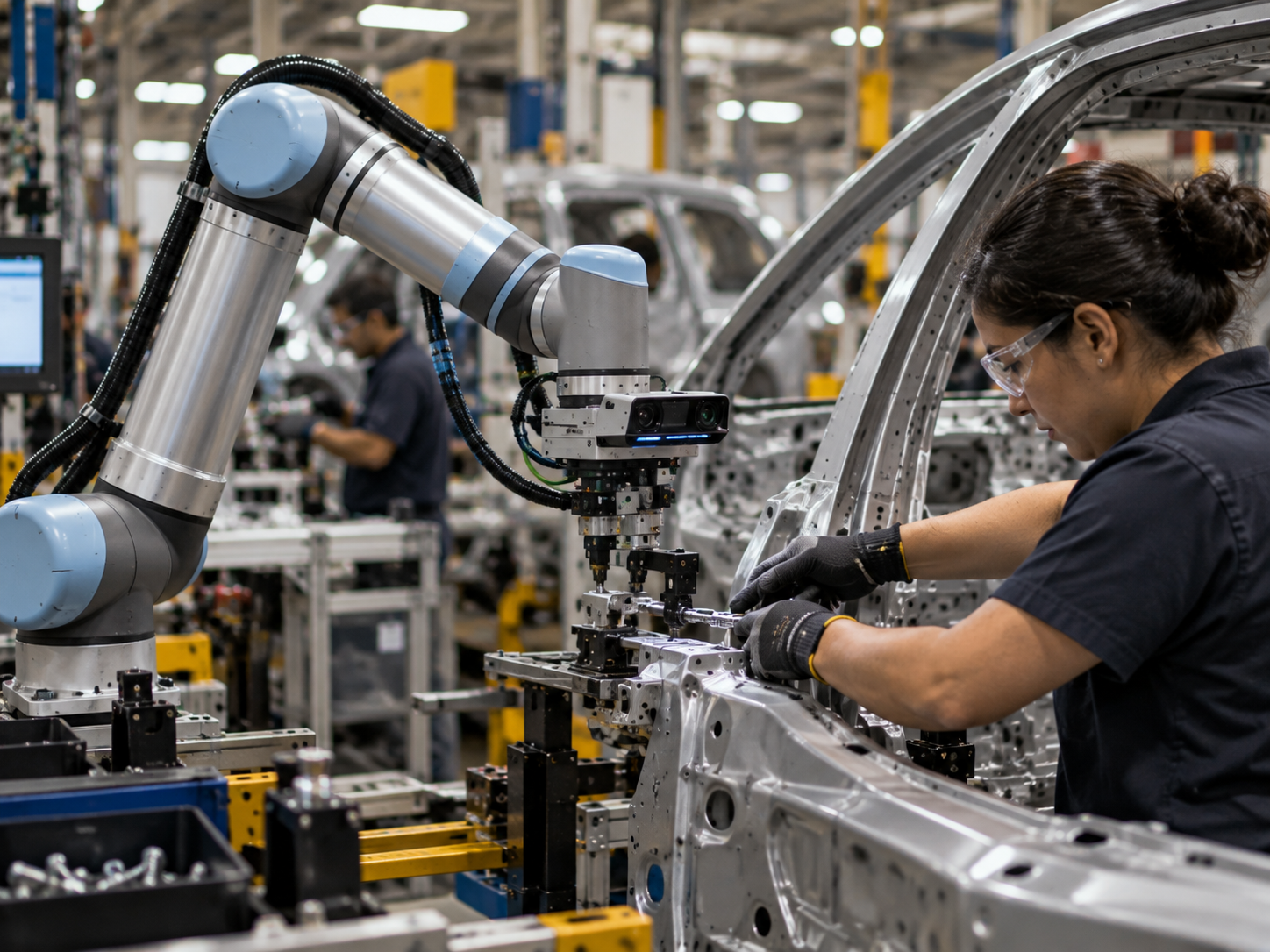
Collaborative Robots With AI Vision
Collaborative robots equipped with AI-powered vision systems work alongside human operators on automotive assembly lines. They identify part orientation, verify assembly steps, and adjust movements using live camera and sensor feedback.
This allows cobots to assist with repetitive assembly tasks while remaining flexible enough to accommodate production variation without constant reprogramming.
AI-Directed Material Handling
Automated Guided Vehicles (AGVs) and autonomous material handling systems increasingly use AI for path planning, obstacle avoidance, and workstation sequencing.
Rather than following fixed routes, these systems respond dynamically to changing shop-floor conditions, helping ensure that parts arrive at the correct workstation while reducing congestion and unnecessary transport delays.

AI Inspection Robots
Robotic inspection systems equipped with high-resolution cameras and machine learning models perform dimensional and surface inspections on complex automotive components.
They are particularly valuable for inspecting exterior body panels, welded assemblies, and interior trim where manual inspection can vary between operators and become inconsistent over long production shifts.
Most mid-market automotive suppliers do not operate highly automated robotic factories. Many rely on legacy machining centers, stamping presses, and manual assembly processes. For these manufacturers, AI delivers the greatest value not by replacing existing equipment but by adding intelligence to the production data those systems already generate.
GrayCyan does not supply robotics hardware. Where AI-enabled robotics make sense for a manufacturer's operation, GrayCyan evaluates the required data integrations, production workflows, and system architecture to recommend an approach that fits existing manufacturing infrastructure instead of requiring a complete automation overhaul.
Not ready to buy new inspection hardware?
The quality insights are often already sitting in your inspection reports, non-conformance logs, scrap records and SPC data.
AI for Supply Chain and Production Planning in Automotive Manufacturing
Automotive supply chains operate under conditions that make AI essential, not optional. Just-in-time delivery windows measured in hours, OEM production penalties for line stoppages, multi-tier supplier networks spanning dozens of countries, and increasing EV model complexity are compressing the margin for supply chain error to near zero. As a result, AI in the automotive industry is becoming an important tool for suppliers that need to improve visibility, planning accuracy, and operational resilience without adding unnecessary complexity.
Demand Signal Processing
AI models analyze OEM production schedules, call-off signals, historical demand patterns, and customer order data to generate supplier-level production plans.
Instead of reacting to sudden schedule changes, manufacturers can anticipate demand shifts earlier and adjust production before they become urgent orders that disrupt operations.
Supplier Risk Intelligence
Machine learning in the automotive industry helps monitor supplier delivery performance, financial health indicators, geopolitical developments, and raw material availability.
By identifying patterns associated with potential disruptions, AI can flag at-risk suppliers two to four weeks before delays begin affecting the production floor.
Production Scheduling Optimization
AI-powered scheduling systems evaluate machine capacity, labor availability, tooling constraints, and production priorities to optimize schedules across CNC machines, assembly cells, and finishing operations.
The result is reduced changeover time, improved equipment utilization, and better alignment with OEM delivery commitments.
Inventory Optimization
Automotive machine learning models balance raw material inventory and work-in-progress levels against production schedules, supplier lead time variability, and forecast demand.
This helps manufacturers reduce excess inventory while maintaining the stock levels required to support consistent OEM deliveries.
For automotive suppliers, supply chain AI integrates with existing ERP systems such as SAP, Oracle, Epicor, and Microsoft Dynamics through API middleware. It reads OEM call-offs and purchase orders, processes them through machine learning models, and writes optimized production schedules back into the ERP without replacing existing systems. Manufacturers looking to connect operational data with intelligent planning can explore GrayCyan's ERP AI integration solution.
Generative AI in Automotive Manufacturing: Design, Documentation and Knowledge Systems
Most AI in automotive manufacturing today relies on predictive and classification models that detect defects, forecast failures, or optimize production schedules. Generative AI in automotive manufacturing serves a different purpose. Instead of predicting an outcome, it creates new outputs from your existing operational data: engineering documentation, work instructions, technical summaries, design alternatives, and knowledge retrieval that previously required hours of manual effort.
As manufacturers search for practical generative AI automotive applications, the greatest value is often found not in replacing engineering teams, but in helping them work faster using the technical information they already own.
Engineering Documentation Generation
Engineering documentation is one of the largest hidden bottlenecks in automotive manufacturing. Engineering drawings, CAD revisions, bills of materials, change notices, and ERP records must all be translated into work instructions, assembly procedures, inspection plans, and production documentation.
Generative AI can automatically produce these documents by interpreting engineering drawings, specifications, and manufacturing data. Instead of manually recreating documentation for every engineering change, manufacturers can generate updated work instructions in minutes while maintaining consistency across production teams.
Generative Design for Vehicle Components
Generative AI also supports component design by producing multiple design alternatives that satisfy predefined engineering constraints such as weight, strength, manufacturability, and material usage.
Rather than replacing engineering judgement, the system rapidly evaluates numerous design possibilities for brackets, housings, structural members, and other automotive components. Engineers review the generated concepts, refine the most promising options, and accelerate the transition from design to production during new vehicle programs.
Technical Knowledge Retrieval for Automotive Suppliers
For many Tier 1, Tier 2, and Tier 3 suppliers, decades of engineering knowledge are scattered across OEM specifications, CAD libraries, project folders, supplier manuals, and legacy document repositories.
RAG AI systems index this information and allow engineers to ask questions in natural language. Instead of manually searching folders for historical drawings or technical specifications, teams receive contextual answers supported by the original engineering documents.
SOP and Work Instruction Generation
Whenever engineering designs change, manufacturers must update standard operating procedures, quality documentation, and assembly instructions. This documentation process often delays production launches more than the engineering changes themselves.
Generative AI automatically creates or updates SOPs and work instructions using engineering drawings, process parameters, and ERP information, reducing documentation effort while helping ensure production teams always work from current procedures.
Fault Diagnosis and Troubleshooting Guidance
Maintenance technicians often spend valuable time locating manuals, reviewing maintenance history, and interpreting equipment alarms before beginning repairs.
Generative AI connected to maintenance records, equipment documentation, and historical repair logs provides technicians with step-by-step troubleshooting guidance in plain language. This reduces mean time to repair while making specialized maintenance knowledge available across the entire maintenance team.
Siemens' Industrial Copilot demonstrates how automotive manufacturers are beginning to use generative AI in production environments. Deployed across automotive OEM operations, it enables engineers to write and debug PLC code using natural language, translate complex machine error codes into understandable guidance, and navigate large volumes of engineering data more efficiently.
For most Tier 1, Tier 2, and Tier 3 automotive suppliers, however, the highest-return generative AI in automotive initiative is usually much simpler. A Retrieval-Augmented Generation (RAG) system that indexes engineering documentation, OEM specifications, quality records, and historical project data gives every engineer immediate access to decades of organizational knowledge without changing existing workflows.
Organizations looking to build these capabilities can also explore GrayCyan's generative AI development services for custom manufacturing-focused implementations.
Machine Learning in the Automotive Industry: Applications Beyond the Assembly Line
Machine learning in the automotive industry extends well beyond the production line. Automotive OEMs and suppliers increasingly apply machine learning across the entire manufacturing value chain; from raw material selection and process optimization to warranty analysis, tooling maintenance, and energy management. While quality inspection and predictive maintenance receive much of the attention, many of the highest-value applications happen before and after production.
Materials and Process Optimization
Machine learning models analyze relationships between raw material characteristics, production settings, and quality outcomes to identify the combinations that consistently produce the lowest scrap rates and highest product quality, using historical production data rather than trial-and-error experimentation.
Tool and Die Life Prediction
Models trained on press tonnage, cycle counts, maintenance history, vibration data, and production performance can predict tooling wear and recommend replacement at the optimal time, reducing both unnecessary maintenance costs and line stoppages from unexpected tool failures.
Warranty and Field Failure Analysis
Models analyze warranty claims alongside production records, quality logs, operator information, and material batches to trace field failures back to specific production windows, machines, suppliers, or process conditions.
Energy Consumption Optimization
Machine learning continuously evaluates consumption alongside production variables, highlighting which operating conditions consistently produce the lowest energy consumption for each process without sacrificing throughput or quality.
New Model Launch Optimization
Systems monitor production stability throughout new model introductions by analyzing quality data, process measurements, and production trends in real time, alerting engineers before small process variations become large-scale quality issues.
As machine learning in the automotive industry continues to mature, its value increasingly comes from connecting information across engineering, manufacturing, maintenance, supply chain, and warranty operations. Rather than optimizing a single production process, automotive machine learning enables manufacturers to improve decisions throughout the entire product lifecycle using data they already generate every day.
AI in Automotive Manufacturing: Real Case Studies and Measured Outcomes
The most widely cited examples come from global OEMs. However, the majority of automotive production takes place across Tier 1, Tier 2, and Tier 3 suppliers, where many of the same AI approaches deliver measurable value without requiring billion-dollar transformation programs.

Audi: AI-Powered Weld Splatter Detection
Audi uses an AI-powered computer vision system on its production lines to detect weld splatter on vehicle bodies in near real time.
Cameras installed along the production line identify weld splatters automatically and guide operators to remove them before they create downstream quality issues or workplace safety hazards.
Running on Siemens Industrial Edge infrastructure, the system improves inspection consistency while helping prevent injuries associated with manual weld splatter removal.

ZF Group: Predictive Maintenance Across Manufacturing Operations
Global automotive supplier ZF Group applies machine learning to predict equipment failures while also optimizing production efficiency and energy consumption across its manufacturing facilities.
The company uses AI not only to improve equipment reliability but also to support engineering, manufacturing, and operational decision-making throughout the production lifecycle.
“AI is of strategic importance for ZF because it helps us redesign and optimize our products and development processes.”Torsten Gollewski, Executive Vice President of Research and Development, ZF GroupPredictive Maintenance

Sachsenmilch: Planned Maintenance Through AI Insights
Although Sachsenmilch operates in food manufacturing rather than automotive, its predictive maintenance results closely mirror the challenges faced by automotive suppliers.
By identifying equipment degradation before failure, the company scheduled a pump replacement during planned downtime instead of reacting to an unexpected breakdown. The same predictive maintenance approach applies directly to presses, CNC machines, robotic welding cells, and conveyor systems used throughout automotive manufacturing.
“We were able to plan a pump replacement that resulted in much shorter downtime compared to an unplanned pump failure during production. This action alone saved us money in the low six figures.”Roland Ziepel, Technical Manager, SachsenmilchPlanned Downtime
GrayCyan Manufacturing Projects Applicable to Automotive Suppliers
While GrayCyan's production deployments span multiple manufacturing sectors, the operational challenges closely match those faced by automotive component manufacturers.

Access Industrial: Engineering Document Intelligence
GrayCyan developed a RAG AI knowledge system that enabled engineers to search engineering drawings, OEM manuals, and decades of project documentation using natural language.
Proposal preparation time dropped by 90 percent, reducing work that previously required eight hours to approximately thirty minutes. The same approach translates directly to automotive suppliers managing complex engineering documentation across multiple customer programs.

Fishbowl ERP Middleware: Data Entry Automation
For a manufacturing distribution environment, GrayCyan implemented ERP middleware that automated data movement between business systems, reducing manual data entry by 85 percent, from roughly 12 hours per day to under 2 hours.
Similar integrations help automotive suppliers synchronize ERP, MES, purchasing, and production systems without replacing existing software.

Air-Gapped Engineering Knowledge Retrieval
GrayCyan also built an on-premises RAG AI system that enables engineers to search more than forty years of technical drawings and engineering documentation inside a secure, air-gapped environment.
This architecture is particularly relevant for automotive suppliers supporting defense, aerospace, or other regulated manufacturing programs where sensitive engineering information cannot leave internal networks.
Across each of these examples, the pattern is consistent. AI in automotive manufacturing delivers measurable returns when it addresses a clearly defined operational challenge using existing production data and integrates with current manufacturing systems rather than replacing them. Whether deployed by a global OEM or a mid-market Tier 2 supplier, successful AI projects focus on solving one business problem well before expanding to broader manufacturing operations.
Start with one asset, not the whole plant.
Tell us which machine or line is costing you the most, and we will map what AI can realistically do with the data you already collect.
Benefits of AI in Automotive Manufacturing: What Manufacturers Actually Measure
The most credible way to evaluate the benefits of AI in the automotive industry is to look at measurable operational outcomes rather than projected estimates. Manufacturers that successfully implement AI track improvements in uptime, quality, engineering efficiency, planning accuracy, and maintenance performance. The results are tied to clearly defined business problems, not broad digital transformation initiatives.
Reduced Unplanned Downtime
AI-driven predictive maintenance has been shown to reduce unplanned equipment downtime by 30 to 50% in documented enterprise deployments, allowing maintenance during planned production windows instead of emergency stoppages.
Improved Defect Detection
Machine learning vision inspection consistently achieves 95 to 99% defect detection accuracy at line speed, compared to approximately 80 to 85% for manual inspection under typical conditions.
Faster Engineering Documentation
Instead of manually reviewing drawings and historical project files for 30 to 45 minutes, engineers retrieve relevant information in seconds. GrayCyan's work with Access Industrial reduced proposal preparation time by 90%, from eight hours to approximately thirty minutes.
Reduced Manual Data Entry
AI-powered ERP middleware automates repetitive transfers between systems. GrayCyan's Fishbowl ERP implementation reduced daily manual data entry by 85%, from approximately 12 hours per day to under 2 hours.
Improved Demand Forecasting
Machine learning forecasting models improve accuracy by 30 to 50% compared to traditional statistical methods, helping suppliers balance capacity, inventory, and OEM delivery commitments while reducing emergency schedule changes.
Lower Maintenance Costs
Condition-based maintenance replaces fixed schedules with service based on actual equipment condition, reducing unnecessary maintenance labour, extending equipment life, and lowering overall costs without increasing operational risk.
None of these benefits occur automatically. They depend on clearly defining the operational problem, ensuring data readiness, and implementing AI in a way that operators trust and adopt. The manufacturers achieving the strongest results follow a consistent approach: start with one measurable use case, demonstrate value, then expand AI across additional manufacturing operations.
How to Implement AI in Automotive Manufacturing: A Practical Starting Framework
The biggest mistake in AI in automotive manufacturing is starting with the technology instead of the operational problem. Every successful implementation follows the same sequence, whether it is a global OEM or a Tier 3 stamping supplier. Manufacturers that achieve measurable ROI begin with a specific business challenge, validate their data, and expand only after proving value in a controlled environment.
GrayCyan works with Tier 1, Tier 2, and Tier 3 automotive suppliers to implement AI using existing production systems rather than replacing ERP, MES, or plant control infrastructure. Every engagement begins with an AI Readiness Assessment, ensuring the operational problem, data quality, and implementation approach are validated before development starts.
Define the Operational Problem and Its Cost
Start by identifying one manufacturing problem that has a measurable financial impact. This could be frequent unplanned downtime on a critical machining center, high scrap rates on a production line, slow quality inspections, or excessive manual data entry between business systems.
Once the problem is identified, quantify its cost per week or per month. Understanding the financial impact helps determine whether AI is the right solution, which implementation approach is appropriate, and how success will be measured after deployment.
Audit Existing Data
Before any AI model is developed, manufacturers need to understand where relevant data exists and whether it is reliable. Review information across ERP systems, MES platforms, CMMS records, production historians, quality logs, maintenance reports, and engineering documentation.
Evaluate the consistency, completeness, and historical depth of the available data. Many automotive suppliers discover data quality issues during this stage that must be addressed before machine learning models can produce dependable results.
Start With One Use Case on One Asset or Product Line
Successful AI programs begin with a narrowly defined scope rather than an enterprise-wide rollout. This might involve predictive maintenance for one stamping press, computer vision inspection for one high-scrap component, or machine learning analysis of quality data from a single production line.
Limiting the initial deployment reduces implementation risk while allowing teams to demonstrate measurable improvements before expanding to additional assets or facilities.
Connect AI to Existing Systems
AI should become part of existing manufacturing workflows instead of operating as a standalone application. The most effective implementations connect AI with ERP, MES, CMMS, and quality management systems through APIs and middleware.
OEM call-off schedules, maintenance work orders, production records, and inspection results should move automatically between systems, eliminating manual data transfer and ensuring AI recommendations fit naturally into existing operations.
Deploy With Operator Trust in Mind
Technology adoption depends as much on operator confidence as technical performance. A practical deployment begins with shadow mode, where AI runs alongside existing processes without influencing production decisions. Next comes a human approval phase, where operators review AI recommendations before any action is taken.
Only after accuracy has been consistently demonstrated should routine tasks become automated, while exceptions continue to require human oversight. Skipping this gradual rollout is one of the most common reasons AI initiatives struggle to gain acceptance on the production floor.
Frequently Asked Questions: AI in Automotive Manufacturing
Ready to Start With One Measurable Use Case?
Tell us which operational problem is costing you the most: unplanned downtime on a critical asset, scrap on a production line, slow quality inspection, or manual data entry between ERP and production systems.
GrayCyan works with Tier 1, Tier 2, and Tier 3 automotive suppliers using existing production systems rather than replacing ERP, MES, or plant control infrastructure.
Explore GrayCyan's manufacturing AI solutions to identify the highest-value use cases for your operation →