
Generative AI Development Company for Manufacturers and B2B
No off-the-shelf tools. Built around your operation.
GrayCyan builds custom GenAI solutions, RAG systems, AI agents, and workflow automation for manufacturers and B2B businesses, designed around your existing systems and the way your teams already perform their work.
Book a Discovery Call


















What Is a Generative AI Development Company, and What GrayCyan Actually Builds
Most generative AI demonstrations look impressive, until they are connected to real operational data. An AI language model that can write a marketing email is dealing with a very different problem than matching a purchase order against a legacy ERP schema while production is running and a quality audit is underway. That difference is why choosing the right generative AI development company matters.
In manufacturing and B2B operations, generative AI is not about producing clever conversations. It is about creating useful outputs from your own business data. That could mean generating audit-ready documentation from batch records, drafting RFQs from approved supplier lists, preparing shift handover reports from production data, or answering engineering questions using decades of drawings, manuals and specifications with clear source citations.
GrayCyan is a generative AI development company that builds custom systems around the way manufacturers and industrial businesses actually work. We do not deliver off-the-shelf chatbot packages or generic AI tools. Every solution is designed around your existing systems, your operational processes and the way your teams already perform their work.
As a generative AI development services company, we build solutions that solve specific operational problems instead of adding other disconnected applications to your technology stack.
These systems become part of your daily operation, helping people complete work faster while maintaining the controls and oversight your business already depends on.

RAG Knowledge Systems
Systems that help employees find accurate answers across engineering documents, ERP records, SOPs, manuals, and other internal information.
Answers come back with citations to the original documents, so employees can verify rather than simply trust the AI.

AI Workflow Agents
Agents that generate documents, move work between systems, and assist with approvals.
People stay involved where decisions matter.

Custom Generative AI Applications
Applications designed for manufacturing, industrial, and B2B environments.
Built for settings where accuracy, traceability, and operational reliability are essential.
Generative AI Development Services, What GrayCyan Builds
Many companies describe themselves as a generative AI development services company because they can connect a chatbot to a language model. That is only a small part of what manufacturers and B2B organizations actually need. GrayCyan builds production-ready systems that work with your documents, business applications, and operational processes so they deliver value beyond answering questions.
RAG AI Knowledge Systems
Many organizations have valuable information spread across engineering drawings, ERP records, SharePoint libraries, SOPs, maintenance manuals, quality documents, and decades of archived files.
Through RAG AI in manufacturing, GrayCyan builds retrieval systems that index these sources and return answers with citations to the original documents.
For example, an engineer can ask, "What is the torque specification for the Series 4 valve?" Within seconds, the system returns the correct value together with the exact drawing, revision, and page where the information was found. This allows employees to verify answers instead of simply trusting the AI.
Generative AI Work Agents
Many repetitive office and operational tasks involve gathering information from multiple systems before producing a document or making a recommendation. GrayCyan builds AI workflow agents that complete these tasks while keeping people involved for approvals and exceptions.
An accounts payable agent, for example, can read an invoice, extract line-item data, compare it against the purchase order in a legacy system and the goods receipt in the ERP, then prepare the transaction for approval.
If a discrepancy is found, the workflow pauses and routes the exception to the appropriate employee instead of making an automatic decision.
Custom Generative AI Applications
Some organizations need a purpose-built application rather than a general assistant. As a custom generative AI app development company, GrayCyan develops solutions for highly specific operational workflows.
Examples include automatically generating HACCP documentation during food production, preparing batch records as production progresses, creating shift handover summaries from machine and operator data, or producing yield reports using information collected from multiple production systems.
These applications reduce manual documentation while maintaining consistency and traceability.
LLM Fine-Tuning and Domain Customization
General-purpose language models understand broad topics, but they do not automatically understand your products, engineering terminology, compliance requirements, or internal procedures.
GrayCyan customizes foundation models using your operational knowledge, technical documents, and business vocabulary. The process includes prompt engineering, evaluation testing, response validation, and safeguards designed to reduce inaccurate answers.
The goal is a system that understands your business instead of relying only on public internet knowledge.
Air-Gapped and On-Premises Generative AI
Many manufacturers cannot send sensitive engineering data, customer information, or regulated documents to public cloud services.
GrayCyan builds complete on-premises and air-gapped generative AI environments where the language model, vector database, document index, and supporting infrastructure all remain inside your network.
Prompts, technical documents, and intellectual property never leave your environment, making this approach well suited for defense contractors, pharmaceutical manufacturers, food producers, and other regulated industries. The same architecture also supports secure RAG AI in manufacturing deployments where privacy and compliance are critical.
GenAI Integration with ERP and Business Systems
Generative AI becomes significantly more valuable when it works with the systems your business already depends on. GrayCyan connects AI applications to ERP, MES, WMS, CRM, document management platforms, and other operational software through APIs and middleware.
This allows AI to retrieve information, generate documents, trigger workflows, and write approved updates back into your existing systems without replacing your current technology.
The result is practical ERP AI integration that fits naturally into daily operations instead of creating another disconnected application.
Who We Build Generative AI For, Industries and Use Cases
Many AI development firms promote the same solution to every industry. Manufacturing and B2B operations rarely work that way. Every environment has different documentation, compliance requirements, production processes, and system constraints. GrayCyan builds generative AI around those realities instead of asking your operation to adapt to a generic platform.
Manufacturing and Industrial Operations
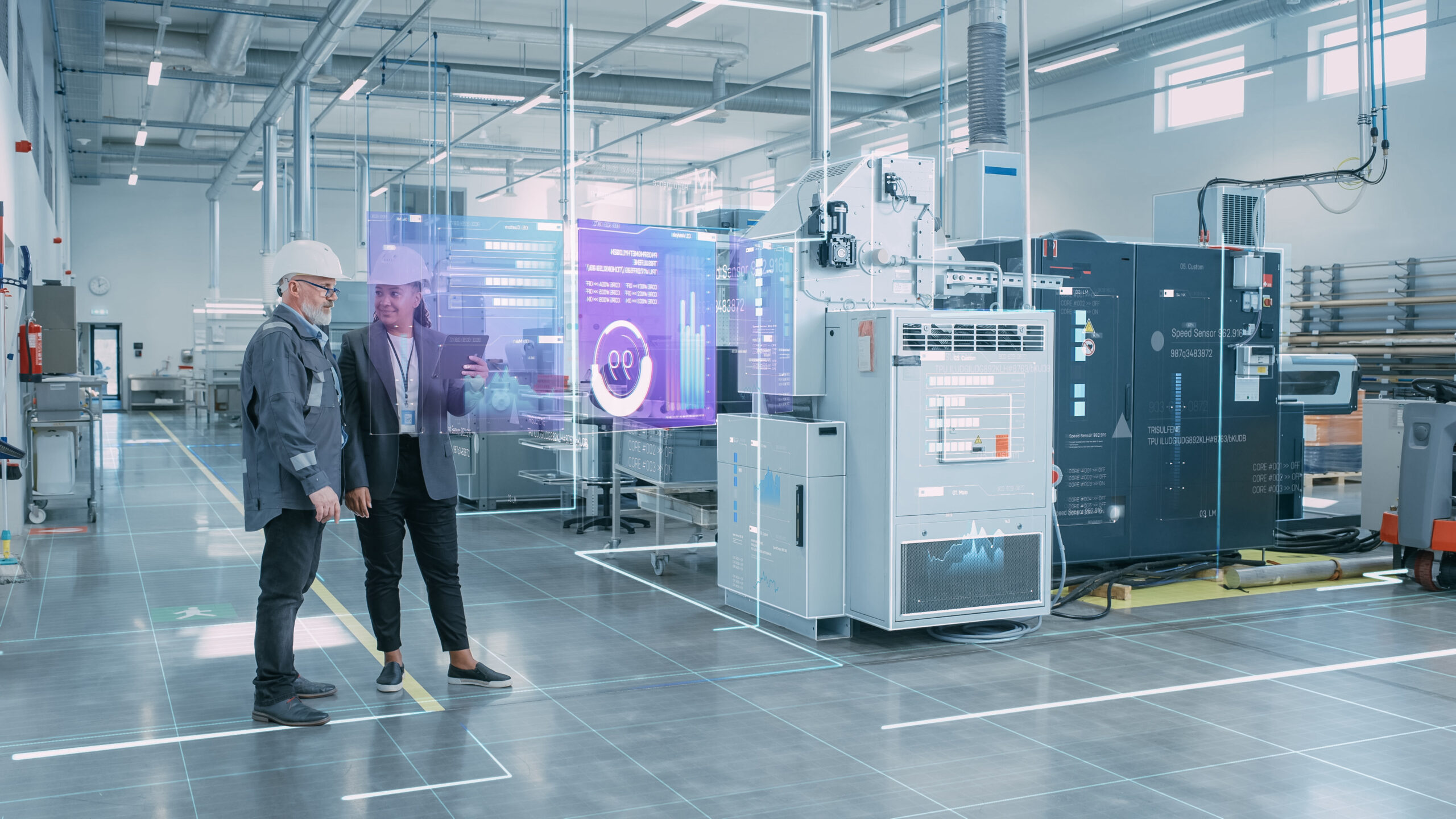
Manufacturers generate thousands of documents every year, including engineering drawings, work instructions, BOM revisions, maintenance records, quality reports, and production data. Finding the right information quickly is often harder than creating it.
GrayCyan builds manufacturing AI solutions that automate batch record creation, generate shift summaries, retrieve engineering knowledge with citations, manage BOM version history, and produce operational reports using live business data.
These systems fit into existing workflows so engineers, supervisors, and operations teams spend less time searching for information and more time acting on it.

Food Manufacturing and CPG Brands
Food manufacturers operate under strict quality and traceability requirements where documentation is as important as production itself.
For food manufacturing and CPG brands, GrayCyan develops generative AI systems that create USDA and FSMA documentation, support co-packer traceability, verify allergen information across product lines, recalculate recipe costs when ingredient prices change, and combine supply chain information from multiple business systems.
The objective is to reduce manual paperwork while improving consistency and audit readiness.

Industrial Distribution and Technical Sales
Industrial distributors manage large product catalogs, technical manuals, customer specifications, and years of project history. Sales and support teams often spend valuable time searching for information instead of helping customers.
GrayCyan builds retrieval systems that allow employees to search OEM manuals, engineering documentation, pricing history, and product catalogs using natural language.
Teams can quickly answer application questions, locate historical project information, and recommend products based on accurate internal knowledge rather than memory alone.

B2B Professional Services
Knowledge-intensive businesses often struggle with repetitive document preparation and fragmented information across multiple platforms.
GrayCyan develops generative AI applications that automate proposal creation, review contracts, prepare client documentation, summarize meetings, and organize institutional knowledge across departments. These systems reduce repetitive administrative work while giving consultants and technical specialists faster access to the information they need.

Regulated Industries
Organizations in aerospace, defense, pharmaceutical manufacturing, and other regulated sectors face additional requirements around security, compliance and data control.
GrayCyan designs air-gapped generative AI environments, audit-trailed workflows, and secure document retrieval systems that keep sensitive information inside your infrastructure.
Every deployment is built with governance, access controls, and compliance requirements in mind so AI supports regulated operations without creating unnecessary risk.
If your industry is not listed, it likely means we have not built a dedicated case study page for it yet, not that we have not worked in it. Talk to us about your specific use case, and we will help determine whether generative AI is the right fit for your operation.
Industry not listed? We have probably built inside it.
Talk to us about your specific use case, and we will help determine whether generative AI is the right fit for your operation.
What Makes Us a Different Kind of Generative AI Development Company
Many companies can build an AI demonstration. Far fewer can build a system that continues to perform when it is connected to production data, legacy software, compliance requirements, and employees who depend on it every day. That is where GrayCyan approaches projects differently.
Built for Operations, Not Demonstrations
Many AI projects perform well in controlled demonstrations because the data is clean and the workflow is simple. Manufacturing environments rarely look like that. Data comes from different systems, documents exist in multiple formats, and decades of business knowledge are often stored in places that were never designed for AI.
GrayCyan builds systems that work within those conditions. We account for inconsistent data, legacy applications, regulated processes, and the practical realities of day-to-day operations before development begins.
Manufacturing and B2B Experience from Day One
Our team does not spend the first few months learning basic manufacturing terminology. GrayCyan's founder has a chemical engineering background with hands-on operational experience, and our projects have included USDA-regulated food manufacturers, aerospace programs, industrial distributors, and large ERP modernization initiatives.
We understand batch records, BOM revisions, HACCP documentation, engineering drawings, supplier documentation, and production workflows because these are the environments we build for.
Custom Systems, Not Chatbot Wrappers
There is a significant difference between placing a chatbot interface on top of a public language model and designing a complete generative AI solution around your business.
GrayCyan builds retrieval architectures, custom workflows, agent orchestration, evaluation pipelines, and integrations that connect directly with your existing systems. Every solution is designed around your documents, your data, and the way your teams already work.
You Own Everything We Build
Many AI platforms require ongoing licensing costs and create long-term dependence on the original vendor.
GrayCyan takes a different approach. The code, infrastructure, integrations, embeddings, and supporting components developed during your project belong to your organization. You retain ownership of the solution without recurring licensing fees on the systems we build together.
Every Engagement Starts with AI Readiness
Building AI before understanding your data is one of the fastest ways to waste time and budget. Before development begins, GrayCyan conducts an AI Readiness Assessment to evaluate your operational data, existing systems, documentation quality, and business priorities.
The assessment identifies where generative AI is likely to produce measurable value, highlights potential data issues early, and provides a clear roadmap before any development work starts.
This structured approach has been independently validated by IT Brew and BetaNews and has been applied across more than 150 organizations. It helps clients invest in projects that have a realistic path to production instead of pursuing technology for its own sake.
Our Generative AI Development Process, How We Build
GrayCyan's generative AI development process starts with operational reality, not a software demo or abstract requirements document. Most failed AI projects begin with assumptions about data quality and system readiness that are only tested after months of development. Our process is designed to surface those issues early and build systems that can operate in real conditions.
Initial use cases are typically deployed in 6 to 10 weeks after the assessment phase, followed by phased expansion into additional workflows and systems. Across all steps, the objective remains the same: build generative AI that works inside your operation, not beside it.
AI Readiness and Use Case Assessment
We begin by mapping your data sources, including ERP systems, document repositories, production systems, and external tools. We assess how accessible and consistent that data is, and identify where generative AI can create measurable value.
The goal is to find one or two high impact use cases that are realistic to implement, not a long list of theoretical possibilities. We also provide a go or no go recommendation so you understand feasibility before investment begins.
Data Architecture and Retrieval Design
Once a use case is defined, we design how information will be structured for AI use. This includes documents such as PDFs, engineering drawings, ERP exports, manuals, and spreadsheets.
We define how this data is broken into usable components, how it is indexed, and how relationships between documents are preserved. This step is critical for systems that rely on RAG AI in manufacturing, where accuracy depends on how well information is retrieved and connected.
Model Selection and Fine Tuning
We evaluate foundation models such as GPT, Claude, Llama, and Mistral based on your requirements for accuracy, latency, cost and data privacy. In regulated environments, we also design on premises or private deployments from the beginning.
Where needed, models are fine tuned using your domain data, including engineering terminology, operational language, and compliance requirements. This ensures the system responds in a way that matches your business context instead of generic public knowledge.
Agent Design and Workflow Integration
For systems that go beyond answering questions, we design AI agents that perform structured tasks. These agents can generate documents, route approvals, extract data from multiple systems, or trigger actions through APIs.
Every workflow is defined with clear boundaries. The system can suggest actions, but approvals are controlled through human in the loop checkpoints where required. This is especially important in ERP connected environments where accuracy and traceability matter.
Validation, Guardrails, and Go Live
Before deployment, we run evaluation cycles with subject matter experts from your team. These are real users testing real questions and real documents.
We measure accuracy, consistency and citation quality, and refine the system until it meets operational expectations. Guardrails are implemented to reduce hallucinations and ensure outputs remain traceable. Only then is the system deployed into production.
Client Results, Generative AI in Production
GrayCyan's generative AI systems are built for live operational environments, not controlled pilots. The focus is always on systems that handle real documents, real workflows, and real constraints found in manufacturing, regulated industries, and B2B operations.

Air-Gapped Engineering Retrieval for a Regulated Manufacturer
A defense adjacent manufacturer needed access to decades of engineering drawings, specifications, and technical documents that were previously searchable only through manual file lookup or tribal knowledge.
GrayCyan built an on premises generative AI system with OCR processing for scanned drawings, vector embeddings for semantic search, and a retrieval layer that connects related documents across revisions and part relationships.
The system allows engineers to ask operational questions in natural language and receive answers with direct citations to source drawings and specifications. It also links related components so a search for one part surfaces all connected documentation across the system. The deployment runs entirely inside the client environment.
AP Automation Agent for Multi System Finance Operations
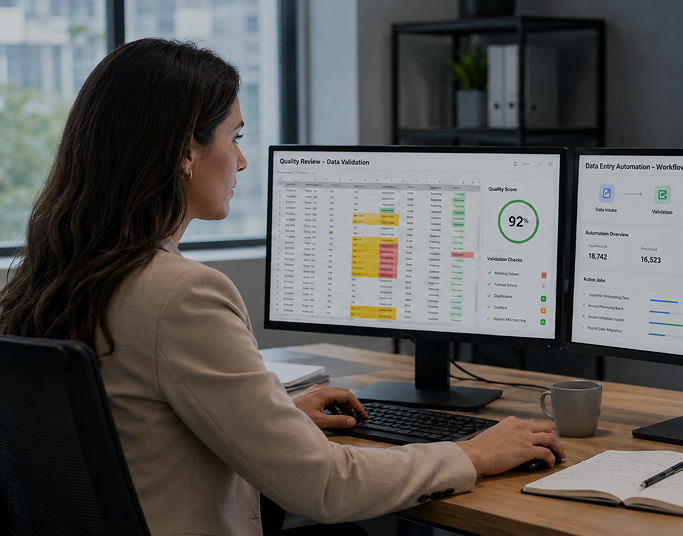
A regulated manufacturing organization with fragmented finance systems was spending significant time matching invoices against purchase orders and receipts across a mainframe system and a modern ERP during an ongoing migration.
GrayCyan built a workflow agent that extracts invoice data, validates it against both systems, and proposes payment decisions based on matching rules. Exceptions are flagged for human review with full traceability of why a record was flagged.
One high volume vendor process alone previously required roughly 16 hours per month of manual reconciliation work. That workload was reduced significantly through automation while maintaining audit controls.

Access Industrial Reporting Automation
In a separate deployment for Access Industrial, engineering proposal reporting that previously required up to 8 hours of manual effort was reduced to approximately 30 minutes through automated data extraction and structured generation workflows.
The system pulls relevant project data, formats it into standardized reporting structures, and prepares documentation for internal and client use without manual compilation.
Across all of these implementations, the outcome is consistent. These are not prototypes or proof of concept systems. They are production deployments running inside real operational environments with measurable reductions in manual effort and processing time.
Frequently Asked Questions: Generative AI Development Company
Ready to Build Generative AI Around Your Operation?
Tell us what your team is doing manually today that could be generated, automated, or answered by a system that understands your documents and your workflows. We will show you what generative AI can realistically do for that use case, and where it will not be effective.
GrayCyan has built generative AI systems in air gapped defense environments, USDA regulated food plants, and multi system ERP operations. If your environment has constraints, we have likely built inside them before.
Not sure if you are ready? Start with our AI Readiness Assessment →