- 2026 Comprehensive Guide
AI in Manufacturing: Examples, Use Cases & Applications
Explore how AI in manufacturing is transforming the work process with real-world examples, use cases & applications across predictive maintenance, quality control, supply chain & more.
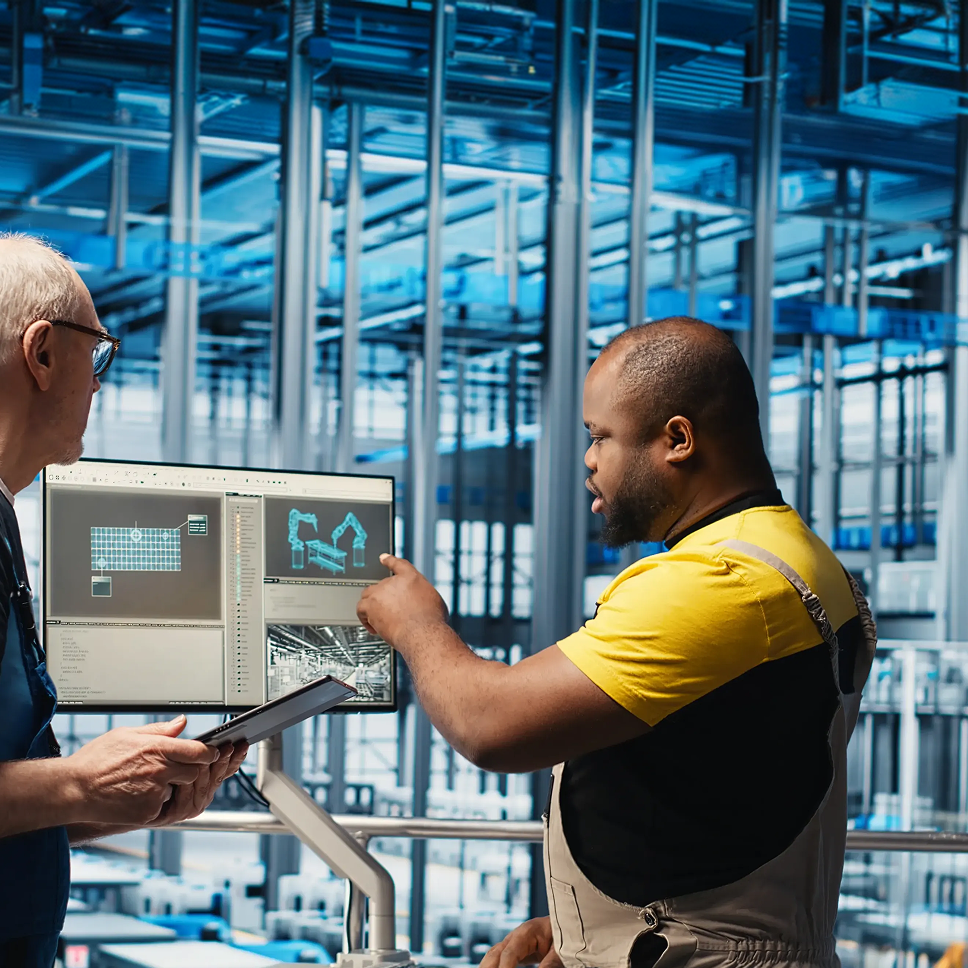
10% – 20%
roductivity Improvement
Up to 90%
Defect Detection Improvement
20% – 30%
Inventory Cost Reduction




executive summary
Artificial intelligence (AI) has brought transformational changes to manufacturers for managing their processes of manufacturing, quality management, maintenance, and decision-making. Nonetheless, the journey from mere interest to successful adoption is not easy.
According to industry studies, while 89% of manufacturers are planning to implement AI in manufacturing, only 16% of them were able to implement the technology successfully. It is usually because of disconnected systems, unstructured data, and unclear implementation rather than a lack of technology that makes AI difficult to implement.
This is where a practical real-life deployment becomes really important. GrayCyan acts as a bridge by focusing on operational AI that is compatible with the existing setup and does not require expensive hardware or infrastructure changes. Explore our AI manufacturing solutions built for real industrial operations.
What Is AI in Manufacturing?
“What is AI in manufacturing” this is a common question in today’s digital world where almost everything is now connected with Artificial intelligence. Artificial Intelligence in manufacturing refers to leveraging smart technology for optimizing production, minimizing mistakes, and enabling more better decision-making based on analysis and automation. Unlike relying solely on manual techniques, AI in manufacturing industry learns from real time data and delivers insights that are helpful during the production process. AI in manufacturing leverages multiple techniques to boost efficiency.
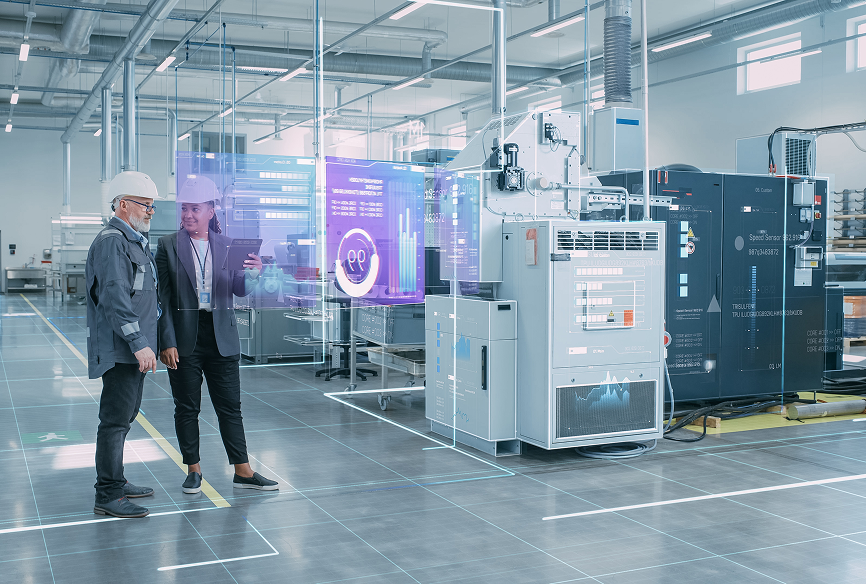
01 Machine Learning involves analyzing data and predicting results, such as equipment failure or a change in consumer demand.
02 Computer Vision analyzes images captured by cameras and is used in product inspection and defect detection.
03 NLP enables machines to understand natural language in both written and spoken forms for report or communication tasks.
04 On the other hand, Gen AI enables machines to generate recommendations, reports, and other content from the available data.
04 Lastly, agentic AI completes tasks and makes decisions in line with pre-set objectives.
As AI in the manufacturing industry keep rising, GrayCyan offers AI applications that are more operational in nature and integrate into a business’s process without the need for it to overhaul its hardware and processes from scratch. Learn more about our approach to AI for manufacturing industry.
Let’s
Talk
Book your manufacturing AI strategy session
How Is AI Used in Manufacturing?
Now that we know what AI is in manufacturing, you must be wondering how is AI used in manufacturing industry. The use of AI in manufacturing is applied in order to improve processes, eliminate operational delays, enhance quality, and facilitate good decision-making. Companies use AI technology to analyze large sets of information and detect patterns that will help to predict future occurrences or problems and even automate some tasks.
| Area | What AI Does | Business Impact |
|---|---|---|
|
Production |
Optimizes schedules and production flow |
Higher productivity and lower downtime |
|
Quality |
Detects product defects using image analysis |
Better quality control and reduced waste |
|
Supply Chain |
Predicts demand and inventory needs |
Improved planning and fewer shortages |
|
Engineering |
Analyzes designs and process performance |
Faster development and process improvements |
|
Maintenance |
Predicts equipment failures before breakdowns |
Lower repair costs and reduced interruptions |
|
Workforce |
Supports staffing, training, and task allocation |
Improved efficiency and resource use |
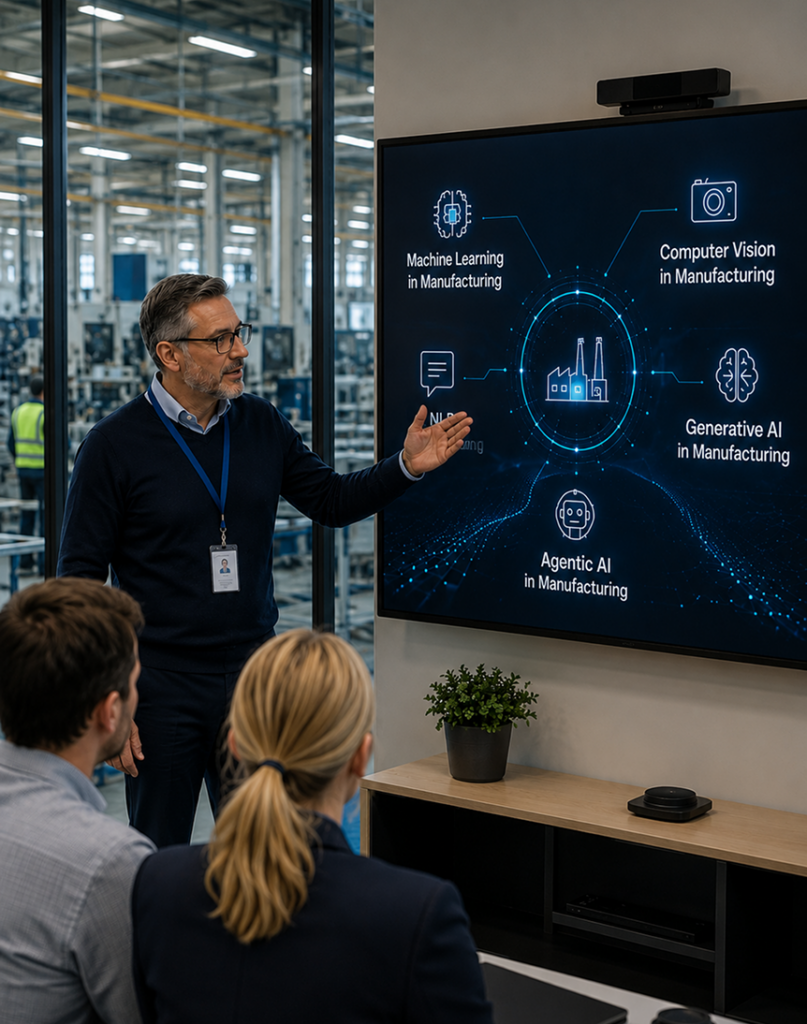
Types of AI Technologies Used in Manufacturing
|
Machine Learning in manufacturing industry examines production data to learn production processes and make predictions based on previous results. |
|
Computer Vision uses computer-based vision to check manufactured goods and detect any errors or areas for improvement. |
|
NLP allows machines to comprehend text and speech. In the manufacturing industry, it enables operations such as interpreting maintenance records. |
|
Generative AI produces reports, summaries, directions, and recommendations using operational data. |
|
Agentic AI makes independent decisions by following objectives and criteria. |
| Technology | What It Does | Manufacturing Example |
|---|---|---|
|
Machine Learning |
Learns patterns from data |
Predictive maintenance alerts |
|
Computer Vision |
Inspects images and products |
Defect detection on production lines |
|
NLP |
Understands language and text |
Maintenance report analysis |
|
Generative AI |
Creates content and insights |
Automated production summaries |
|
Agentic AI |
Performs actions based on goals |
Dynamic workflow management |
AI Use Cases in Manufacturing

Predictive maintenance powered by AI — reducing unplanned downtime across manufacturing operations
- Maintenance
01 Predictive Maintenance:
AI gathers data from IoT sensors, machine logs, temperature measurements, vibration data, and performance history to forecast the odds of a malfunction occurring before it causes interruptions.
- Quality
02 AI-Powered Quality Control:
Computer vision systems rely on cameras and image recognition to continually scan products and identify any scratches, missing parts, or wrongly assembled products in real time.
- Supply Chain
03 Supply Chain Optimization:
AI algorithms take into account past sales history, supplier information, seasonal changes, and logistical factors when developing demand predictions and inventory plans.
- Production
04 Production Scheduling & Workflow:
Automated work in progress tracking, shift report generation, and identifying bottlenecks in operations. See our AI workflow automation software.
- Engineering
05 Engineering and BOM Management:
AI technology is capable of analyzing information provided in technical drawings, coordinating ERP and PLM platforms, and pinpointing discrepancies between different versions of products.
- Inventory
06 Inventory Management:
AI systems constantly monitor inventory levels while making predictions based on consumption patterns for improved visibility and fewer shortages.
- Gen AI
07 Generative AI in Manufacturing:
AI technologies provide document summarization, generation of RFQs, product search engines, and management of operational information.
- Robotics
08 Cobots & Intelligent Automation:
Robots designed to understand movements, their surroundings, and perform repetitive tasks with the help of AI models and sensors to increase productivity.
- Simulation
09 Digital Twins:
AI utilizes data from real-world operations to simulate procedures, changes, and the outcome of implementation prior to being adopted in factories.
- Workforce
10 Workforce & Shift Intelligence:
AI technology creates shift reports, safety monitoring, and unifies the operational outlook for management purposes — replacing scattered spreadsheets and manuals.
Let’s
Talk
Book your manufacturing AI strategy session
AI in Manufacturing Examples

AI-powered supply chain optimization — smarter procurement and demand forecasting
| Company | Industry | AI Application | Result |
|---|---|---|---|
|
BMW |
Automotive |
AIQX platform for quality inspection and defect detection |
Faster identification of production issues and improved quality consistency |
|
Ford |
Automotive |
AI-powered robotic arms and intelligent automation |
Improved assembly-line efficiency and support for repetitive tasks |
|
Rolls-Royce |
Aerospace |
Digital twins and predictive maintenance systems |
Better engine monitoring and reduced unexpected maintenance events |
|
GE |
Industrial Manufacturing |
Proficy Sustainability and operational analytics |
Improved operational visibility and data-driven decisions |
|
Industrial Services |
AI-assisted proposal and document workflows through GrayCyan |
Proposal creation time reduced from
~8 hours to 30 minutes |
|
|
Food & Beverage |
Operational AI workflow improvements |
Faster information handling and more streamlined business processes |
Machine Learning in Manufacturing
|
Predictive maintenance assists in identifying potential problems in machines before they actually fail. |
|
Quality control discovers faults in products using pattern recognition. |
|
Demand forecasting forecasts future demand and requirements for inventory management. |
|
Process optimization streamlines the production process and reveals inefficiencies. |
|
Energy forecasting calculates future energy consumption and facilitates cost-cutting. |
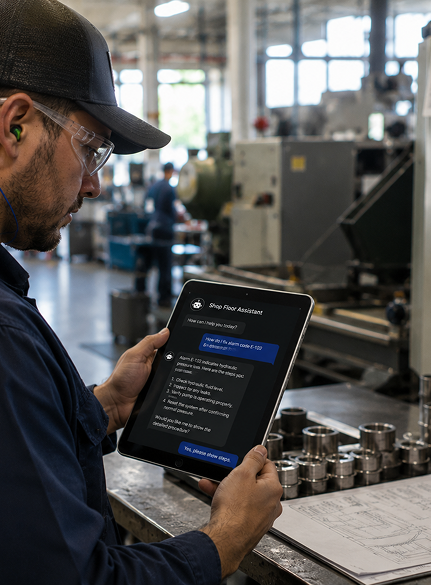
01 AI
Mimics decision-making and automation
02 ML
Learns patterns and predicts outcomes
03 Generative AI
Creates content and recommendations
GrayCyan can extract specifications from engineering drawings, identify inconsistencies in ERP data, and maintain accurate BOM versions. Learn how our RAG AI for manufacturing makes this possible.
The importance of ML adoption in manufacturing
Chart 1
Average improvement through machine intelligence, by KPI
McKinsey — Toward
smart production, 2022
Bottom 50%
Top quartile
Efficiency
Factory
+13%
Labor
+11%
Equipment
+9%
Cost
Operating
+7%
Warehousing
+5%
Quality
+12%
Inventory
+8%
Product
+5%
Revenue
Revenue
+6%
Demand acc.
+5%
Responsiveness
Lead time
+9%
Speed mkt
+14%
Design time
+13%
Lot size
+9%
Changeovers
+10%
Customer exp.
Service
+9%
NPS
+7%
Complaints
+7%
Environmental
Env. impact
+16%
Energy
+14%
Satisfaction
+8%
Chart 2
Companies investing in digital factories
PwC — Digital Factories 2020
01
9%
Digital factory not planned No digitisation initiatives
02
41%
Stand-alone digital solutions Digital tech used in silos
03
44%
Partially integrated factory 91% total potential
04
6%
Fully integrated digital factory End-to-end connected

Let’s
Talk
Book your manufacturing AI strategy session
Benefits of AI in Manufacturing

Key benefits of AI in manufacturing — efficiency, cost savings, quality and supply chain resilience
Measured impact
10-20%
Productivity
improvement
~14%
Cost savings
average reduction
up to 90%
Defect detection
error reduction
20-30%
Inventory costs
reduction
~90%
Reporting eff.
process improvement
10-15%
Energy savings
efficiency gains
01 Enhanced Efficiency and Higher Throughput:
Manufacturers adopting AI-based manufacturing solutions can achieve productivity improvements ranging between 10%–20%.
02 Cost Savings:
Organizations using AI report average cost savings of about 14% through predictive maintenance, decreased downtime, and optimized staffing.
03 Improved Product Quality:
Computer vision systems may cut down defect detection errors by up to 90%.
04 Supply Chain Resilience:
Enhanced forecasting helps reduce inventory costs by 20%–30%, while making products more readily available.
05 Better Decision-Making:
AI analyzes large amounts of operational data with real-time insights so managers can act faster.
06 Improved Worker Safety:
AI identifies potentially unsafe situations and monitors hazardous areas, ensuring fewer accidents.
07 Energy Efficiency:
Many companies reported saving around 10%–15% of energy as a result of AI monitoring systems.
08 Competitive Advantage:
Companies that utilize AI tend to adapt to changes and customer requirements faster compared to their competitors.
According to GrayCyan clients, companies have experienced as much as 90% improvement in reporting processes and operation improvements of around 2x from AI utilization.
Challenges of AI in Manufacturing
Research data
The bottlenecks of AI adoption in manufacturing
Source: O’Reilly Media — AI Adoption in the Enterprise, 2021
19%
Lack of skilled people
18%
Data quality issues
17%
Identifying use cases
14%
Company culture
12%
Technical infrastructure
8%
Not applicable
6%
Legal / compliance
3%
Workforce reproducibility
2%
Hyperparameter tuning
Data Quality and Availability:
Data is often scattered among different sources like workbooks, machines, logs, and mainframe programs. Incorrect or missing data hampers AI reliability.
First, organize and clean operational data before scaling AI projects. GrayCyan's data connections and system integration services can help.
Skills Shortage and Talent Gap:
Manufacturers often don't have people with AI and data analytics experience, making implementation and long-term management difficult.
Use AI partners and platforms designed for practical business users rather than highly specialized teams.
Integration with Legacy Systems:
Existing ERP systems and machines might not be compatible with new AI tools, increasing project complexity and cost.
Adopt solutions that allow you to keep running your present systems while still benefiting from AI.
Cybersecurity Concerns:
Connected devices and AI platforms can raise security risks if not supported by strong data protection policies.
Use robust security measures. See how GrayCyan handles monitoring accuracy and compliance.
High Initial Costs:
Initial expenses on software development and process changes can be problematic, especially for smaller manufacturers.
Start with a small use case that delivers tangible results and then scale up.
Let’s
Talk
Book your manufacturing AI strategy session
Future of AI in Manufacturing
AI will undertake processes such as planning, coordinating production, tracking workflow, and making decisions without much human assistance.
02 Generative AI for Document Intelligence
Generative AI for manufacturing will keep increasing in document summarization, RFQ generation, procurement, and rapid data access.
03 AI Native Factories as Standard
AI integration will become part of regular factory processes — real-time data and decision-making systems as the everyday standard.
04 Human + AI Collaboration
AI will assist workers rather than replace them. Workers handle strategic tasks; AI takes care of repetitive processes.
How to Implement AI in Manufacturing

AI-powered inventory management — real-time visibility and fewer stockouts
Stage
01 Foundational Intelligence
Document extraction, ERP updates, daily logs, procurement drafting
Manufacturers starting with disconnected systems
Faster information handling and reduced admin workload
Digitizing documents, streamlining procurement tasks, and pulling structured information from the company's database. Reduced manpower efforts and quicker information access.
Stage
02 Operational Intelligence
Multi-step automation across supply chain, production, quality, engineering
Companies improving operational efficiency
Reduced delays, better visibility
AI implemented in interconnected workflows for different departments. Automate mundane operations, eliminate bottlenecks, and facilitate communication.
Stage
03 Human-Led Autonomous Operations
AI connecting ERP, PLM, MES, scheduling platforms, vendor systems
Organizations seeking fully connected operations
Real-time decision-making and unified intelligence
AI works as a layer of operational intelligence integrated into different systems and departments with continuous information flow.
Assess Your AI Maturity Now with GrayCyan.
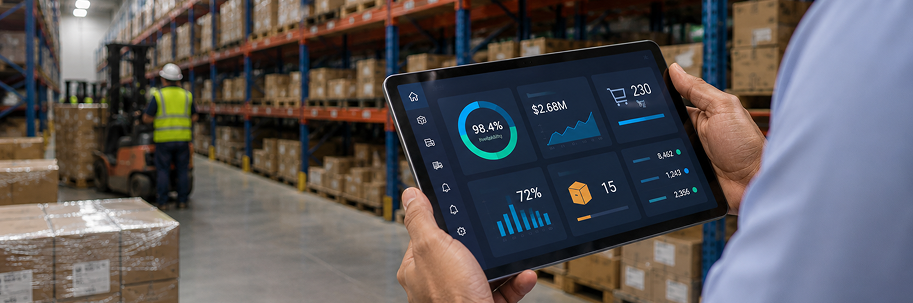
AI-driven production planning and scheduling — optimizing throughput and reducing delays
Top AI Tools & Platforms for Manufacturing
| Category | Examples | What It Does |
|---|---|---|
|
Predictive Maintenance Platforms |
Machine monitoring systems, sensor analytics tools |
Predicts equipment failures and reduces downtime |
|
Quality Inspection / Computer Vision |
AI vision systems, defect detection platforms |
Identifies defects and improves product quality |
|
Supply Chain AI |
Forecasting and inventory optimization platforms |
Improves demand planning and reduces disruptions |
|
ERP-Integrated AI |
SAP, Oracle, Infor, Epicor |
Connects AI with operational and business data |
|
Generative AI Copilots |
AI assistants and workflow copilots |
Creates reports, drafts documents, improves information access |
Let’s
Talk
Book your manufacturing AI strategy session
AI in Manufacturing FAQ
What is AI in manufacturing?
AI for manufacturing includes a number of artificial intelligence techniques to enhance the workings of a manufacturing company via automation and predictive analytics. Applications include manufacturing procedures, quality control, supply chain management, maintenance tasks, and managerial decisions.
What is an example of AI in manufacturing?
BMW utilizes an AIQX platform to detect and monitor defects in its manufacturing processes. Rolls-Royce uses digital twins and predictive intelligence to monitor engine maintenance.
How is AI used in manufacturing?
AI provides various functions such as production planning and scheduling, quality control, supply chain planning, engineering processes, predictive maintenance, and staffing — all using data analysis to identify patterns and assist in quick decision-making.
Which companies use AI in manufacturing?
BMW, Ford, GE, and Rolls-Royce are major adopters. Smaller companies are also adopting AI due to developments in workflow technologies that improve operational efficiency.
What are the most common AI use cases in manufacturing?
Predictive maintenance, quality assurance, logistics planning, demand forecasting, inventory planning, and production process automation are the most common and measurable AI use cases.
What is the difference between AI and ML in manufacturing?
Machine Learning is a part of AI. ML involves using past and present data to learn and enhance prediction accuracy. AI is the broader term covering automation, intelligence, language understanding, and decision-making systems.
How can generative AI help in manufacturing?
Generative AI helps with documentation, RFQ creation, procurement, and information seeking — avoiding redundant tasks and enabling faster information processing.
What are the biggest challenges of AI in manufacturing?
Low-quality data, inadequate skills, integration issues, cybersecurity problems, and high implementation costs. Most companies address these by implementing small use cases first before scaling up.
How many manufacturing companies use AI?
Roughly 68% have undertaken AI projects, about 89% intend to pursue AI strategies, but only about 16% have successfully accomplished implementation goals.
How do I get started with AI in manufacturing?
Start by identifying a specific problem. Try AI for a small focused project, measure results, then scale further.
Which AI stage is your factory in?
GrayCyan uses a 3-step approach from foundational AI to operationalized intelligent systems. Companies using this pragmatic approach have seen up to 90% improvements in reporting efficiency.
Assess Your AI Maturity With GrayCyan Today!
Contributor:

Nishkam Batta
Editor-in-Chief – HonestAI Magazine
AI consultant – GrayCyan AI Solutions

Nish leads an applied AI company that helps manufacturing and related companies automate operations with human-in-the-loop AI that integrates into ERPs, WMS, CRMs, and other enterprise tools, with an emphasis on no black box AI (explainable AI), clear audit trails, driving efficiency, and measurable outcomes. His team builds agentic ERP systems that execute multi-step tasks inside approved guardrails so humans keep accountability, approvals, and override control.
As featured in