Manufacturing AI Solutions That Work Without Replacing Your ERP

GrayCyan delivers practical manufacturing AI solutions that automate quality control, ERP workflows, compliance, and supply chain operations. 

Our AI automation solutions for manufacturing work alongside your existing systems — without replacements, shutdowns, or lengthy implementations. Built for mid-market manufacturers who need results in 30–60 days, not 12 months.

Trusted by and Featured in
all logos
Understanding AI in Manufacturing

What Is AI in Manufacturing?

AI in manufacturing simply put is the use of artificial intelligence to help manufacturers make better decisions, automate repetitive tasks and improve operational efficiency. Rather than replacing people, AI supports teams in working faster by analyzing large amounts of data, identifying various patterns, answering questions and fuelling day-to-day workflows across engineering, quality, maintenance, operations and technical sales.

Unfortunately AI is misunderstood and scares people. Most of them happen to think that AI is here to replace them, when the truth is far from this. Using AI does not equate to replacing your ERP system, shutting down production lines or investing in entirely new hardware. In most cases, AI is like an acceleration tool that works alongside the systems manufacturers are already using, including ERP platforms, engineering databases, document repositories, quality systems and operational workflows. The goal is not to rebuild processes from scratch but to make existing ones more efficient.

And this growing demand is reflected by the market. According to Fortune Business Insights, the global AI manufacturing market is projected to grow from $9.85 billion in 2026 to $128.81 billion by 2034. This sheds light on how rapidly manufacturers are investing in operational improvements that are caused by AI-driven systems.

The opportunity to use AI is especially significant for mid-market manufacturers. Unlike large enterprises having dedicated AI teams and multi-million dollar budgets that lead to massive transformations, mid-market operators are always on the lookout for practical solutions that deliver results that are measurable without prolonged implementations or major investments in infrastructure.

For most manufacturers, the biggest opportunities do not exist on the shop floor but get easily lost in knowledge silos, disconnected systems, manual processes and engineering workflows that slow down decision-making. These are exactly the operational challenges that GrayCyan helps manufacturers solve with AI.

$128B Projected market size by 2034
(Fortune Business Insights)
30–60 Days to first live workflow
with GrayCyan
150+ Manufacturers assessed through
GrayCyan's AI Maturity Model

AI Myths vs. Reality for Manufacturers

❌  Myth ✅  Reality
AI will replace your team and eliminate jobs on the floor. AI handles repetitive data work so your team can focus on higher-value decisions and engineering work.
You need to replace your ERP system to use AI. GrayCyan connects as an intelligence layer on top of your existing ERP — no replacement required.
AI implementations take years and disrupt production. First workflows go live in 30–60 days, alongside live production with zero downtime.
AI is only for large enterprises with big budgets. Mid-market manufacturers get the most measurable impact — GrayCyan is built specifically for operations at this scale.

PROBLEMS WE SOLVE

What leading manufacturers come to us to fix

If any of these sound like your operation, you’re in the right place.

01

"If our key person leaves, everything stops."

Critical knowledge — quotes, specs, SOPs, vendor terms —lives in one person’s head. When they’re out, so is your operation. And every new hire starts from scratch.

Knowledge Dependency

02

"We waste hours moving data between systems that don't talk."

Your ERP, QC logs, procurement sheets, and scheduling tools are siloed. Your team manually bridges every gap — creating double-entry errors and reconciliation nightmares.

System Fragmentation & Manual Work

03

"Compliance errors cost us real money. Audits are a nightmare."

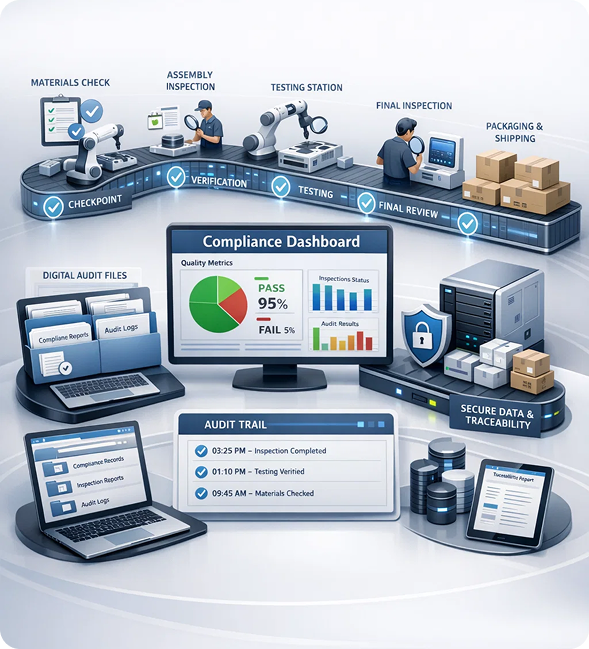
Manual data transfer in regulated environments means mislabeling, missed records, and costly reruns. When an auditor/inspector shows up, nothing is ready and everything is at risk.

Compliance & Quality Risk

Built for Manufacturing

Industrial AI — Built For The Factory Floor

Industrial AI is significantly different from generic AI. Generic AI understands language — industrial AI understands shift reports, sensor logs, machine downtime, and BOM versions. It is designed to operate within the realities of manufacturing environments, where critical information is spread across production systems, maintenance records, quality documentation and operational workflows — and needs to flow automatically, not manually.

Maintenance

Handwritten notes → structured ERP entries

A technician's handwritten maintenance note is automatically extracted, structured, and logged into the ERP system — eliminating manual data entry and reducing transcription errors at the source.

Production

Auto-generated shift handover summaries

Using live WIP data, shift handover summaries are generated automatically — giving incoming teams immediate visibility into production status, open issues, and priorities without a supervisor spending an hour compiling reports.

Compliance

Labeling errors caught before the line

In food manufacturing, AI compares labeling data against production records in real time — flagging mislabelled ingredients before they reach the line, preventing costly rework and compliance violations.

Zero
New hardware required
GrayCyan works with data already in your existing systems — no sensors, no new infrastructure
Day 1
Operational visibility
Teams get accurate shift data and production status from the first deployment — no ramp-up period
100%
Audit traceable
Every AI action, extraction, and decision is logged — so your team stays accountable and compliant
Generative AI

Generative AI in Manufacturing — What It Means For Your Operation

Generative AI for manufacturing is different from the consumer AI tools most people are already familiar with. In a manufacturing environment, generative AI means systems that automatically create outputs based on data that is already flowing through your operation. It generates reports, summaries, documents, recommendations, and workflow outputs that teams would otherwise create manually, rather than simply analyze information.

The value is not in generating generic content but in transforming operational data into useful outputs that support engineering, quality, procurement, maintenance and production teams. By reducing administrative work, manufacturers can focus more time on decision-making and execution.

📋

Audit-ready CAPA packets

Created directly from QC floor data — structured, linked to supporting records, and ready for an auditor without manual document assembly.

📝

RFQ drafts from BOM data

Draft an RFQ using an approved supplier list and BOM — reducing procurement prep time from hours to minutes.

🔄

Night-shift handover summaries

Generated from WIP and scheduling systems — giving incoming teams a complete, accurate handover without supervisor effort.

🔍

Structured inspection reports

Handwritten technician notes automatically structured into inspection reports — moving directly from the production floor into an audit-ready packet, reducing administrative effort and improving compliance readiness.

It's important to remember that this is not AI that chats — this is AI that works. Generative AI in manufacturing transforms operational data into useful outputs that your teams can actually act on.

Hours → Minutes

Administrative tasks that once required hours of manual effort are completed automatically with full traceability.

HOW WE SOLVE IT

AI built for how manufacturing actually works

Our workflow agents, and agentic systems work alongside your existing tools — no ERP replacement, no hardware, no production disruption.

icon (10)

Engineering & BOM

Extract specs from drawings, flag ERP inconsistencies, maintain BOM versions across engineering and production.
icon (6)

Quality & Compliance

Extract QC notes, auto-generate inspection reports, prepare audit-ready CAPA packets. Zero manual transcription.
icon

Agentic Systems

Multi-system orchestration —connecting ERP, PLM, MES, quality, and vendor platforms into end-to-end coordinated workflows.
icon (5)

Production & Scheduling

WIP updates, shift summaries, bottleneck detection, and schedule suggestions — auto-generated across shifts.
icon (7)

Supply Chain & Procurement

Compare vendor quotes, draft RFQs, reconcile PO→GRN→Invoice, and predict delays before they hit production.
icon (9)

Maintenance & Asset Health

Predictive maintenance triggers, risk scoring, downtime classification — from logs and sensor data already in your system.
ERP AI Integration

ERP AI Integration — No Replacement Required

The first question we hear from every manufacturer is — "Do we have to replace our ERP?" And the answer thankfully is no.

Most manufacturers have invested years configuring their ERP systems around their operations. It is extremely expensive, disruptive as well as unnecessary to replace those systems. The good news is that GrayCyan uses an ERP AI integration approach that connects to your existing systems as an intelligence layer on top.

To put into simpler words, our AI reads data from your ERP and related systems, triggers workflows based on business rules and writes validated results back into the systems that your team already uses.

This enables manufacturers to add AI-powered automation, compliance workflows, reporting and operational intelligence without rebuilding their technology stack.

GrayCyan works with
Oracle
SAP
Epicor
Infor
Microsoft Dynamics
Odoo
Fishbowl
+ others
Take Our Free AI Readiness Assessment →

For manufacturers evaluating AI implementation, the goal should not be replacing systems that already work. Instead, it should be extending their value with automation and intelligence.

The impact can be monumental. In one Fishbowl ERP deployment, GrayCyan reduced manual data entry by 85%, cutting daily manual entry time from approximately 12 hours to under 2 hours.

85%
Reduction in manual data entry

Daily manual entry cut from ~12 hrs to under 2 hrs. Automated PO imports, syncing, and reconciliation created one unified data workflow — improving accuracy and freeing teams for higher-value work.

Read the Fishbowl ERP case study →

If you have an ERP, GrayCyan connects to it. You keep what's working — we add what's missing.

WHY GRAYCYAN

What actually sets us apart

Not ERP compatibility. Not generic “industry experience.” These are the five reasons manufacturers choose us over everyone else. 

icon

Industry-Recognized AI Maturity Model

Validated by BetaNews, IT Brew, and applied across 150+ manufacturers. You know exactly where you stand before we build anything.
icon (1)

Deep Manufacturing Fluency

From USDA meat processing to cannabis to industrial valves to stamping — we speak production floor, not just software.
icon (2)

You Own the IP

Everything we build belongs to you. No vendor lock-in. No licensing fees on the system we built together.
icon (3)

Built Alongside Live Production

We build while you run. No shutdowns, no parallel testing phases that drag on. AI goes live incrementally with zero disruption.
icon (4)

A Founder Who Speaks Your Language

No account managers. Nish — chemical engineer, MBA, 8 years in AI — is present on every engagement from discovery to delivery.

LET'S TALK

If this sounds like your operation, let's have a conversation.

We work with manufacturers who are serious about fixing the friction that’s costing them time, compliance risk, and growth. If that’s you, we’d love to connect.

CLIENT RESULTS

Results from the factory floor

Real outcomes from manufacturers who were exactly where you are now.

90%

faster reporting

Engineering proposals automated

Access Industrial cut proposal prep from 8 hrs → 30 mins, improving accuracy and client trust.

manufacturing ai solutions

2X

client growth

SaaS scalability achieved

Kaizenify doubled its customer base after full-stack rebuild and AI integration.

manufacturing ai solutions

85%

reduction in manual data entry

ERP middleware automation

Fishbowl ERP cut daily manual entry from ~12 hrs to under 2 hrs, created a unified data workflow, and accelerated order processing with automated PO imports, syncing, and reconciliation.

manufacturing ai solutions

90%

Faster proposal generation

Engineering Proposals Cut from 8 Hours to 30 Minutes

Critical knowledge — quotes, specs, SOPs, vendor terms —lives in one person’s head. When they’re out, so is your operation. And every new hire starts from scratch.

ACCESS INDUSTRIAL · MANUFACTURING

65%

Lower 3-year TCO VS. leading ERP

Production Intelligence Without the ERPR eplacement Bill

Full-stack AI proposal delivered $81K–$97K vs. $213K–$237Kcompetitor 3-year cost — covering production, QA, and logistics operations end-to-end.

USDA PROCESSOR

2x

Client growth

Doubled Customer Base After Full-Stack AI Integration

Full rebuild and AI-powered workflow layer enabled Kaizenify to scale operations and onboard clients 2× faster with the same team size.

KAIZENIFY · SAAS PLATFORM

AI Implementation

AI Implementation — How GrayCyan Works

Most AI projects fail because they try to boil the ocean. GrayCyan doesn't.

01

AI Maturity Assessment

Every engagement starts with an assessment of your operational readiness. We evaluate your business across three dimensions — MEI × VEI × AFM — to understand where AI can create the greatest impact and where potential risks exist. Before spending a dollar, you know exactly where you stand and what opportunities are worth pursuing.

Learn more: AI Readiness Assessment →
02

Workflow Design

We identify the two to three manual processes that are costing your organization the most amount of time, risk or money. Rather than applying a generic template, we design AI workflows around your actual operation, systems, data and business objectives to ensure measurable value.

03

Incremental Go-Live

AI is deployed alongside your existing production environment without requiring shutdowns or replacements that cause disruptions to the system. There are no lengthy parallel testing phases. The focus instead is on delivering value quickly, with the first workflow typically live within 30–60 days.

04

Monitoring & Optimization

After deployment, we continuously monitor accuracy, performance and adoption through governance dashboards and operational reviews. The system remains under your control while we help optimize workflows, improve outcomes and support responsible AI implementation over time.

Explore our AI Strategy Readiness framework →
Typical timeline First AI-powered workflow live within 30–60 days — alongside live production, zero disruption.

Modern factories run on information drawings, specs, quotes, WIP updates, QC notes, ERP data, vendor communication, schedules, maintenance logs, and reports. But most of this information still moves through email, PDFs, spreadsheets, and manual entry, causing bottlenecks, errors, and inefficiencies.

GrayCyan helps manufacturers implement practical, operational AI that supports your teams across production, engineering, quality, supply chain, procurement, and leadership. Our AI copilots, predictive engines, workflow automations, and multi-step agents eliminate friction across your operations, without replacing your ERP or introducing complex robotics.

How AI Supports Manufacturing Operations

AI reduces administrative friction, improves data visibility, and keeps production moving — all inside the systems you already use.

Supply Chain, Procurement & Vendor Management

AI reduces the manual coordination behind buying materials, comparing quotes, updating costs, and following up with vendors.

Capabilities:
mask group

Extract and compare vendor quotes automatically

mask group (1)

Auto-update landed cost sheets with new terms

mask group (2)

Draft PRs, RFQs, follow-ups, and reminders

mask group (3)

Maintain supplier scorecards and performance insights

mask group (4)

Predict delays and suggest vendor alternatives

mask group (5)

Reconcile PO → GRN → Invoice automatically

Impact: Faster procurement cycles, fewer discrepancies, and lower supply chain friction.

Supply Chain, Procurement & Vendor Management

AI extracts and compares vendor quotes, updates landed costs, drafts RFQs and follow-ups, maintains supplier scorecards, predicts delays, and reconciles PO–GRN–Invoice workflows automatically.
Impact: Faster procurement cycles with fewer discrepancies and lower supply chain friction.
supply chain automation
ai production scheduling

Production, Scheduling & Daily Coordination

AI keeps your production data current, accurate, and easy to understand so work flows smoothly across shifts and departments.

Capabilities:
mask group (2)

Auto-generate WIP updates, shift summaries, and production logs

mask group (6)

Summarize downtime logs and classify root causes

mask group (24)

Detect bottlenecks or stalled work orders early

mask group (25)

Highlight missing materials or incomplete work orders

mask group (27)

Provide simple schedule suggestions based on load and capacity

Impact: Higher throughput, better communication across shifts, and fewer unplanned delays.

Production, Scheduling & Daily Coordination

AI generates WIP updates, shift summaries, and production logs while detecting bottlenecks, missing materials, downtime causes, and schedule constraints before they disrupt execution.
Impact: Higher throughput, smoother shift coordination, and fewer unplanned delays.

Quality Control, Compliance & Documentation

AI extracts defect data from handwritten or digital notes, detects recurring quality issues, generates inspection reports, prepares CAPA summaries, and organizes calibration and verification records.
Impact: Cleaner data, faster reporting, and stronger audit readiness.

Quality Control, Compliance & Documentation

Quality teams spend hours interpreting QC notes, updating logs, and preparing reports. AI accelerates this work and improves visibility.

Capabilities:
mask group (8)

Extract defects, measurements, and trends from handwritten or digital QC notes

mask group (20)

Spot recurring quality issues before they escalate

mask group (7)

Auto-generate inspection reports

mask group (25)

Prepare CAPA summaries and audit-ready packets

mask group (21)

Organize calibration logs, verification records, test sheets

Impact: Cleaner data, faster reporting, fewer errors, and higher consistency.
ai compliance automation
engineering automation

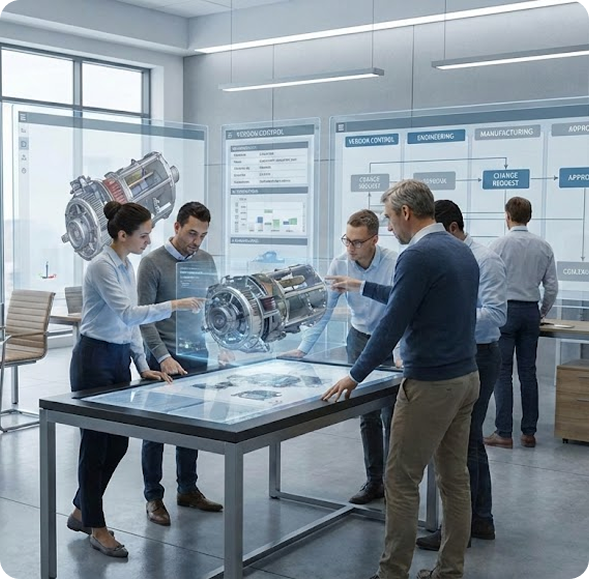
Engineering, Product Data & BOM Management

Engineering files and product data constantly change. AI makes it easier to keep everything synchronized.

Capabilities:
mask group (8)

Extract structured data from drawings, PDFs, & datasheets

mask group (22)

Flag inconsistencies between engineering documents and ERP data

mask group (7)

Auto-update specs across ERP, PLM, and catalog repositories

mask group (9)

Organize manuals, ECRs, ECOs, and change logs

mask group (21)

Maintain BOM versions and suggest updates

Impact: Better version control, fewer rework loops, and smoother communication between engineering and production.

Engineering, Product Data & BOM Management

AI extracts structured data from drawings and specifications, flags inconsistencies between documents and ERP systems, updates BOM versions, and organizes ECRs and ECOs.
Impact: Better version control and fewer rework loops between engineering and production.

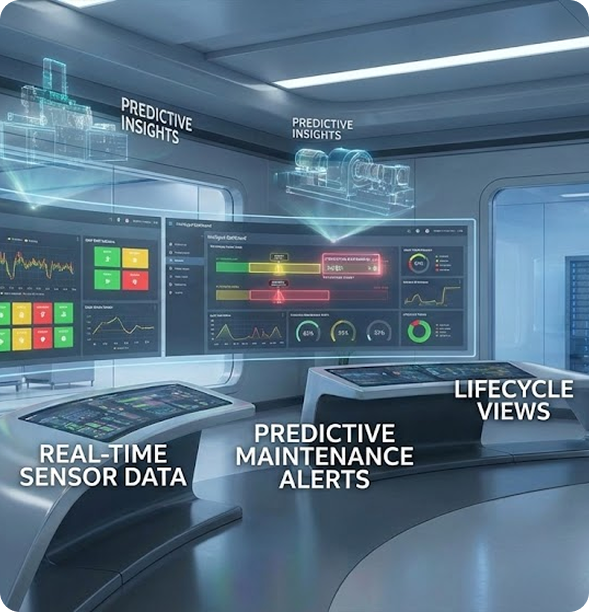
Maintenance, Asset Health & Predictive Insights

AI shifts maintenance from reactive to proactive by identifying patterns hidden in logs, downtime notes, and sensor data.

Capabilities:
mask group (10)

Predictive maintenance triggers

mask group (11)

Risk scoring for critical equipment

mask group (12)

Downtime classification and trend detection

mask group (13)

Summaries of technician notes and service histories

mask group (14)

Maintenance scheduling suggestions

Impact: Less unplanned downtime and clearer understanding of asset health.

Maintenance, Asset Health & Predictive Insights

AI analyzes logs and service histories to predict equipment risk, classify downtime patterns, and recommend maintenance scheduling adjustments.
Impact: Reduced unplanned downtime and clearer asset health visibility.
ai predictive maintenance manufacturing
ai agent workflow

Workflow AI Agents for Manufacturing Teams

AI that works inside your manufacturing systems to reduce repetitive work.

Workflow AI Agents operate within a single system at a time — ERP, PLM, MES, quality systems, or document repositories — helping manufacturing teams complete everyday tasks faster and more consistently. These agents read inputs, structure information, and prepare updates inside the tools your teams already use, without changing workflows or adding new platforms.

They are workflow-aware, rule-driven, and fully explainable — ensuring accuracy, consistency, and human oversight

Workflow AI Agents Can
manufacturing ai solutions

Draft vendor emails, internal reports, summaries, and documentation

mask group (2)

Convert QC notes, logs, and forms into structured, usable data

mask group (15)

Answer internal questions using manuals, SOPs, specifications, and PLM data

mask group (25)

Update ERP or quality system fields from inputs, logs, or scanned documents

mask group (16)

Prepare production summaries, shift updates, or procurement packets

Impact: Your staff gets instant support, and your processes become more consistent.

Workflow AI Agents for Manufacturing Teams

Workflow AI Agents operate inside ERP, PLM, MES, and quality systems to structure inputs, draft documentation, update fields, and guide daily tasks without changing existing workflows. They are rule-driven, explainable, and built for operational accuracy.
Impact: Faster task completion and more consistent execution inside your current tools.

Agentic systems for Industrial Complexes

AI that connects systems, coordinates actions, and keeps complex operations moving.

Agentic systems manage workflows that span multiple systems, documents, and departments across industrial environments. Acting as middleware between ERP, PLM, MES, scheduling, quality, and vendor systems, these agents don’t just move data — they validate inputs, assemble outputs, and trigger coordinated actions across operations with human oversight.

This is how fragmented industrial processes become connected, predictable workflows.

Examples:
Impact : More predictable operations, smoother cross-department coordination, fewer manual handoffs — and industrial workflows that actually execute end-to-end instead of stalling between systems.

Agentic Systems for Industrial Operations

Agentic systems coordinate workflows across ERP, PLM, MES, scheduling, and vendor systems. They validate inputs, assemble outputs, and trigger cross-system actions to complete complex processes end-to-end with full traceability.
Impact : Connected industrial workflows that execute reliably instead of stalling between systems.
Examples:
mask group (1)

Vendor Quote → Cost Sheet → Sourcing Recommendation

Pulls pricing and terms from vendor quotes, validates against cost models, updates ERP cost sheets, and prepares sourcing recommendations.

mask group (21)

Engineering File → Structured Extraction → BOM Update

Extracts specs from drawings or documents, checks for inconsistencies, and updates BOMs across engineering and production systems.

mask group (15)

QC Notes → Defect Classification → Inspection Report

Classifies defects from QC notes, validates against quality standards, and generates inspection reports across quality and compliance tools.

mask group (2)

Maintenance Log → Risk Scoring → Schedule Update

Analyzes maintenance logs, scores operational risk, and updates production or maintenance schedules across planning systems.

manufacturing ai solutions

Work Order → Material Check → Schedule Update → Summary

Verifies material availability, updates schedules, and generates execution summaries across ERP and scheduling platforms.

What Cross-System Flows Look Like
mask group (1)

Vendor Quote to Cost Sheet to Sourcing Recommendation

mask group (21)

Engineering File to Structured Extraction to BOM Update

mask group (15)

QC Notes to Defect Classification to Inspection Report

mask group (2)

Maintenance Log to Risk Scoring to Schedule Update

manufacturing ai solutions

Work Order to Material Check to Schedule Update to Summary

Each flow moves from fragmented coordination to structured, automated execution.

Life Before AI vs. Life After AI

BEFORE AI

manufacturing ai solutions

WIP updates, shift logs, downtime notes, and QC findings require manual typing

manufacturing ai solutions

Vendor emails, quotes, RFQs, and cost sheets live in different inboxes and folders

manufacturing ai solutions

Engineers manually update specs, BOMs, routing steps, and catalog entries

manufacturing ai solutions

QC teams decode handwritten notes and prepare reports manually

image 137

Maintenance teams rely on complaints, periodic checks, and tribal knowledge

manufacturing ai solutions

Production schedules change slowly because updates are fragmented

manufacturing ai solutions

Leaders lack a unified operational snapshot

AFTER AI

image 147

Production workflow AI agents generate WIP updates, shift summaries, downtime insights instantly

A practical AI readiness scan across workflows, data, and existing tools

Procurement autonomous AI agents compare quotes, draft RFQs, analyze vendors, and update costs

group 1000004319

Engineering intelligence updates BOMs, specs, catalog data, and catches inconsistencies

group 1000004317

QC intelligence extracts defects, creates inspection summaries, and flags emerging issue

image 145

Predictive models surface early maintenance and production risks

group 1000004318

Scheduling intelligence recalculates load, capacity, and priorities in real time

image 148

Leaders operate with a unified, AI-curated view of factory performance

Life Before AI vs. Life After AI

BEFORE AI

manufacturing ai solutions

Manual WIP updates and shift logs.

manufacturing ai solutions

Scattered vendor communication.

manufacturing ai solutions

Manual BOM and spec changes.

manufacturing ai solutions

Handwritten QC interpretation.

image 137

Reactive maintenance checks.

manufacturing ai solutions

Fragmented scheduling updates.

manufacturing ai solutions

Limited operational visibility.

AFTER AI

image 147

Auto-generated production summaries.

A practical AI readiness scan across workflows, data, and existing tools

Intelligent quote comparison and cost updates.

group 1000004319

Automated BOM validation.

group 1000004317

Structured QC reporting.

image 145

Predictive maintenance alerts.

group 1000004318

Dynamic scheduling adjustments.

image 148

Unified factory dashboards.

Why Manufacturing Teams Choose GrayCyan

AI that works inside ERP and operational systems including Oracle, SAP, Epicor, Infor, Odoo, Microsoft Dynamics, and custom platforms. Built for real-world factory environments with unstructured data, shift-based workflows, and legacy tools. Governed, explainable, and production-ready with full validation and traceability.

Impact: Improved throughput and coordination without replacing systems or adding hardware.

mask group (21)

AI that works inside your ERP and operations tools

Oracle, Epicor, SAP, Infor, Odoo, Microsoft Dynamics, Fishbowl, JobBOSS, ProShop, E2, and custom systems.
mask group (20)

Designed for factories with real-world constraints

Unstructured data, legacy systems, shift-based operations, handwritten notes, variable processes.
mask group (18)

Safe, compliant, and production-ready

Version control, audit trails, data validation, operational governance, and secure deployments.
mask group (19)

Improve throughput without changing your systems or adding hardware

AI augments your team, not your production line.

Trusted by business leaders across manufacturing

Trusted by Industry Leaders

We help small and mid-sized teams automate daily work, improve accuracy, and reclaim time, without changing their existing systems.

Automate daily operations. Improve accuracy. Save time. All within your existing systems.

FULL CAPABILITIES

Everything we can help you with

Beyond the core problems above, here’s the full scope of what GrayCyan delivers across manufacturing operations.

AI Strategy & Readiness Assessment

WIP Update & Shift Summary Automation

ECR / ECO Change Log Management

Manufacturing AI Maturity Scoring (MEI×VEI×AFM)

Downtime Log Classification & Trend Detection

ERP ⇿ PLM ⇿ Catalog Sync & Inconsistency Flagging

ERP Data Extraction & Structuring

Production Bottleneck Detection

Predictive Maintenance Triggers & Risk Scoring

RAG Knowledge Systems (SharePoint, Teams, PDFs)

Schedule Load & Capacity Suggestions

Technician Note Summarization

Custom AI Copilots for Engineering Teams

QC Note Extraction & Defect Classification

Maintenance Scheduling Suggestions

Vendor Quote Extraction & Comparison

Inspection Report Auto-Generation

Multi-System Agentic Workflow Orchestration

Auto-Generated RFQs, PRs & Follow-Ups

CAPA Summary & Audit-Ready Packet Preparation

Compliance Automation (ISO, NADCAP, USDA, Health Canada)

Landed Cost Sheet Automation

Calibration Log & Verification Record Organization

AI Monitoring, Accuracy & Governance Dashboards

Supplier Scorecard & Performance Tracking

BOM Version Control & Update Suggestions

Ongoing AI Optimization & Support Retainers

PO → GRN → Invoice Reconciliation

Engineering Drawing & Datasheet Extraction

Data Connections & System Integration (API & Middleware)

Frequently Asked Questions

Frequently Asked Questions — AI in Manufacturing

Common questions from manufacturers evaluating AI for their operations.

What is AI in manufacturing?
AI in manufacturing refers to the use of artificial intelligence to automate workflows, analyze operational data, improve decision-making, and reduce manual work across engineering, production, quality, maintenance, and supply chain functions. Unlike traditional automation, AI can interpret information, generate outputs, identify patterns and coordinate actions across multiple systems.
How is AI used in manufacturing?
Manufacturers use AI for engineering document management, predictive maintenance, production scheduling, quality control, compliance reporting, procurement automation, and ERP workflow automation. AI can extract information from drawings, generate reports, reconcile data between systems, and help teams make faster operational decisions using existing business data.
What are the benefits of AI in manufacturing?
The primary benefits of AI in manufacturing include reduced manual work, faster decision-making, improved compliance, fewer data-entry errors, accelerated onboarding, and better use of engineering resources. Manufacturers often recover significant productivity by automating administrative tasks and making institutional knowledge easier to access across the organization.
Can manufacturers use AI without replacing their ERP system?
Yes. Most AI implementations sit on top of existing ERP platforms rather than replacing them. GrayCyan connects to systems such as SAP, Oracle, Epicor, Infor, Microsoft Dynamics, Odoo, and Fishbowl, allowing manufacturers to add AI capabilities while continuing to use the ERP systems already embedded in their operations.
What is industrial AI and how is it different from general AI?
General AI understands language and generates content. Industrial AI understands manufacturing-specific information such as BOMs, shift reports, quality records, sensor data, maintenance logs, engineering drawings, and production workflows. It is designed to operate within factory environments and support real operational processes rather than general-purpose tasks.
How long does AI implementation take in manufacturing?
Implementation timelines vary based on complexity and scope, but manufacturers can often see their first AI-powered workflow deployed within 30–60 days. GrayCyan follows a phased implementation approach that begins with readiness assessment and workflow design before expanding into broader operational use cases.
What are examples of AI in manufacturing?
Examples include automated engineering proposal generation, predictive maintenance alerts, AI-generated shift summaries, inspection report creation, procurement workflow automation, ERP data reconciliation, compliance documentation, and RAG-based knowledge systems that allow employees to query engineering and operational documents in natural language.
How much does AI implementation cost for manufacturers?
The cost depends on factors such as business size, process complexity, integration requirements, and implementation scope. Rather than starting with a fixed price, manufacturers should first assess operational readiness and identify the workflows that offer the highest return. GrayCyan's AI Readiness Assessment helps organizations determine the most effective and cost-efficient path forward.


LET'S TALK

If this sounds like your operation, let's have a conversation.

We work with manufacturers who are serious about fixing the friction that’s costing them time, compliance risk, and growth. If that’s you, we’d love to connect.
Scroll to Top