

Leadership Already Knows But the Current Approach Doesn’t Scale
Most leadership teams aren’t unaware of the problem. In fact, they see it unfolding every day.
Critical knowledge is slipping through the cracks. New hires take months, sometimes close to a year to become fully productive.
Decision-making is slower than it should be, not because teams lack talent, but because they lack access to the right information at the right time.
The concern isn’t hypothetical. It’s operational and it’s already affecting efficiency, costs, and long-term competitiveness.
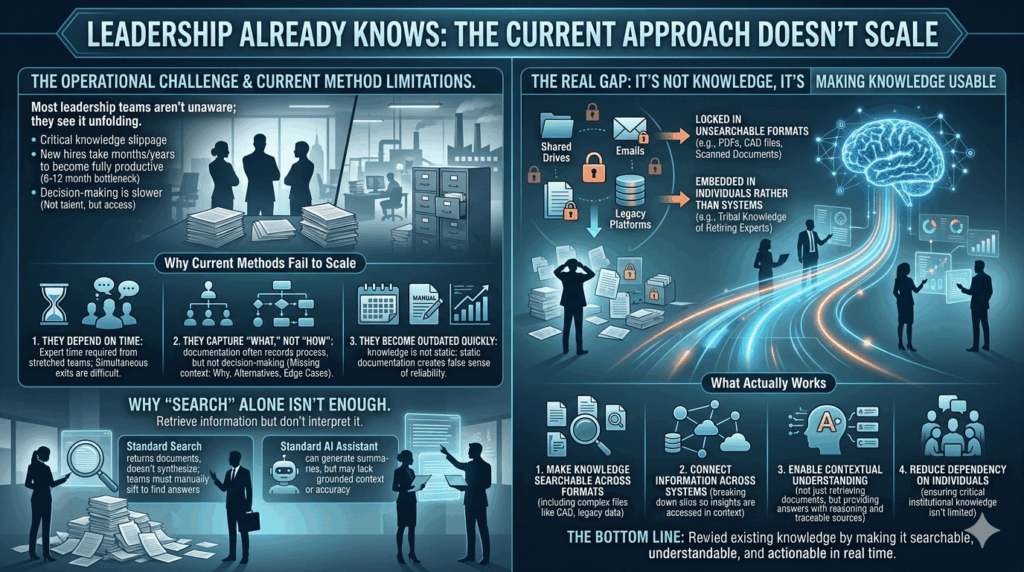
Table of Contents
From the Ground: What Our Clients at GrayCyan Experiencing
Across industries, the same patterns keep emerging. These aren’t assumptions, they’re direct observations from organizations navigating complex knowledge environments:
- “We have over 2TB of documents spanning 45 years—but no centralized way to search them.”
- “It takes nearly a year for a new hire to become fully productive.”
- “Senior engineers nearing retirement hold critical tribal knowledge.”
- “Complex quotes take 2–3 days of manual research.”
- “We need to search inside DWG files, but they aren’t searchable.”
- “Copilot could surface documents, but couldn’t reason or cite sources.”
These aren’t edge cases they represent a broader, systemic issue. Organizations are sitting on vast amounts of valuable knowledge, but accessing and using it efficiently remains a challenge.
Why Current Methods Fall Short
To address knowledge gaps, most organizations rely on familiar approaches:
- Manual documentation
- Exit interviews
- Job shadowing
- Recorded walkthroughs
At a glance, these methods seem practical. They’ve been used for decades and, in isolated cases, they do provide some value.
But they share a critical limitation: they don’t scale.
They Depend on Time
Capturing knowledge manually requires time from experts who are already stretched thin, and time from teams trying to absorb that information.
When multiple experienced employees leave around the same time, these methods simply can’t keep up.
They Capture “What,” Not “Why”
Documentation often records processes, but not decision-making.
It tells you what was done, but not:
- Why a specific decision was made
- What alternatives were considered
- How edge cases were handled
That missing context is where real expertise lives.
They Become Outdated Quickly
Knowledge is not static. Processes evolve, tools change, and exceptions emerge.
Static documentation, no matter how detailed quickly becomes outdated, creating a false sense of reliability.
The Real Gap: It’s Not Knowledge – It’s Access.
Most organizations don’t have a knowledge shortage.
They have an access problem.
Valuable information already exists, but it is:
- Scattered across multiple systems (shared drives, emails, legacy platforms)
- Locked in unsearchable formats (PDFs, CAD files, scanned documents)
- Embedded in individuals rather than systems
This creates a fragmented environment where finding the right information becomes a task in itself.
And when finding information takes too long, teams stop searching—and start guessing.
Why “Search” Alone Isn’t Enough
Many organizations have attempted to solve this issue with modern tools, enterprise search platforms, document management systems, or AI assistants.
While these tools improve accessibility to some extent, they often fall short in one key area:
They retrieve information but don’t interpret it.
For example
- A search tool returns documents but doesn’t synthesize results, you still have to manually sift through them to find the answer.
- An AI assistant can generate summaries, but they may sometimes lack grounded context or accuracy because the system isn’t specifically trained for institutional knowledge in every case.
The result? Teams still spend significant time validating information, cross-referencing sources, and making judgment calls.
In high-stakes environments, that’s not just inefficient—it’s risky.
The Hidden Cost of Knowledge Loss
When experienced employees leave, organizations don’t just lose headcount. They lose:
Speed
Tasks that once took minutes now take hours or days because the “shortcut knowledge” is gone.
Accuracy
Without historical context, teams are more likely to make errors or repeat past mistakes.
Confidence
Decision-making slows down when teams aren’t sure they’re working with complete or reliable information.
These losses compound over time, impacting everything from operational efficiency to customer satisfaction.
The Productivity Bottleneck No One Talks About
One of the most overlooked challenges is onboarding.
When it takes 6–12 months for a new hire to become productive, it creates a significant bottleneck:
- Senior employees spend time answering repetitive questions
- New hires struggle to navigate fragmented information systems
- Teams operate below full capacity for extended periods
This isn’t just an HR issue, it’s a business performance issue.
Moving Beyond Documentation: What Actually Works
Solving this problem requires a shift in approach.
Instead of focusing solely on capturing more knowledge, organizations need to focus on making existing knowledge usable.
This means:
Making Knowledge Searchable Across Formats
Including complex files like CAD drawings, scanned documents, and legacy data.
Connecting Information Across Systems
Breaking down silos so insights can be accessed in context, not isolation.
Enabling Contextual Understanding
Not just retrieving documents, but providing answers with reasoning and traceable sources.
Reducing Dependency on Individuals
Ensuring that critical institutional knowledge is not limited to a few experienced employees.
The Bottom Line
Leadership teams already recognize the risk. The challenge isn’t awareness, it’s execution. As experienced employees exit, organizations lose more than people. They lose speed, accuracy, and confidence in decision-making.
And while traditional methods attempt to address the issue, they simply don’t scale to meet the demands of modern, data-heavy environments.
The real opportunity lies elsewhere. It’s not about capturing more knowledge.
It’s about revealing the knowledge you already have by making it searchable, understandable, and actionable in real time.