Launch
- CRM and Sales
- Purchase
- Inventory and Warehouse
- Invoicing and basic Accounting setup
- Standard data migration
- User configuration and permissions
- Training, UAT and go-live
Odoo from CRM to warehouse to shop floor.
GrayCyan helps manufacturers, warehouses, and distributors implement Odoo across sales, projects, service, finance, procurement, inventory, fulfillment, production, quality, traceability, and maintenance, then adds managed services and AI middleware where they create measurable operational value.
Book a Discovery Call→GrayCyan works with manufacturers, warehouses, distributors, and industrial businesses, typically with 50 to 500 employees, that need Odoo to connect sales, service, finance, procurement, inventory, fulfillment, production, quality, and the operational work around them.
GrayCyan combines broad Odoo implementation across CRM, sales, service, projects, finance, procurement, inventory, warehousing, distribution, and operations with deeper manufacturing expertise across MRP, shop-floor execution, quality, traceability, maintenance, and plant-floor integration.
CRM, Sales, Purchase, Accounting, Project, Timesheets, Helpdesk, Field Service, Inventory, Barcode, Manufacturing, Quality, Maintenance, PLM, Documents, Approvals, and other Odoo apps required by the operation.
Requirements mapping, configuration, migration, custom development, integration, training, stabilization, administrative support, support, optimization, and AI middleware.
Scanners, label printers, scales, sensors, PLCs, EDI feeds, ecommerce systems, carrier platforms, legacy databases, and other systems that remain in the operation.
GrayCyan connects Odoo to AI models and automation workflows without replacing Odoo as the system of record.
Odoo software licensing is separate from GrayCyan implementation and managed-service pricing, so the company can see what it is paying for.
With manufacturing, warehousing, distribution, engineering, and B2B operational experience.
GrayCyan is built for operationally complex businesses where Odoo has to connect commercial, administrative, warehouse, production, quality, and service workflows, not just accounting.
GrayCyan is led by Founder and CEO Nishkam Batta, a chemical engineer by training who started his career around large industrial and engineering environments. Before GrayCyan, he worked at Larsen & Toubro (L&T), the global engineering conglomerate that was roughly a $15 billion annual-revenue business during that period.
Nishkam completed MIT Sloan School of Management's Artificial Intelligence: Implications for Business Strategy program in 2018 and has worked in applied AI since 2018. That mix of engineering, enterprise operations, commercial execution, and AI shapes GrayCyan's approach to Odoo: understand the real workflow first, then configure, integrate, automate, and support the system around it.
He is a Forbes Business Council member and contributor, Editor-in-Chief of HonestAI Magazine, has been profiled by Entrepreneur, and publishes on applied AI through outlets including Forbes and Unite.AI.
HonestAI Magazine reaches a manufacturing audience of more than 400,000.
GrayCyan maps the current process, configures the required Odoo apps and workflows, migrates data, runs testing and parallel validation where needed, prepares users, manages cutover, and supports post-go-live stabilization.
Migrations can include systems such as NetSuite, SAP, Epicor, Acumatica, Fishbowl, Infor, Microsoft Dynamics, QuickBooks, spreadsheets, and legacy databases.
Where a process does not map cleanly to standard Odoo functionality, GrayCyan develops custom workflows, modules, integrations, and reusable components using the Odoo framework and Python.
The goal is to close real workflow gaps without turning the implementation into unnecessary custom software.
Training runs on separate tracks for floor users and administrators. Floor users learn the workflows required for their shift and role.
Administrators learn configuration, permissions, reporting, master data responsibilities, and the operating procedures they will manage internally.
GrayCyan provides ongoing Odoo managed services after go-live, including stabilization, functional support, issue resolution, administrator support, and workflow adjustments.
Plus integration monitoring, release and upgrade planning, enhancement work, and continuous optimization of the Odoo environment and connected GrayCyan services.
Most mid-market manufacturers, warehouses, and distributors are not replacing every system at once.
GrayCyan connects Odoo with the systems that are staying, including plant-floor devices, label printers, scanners, scales, temperature sensors, PLCs, EDI feeds, quality databases, ecommerce platforms, carrier and logistics tools, supplier systems, external warehouses, and other business applications where appropriate.
GrayCyan adds an AI middleware layer that reads authorized Odoo data through APIs, applies models or business logic, and returns the result to the operating workflow.
That result can be a draft, recommendation, alert, classification, exception, or approved update. Odoo remains the system of record.
Odoo has a substantial manufacturing stack. The job of a manufacturing-focused Odoo integrator is to configure those capabilities around the real operation, extend them where plant-specific requirements demand it, and connect them to the equipment and systems that Odoo does not replace. GrayCyan focuses on nine manufacturing capability areas.
Bills of materials, multi-level BOMs, manufacturing orders, work orders, routings, work centers, dependencies, capacity, master production scheduling.
Plus scrap, by-products, backorders, changeovers, and production reporting.
Operator-facing work-order execution, tablets and scanning workflows, time capture, production reporting, and instructions.
Plus quality interactions and real-time visibility into work center activity.
Receiving, internal moves, replenishment, storage locations, putaway rules, picking, packing, and barcode execution.
Covering raw materials, WIP, finished goods, packages, multi-step routes, and removal strategies such as FIFO and FEFO.
Quality control points, pass/fail checks, measurements, instructions, pictures, and production checks.
Plus nonconformance handling, approval workflows, evidence capture, and process-specific compliance requirements.
Lot and serial tracking, expiration dates, traceability reporting, and raw-material-to-finished-goods linkage.
Plus recall workflows, genealogy requirements, and plant-specific transformation logic where standard traceability must be extended.
Preventive and corrective maintenance, equipment records, and work-center maintenance.
Plus downtime workflows, maintenance triggers, and operational reporting around equipment reliability.
Engineering change orders, BOM revisions, approvals, version control, and product changes.
Plus controlled movement from engineering decisions into manufacturing execution.
Purchase workflows, supplier coordination, replenishment, and make-versus-buy decisions.
Plus subcontracting, resupply to subcontractors, dropship-to-subcontractor flows, and supplier-related exceptions.
Scales, barcode scanners, label printers, PLCs, sensors, IoT devices, EDI feeds, and legacy quality systems.
Plus other API or middleware connections required to make Odoo part of the operating environment rather than a disconnected back-office system.
Where standard Odoo already solves the requirement, GrayCyan configures standard Odoo. Where a manufacturer needs plant-specific controls, integrations, compliance evidence, exception logic, or additional automation, GrayCyan adds the required layer without over-customizing the ERP.
We scope the module set around the workflows that share data, not around a full-suite checklist.
Book a Discovery Call→Manufacturing is a core GrayCyan specialization, but Odoo is equally valuable when the operating model depends on warehousing, distribution, wholesale, sales, service, projects, and back-office execution. GrayCyan can implement and connect the front-office, back-office, service, warehouse, distribution, and manufacturing modules that need to work together.
Multi-warehouse inventory, receiving, putaway, replenishment, barcode workflows, picking and packing, transfers, cross-dock and dropship flows, customer-specific pricing, sales-order fulfillment, returns, lot and serial tracking, carrier handoff, and coordination between purchasing, inventory, sales, and shipping.
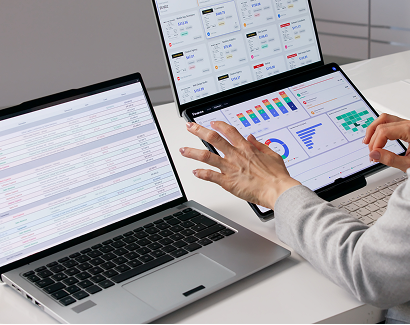
Lead and opportunity management, pipelines, activities, quotations, sales orders, customer-specific pricelists, contract pricing, customer history, approvals, returns, order changes, and handoff from sales into warehouse fulfillment, service, projects, or production.
Project delivery, task management, resource planning, milestones, time capture, billable and non-billable work, internal project costing, and visibility from sold work into execution.
Ticket intake, assignment, SLA workflows, escalations, customer history, warranty or service issues, knowledge workflows, and connection between customer support and the operational teams resolving the issue.
Service jobs, technician scheduling, parts usage, time capture, customer sign-off, follow-up work, and service history connected back to the customer, product, equipment, or installed base.
Requests for quotation, purchase orders, vendor pricing, approvals, replenishment, subcontracting, receipt workflows, supplier performance, and purchasing decisions connected to inventory and production demand.
Customer invoicing, vendor bills, payments, expenses, analytic accounting, landed costs, manufacturing and project cost visibility, and the financial workflows that connect operating activity to the books.
Document workflows, e-signature, approvals, controlled records, internal requests, and supporting documentation connected to the underlying Odoo transaction instead of living in disconnected email threads and folders.
Website and ecommerce workflows, forms, customer portals, marketing automation, email marketing, events, and online transactions when those modules are part of the wider Odoo deployment.
Employee records, recruitment, time off, expenses, appraisals, fleet, and other internal Odoo workflows where consolidating systems creates a meaningful operational benefit.
GrayCyan does not force every Odoo app into every implementation. The module set is selected around the workflows that need to share data, eliminate duplicate entry, and support the operating model.
GrayCyan AI middleware is not a replacement ERP and it does not force users into a separate system. It sits between Odoo, authorized external systems, and the people who would otherwise read records, compare data, draft documents, identify exceptions, or route work manually. The goal is to keep Odoo as the operating system while using AI where interpretation, prediction, drafting, retrieval, or exception handling saves meaningful time.
Monitors stock movement, cycle-count variance, unusual consumption, receiving discrepancies, and other patterns that may indicate a process issue rather than a simple counting error.
Uses Odoo and approved operational data to identify demand patterns, material risk, potential expiry exposure, and reorder timing where additional forecasting adds value beyond configured ERP rules.
Flags production, yield, scrap, material-consumption, receiving, or quality exceptions that require a person to investigate.
Drafts quotes, production documents, batch or compliance records, audit responses, internal summaries, and other documents from authorized Odoo records rather than asking a person to assemble the same information repeatedly.
Routes the issue to the correct person with the relevant Odoo context attached so the operator, planner, buyer, quality lead, or manager can act without reconstructing the problem.
Connects approved operational knowledge, procedures, historical records, and Odoo context so teams can retrieve the information needed to make a decision faster.
Summarizes account history, prioritizes opportunities, drafts follow-up or proposal content, surfaces missing information, and helps sales teams act on Odoo data without manually assembling context.
Classifies tickets, summarizes history, suggests responses or next actions, detects SLA risk, and routes service issues with the relevant customer, product, project, or order context attached.
Flags project overruns, missing time, delivery risk, margin erosion, and task exceptions, and can generate concise status summaries from project activity.
Identifies unusual vendor, purchasing, invoice, cost, or approval patterns that deserve review without replacing the financial controls already configured in Odoo.
The middleware does not replace decisions that belong to a person. Where an Odoo automated action, rule, or standard workflow solves the problem, GrayCyan uses the native capability.
AI is added where interpretation, prediction, drafting, retrieval, or exception handling creates additional value.
The AI layer reads authorized data, applies logic, and returns a draft or exception to the workflow. It does not replace the ERP.
Book a Discovery Call→An Odoo implementation does not end at go-live. GrayCyan can stay engaged as the ongoing Odoo partner responsible for keeping the scoped environment stable, supported, administered, integrated, and continuously improved. The managed-service model is designed for manufacturers, warehouses, distributors, and industrial businesses that want one team to retain operational context across support, administration, enhancements, upgrades, integrations, and AI workflows.
Support for day-to-day questions, configuration changes, permissions, user issues, workflow adjustments, reporting needs, master-data maintenance, and administrator guidance across the Odoo modules in scope.
Structured support after cutover to resolve production issues, correct configuration gaps, support users, validate data and workflows, and move the environment from implementation mode into stable daily operation.
Maintain a prioritized backlog of improvements as the business changes.
Including new workflows, additional automation, reporting, module expansion, usability improvements, and process changes discovered after teams begin working in Odoo every day.
Support the integrations that connect Odoo to scanners, label printers, ecommerce platforms, EDI, legacy systems, plant-floor technology, external databases, and GrayCyan AI middleware.
Plan Odoo upgrades and material configuration changes, identify dependencies, test critical workflows and integrations, and reduce the risk that a version change breaks a production, finance, sales, service, or warehouse process.
Operate and improve the AI workflows connected to Odoo.
Including prompt and workflow tuning, exception logic, model or connector updates, output-quality review, and changes required as the underlying Odoo process evolves.
A company may start with a smaller set of Odoo modules and add more over time. GrayCyan managed services can expand with that footprint rather than requiring a new implementation or support partner for every phase.
Managed back-office and administrative support
GrayCyan can also provide hands-on administrative support inside Odoo for teams that want more than technical support. The exact tasks are defined in the managed-services scope and can include:
Odoo software licensing and third-party software charges are separate. Final pricing can also account for unusually complex migrations, multi-company or multi-site rollouts, advanced integrations, onsite requirements, or unusually heavy AI or model usage.
Pick your term and user count. Your monthly implementation price and included implementation hours update instantly.
What is included: your plan includes the implementation hours shown above. If your rollout needs more time, integrations, or custom work, we will review it with you first so there are no surprises. Odoo licenses are separate.
The monthly GrayCyan subscription can include discovery, configuration, module implementation, migration support, integrations, training, go-live stabilization, functional support, managed administrative services, integration monitoring, enhancement work, upgrade planning, AI middleware operations, and ongoing optimization.
Exact inclusions depend on the selected plan and statement of work.
GrayCyan supports Odoo migration projects for manufacturers, warehouses, distributors, and industrial businesses moving from QuickBooks, spreadsheets, legacy databases, Fishbowl, NetSuite, SAP, Epicor, Acumatica, Infor, Microsoft Dynamics, or another ERP. The migration plan is based on the data required to operate on day one, not on copying every historical field into a new database.
Items, customers, suppliers, units of measure, categories, locations, and configuration data.
BOMs, routings, work centers, operations, and relevant engineering or quality structures.
Open purchase orders, sales orders, manufacturing orders, inventory positions, lots, serials, and other required transactions.
Reconciliation, trial migration, parallel validation where appropriate, and cutover controls.
These examples are GrayCyan manufacturing, warehouse, distribution, and industrial systems work on the ERPs and operational environments our clients were already running. They are not presented as Odoo case studies. They demonstrate the operational, integration, automation, traceability, and AI experience GrayCyan brings into an Odoo engagement.

HACCP documentation, batch records, and lethality evidence were assembled manually after production, with audit response taking 2 to 3 days.
GrayCyan built key data element capture at critical tracking events and automated batch-record generation. Audit response dropped to under 60 seconds.
Manual receiving and inventory bridging consumed roughly 12 hours daily, while lot tracking was incomplete for compliance.
GrayCyan built scan-based receiving connected to purchase orders with lot capture and forward linkage to outbound shipments. Manual data entry dropped 85 percent, with lot genealogy traceable in minutes.
Proposal generation took around 8 hours using historical records.
GrayCyan built a middleware layer that drafts proposals from existing system data. Turnaround dropped to roughly 30 minutes.
Forty years of engineering drawings and specifications were not searchable on a network with no external connectivity.
GrayCyan built a fully on-premises retrieval system, making decades of drawings searchable in seconds without data leaving the facility.
Six phases, each with a defined output. The configure-versus-customize decision gets made per gap in phase one, before any development starts.
The engagement does not end at cutover. Phase six is an ongoing managed-service relationship covering support, administration, enhancements, upgrades, integrations, and AI middleware operations.
Walk through CRM, sales, order management, purchasing, receiving, inventory, warehousing, fulfillment, production where applicable, quality, maintenance, projects, service, finance touchpoints, administrative work, and existing systems.
Output: current-state process map, requirements, risk areas, and a configure-versus-customize decision for each material gap.
Configure Odoo modules and design the required integration, custom module, and AI middleware architecture.
Output: solution design and configured environment using representative data.
Develop approved custom workflows and integrations, prepare migration scripts, load master and operational data, and connect required systems.
Output: testable end-to-end workflows.
Run user acceptance testing, reconciliation, role-based training, and parallel validation where the risk profile requires it.
Output: signed-off workflows, trained users, and cutover readiness.
Execute cutover, resolve early operational issues, monitor integrations and managed components, and stabilize the production environment.
Output: live operation with defined support responsibilities.
Continue operating and improving the environment after go-live through managed services.
GrayCyan supports the agreed Odoo modules and workflows, maintains supported integrations and AI middleware, manages an enhancement backlog, assists administrators and users, plans upgrades, validates changes, and optimizes the system as the business evolves.
Most manufacturers, warehouses, and distributors evaluating an Odoo implementation partner are not simply comparing software features. The decision is whether the partner can make Odoo work across the real operation. Before hiring an Odoo partner in the USA or elsewhere, test four things.
Ask whether the team has worked with MRP, work orders, work centers, Shop Floor, Quality, Inventory, Barcode, Maintenance, PLM, procurement, subcontracting, and traceability.
Not only Sales, Accounting, and CRM.
Odoo already supports substantial manufacturing and warehouse functionality, including lots and serials, FEFO, putaway rules, barcode workflows, quality checks, MRP, Shop Floor, and subcontracting.

The partner should know when standard Odoo is sufficient and when a plant-specific requirement genuinely needs configuration, custom development, integration, or middleware.
Ask what the team has actually connected.
Including scanners, scales, printers, sensors, PLCs, EDI, quality systems, ecommerce, logistics platforms, and legacy databases.
Confirm what is included in Odoo software licensing, and what is included in the implementation or monthly service.
Plus what support is provided after go-live, and what costs may sit outside the core scope.
Wholesalers and industrial businesses, typically with 50 to 500 employees, implementing Odoo or already running it.
Where sales orders, purchasing, inventory, warehouse execution, production, quality, service, projects, accounting administration, or cross-system handoffs are still partly manual.
That need traceability, quality evidence, lot or serial controls, batch records, audit support, or controlled workflows embedded in daily operations.
Companies that need Odoo connected to plant-floor devices, external warehouses, ecommerce systems, carrier platforms, supplier systems, EDI, legacy applications, or other operational technology.
Companies that want AI and automation connected to Odoo without replacing Odoo as the system of record.
From QuickBooks, spreadsheets, Fishbowl, a legacy ERP, or another mid-market or enterprise system, needing the operational build handled by one team.
Usually not the right fit:
Tell us which ERP you run today, how many employees, warehouses, plants, and sites you have, and which Odoo modules you need.
Tell us where work is still manual across CRM, sales orders, purchasing, projects, service, accounting administration, inventory, warehouse, distribution, production, quality, or finance, and whether you need implementation only or an ongoing managed-service relationship after go-live.