- 2026 Comprehensive Guide
Agentic AI in Manufacturing: Use Cases, Applications & Examples
Explore the most impactful Agentic AI use cases in manufacturing, the companies that have already deployed them, and a practical framework for implementation.
40% of Manufacturers
Plants Autonomous by 2030
Oracle, SAP, Epicor & more
ERP Platforms Supported




executive summary
Manufacturing is entering a new phase of AI adoption. The focus is gradually shifting from AI that advises people on what to do to AI that can actually take action on their behalf. While Generative AI helps create content and answer questions, agentic AI goes a step further. It can plan, make decisions and execute multi-step workflows across multiple systems. This evolution of AI is grabbing attention across the industry, particularly as manufacturers face major shortages in labour, complexities in operations, and the growing pressures to improve productivity. According to a survey by the Manufacturing Leadership Council, 40% of manufacturers expect plants to operate without any human input by 2030.
GrayCyan helps manufacturers deploy practical agentic AI systems that coordinate work across business systems. This does not mean the deployment of robots or generic chatbots. Let’s understand what agentic AI actually works in a factory today.
What is Agentic AI in Manufacturing?
Agentic AI in manufacturing refers to AI systems that can autonomously plan, decide and execute multi-step tasks across systems without the involvement of any human input at every step. Unlike traditional AI that can predict outcomes or generative AI that can create content, agentic AI goes beyond all this as it takes action towards achieving a specific operational goal while maintaining human oversight.
Simply put, agentic AI acts as a manufacturing AI agent that coordinates work across multiple systems. Instead of simply identifying a problem or generating recommendations, it can act as a catalyst for workflows, gather information from various sources, validate requirements and complete routine tasks automatically. These systems are designed around four core characteristics:

01 Goal-oriented execution
02 Multi-step reasoning
03 Cross-system coordination
04 Human oversight & approval controls
In manufacturing environments, agentic AI connects systems such as ERP, MES, PLM, quality management platforms, scheduling tools, supplier portals, and maintenance applications. This therefore results in a coordinated workflow that can move around information, make routine decisions, and execute actions across the operation without having employees work manually to bridge every system.
01 Traditional AI
Analyzes data and makes predictions, classifications, or recommendations
Predicts equipment failure based on sensor data
02 Generative AI
Generates new content such as text, summaries, reports or code
Creates a maintenance report from logs and technician notes
03 Agentic AI
Pursues goals by planning, reasoning, and coordinating across systems
Detects a maintenance issue, creates a work order, gathers documentation, notifies stakeholders & updates systems
GrayCyan’s agentic systems act as a middleware between ERP, PLM, MES, scheduling, quality and vendor systems — validating inputs, assembling outputs, and triggering coordinated actions across operations while keeping humans in control of critical decisions.
Let’s
Talk
Book your manufacturing AI strategy session
AI Agents for Manufacturing v/s Agentic AI — What's The Difference?

The terms are often used interchangeably. However, it’s important to understand that they are not the same thing. An AI agent for manufacturing is a single autonomous software entity that can perceive information, make decisions within a defined scope and take action. For example, an AI agent might extract data from a vendor quote, classify it, and enter it into a procurement workflow.
Agentic AI on the other hand is a broader system that coordinates multiple AI agents to achieve a larger business objective. In a manufacturing environment, one agent may extract vendor data, another may update the ERP and a third may draft a procurement recommendation for review. Therefore the AI agents work together to complete a workflow rather than focus on a single task.
At GrayCyan, workflow AI agents typically operate within a single system or process, while agentic systems coordinate actions across ERP, MES, PLM, quality, scheduling, and vendor platforms. This distinction becomes clearer when looking at real-world manufacturing use cases.
Agentic AI Use Cases in Manufacturing
Agentic AI use cases in manufacturing are moving beyond analysis and automation and transitioning towards autonomous execution. Instead of simply generating recommendations, AI agents are able to monitor conditions, make decisions, coordinate across systems, and complete workflows with minimal human intervention. Provided below are seven real-world applications of agentic AI in manufacturing that are delivering end-to-end operational outcomes today.
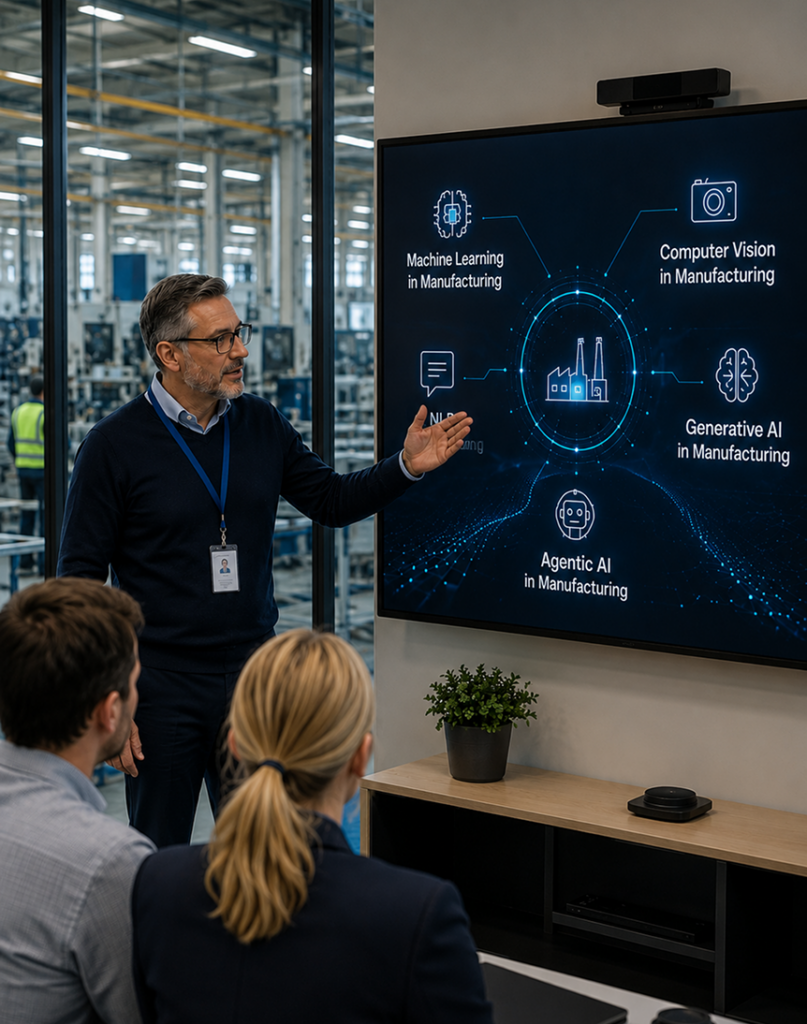
- Maintenance
01 Agentic Predictive Maintenance:
Agentic AI improves predictive maintenance by continuously monitoring sensor data equipment performance metrics, and maintenance logs to identify emerging risks before failures occur. Rather than stopping at risk prediction, the agentic workflow scores equipment health, updates maintenance schedules, creates work orders, and alerts technicians with a diagnosis and recommended action plan.
GrayCyan's Maintenance Log → Risk Scoring → Schedule Update workflow automates this process across maintenance systems. A well-known example is Rolls Royce's Intelligent Engine program, which continuously monitors engine performance across fleets to optimize maintenance planning and reduce unplanned downtime.
- Quality
02 Autonomous Quality Control and Defect Management:
Quality teams spend a significant amount of time in manually reviewing inspection records, defect reports, and CAPA documentation. Agentic AI automated the entire workflow by extracting defect information from handwritten or digital QC notes, classifying issues against the quality standards, generating inspection reports, identifying recurring patterns, and triggering corrective-action workflows.
GrayCyan's QC Notes → Defect Classification → Inspection Report workflow removes manual data entry while improving traceability. Similar approaches can be seen in BMW's AIQX quality platform, which uses AI-driven inspection systems to identify defects and trigger corrective actions with extremely high precision.
- Maintenance
03 Agentic Supply Chain & Procurement:
Procurement processes often require employees to move information between vendor communications, pricing spreadsheets, ERP systems and sourcing documentation. Agentic AI can automate these workflows by extracting pricing data from supplier quotes, validating it against internal cost models, updating ERP cost sheets, preparing sourcing recommendations, and drafting follow-up RFQs.
GrayCyan's Vendor Quote → Cost Sheet → Sourcing Recommendation workflow reduces administrative effort while improving consistency. Because the agent operates across procurement systems, ERP platforms, and vendor communication channels simultaneously, sourcing teams can focus on strategic decisions rather than routine coordination tasks.
- Maintenance
04 Autonomous Production Scheduling:
Production scheduling requires constant coordination between work orders, material availability, labour capacity, and production priorities. Agentic AI continuously monitors WIP status, inventory availability, machine utilization, and capacity constraints. When bottlenecks emerge or work orders stall, the system recalculates priorities, updates schedules, synchronizes planning systems, and generates shift summaries for supervisor review.
GrayCyan's Work Order → Material Check → Schedule Update → Summary workflow helps manufacturers maintain production flow with less manual intervention. Hyundai's Metaplant initiative demonstrates how AI can monitor operations, identify issues, analyze root causes, and support operational decision-making in real time.
- Maintenance
05 Engineering & BOM Synchronization:
Engineering changes often create disconnects between drawings, specifications, BOMs and ERP records. Agentic AI helps maintain alignment by extracting structured information from engineering drawings, PDFs and technical documents, validating data against the ERP records, updating BOM versions, and maintaining change logs across systems. Agentic AI automatically flags any discrepancies for engineer review before they create downstream production issues.
GrayCyan's Engineering File → Structured Extraction → BOM Update workflow eliminates many of the manual rework loops that commonly occur between engineering and production teams, improving data consistency throughout the product lifecycle.
- Maintenance
06 Multi-Agent Systems for Smart Factories:
In smart manufacturing, the most advanced form of agentic AI involves multiple specialized agents working together under a coordinated orchestration layer. One agent may monitor production performance, another may track supply chain risks, while another manages quality and compliance workflows. An orchestrating system prioritizes actions, resolves conflicts, validates information, and maintains human oversight.
This aligns closely with GrayCyan's Stage 3 Connected AI systems vision, where AI becomes the operational layer connecting ERP, PLM, MES, scheduling, quality, and vendor systems. The outcome therefore is a more connected, predictable, and responsive manufacturing operation.
- Workforce
07 Agentic AI for Workforce & Shift Intelligence:
Manufacturing leaders often spend considerable time gathering information from production logs, downtime reports, quality records and supervisor updates before fully understanding all that occurred during a shift. Agentic AI automates this process by collecting information from multiple operational systems, generating shift summaries, producing WIP updates, identifying downtime trends, and highlighting anomalies that require attention.
GrayCyan's production workflow AI agents generate operational insights instantly, providing managers with a unified view of factory performance. Leaders can focus on solving problems and improving operational outcomes instead of wasting hours and hours in compiling reports.
Autonomous quality control — detect, decide, document and act with AI-powered defect management
Let’s
Talk
Book your manufacturing AI strategy session
GrayCyan's Agentic AI for Manufacturing
GrayCyan’s agentic AI for manufacturing is built specifically for industrial environments. It is not generic enterprise AI that is repurposed for factories. Our systems are designed to operate within the reality of manufacturing operations, connecting existing business systems, validating information, and coordinating actions across workflows. Rather than replacing technology investments, GrayCyan works inside existing ERP environments, including Oracle, SAP, Epicor, Infor, Microsoft Dynamics, Odoo and other manufacturing platforms. There’s no new hardware, ERP replacements or disruption to production.
Instead of being completely automated, GrayCyan does have human oversight at every workflow as well as audit trails, data validation, and approval controls when required. Manufacturers remain in control while AI agents handle routine coordination and execution tasks.

| Workflow Name | Systems Connected | What the Agent Does | Business Impact |
|---|---|---|---|
|
Vendor Quote → Cost Sheet → Sourcing Recommendation |
Vendor Systems, Procurement Platforms, ERP |
Extracts pricing from vendor quotes, validates against cost models, updates cost sheets, prepares sourcing recommendations, and drafts follow-up RFQs. |
Faster procurement cycles and reduced manual sourcing effort. |
|
Engineering File → Structured Extraction → BOM Update |
Engineering repositories, PLM, ERP |
Extracts structured specifications from drawings and PDFs, validates against ERP records, updates BOM versions and flags discrepancies for review. |
Improved engineering-to-production alignment and fewer data inconsistencies. |
|
QC Notes → Defect Classification → Inspection Report |
Quality systems, ERP, compliance platforms |
Extracts defect information, classifies quality issues, generates inspection reports, identifies recurring patterns, and triggers CAPA workflows. |
Reduced manual quality documentation and improved compliance readiness. |
|
Maintenance Log → Risk Scoring → Schedule Update |
Maintenance systems, ERP, CMMS |
Evaluates maintenance logs and equipment risk, prioritizes issues, updates schedules, and alerts technicians with recommended actions. |
Reduced unplanned downtime and improved asset reliability. |
|
Work Order → Material Check → System Update → Summary |
ERP, scheduling systems, inventory systems |
Monitors work orders, checks material availability, updates production schedules and generates operational summaries. |
Faster production decisions and improved scheduling efficiency. |
Machine Learning in Manufacturing
|
Predictive maintenance assists in identifying potential problems in machines before they actually fail. |
|
Quality control discovers faults in products using pattern recognition. |
|
Demand forecasting forecasts future demand and requirements for inventory management. |
|
Process optimization streamlines the production process and reveals inefficiencies. |
|
Energy forecasting calculates future energy consumption and facilitates cost-cutting. |
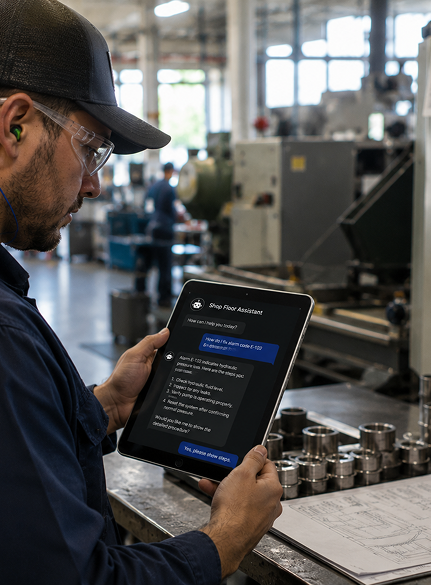
01 AI
Mimics decision-making and automation
02 ML
Learns patterns and predicts outcomes
03 Generative AI
Creates content and recommendations
GrayCyan can extract specifications from engineering drawings, identify inconsistencies in ERP data, and maintain accurate BOM versions. Learn how our RAG AI for manufacturing makes this possible.
The importance of ML adoption in manufacturing
Chart 1
Average improvement through machine intelligence, by KPI
McKinsey — Toward
smart production, 2022
Bottom 50%
Top quartile
Efficiency
Factory
+13%
Labor
+11%
Equipment
+9%
Cost
Operating
+7%
Warehousing
+5%
Quality
+12%
Inventory
+8%
Product
+5%
Revenue
Revenue
+6%
Demand acc.
+5%
Responsiveness
Lead time
+9%
Speed mkt
+14%
Design time
+13%
Lot size
+9%
Changeovers
+10%
Customer exp.
Service
+9%
NPS
+7%
Complaints
+7%
Environmental
Env. impact
+16%
Energy
+14%
Satisfaction
+8%
Chart 2
Companies investing in digital factories
PwC — Digital Factories 2020
01
9%
Digital factory not planned No digitisation initiatives
02
41%
Stand-alone digital solutions Digital tech used in silos
03
44%
Partially integrated factory 91% total potential
04
6%
Fully integrated digital factory End-to-end connected

Let’s
Talk
Book your manufacturing AI strategy session
Benefits of AI in Manufacturing

Key benefits of AI in manufacturing — efficiency, cost savings, quality and supply chain resilience
Measured impact
10-20%
Productivity
improvement
~14%
Cost savings
average reduction
up to 90%
Defect detection
error reduction
20-30%
Inventory costs
reduction
~90%
Reporting eff.
process improvement
10-15%
Energy savings
efficiency gains
01 Enhanced Efficiency and Higher Throughput:
Manufacturers adopting AI-based manufacturing solutions can achieve productivity improvements ranging between 10%–20%.
02 Cost Savings:
Organizations using AI report average cost savings of about 14% through predictive maintenance, decreased downtime, and optimized staffing.
03 Improved Product Quality:
Computer vision systems may cut down defect detection errors by up to 90%.
04 Supply Chain Resilience:
Enhanced forecasting helps reduce inventory costs by 20%–30%, while making products more readily available.
05 Better Decision-Making:
AI analyzes large amounts of operational data with real-time insights so managers can act faster.
06 Improved Worker Safety:
AI identifies potentially unsafe situations and monitors hazardous areas, ensuring fewer accidents.
07 Energy Efficiency:
Many companies reported saving around 10%–15% of energy as a result of AI monitoring systems.
08 Competitive Advantage:
Companies that utilize AI tend to adapt to changes and customer requirements faster compared to their competitors.
According to GrayCyan clients, companies have experienced as much as 90% improvement in reporting processes and operation improvements of around 2x from AI utilization.
Challenges of AI in Manufacturing
Research data
The bottlenecks of AI adoption in manufacturing
Source: O’Reilly Media — AI Adoption in the Enterprise, 2021
19%
Lack of skilled people
18%
Data quality issues
17%
Identifying use cases
14%
Company culture
12%
Technical infrastructure
8%
Not applicable
6%
Legal / compliance
3%
Workforce reproducibility
2%
Hyperparameter tuning
Data Quality and Availability:
Data is often scattered among different sources like workbooks, machines, logs, and mainframe programs. Incorrect or missing data hampers AI reliability.
First, organize and clean operational data before scaling AI projects. GrayCyan's data connections and system integration services can help.
Skills Shortage and Talent Gap:
Manufacturers often don't have people with AI and data analytics experience, making implementation and long-term management difficult.
Use AI partners and platforms designed for practical business users rather than highly specialized teams.
Integration with Legacy Systems:
Existing ERP systems and machines might not be compatible with new AI tools, increasing project complexity and cost.
Adopt solutions that allow you to keep running your present systems while still benefiting from AI.
Cybersecurity Concerns:
Connected devices and AI platforms can raise security risks if not supported by strong data protection policies.
Use robust security measures. See how GrayCyan handles monitoring accuracy and compliance.
High Initial Costs:
Initial expenses on software development and process changes can be problematic, especially for smaller manufacturers.
Start with a small use case that delivers tangible results and then scale up.
Let’s
Talk
Book your manufacturing AI strategy session
Future of AI in Manufacturing
AI will undertake processes such as planning, coordinating production, tracking workflow, and making decisions without much human assistance.
02 Generative AI for Document Intelligence
Generative AI for manufacturing will keep increasing in document summarization, RFQ generation, procurement, and rapid data access.
03 AI Native Factories as Standard
AI integration will become part of regular factory processes — real-time data and decision-making systems as the everyday standard.
04 Human + AI Collaboration
AI will assist workers rather than replace them. Workers handle strategic tasks; AI takes care of repetitive processes.
How to Implement AI in Manufacturing

AI-powered inventory management — real-time visibility and fewer stockouts
Stage
01 Foundational Intelligence
Document extraction, ERP updates, daily logs, procurement drafting
Manufacturers starting with disconnected systems
Faster information handling and reduced admin workload
Digitizing documents, streamlining procurement tasks, and pulling structured information from the company's database. Reduced manpower efforts and quicker information access.
Stage
02 Operational Intelligence
Multi-step automation across supply chain, production, quality, engineering
Companies improving operational efficiency
Reduced delays, better visibility
AI implemented in interconnected workflows for different departments. Automate mundane operations, eliminate bottlenecks, and facilitate communication.
Stage
03 Human-Led Autonomous Operations
AI connecting ERP, PLM, MES, scheduling platforms, vendor systems
Organizations seeking fully connected operations
Real-time decision-making and unified intelligence
AI works as a layer of operational intelligence integrated into different systems and departments with continuous information flow.
Assess Your AI Maturity Now with GrayCyan.

AI-driven production planning and scheduling — optimizing throughput and reducing delays
Top AI Tools & Platforms for Manufacturing
| Category | Examples | What It Does |
|---|---|---|
|
Predictive Maintenance Platforms |
Machine monitoring systems, sensor analytics tools |
Predicts equipment failures and reduces downtime |
|
Quality Inspection / Computer Vision |
AI vision systems, defect detection platforms |
Identifies defects and improves product quality |
|
Supply Chain AI |
Forecasting and inventory optimization platforms |
Improves demand planning and reduces disruptions |
|
ERP-Integrated AI |
SAP, Oracle, Infor, Epicor |
Connects AI with operational and business data |
|
Generative AI Copilots |
AI assistants and workflow copilots |
Creates reports, drafts documents, improves information access |
Let’s
Talk
Book your manufacturing AI strategy session
AI in Manufacturing FAQ
What is AI in manufacturing?
AI for manufacturing includes a number of artificial intelligence techniques to enhance the workings of a manufacturing company via automation and predictive analytics. Applications include manufacturing procedures, quality control, supply chain management, maintenance tasks, and managerial decisions.
What is an example of AI in manufacturing?
BMW utilizes an AIQX platform to detect and monitor defects in its manufacturing processes. Rolls-Royce uses digital twins and predictive intelligence to monitor engine maintenance.
How is AI used in manufacturing?
AI provides various functions such as production planning and scheduling, quality control, supply chain planning, engineering processes, predictive maintenance, and staffing — all using data analysis to identify patterns and assist in quick decision-making.
Which companies use AI in manufacturing?
BMW, Ford, GE, and Rolls-Royce are major adopters. Smaller companies are also adopting AI due to developments in workflow technologies that improve operational efficiency.
What are the most common AI use cases in manufacturing?
Predictive maintenance, quality assurance, logistics planning, demand forecasting, inventory planning, and production process automation are the most common and measurable AI use cases.
What is the difference between AI and ML in manufacturing?
Machine Learning is a part of AI. ML involves using past and present data to learn and enhance prediction accuracy. AI is the broader term covering automation, intelligence, language understanding, and decision-making systems.
How can generative AI help in manufacturing?
Generative AI helps with documentation, RFQ creation, procurement, and information seeking — avoiding redundant tasks and enabling faster information processing.
What are the biggest challenges of AI in manufacturing?
Low-quality data, inadequate skills, integration issues, cybersecurity problems, and high implementation costs. Most companies address these by implementing small use cases first before scaling up.
How many manufacturing companies use AI?
Roughly 68% have undertaken AI projects, about 89% intend to pursue AI strategies, but only about 16% have successfully accomplished implementation goals.
How do I get started with AI in manufacturing?
Start by identifying a specific problem. Try AI for a small focused project, measure results, then scale further.
Which AI stage is your factory in?
GrayCyan uses a 3-step approach from foundational AI to operationalized intelligent systems. Companies using this pragmatic approach have seen up to 90% improvements in reporting efficiency.
Assess Your AI Maturity With GrayCyan Today!
Contributor:

Nishkam Batta
Editor-in-Chief – HonestAI Magazine
AI consultant – GrayCyan AI Solutions

Nish leads an applied AI company that helps manufacturing and related companies automate operations with human-in-the-loop AI that integrates into ERPs, WMS, CRMs, and other enterprise tools, with an emphasis on no black box AI (explainable AI), clear audit trails, driving efficiency, and measurable outcomes. His team builds agentic ERP systems that execute multi-step tasks inside approved guardrails so humans keep accountability, approvals, and override control.
As featured in