

How Is AI Used in Manufacturing Industry to Transform Modern Factories
Manufacturing has changed dramatically over the last decade. Factories that once depended entirely on manual inspections and reactive maintenance are now powered by intelligent systems capable of learning, predicting, and optimizing operations in real time. That shift is exactly why so many businesses are asking one important question: how is AI used in manufacturing industry today?
Artificial intelligence is no longer just a futuristic concept. It has become a practical tool helping manufacturers improve efficiency, reduce downtime, enhance product quality, and automate complex processes. From predictive maintenance to smart robotics and supply chain forecasting, AI is reshaping the future of industrial production.
Artificial intelligence is no longer just a futuristic concept. It has become a practical tool helping manufacturers improve efficiency, reduce downtime, enhance product quality, and automate complex processes. From predictive maintenance to smart robotics and supply chain forecasting, AI is reshaping the future of industrial production.
What Is AI in Manufacturing?
AI in manufacturing refers to the use of artificial intelligence technologies such as machine learning, computer vision, robotics, and predictive analytics to improve manufacturing operations. These systems analyze massive amounts of data, recognize patterns, and make intelligent decisions faster than humans can.
Manufacturers use AI-powered systems to automate repetitive tasks, monitor production lines, inspect products, forecast maintenance needs, and optimize inventory management. This creates faster, smarter, and more efficient production environments.
Interestingly enough, AI does not only improve automation. It also helps companies become more flexible and responsive to changing market demands. Modern factories can adapt production schedules, reduce waste, and improve decision-making using real-time insights generated by intelligent manufacturing systems.
Table of Contents
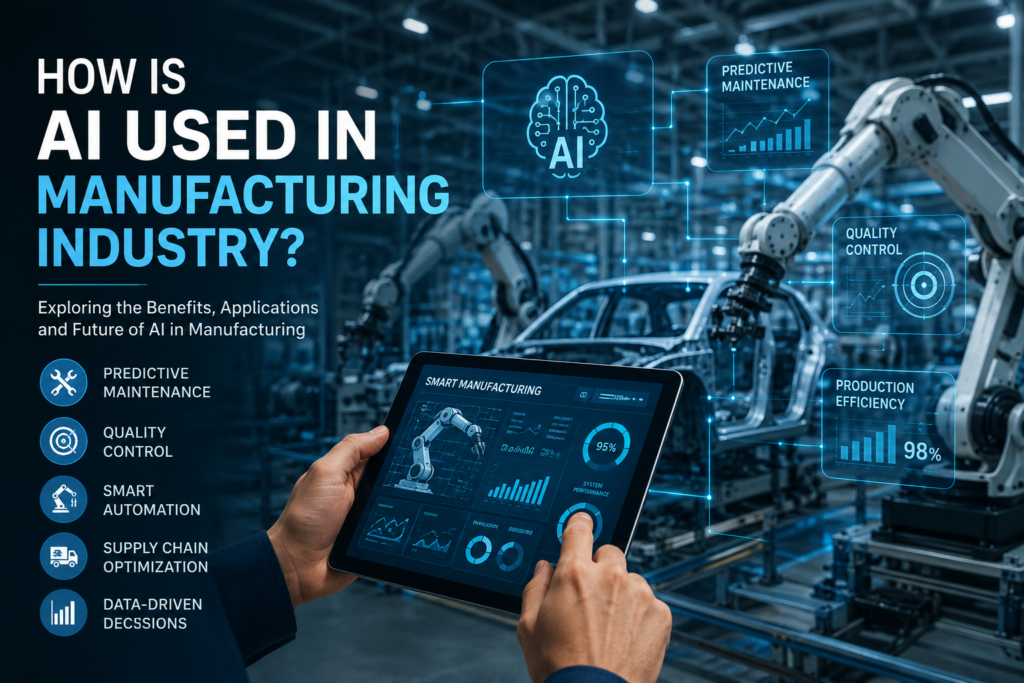
How Smart Factories Use AI Every Day
Smart factories are one of the biggest examples of AI transformation in manufacturing. These facilities use connected sensors, cloud computing, AI software, and industrial IoT devices to create highly intelligent production environments.
AI-powered factories monitor equipment performance continuously. Machines communicate with one another, production systems analyze workflows in real time, and factory managers receive instant insights about operational efficiency. This level of visibility allows businesses to solve problems before they become expensive disruptions.
As a matter of fact, smart manufacturing AI systems can also reduce energy consumption and improve sustainability. Manufacturers use AI analytics to identify inefficient machines, reduce material waste, and optimize production cycles.
Predictive Maintenance with Artificial Intelligence
One of the most valuable applications of AI in manufacturing is predictive maintenance. Traditional maintenance strategies often depend on scheduled inspections or waiting for equipment to fail. Both approaches create unnecessary costs and production interruptions.
Predictive maintenance AI changes that completely. Sensors collect data from machines, including temperature, vibration, pressure, and operational speed. AI systems then analyze this information to detect early warning signs of failure.
When unusual patterns appear, maintenance teams receive alerts before equipment breaks down. This reduces downtime, extends machine lifespan, and lowers repair costs significantly. Many manufacturers consider predictive maintenance one of the fastest-return AI investments available today.
How AI Improves Quality Control
Maintaining product quality is essential in manufacturing. Even small defects can damage customer trust and increase operational costs. AI quality control systems help manufacturers inspect products with remarkable speed and accuracy.
Computer vision manufacturing systems use cameras and machine learning algorithms to identify scratches, cracks, missing components, or labeling errors automatically. These systems detect defects that human inspectors might miss during repetitive inspections.
Honestly, AI-powered quality inspection has become especially important in industries such as automotive manufacturing, electronics, pharmaceuticals, and food production where precision matters deeply.
Machine Learning in Manufacturing Automation
Machine learning allows manufacturing systems to improve over time through experience and data analysis. Instead of following fixed programming forever, machine learning models adapt based on operational patterns and historical performance.
Manufacturers use machine learning in manufacturing to optimize production schedules, improve forecasting accuracy, detect inefficiencies, and automate complex workflows. AI systems continuously learn from factory operations and recommend smarter processes.
That being said, manufacturing automation powered by AI also creates greater flexibility. Factories can scale production faster while maintaining consistency and efficiency.
AI Robotics and Human Collaboration
AI robotics manufacturing systems have evolved far beyond traditional industrial robots. Modern collaborative robots, often called cobots, work safely alongside human employees and adapt to changing tasks dynamically.
These robots help workers perform repetitive, physically demanding, or dangerous activities more safely and efficiently. AI-powered robotics improve workplace safety while increasing productivity on factory floors.
Come to think of it, AI is not replacing human workers entirely. Instead, it often supports employees by reducing repetitive labor and allowing teams to focus on technical problem-solving and strategic operations.
How AI Optimizes Supply Chains
Supply chain disruptions have become one of the biggest challenges facing manufacturers worldwide. AI supply chain optimization tools help companies forecast demand, manage inventory, and improve logistics planning more accurately.
AI analyzes supplier performance, customer demand trends, market conditions, and shipping data to help manufacturers make smarter decisions. This reduces delays, minimizes inventory shortages, and improves operational efficiency.
On the other hand, AI also helps manufacturers detect supply chain risks earlier. Businesses can identify weak suppliers or transportation bottlenecks before production suffers.
The Benefits of AI in Manufacturing
Artificial intelligence offers a wide range of advantages for manufacturing companies. These benefits go far beyond automation and include operational improvements across nearly every department.
- Reduced equipment downtime
- Improved product quality
- Lower operational costs
- Faster production cycles
- Smarter inventory management
- Enhanced workplace safety
- Better demand forecasting
- Improved energy efficiency
- Greater manufacturing flexibility
- Higher customer satisfaction
Manufacturers that adopt AI manufacturing solutions early often gain a strong competitive advantage in global markets.
Challenges of AI Adoption in Manufacturing
Despite its benefits, implementing AI in manufacturing still comes with challenges. Many companies struggle with outdated infrastructure, disconnected systems, and inconsistent data quality.
AI systems depend heavily on accurate data. Poor-quality information can limit AI performance and reduce decision-making accuracy. Manufacturers often need to modernize their systems before fully adopting AI technologies.
Cost is another major factor. AI implementation may require investments in cloud computing, sensors, software integration, cybersecurity, and employee training. Smaller manufacturers sometimes hesitate because of these upfront expenses.
The Future of AI in Manufacturing Industry
The future of AI in manufacturing looks incredibly promising. Technologies like generative AI, digital twins, and autonomous robotics are already transforming industrial production environments.
Generative AI manufacturing systems can help engineers create optimized product designs, simulate manufacturing processes, and reduce development time significantly. Digital twin manufacturing technology allows companies to create virtual factory models for testing and optimization.
Interestingly enough, the factories of the future will likely become even more connected, automated, and intelligent. Companies combining human expertise with advanced AI systems will lead the next era of industrial innovation.
Frequently Asked Questions About AI in Manufacturing
What is AI in manufacturing?
AI in manufacturing refers to the use of artificial intelligence technologies such as machine learning, robotics, predictive analytics, and computer vision to improve manufacturing operations, automation, and decision-making.
How is AI used in manufacturing industry?
AI is used in manufacturing for predictive maintenance, quality control, supply chain optimization, robotics automation, inventory forecasting, smart factory management, and production efficiency improvements.
What are the benefits of AI in manufacturing?
AI helps manufacturers reduce downtime, improve product quality, lower costs, increase efficiency, improve workplace safety, and make smarter operational decisions.
Can AI replace workers in manufacturing?
AI typically supports workers rather than replacing them entirely. Many AI systems automate repetitive tasks while allowing employees to focus on higher-value technical and strategic work.
What industries use AI manufacturing solutions?
Industries using AI in manufacturing include automotive, aerospace, electronics, pharmaceuticals, food production, consumer goods, logistics, and heavy industrial manufacturing.
What is predictive maintenance in manufacturing?
Predictive maintenance uses AI and sensor data to monitor machine health and predict equipment failures before breakdowns happen, helping manufacturers reduce downtime and maintenance costs.
How does computer vision improve manufacturing?
Computer vision systems use cameras and AI algorithms to inspect products automatically, detect defects, improve quality control, and speed up manufacturing inspections.
What is a smart factory?
A smart factory is a manufacturing facility that uses AI, IoT devices, automation systems, and real-time analytics to optimize production and improve operational efficiency.
Final Thoughts
Understanding how is AI used in manufacturing industry is becoming essential for businesses that want to stay competitive in an increasingly automated world. Artificial intelligence is transforming everything from predictive maintenance and robotics to quality control and supply chain optimization.
Manufacturers embracing AI today are building faster, smarter, and more efficient operations for tomorrow. As AI technology continues evolving, the manufacturing industry will likely become even more connected, intelligent, and adaptable in the years ahead.
If you found this guide helpful, share it with your team, leave a comment below, or explore more insights about AI-powered manufacturing solutions and Industry 4.0 technologies.