
The 2026 Developer Stack: A brutally honest guide for the AI-native era
Introduction: Coding Isn’t Dead—But the Job Description Is
We’ve reached the end of 2025, and the same recycled questions still float around the tech world:
“Will AI replace developers?”
“Why learn to code when I can prompt?”
“Doesn’t ChatGPT write better Python anyway?”
Let’s be clear: AI didn’t eliminate developers—it eliminated average development.
In 2026, a developer is no longer someone who memorizes syntax. You’re now a system designer, logic engineer, and the person who decides how humans and machines collaborate. AI can generate functions, but it still can’t architect a reliable, scalable system from scratch.
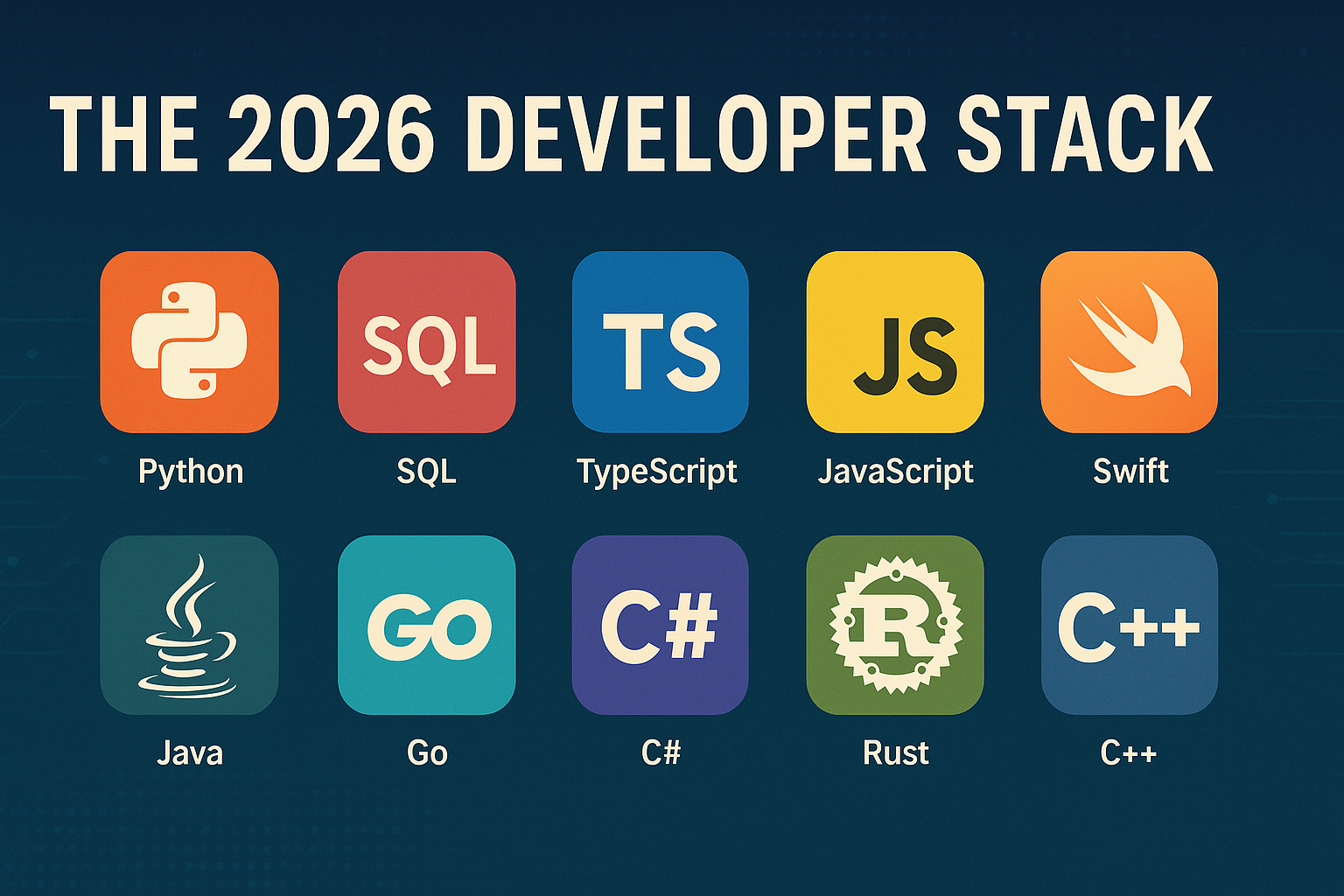
To design modern software, you must understand the languages powering each layer of the stack. This ranking prioritizes function and relevance—not hype or nostalgia.
I. Intelligence Languages (Data, AI & High-Level Logic)
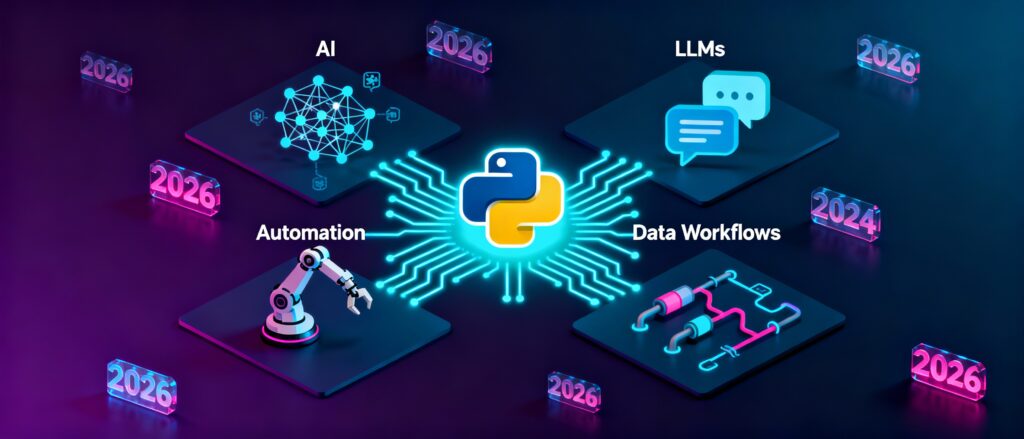
These languages fuel machine learning workflows, data analysis, automation chains, and LLM-driven apps.
1. Python — The Command Center of Modern Computing
Python continues to dominate any environment involving data, AI, or automation. It’s not the fastest, and it’s not the most memory-efficient, but it remains the only language that bridges researchers, analysts, and engineers without friction.
Why Python rules 2026
The entire AI ecosystem—LLMs, training pipelines, vector databases—lives in Python.
Massive library support makes development extremely fast.
Ideal for automation, prototyping, and orchestrating AI systems.
2026 Reality:
You don’t use Python to beat latency.
You use Python to control the models that are reshaping the world.
2. SQL — The Language Behind Every Reliable Answer
Decades have passed, yet SQL is still the VIP pass to accurate data. AI can predict patterns, but SQL ensures the information feeding it is correct.
Why SQL is non-negotiable
Databases haven’t vanished—if anything, they’ve grown.
Every business decision depends on structured queries.
No full-stack skillset is complete without data fluency.
2026 Reality:
If your query skills stop at SELECT *, you’re not a developer—you’re a spectator.
Why Choose GrayCyan for AI Chatbot Development?
15+ Years Experience in AI & enterprise software development.
Proven Industry Expertise with clients across healthcare, finance, retail, and SaaS.
Custom Solutions (not cookie-cutter bots).
Enterprise Security with compliance for GDPR, HIPAA, SOC2.
End-to-End Services – from consultation to deployment and support.
Track Record of ROI – Our chatbots consistently reduce costs & boost revenue.
II. Experience Languages (UI, UX & Front-End Delivery)
These languages shape everything users see, click, touch, and interact with.
3. TypeScript — The Web’s Insurance Policy
TypeScript has become the default for serious front-end engineering. Modern applications are large, complex, and distributed—TS prevents them from collapsing under their own weight.
Why TypeScript dominates
Strong typing prevents entire categories of bugs.
Every major framework (React, Next.js, Angular, Svelte) embraces it.
Teams depend on it for clarity and long-term maintainability.
2026 Reality:
If you build enterprise-grade web apps, TypeScript isn’t optional—it’s expected.
4. JavaScript — The Internet’s Perpetual Survivor
Love it or hate it, JavaScript is the only language running natively in every web browser—and that alone guarantees its immortality.
Why JS refuses to die
Unmatched ecosystem and community.
Perfect for rapid prototyping and experimentation.
Runs on browsers, servers, IoT hardware, and everything in between.
2026 Reality:
JS is the global passport of the web. It’s not going anywhere.
5. Swift — The Golden Gate to the Apple Ecosystem
Apple continues shaping premium digital experiences, and Swift is the only way inside that walled empire.
Why Swift matters
Required for iOS, macOS, visionOS, and watchOS.
A safe, modern, high-performance language.
Apple users still spend more per app than all other platforms.
2026 Reality:
If you want to monetize apps, Swift is one of the highest-ROI skills.
III. Infrastructure Languages (Backend, Systems, Cloud)
These languages run global-scale applications, critical business systems, and high-load cloud services.
6. Java — The Quiet Engine Behind the World’s Money
Java isn’t fashionable, but it powers banks, governments, healthcare, and the enterprise world. It’s predictable, structured, and incredibly stable.
Why Java is thriving again
The JVM remains one of the strongest production environments ever built.
AI tools eliminate the verbosity developers used to hate.
Ideal for large, long-lived, mission-critical systems.
2026 Reality:
Java is having a second life—and this time, AI is driving it.
7. Go (Golang) — The Backbone of Cloud Infrastructure
Go was built for scalable, concurrent systems—and the cloud era made it indispensable.
Why Go owns the cloud
Simple, efficient, and fast to deploy.
Used by Kubernetes, Docker, Prometheus, Terraform, etc.
Perfect for microservices and distributed architectures.
2026 Reality:
If you’re building cloud-native applications, Go is one of the sharpest tools available.
8. C# — The Bridge Between Enterprise & Real-Time 3D Worlds
C# quietly dominates two massive worlds: enterprise software and game development.
Why C# stays relevant
The .NET ecosystem is battle-tested and still evolving.
Unity uses C# for games, VR, and 3D experiences.
Ideal balance of readability, performance, and structure.
2026 Reality:
As spatial computing grows, C# remains a core skill for interactive experiences.
These languages run global-scale applications, critical business systems, and high-load cloud services.
6. Java — The Quiet Engine Behind the World’s Money
Java isn’t fashionable, but it powers banks, governments, healthcare, and the enterprise world. It’s predictable, structured, and incredibly stable.
Why Java is thriving again
The JVM remains one of the strongest production environments ever built.
AI tools eliminate the verbosity developers used to hate.
Ideal for large, long-lived, mission-critical systems.
2026 Reality:
Java is having a second life—and this time, AI is driving it.
7. Go (Golang) — The Backbone of Cloud Infrastructure
Go was built for scalable, concurrent systems—and the cloud era made it indispensable.
Why Go owns the cloud
Simple, efficient, and fast to deploy.
Used by Kubernetes, Docker, Prometheus, Terraform, etc.
Perfect for microservices and distributed architectures.
2026 Reality:
If you’re building cloud-native applications, Go is one of the sharpest tools available.
8. C# — The Bridge Between Enterprise & Real-Time 3D Worlds
C# quietly dominates two massive worlds: enterprise software and game development.
Why C# stays relevant
The .NET ecosystem is battle-tested and still evolving.
Unity uses C# for games, VR, and 3D experiences.
Ideal balance of readability, performance, and structure.
2026 Reality:
As spatial computing grows, C# remains a core skill for interactive experiences.
IV. Hardware Languages (Performance, Security & Control)
These languages get closest to the metal—where speed, memory, and precision matter most.
9. Rust — The Modern Champion of Memory Safety
Rust is the first language to successfully challenge C++ at its own game.
Why Rust leads the future of secure computing
Prevents memory-related vulnerabilities.
Zero-cost abstractions without garbage collection.
Governments and tech giants are rewriting secure systems in Rust.
2026 Reality:
If your work touches security or low-level systems, Rust is the safest hedge on the future.
10. C++ — The Performance King That Still Won’t Be Dethroned
Despite its complexity, C++ remains unmatched when raw speed and control are required.
Why C++ stays powerful
Powers rendering engines, compilers, browsers, robotics, and AI infra.
Essential for real-time systems and high-frequency workloads.
Hardware-level control still matters—and C++ excels at it.
2026 Reality:
C++ isn’t going anywhere. It’s the foundation beneath modern computing.
The Developer Strategy That Wins in 2026: Become T-Shaped
To survive—and thrive—in the AI-native world, your skill set must be deep in one area and broad across the stack.
✔ Specialize deeply in one production language
Choose from:
TypeScript, Go, Java, or C#
✔ Build strong literacy in AI/data languages
Python + SQL
✔ Understand systems languages conceptually
Rust or C++
This combination makes you agile, adaptable, and irreplaceable—even as AI accelerates.