
Odoo ERP Development Services: Custom Odoo Module Development for Manufacturers
Full Python source code, technical documentation and the repository. You own it.
GrayCyan builds what standard Odoo cannot do: custom modules for manufacturing compliance, AI middleware that connects Odoo to real-time production intelligence, and API integrations between Odoo and external systems that have no native Odoo connector.
Book a Discovery Call




















 Client



 Partner
 Member












What GrayCyan Builds as an Odoo ERP Development Company
GrayCyan is a US based Odoo ERP development company whose Odoo developers build what standard Odoo cannot do. That work falls into four areas, and all of it runs as native Odoo code rather than a separate application alongside it.

Manufacturing Compliance Modules
GrayCyan builds manufacturing compliance modules where FSMA 204 KDE capture runs at every critical tracking event, AS9100 serial genealogy links to Odoo production orders, 21 CFR Part 11 electronic audit trails serve pharmaceutical manufacturers, and METRC API integration serves cannabis processors.
These are built as Odoo native modules that extend the standard manufacturing and inventory modules, not bolted on as separate software.
AI Middleware on Odoo
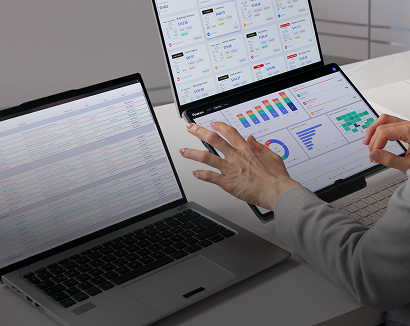
GrayCyan develops middleware that sits on top of Odoo, including ML demand forecasting connected to Odoo reorder points, inventory anomaly detection on Odoo transaction data, and agentic automation agents that coordinate multi-step Odoo workflows.
All of it runs as Python services that read from and write to Odoo through the Odoo API.
Odoo ERP Integrations
API middleware connecting Odoo to WMS platforms, carrier APIs, EDI partners, compliance reporting systems, MES equipment, and legacy databases.
Event-driven, so every Odoo transaction synchronizes in real time.
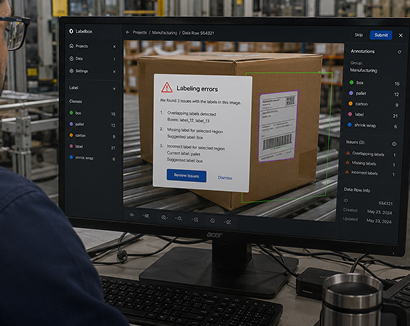
Custom Reporting and Dashboards
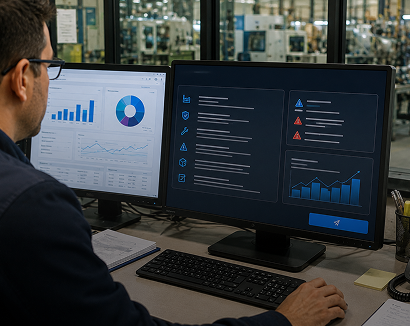
Production floor dashboards pulled from live Odoo manufacturing data, financial dashboards with manufacturing cost breakdown, and quality dashboards drawn from Odoo Quality records.
All built directly on the Odoo ORM.
What GrayCyan does not build matters just as much
GrayCyan does not build Odoo websites, e-commerce, HR or payroll modules, point of sale systems, or marketing automation.
General Business → Manufacturing Only
Custom modules are developed exclusively for manufacturing and industrial distribution, where the gaps in standard Odoo are compliance-specific, production-specific, or AI-specific.
Custom Odoo Manufacturing Compliance Modules
The most common Odoo development request GrayCyan gets from mid-market manufacturers is a compliance module: a custom Odoo module that extends the standard Odoo manufacturing and inventory modules to capture the regulatory documentation that Odoo does not generate natively.
FSMA 204 KDE Capture Module
Standard lot tracking in Odoo Inventory captures lot numbers and quantities, but it does not capture Key Data Elements at each Critical Tracking Event in the structured format the FDA requires. GrayCyan builds a custom module that adds KDE capture fields to the Odoo receiving workflow (Receiving CTE), the manufacturing order (Transforming CTE), and the delivery order (Shipping CTE).
Every scan event generates a structured KDE record with traceability lot code, product description, quantity, location, date, and supplier or recipient in the FDA-required format. The module also adds forward and backward trace queries, so a full traceability record can be produced from any lot number within the 24-hour window.
AS9100 Serial Genealogy Module
Serial number tracking in Odoo Inventory tracks location and movements, but it does not capture the AS9100 genealogy record: raw material COA, special process NADCAP data, inspection results, and as-built configuration, all linked to each serialized unit.
GrayCyan builds a custom module that links the serialized unit record to the raw material lot COA, the NADCAP certifications from outside processors, inspection results from Odoo Quality, and the production order and routing steps the unit went through, producing the full AS9100 genealogy from the Odoo record itself.
METRC Integration Module (Cannabis)
Odoo Inventory tracks lot quantities and locations but has no METRC API connection. GrayCyan builds a custom Odoo module that connects every Odoo inventory movement (receipt, production, internal transfer, delivery) to the corresponding METRC API call.
That covers plant tag creation, harvest batch, package UID assignment, transfer manifest generation, and destruction records. METRC and Odoo stay synchronized without manual double entry.
21 CFR Part 11 Audit Trail Module
Odoo logs changes to records, but that log does not satisfy 21 CFR Part 11 requirements for electronic signatures, immutable records, and operator-specific authentication per regulated transaction.
GrayCyan builds a custom Odoo module that wraps regulated transactions, such as lot status changes, QC release decisions, and production order completion, with Part 11-compliant electronic signature workflows, and generates an immutable audit trail record for each regulated event.
AI Development on Odoo: GrayCyan's Manufacturing Intelligence Layer
GrayCyan builds AI layers on top of Odoo. Not Odoo's built-in AI features, but custom ML models and agentic automation systems that read from Odoo's data through the Odoo API and write results back to Odoo automatically. The difference from standard Odoo Studio customization is real: this is Python development with ML libraries and custom API middleware, not low code configuration.
ML Demand Forecasting Connected to Odoo Reorder Points
A Python service pulls Odoo sales order history (12 to 24 months) and production consumption data through the Odoo JSON RPC API. The ML model, typically a time series model incorporating seasonality and customer-specific patterns, generates SKU-level demand forecasts for each active Odoo product.
Forecast results get written back to Odoo minimum quantity fields via the Odoo API, so Odoo's native reorder rules trigger replenishment at the AI-updated minimum instead of a manually set static one.
Inventory Anomaly Detection on Odoo Transactions
An ML model trained on historical Odoo inventory move data establishes expected transaction patterns by product, location, and time period. Real-time monitoring of Odoo stock moves flags patterns that deviate from the model, including unexpected decreases, receiving variances, and cycle count discrepancies.
Alerts route through Odoo's native chatter and activity system, so anomalies surface in Odoo's interface without requiring the warehouse team to check a separate platform.
Agentic Odoo Workflow Automation
The system coordinates multi-step Odoo workflows without human orchestration. An agentic replenishment agent monitors Odoo inventory levels, evaluates the current demand forecast and supplier lead times, drafts Odoo purchase order requests for buyer approval, and updates Odoo reorder records on confirmation.
An agentic compliance documentation agent receives an audit request and compiles the complete documentation package from Odoo production orders, lot records, quality inspections, and custom compliance module records, without the QA team manually querying each Odoo record.
The architecture is a Python microservice setup connected to Odoo through the Odoo JSON RPC API and webhooks.
Read → Process → Write Back
Odoo remains the system of record. The AI services read from Odoo, process, and write results back, with no separate database maintained outside of it. More on this at Odoo AI integration.
Odoo ERP Integration Development: Connecting Odoo to External Systems
Every Odoo deployment for a manufacturer eventually requires connecting Odoo to at least one external system: a WMS, a carrier API, an EDI network, a compliance platform, or legacy equipment. Custom modules build the API middleware that connects Odoo to these external systems in real time, using Odoo's native API rather than fragile file-based integrations.

Odoo WMS Integration
Odoo pushes purchase and sales orders to the WMS before shipments arrive or pick tasks are released. The WMS pushes receiving confirmations, pick completions, and shipment data back, updating Odoo inventory, closing PO and SO lines, and posting accounting entries in real time.
The pattern is event-driven in both directions: a webhook from Odoo to WMS middleware and an API call from WMS to Odoo on scan confirmation.

Carrier and Shipping API Integration
Odoo delivery orders trigger carrier rate queries across multiple carriers, including UPS, FedEx, USPS, and LTL carriers, returning rates to the Odoo packing screen for selection.
Label generation happens from the Odoo delivery order, the tracking number gets written back to the Odoo delivery record, and the end-of-day manifest triggers at carrier cutoff.

EDI Integration for Manufacturing
EDI 850 (purchase order from customer) maps to an Odoo sales order, so customer EDI orders create Odoo SOs without manual entry. EDI 856 (advance shipment notice) gets generated from the Odoo delivery confirmation, with Odoo shipment data formatted as EDI 856 and transmitted to the customer's EDI system.
EDI 810 (invoice) generates from the Odoo invoice record.

Manufacturing Equipment and MES Integration
OPC UA connections run from Odoo production orders to CNC machines, assembly stations, or testing equipment, pushing work order parameters out and pulling cycle times and results back.
Production order completion can be triggered directly by an equipment signal, removing the need for manual shop floor reporting.
Manufacturers who need Odoo deployed and configured before any of this integration work makes sense should start with Odoo ERP implementation.
When to Build a Custom Odoo Module vs Configure Standard Odoo
Custom Odoo development is not always the right answer. Odoo Studio, configuration parameters, and existing Odoo apps from the Odoo Appstore cover many requirements without any custom development. The decision to build a custom module should be driven by a genuine gap in what configuration and existing apps can deliver, not by a preference for custom over standard.
Before writing a line of code, a GrayCyan Odoo ERP developer evaluates whether the requirement can be met by configuration or an existing Appstore module.
Configuration First → Custom Only If Needed
Custom development gets proposed only when configuration genuinely cannot deliver the requirement, not as the default approach to every customization request.
Odoo Development Delivery: What GrayCyan Produces and Who Owns It
Every custom Odoo module GrayCyan develops is delivered with full source code, technical documentation, and the manufacturer's own Odoo repository.
GrayCyan does not retain source code or require ongoing access fees for the custom work produced.
Every custom Odoo module ships with:
- Complete Python source code: Structured as a standard Odoo addon for compatibility with future Odoo upgrades.
- Technical documentation: Covering the data model, API endpoints, configuration parameters, and upgrade notes.
- A test suite: Unit tests for the module's core logic and integration tests for the Odoo API connections.
- Installation and verification guide: A step-by-step walkthrough for standing the module up and confirming it works.
- Training: A walkthrough of the module's interface and admin configuration for the manufacturer's team.
For manufacturers upgrading Odoo versions, GrayCyan provides module migration services, updating custom module code to the new Odoo version's API without losing custom functionality. Custom module maintenance and support after delivery is handled by GrayCyan's Odoo support team, covering bug fixes, minor enhancements, and compatibility updates for Odoo minor releases.
Frequently Asked Questions: Odoo ERP Development Services
Standard Odoo Does Not Do What Your Manufacturing Operation Needs?
Tell us which Odoo modules you already run, what compliance framework applies (FSMA 204, AS9100, pharmaceutical, or cannabis), and where standard Odoo configuration runs out.
GrayCyan will scope the custom module development needed to close the gap.
See Odoo implementation or Odoo AI integration →