




Most guides to AI tools for manufacturing seem like they were written for a Fortune 500 IT department with an unlimited budget and a dedicated data science team. That's not who's actually searching for this. If you run a 50–500 person manufacturing operation with an ERP system you've spent years configuring, you don't need another list of enterprise platforms priced for GE or Boeing. You need to know which AI automation tools for manufact uring actually fit your size, your data, and your existing systems and when the right answer isn't a tool at all, but a custom-built system.
And this guide covers both. It names the platforms with honest tradeoffs, organizes them by the problem they solve rather than by marketing category, and includes the questions no vendor site will answer for you upfront.
What Are AI Tools for Manufacturing — And How to Think About Them
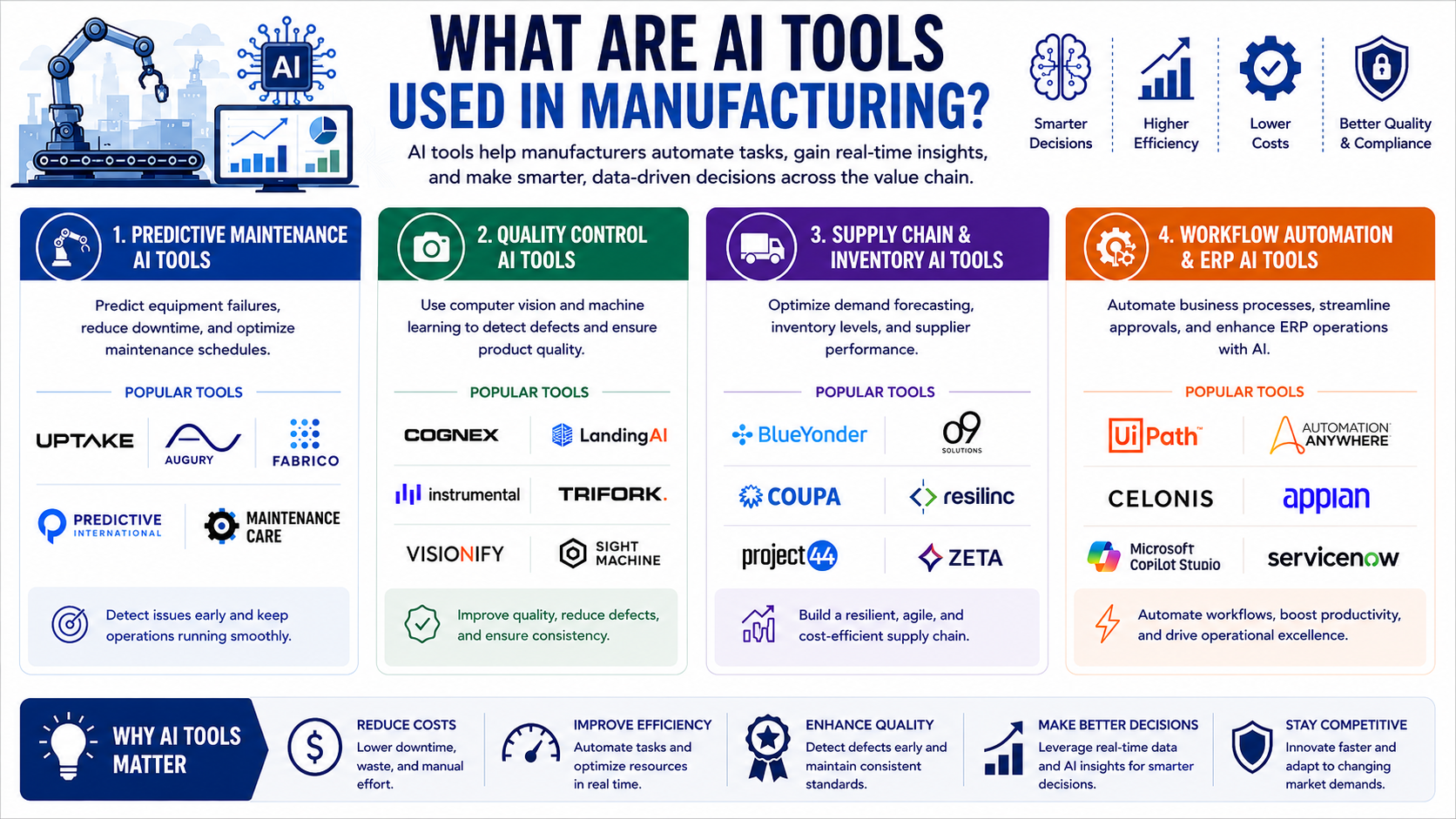
Four practical categories of AI tools for manufacturing
Manufacturing AI adoption is high on paper; most industry surveys put planned or in-progress adoption above 75% but a large share of predictive maintenance projects still fail to deliver value. The reason is rarely the technology itself. It's alarm fatigue, poor data readiness, and buying a platform before defining the problem it needs to solve. The gap between purchasing an AI tool and getting value from it is almost always an implementation and data problem, not a technology problem.
Once you strip away the marketing language, ai automation tools for manufacturing fall into four practical categories:
Predictive Maintenance Tools
They monitor equipment sensor data and maintenance history to flag failures before they happen.
Quality Control and Vision Inspection Tools
Inspect products at line speed using computer vision, catching defects, dimensional deviations, and assembly errors.
Production Planning and Scheduling Tools
Optimize production sequences, capacity allocation, and demand forecasting using machine learning.
Workflow Automation and ERP AI Tools
Connect and automate data flows between ERP, MES, WMS, and operational systems, eliminating manual re-entry.
Most articles on this topic list enterprise platforms like IBM Maximo, Siemens Industrial Copilot, Sight Machine and stop there. These are strong tools, but they're built for large-scale data operations and dedicated IT teams that most mid-market manufacturers (50–500 employees) don't have yet. This guide covers both the enterprise tier and what actually works for manufacturers earlier in their AI journey.
The Real Reason 70% of Manufacturing AI Projects Fail — Before You Pick a Tool
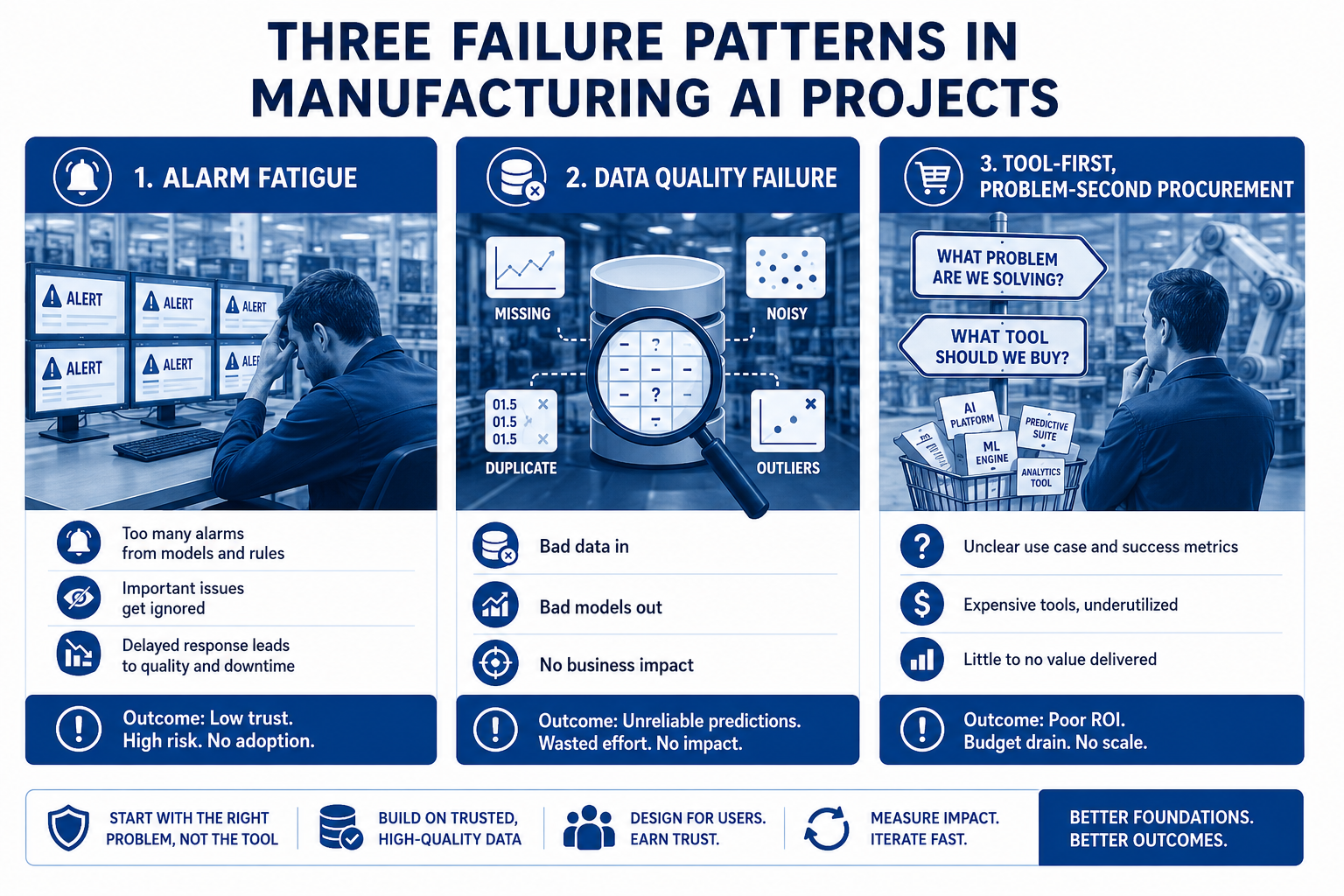
Alarm fatigue, data quality failure, and tool-first procurement — the three failure patterns
Industry analysis has repeatedly pointed to a specific failure mode in predictive maintenance deployments: alarm fatigue. Even the most advanced AI automation tools for manufacturing can fall short if they generate too many alerts without enough actionable context. Operators stop trusting the system, and eventually they ignore it entirely. The tools aren't broken, the deployments are.
Three failure patterns show up again and again in manufacturing AI projects:
A predictive maintenance tool that flags 50 anomalies a day isn't useful but it's noise. The tool has to surface the right alert at the right time, with enough context for a technician to actually act on it.
AI tools train and run on your data. If your ERP has inconsistent units of measure, your CMMS has incomplete maintenance records, or your production data has gaps, the AI amplifies those problems instead of solving them. Garbage in, garbage out isn't a cliché here, it's the number one project killer.
Buying a predictive maintenance platform because it looked impressive in a demo before identifying the specific failure mode you're trying to prevent produces a tool nobody ends up using.
The right sequence is: identify the operational problem, confirm you have the data to solve it, choose a tool category, then evaluate specific platforms. Reversing that order, starting with a platform and finding a problem to justify it, is how projects fail. Keep that sequence in mind as you read the rest of this guide.
AI Tools for Predictive Maintenance in Manufacturing
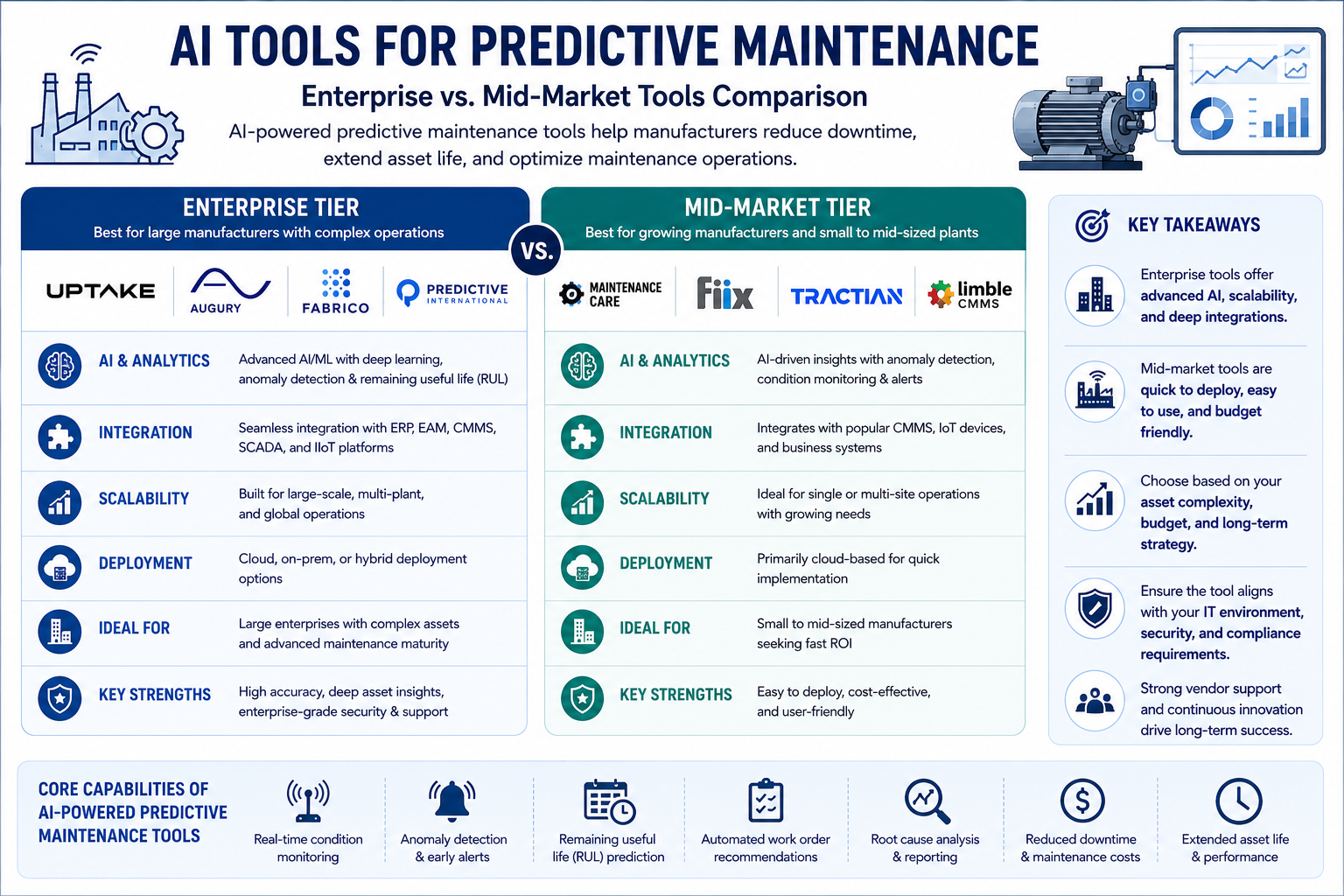
Enterprise-tier vs. mid-market accessible predictive maintenance tools
Predictive maintenance AI automation tools for manufacturing continuously monitor equipment condition data such as vibration, temperature, electrical current, pressure, and run-time hours to detect early signs of failure. By analyzing these data points in real time, they can predict potential equipment issues before they occur, enabling manufacturers to replace fixed maintenance schedules with more efficient condition-based maintenance.
Enterprise-Tier Tools (Large Asset Fleets, Dedicated IT)
- IBM Maximo Application Suite: Comprehensive enterprise asset management combined with predictive maintenance and visual inspection. Strong for large manufacturers managing thousands of assets, but it requires significant implementation work and data standardization. Best for organizations with dedicated IT, a large asset base, and an existing IBM ecosystem.
- Augury: A purpose-built machine health platform that mounts sensors on equipment to monitor vibration and temperature patterns. One of the more mature predictive maintenance solutions in the market. Best for mid-to-large manufacturers willing to invest in sensor hardware, and the honest limitation is that it requires physical installation.
- Uptake: Asset performance management aimed at heavy industry: mining, energy, large-scale manufacturing. Best for distributed asset fleets with diverse equipment types across multiple sites.
Mid-Market Accessible Tools (50–500 Employees)
- Fiix (Rockwell Automation): A cloud-based CMMS with predictive maintenance capabilities and a limited free plan. Works alongside your existing ERP rather than replacing it. A good starting point for manufacturers who need to digitize maintenance records before layering on ML.
- Fabrico: Combines OEE and maintenance tracking in one platform, using PLC data plus video context for high-fidelity production data. Positioned for manufacturers building the data foundation AI actually requires.
GrayCyan's approach: For manufacturers who want predictive maintenance using data already sitting in their CMMS and ERP without new sensor hardware, GrayCyan builds custom ML models trained on existing maintenance history, run-time logs, and sensor data already flowing through your systems. See how this works in predictive intelligence and automation.
AI Tools for Quality Control and Visual Inspection in Manufacturing
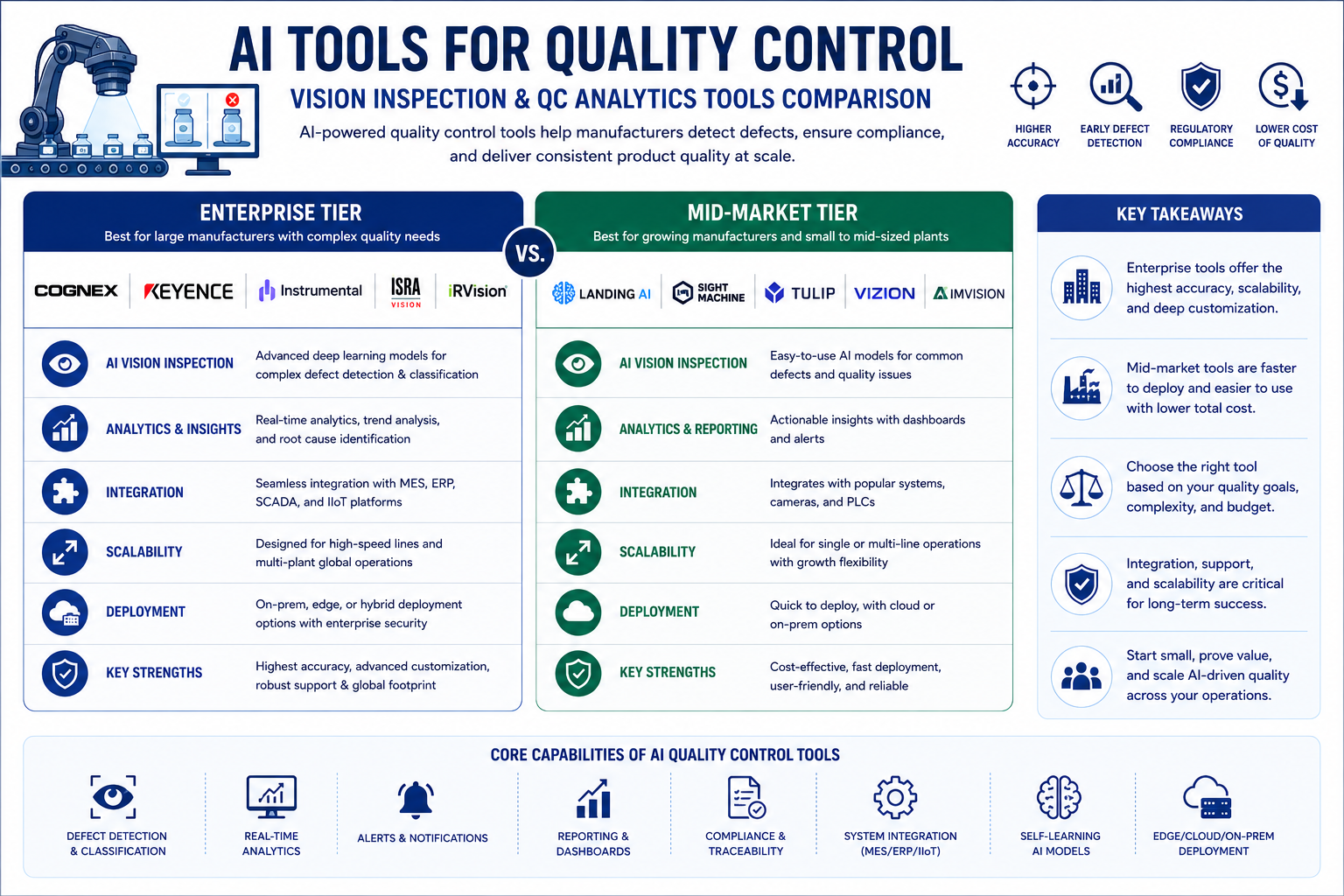
Vision inspection tools vs. QC analytics platforms for manufacturing quality control
The best AI visual inspection tools for manufacturing typically fall into two categories: computer vision systems that inspect products visually at line speed, and machine learning (ML) models that analyze existing quality control (QC) log data to identify defect patterns, uncover root causes, and reveal process correlations. Together, these AI-powered quality control tools help manufacturers improve inspection accuracy, reduce manual errors, and optimize production quality.
Computer Vision / Visual Inspection Tools
- Landing AI (LandingLens): Founded by Andrew Ng, focused exclusively on AI-powered visual inspection for manufacturing. Strong at training custom models on manufacturer-specific defect images. Best for manufacturers needing custom defect classification on unusual or proprietary products.
- Cognex ViDi (Deep Learning Vision): A market leader in machine vision, using deep learning to detect complex visual defects on high-speed lines. Best for high-volume discrete manufacturers with consistent product types.
- Instrumental: AI-powered automated inspection built specifically for electronics and PCB assembly. Best for electronics manufacturers with complex assembly inspection requirements.
QC Analytics and Anomaly Detection (No Camera Hardware Required)
- Seeq: An analytics platform for process manufacturers that works on top of existing data historians, helping engineers search and correlate quality data. Best for process manufacturers like chemicals, food, pharma with existing historian data.
GrayCyan's approach: ML applied directly to existing QC inspection records, surfacing recurring defect patterns, root causes, and shift/operator/material correlations, with no camera investment required for the initial deployment. Details at best AI visual inspection tools for manufacturing solutions.
For regulated manufacturers such as from food processors, pharmaceutical plants, aerospace suppliers, ai tools for quality control in manufacturing also generates audit-ready inspection records that manual inspection can't produce: every inspection timestamped, scored, and traceable to batch, shift, and operator.
AI Tools for Production Planning, Scheduling, and Demand Forecasting
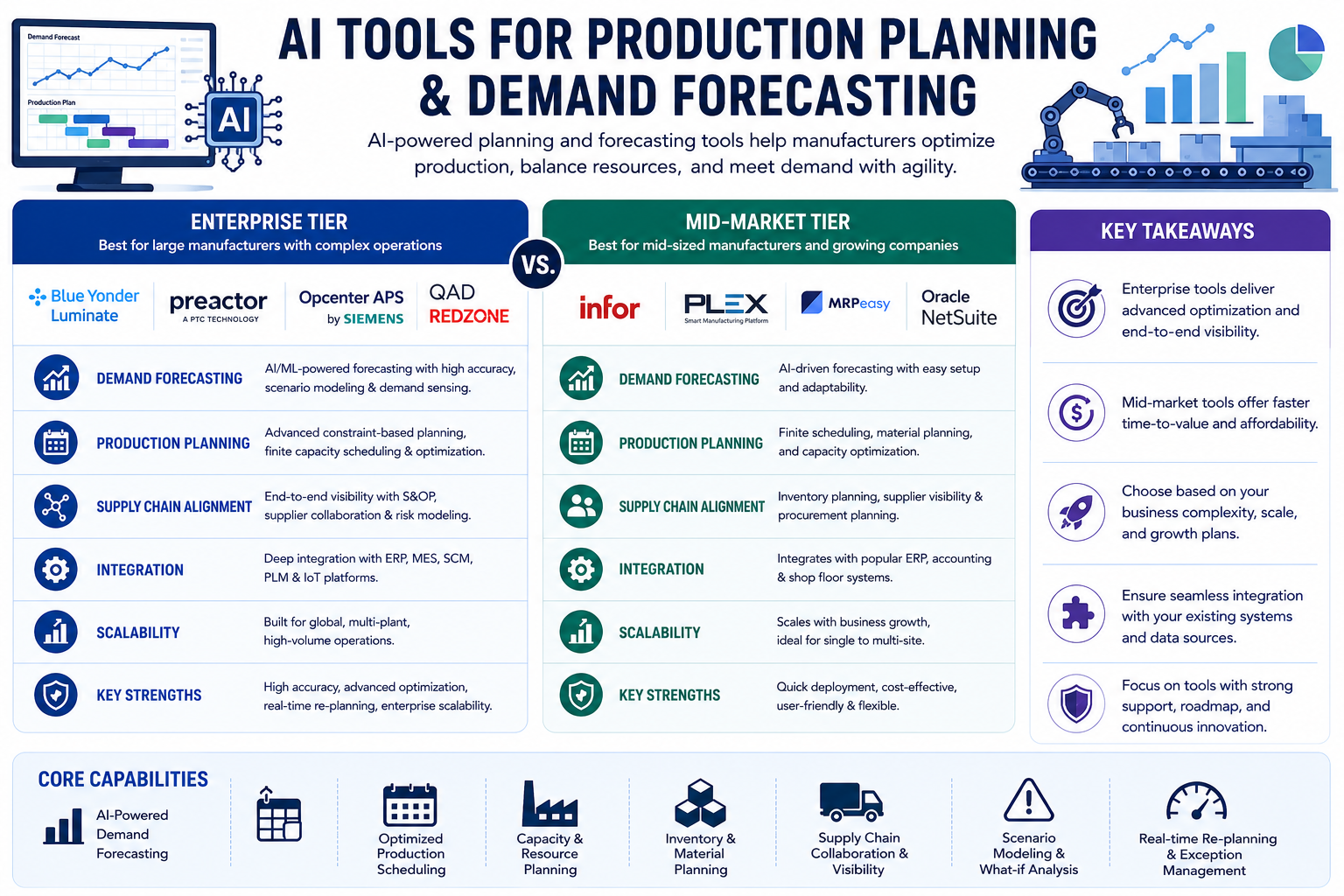
AI-powered APS tools and demand forecasting working together
The best AI tools for forecasting in manufacturing improve production planning by increasing scheduling accuracy, reducing changeover time, and maximizing throughput. However, they require clean demand history and consistent MES data to deliver reliable forecasts. For most manufacturers, these tools are typically the third or fourth AI investment rather than the first.
Production Scheduling and APS Tools
- Preactor (Siemens Opcenter APS): One of the most established Advanced Planning and Scheduling platforms, handling complex constraint-based scheduling across machine capacity, tooling, operator skills, and material availability. Integrates with SAP, Oracle, and other major ERPs as a scheduling layer above the ERP. Best for complex discrete manufacturers whose ERP planning modules can't handle multi-constraint scheduling.
- Blue Yonder: An enterprise supply chain and planning platform covering demand forecasting, inventory optimization, and production scheduling. Best for large manufacturers with complex multi-site supply chains.
- QAD Redzone: A connected workforce platform combining OEE, production performance tracking, and AI-driven insights, built specifically for manufacturing. Best for mid-market manufacturers who want real-time shop floor visibility.
Demand Forecasting
- Blue Yonder Luminate: ML-based demand forecasting feeding into supply chain planning, with documented enterprise deployments showing meaningful forecast accuracy gains over statistical methods.
GrayCyan's approach: Custom demand forecasting models built on ERP order history plus external signals like seasonal patterns, supplier lead times, market conditions that integrated directly into existing ERP workflows with no separate platform required. See ERP AI automation.
AI Tools for ERP and Workflow Automation in Manufacturing
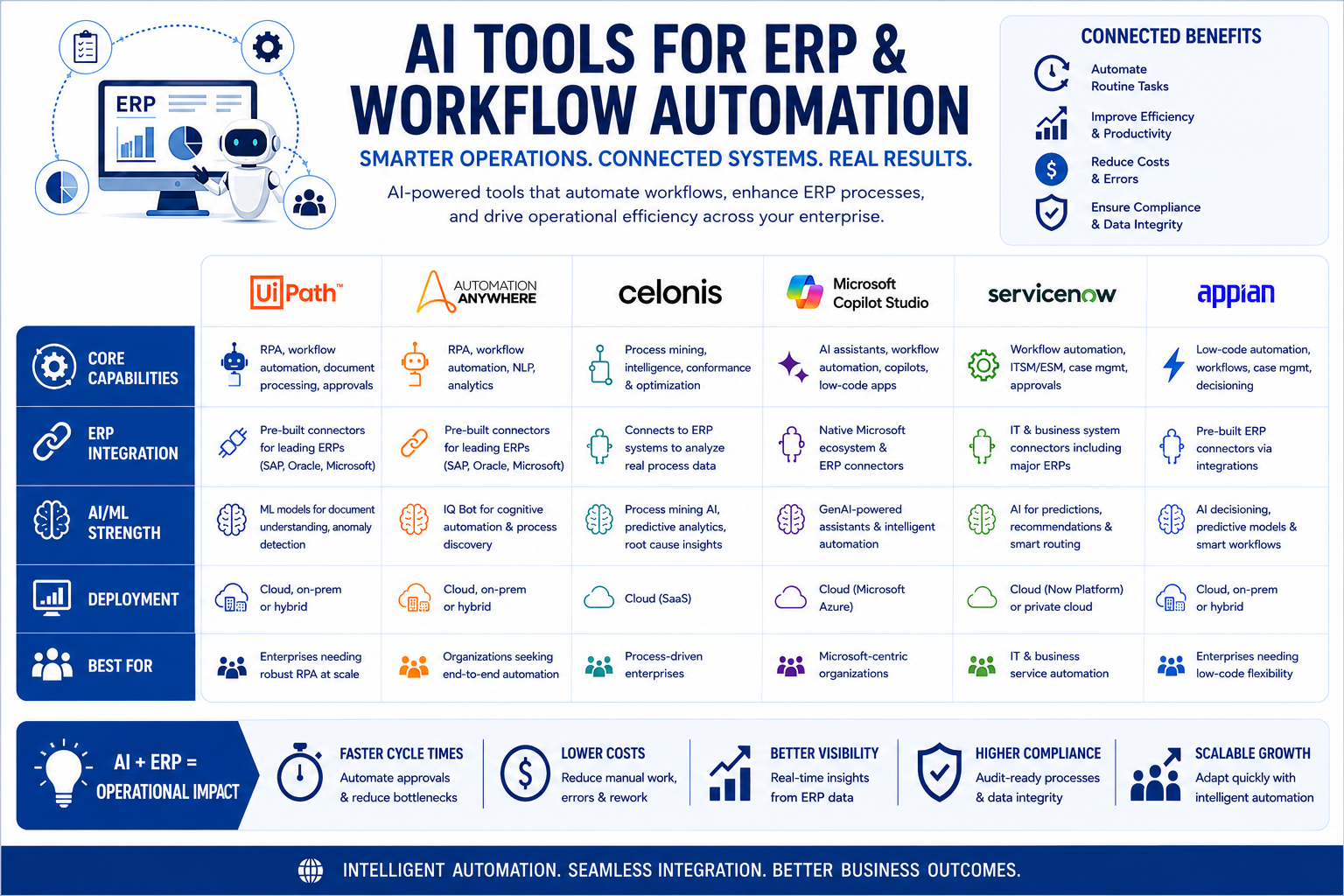
Connecting ERP, MES, and WMS systems through AI-powered automation
Most guides to ai automation tools for manufacturing skip this category entirely. But for mid-market manufacturers, workflow automation and ERP AI tools often deliver faster ROI than predictive maintenance or vision systems, because the problem they solve, manual data bridging between disconnected systems, exists in every operation, regardless of industry or size.
General AI Tools for Manufacturing for Adaptable Workflows
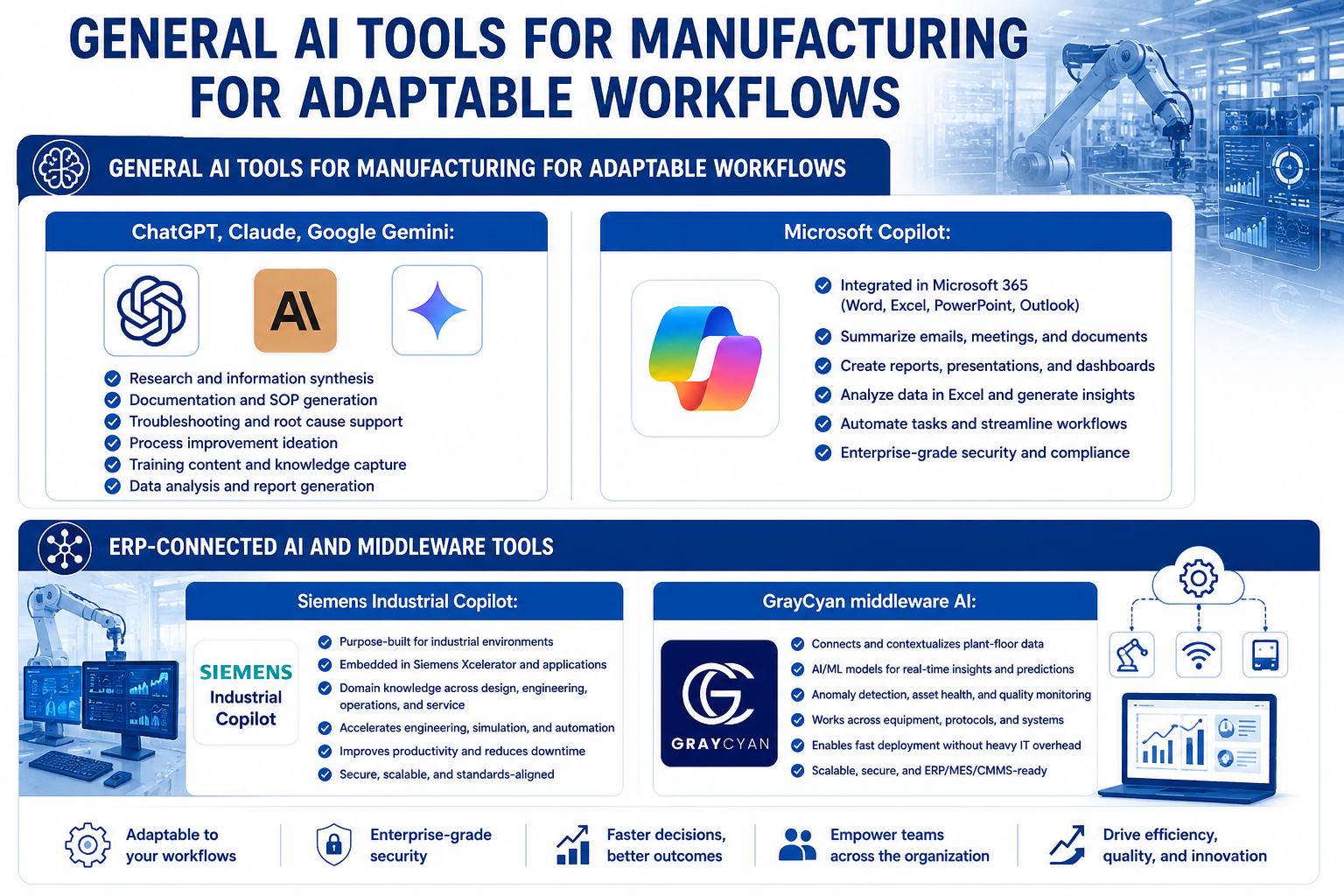
ChatGPT, Claude, Gemini, Microsoft Copilot, Siemens Industrial Copilot and GrayCyan middleware AI
- ChatGPT, Claude, Google Gemini: Large language models manufacturing teams are already using for drafting SOPs, CAPAs, audit responses, maintenance documentation, and compliance reports. Not purpose-built for manufacturing, but immediately accessible and useful for documentation-heavy work.
- Microsoft Copilot: Integrated into Office 365, useful for teams already relying on SharePoint, Teams, and Excel for documentation and reporting. Strongest for knowledge workers rather than shop floor operators.
ERP-Connected AI and Middleware Tools
- Siemens Industrial Copilot: Generative AI embedded in Siemens' automation ecosystem (TIA Portal, Teamcenter, Opcenter), offering a natural language interface for PLC programming, fault diagnosis, and process documentation. Best for manufacturers already inside the Siemens ecosystem.
- GrayCyan middleware AI: A custom-built API and middleware layer connecting existing ERPs like NetSuite, SAP, Epicor, Acumatica, Dynamics, Odoo, Fishbowl to AI models, automating data entry, invoice processing, PO reconciliation, and document workflows without replacing the ERP. In one Fishbowl ERP deployment, this approach cut daily manual data entry from roughly 12 hours to under 2 hours. Read the ERP automation for manufacturing page for more.
RAG AI Knowledge Tools
- GrayCyan RAG AI: Custom knowledge systems that index engineering drawings, OEM manuals, ERP records, SOPs, and maintenance history, making them queryable in natural language by any engineer or operator, including a fully air-gapped deployment for a defense-adjacent manufacturer where 40 years of engineering documentation became searchable on-premises. More detail at RAG AI tools for manufacturing efficiencies.
Custom-Built AI Tools vs. Off-the-Shelf Platforms — When Each Is Right
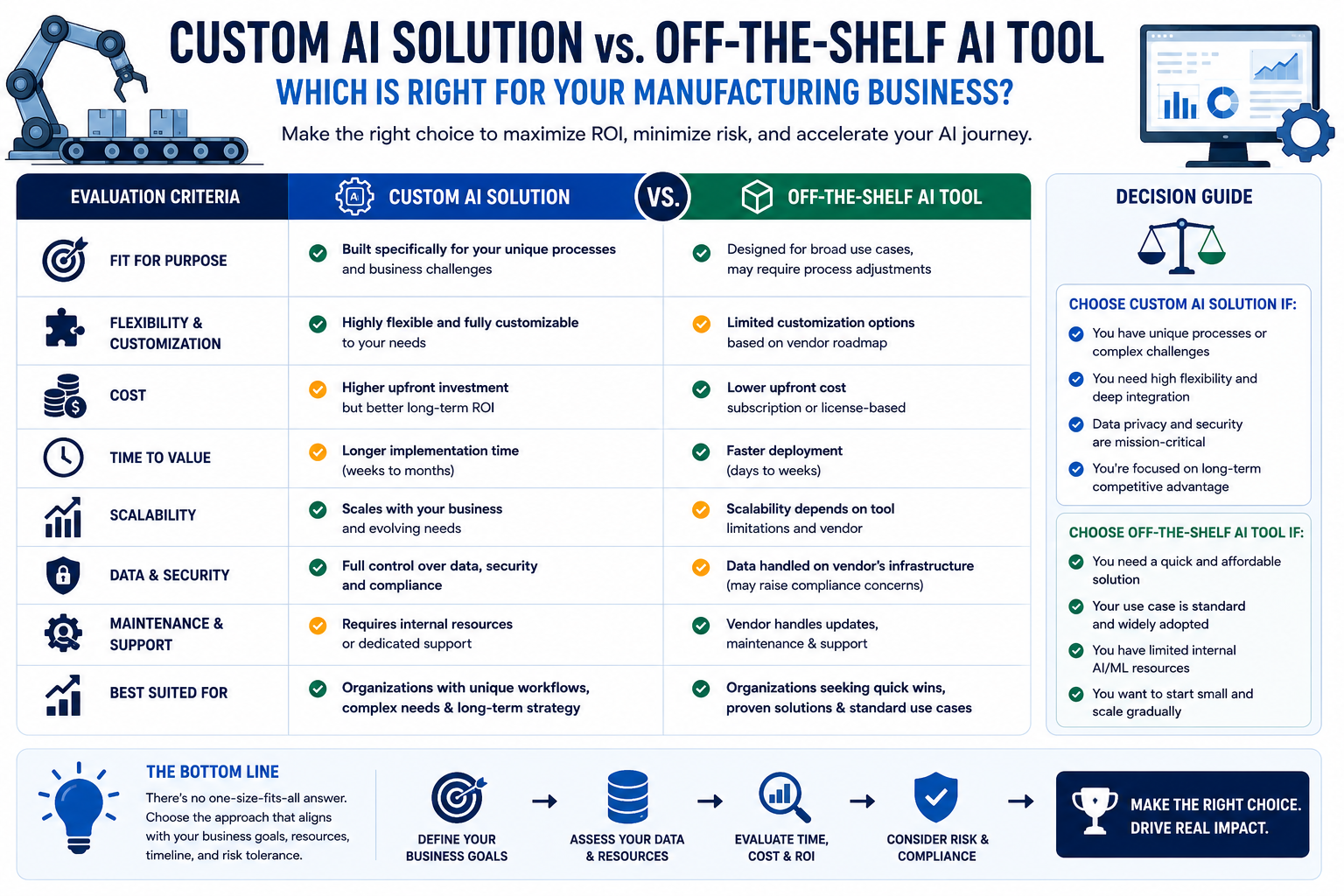
Deciding between a custom-built AI system and an off-the-shelf platform
Every AI tool for manufacturing lists platforms you can buy. And none of them explain when you should build instead. For mid-market manufacturers, this distinction matters, because off-the-shelf platforms are often designed for enterprise-scale operations, while a custom-built system can be purpose-built for your specific workflows, your specific data, and your specific ERP.
When Off-the-Shelf AI Tools Are the Right Call
Your Use Case Is Standard
Your use case is a standard one with established solutions, for predictive maintenance on common equipment types like pumps, motors, and compressors is exactly what Augury or IBM Maximo were built for.
You Need to Move Fast
SaaS platforms deploy faster than custom builds. If you need a quality inspection system on a specific product line within 60 days, Landing AI or Cognex is the right choice.
You Have the Data Infrastructure
You already have the data infrastructure; the platform requires clean, consistently structured historian, MES, and sensor data.
When Custom-Built AI Is the Right Call
Your Use Case Is Specific to Your Operation
Proprietary BOM version control, a USDA compliance workflow, or a co-packer's specific data format. Off-the-shelf platforms will require extensive customization here, often at a cost that exceeds a custom build.
Regulated or Air-Gapped Data Requirements
Cloud SaaS platforms can't serve manufacturers under ITAR, FDA data integrity requirements, or with proprietary recipe/IP data that can't leave the facility.
You Want to Own the System Outright
SaaS platforms create ongoing licensing dependency; a custom-built system transfers full ownership of platform, models, data, code at project completion.
Your ERP Isn't Natively Supported
Most AI platforms have connectors for SAP, Oracle, and NetSuite. If you run Epicor, Acumatica, Fishbowl, or Odoo, the integration work for an off-the-shelf platform can end up comparable in cost to a custom build.
GrayCyan builds custom AI systems for mid-market manufacturers who need AI that fits their specific operation, not a platform that requires their operation to fit the AI. If you're not sure which side of this line you're on, GrayCyan's AI Readiness Assessment is a useful starting point.
5 Questions to Ask Before Buying Any AI Tool for Manufacturing
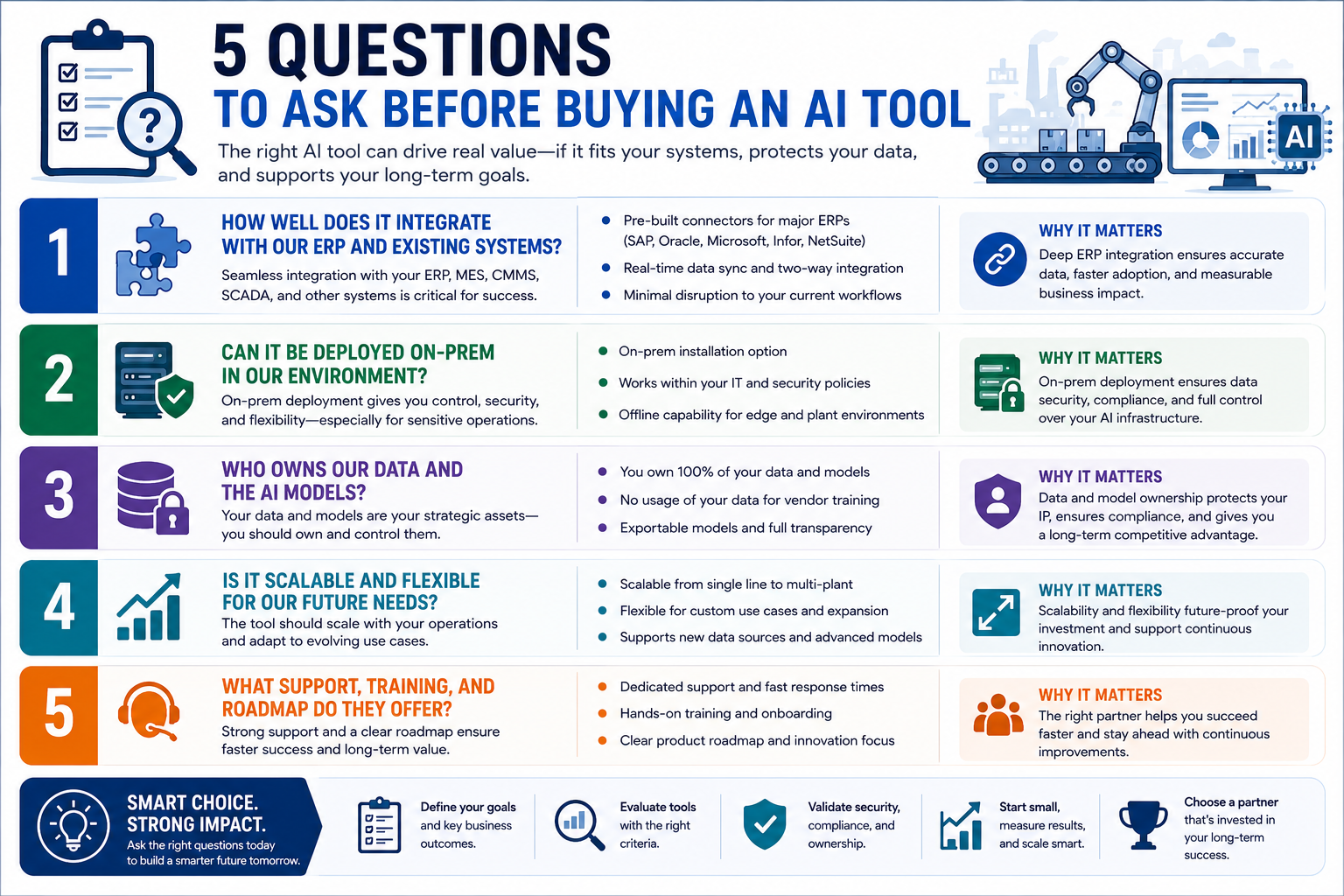
The five questions that separate a working AI deployment from an expensive mistake
Before evaluating any AI tool for manufacturing, answer these five questions. They'll save you from the most common and most expensive mistakes.
State the baseline: downtime minutes per month, scrap rate percentage, manual labor hours per day, forecast accuracy percentage. If you can't quantify the problem, you can't calculate ROI, and you can't evaluate whether any tool is actually solving it.
Every AI tool requires specific inputs. Predictive maintenance needs sensor or run-time data. Vision systems need labeled defect images. Forecasting tools need clean order history. Ask the vendor directly what data format and quality their tool requires, then compare it honestly to what you have.
Most AI tools list ERP integrations on their marketing pages. Ask specifically which version of your ERP they integrate with, how data flows, and what the integration costs. Budget $20K–$100K or more for ERP integration work that vendor pricing pages typically don't include.
For aerospace, defense, pharmaceutical, and food manufacturers with data sovereignty requirements: confirm on-premises support before evaluating anything else. Most SaaS platforms don't offer it. If your data can't go to the cloud, you need either an on-prem option or a custom build.
SaaS platforms typically own the models built for you; if you stop paying, you lose access. Custom-built AI systems transfer full ownership. For manufacturers building long-term operational intelligence, this matters more than it looks at first.
AI Tools for Regulated Manufacturers — USDA, FSMA, ITAR, and Air-Gapped Environments
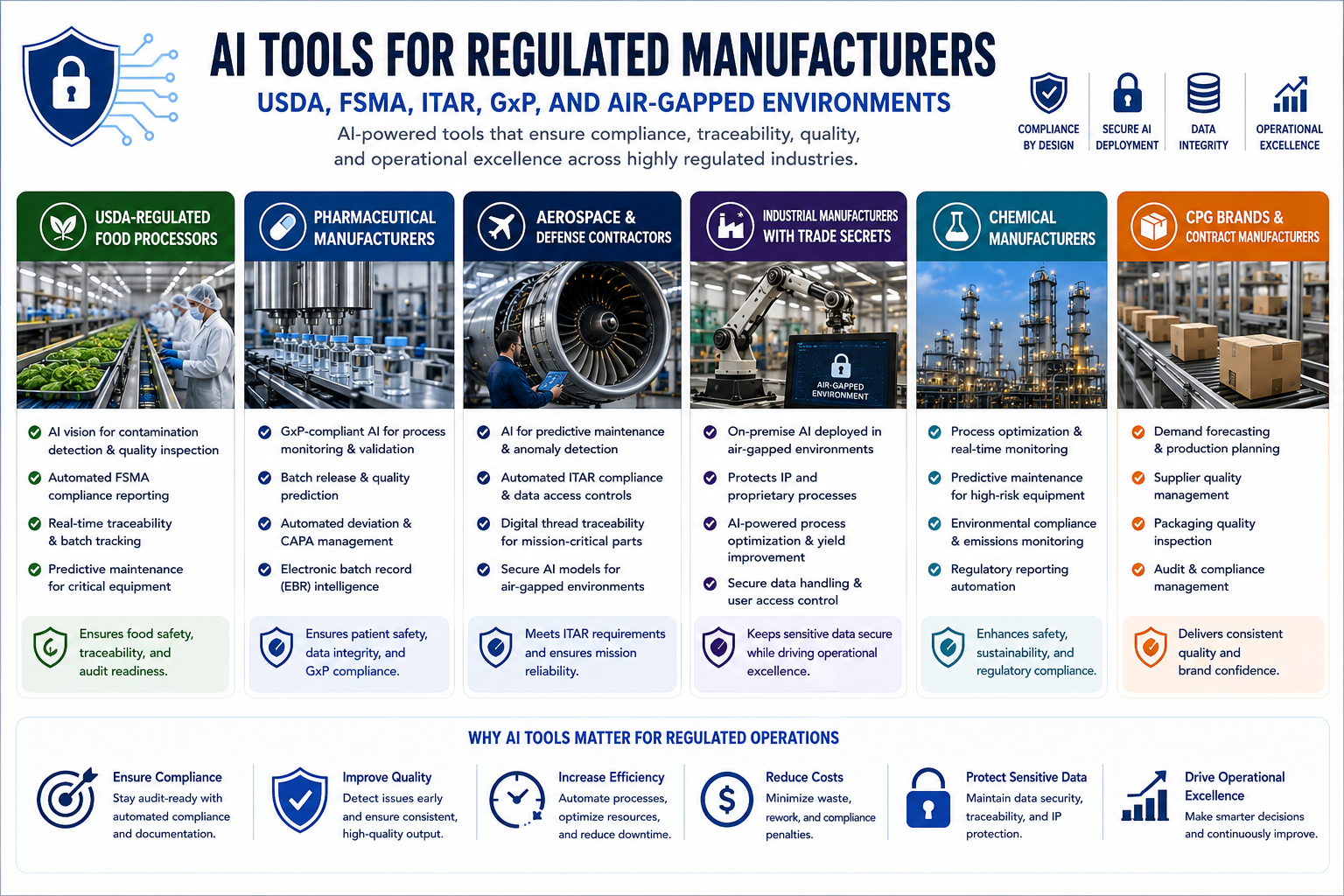
On-premises and air-gapped AI for USDA, pharma, aerospace/defense, and trade-secret-sensitive manufacturers
Every tool named in this guide: IBM Maximo, Augury, Landing AI, Blue Yonder runs on cloud infrastructure. For most manufacturers, that's fine. For regulated manufacturers, it isn't.
Manufacturers who typically need on-premises or air-gapped AI:
USDA-Regulated Food Processors
Proprietary recipes, formula data, and production records that can't be transmitted to external cloud platforms without compliance review.
Pharmaceutical Manufacturers
FDA 21 CFR Part 11 data integrity requirements restrict where production and validation data can be stored and processed.
Aerospace and Defense Contractors
ITAR-controlled technical data (drawings, specifications, manufacturing processes) can't reside on commercial cloud platforms.
Industrial Manufacturers With Trade Secrets
Proprietary process parameters and formulations that represent real competitive IP.
What on-premises AI deployment looks like in practice: The full stack, model, inference engine, vector database, and API layer, all run on facility-owned hardware, inside the facility boundary. No production data, documents, or query logs leave the network. And it doesn't require a data center: a single high-spec workstation can handle inference for most mid-market use cases.
GrayCyan has deployed fully on-premises RAG AI and ML systems for regulated manufacturing clients, including a defense-adjacent manufacturer where ITAR requirements made cloud deployment a non-starter. See the RAG AI tools for manufacturing industry page for the air-gapped case study, and CPG and food manufacturer AI solutions for the food-processing angle.
Frequently Asked Questions — AI Tools for Manufacturing
Not Sure Which AI Tool Is Right for Your Operation?
Choosing the right AI tool for manufacturing depends on your specific operational problem, your data quality, your ERP environment, and whether your use case is better served by an off-the-shelf platform or a custom-built system.
GrayCyan has evaluated, deployed, and built AI systems for mid-market manufacturers across food, aerospace, distribution, and industrial manufacturing including cases where the right answer was a SaaS platform and cases where it was a custom build.
Schedule a Strategy Call