




If your business handles foods covered under the FDA Food Traceability List, FSMA 204 compliance requires more than simply maintaining records. Companies need a clear process for capturing traceability data, connecting information across their supply chain, and producing required records quickly when requested.
The FDA enforcement deadline for FSMA 204 is July 20, 2028. While businesses have additional time to prepare, the compliance requirements remain unchanged, Food manufactures, processors, packers, distributors, and others cover the entities that need to use this time to identify issues and align suppliers to build traceability processes that support faster response during food safety investigations.
In this guide we will see what FSMA 204 requires, who it applies to, what data businesses must capture and how organisations can get ready for compliance without disrupting daily operations.
What is FSMA 204- The Food Traceability Rule
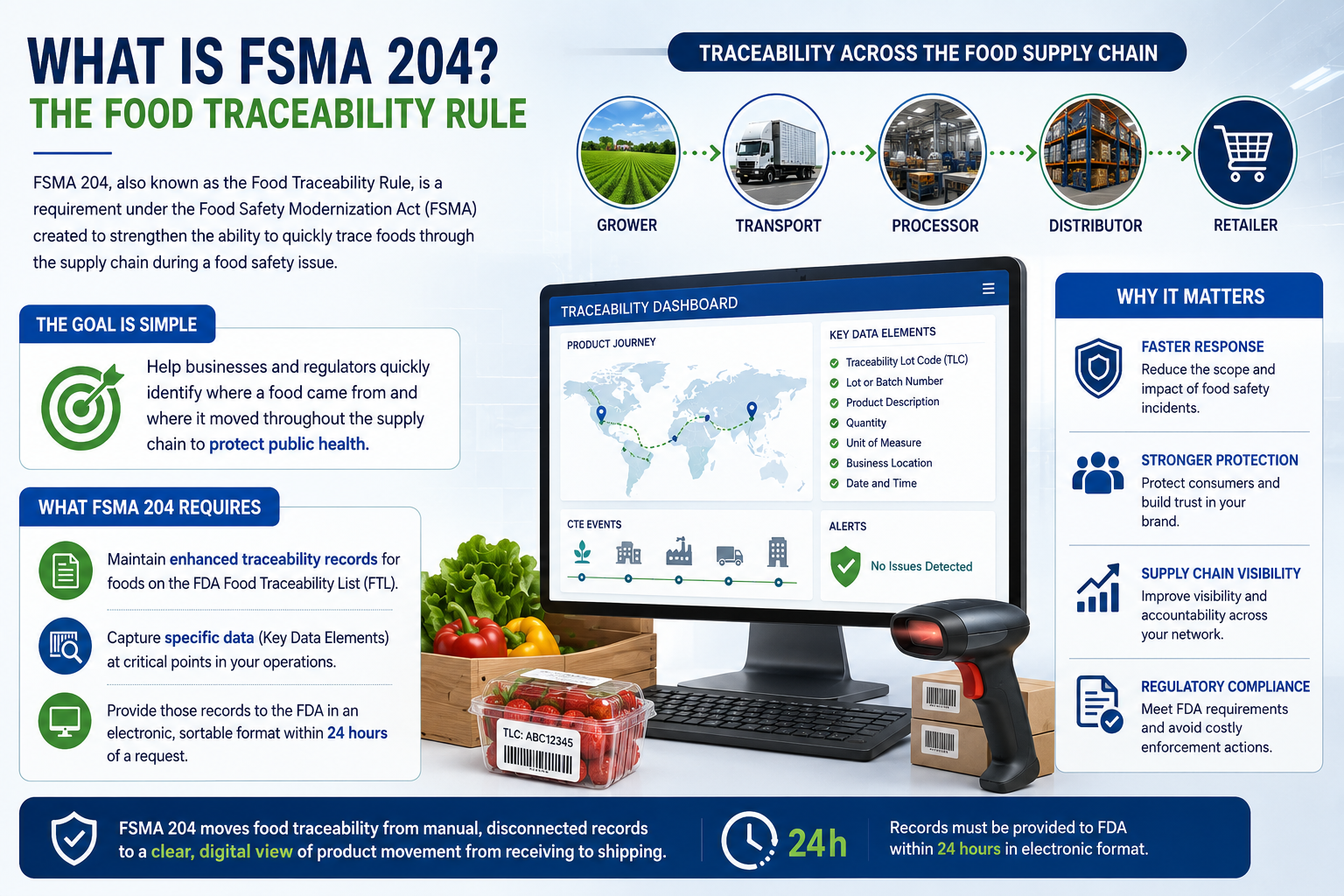
FSMA 204 — the Food Traceability Rule under the Food Safety Modernization Act
The FMSA 204 is also known as the Food Traceability Rule, which is a requirement under the Food Safety Modernization Act (FSMA) focused specifically on improving food traceability.
The aim of FSMA 204 is simple: to help the organisations and regulators quickly identify where a food product came from and where it moved throughout the supply chain during a food safety issue.
Also under this rule, businesses handling certain high risk foods must maintain enhanced traceability records, capture specific data at important points in their operations and provide those records to the FDA in an electronic, sortable format within 24 hours of a request.
Unlike the old record keeping system that depends on disconnected spreadsheets or manual documentations, FSMA 204 requires businesses to maintain a clearer view of product movement from receiving to shipping.
FSMA 204 Compliance Deadline- July 20,2028
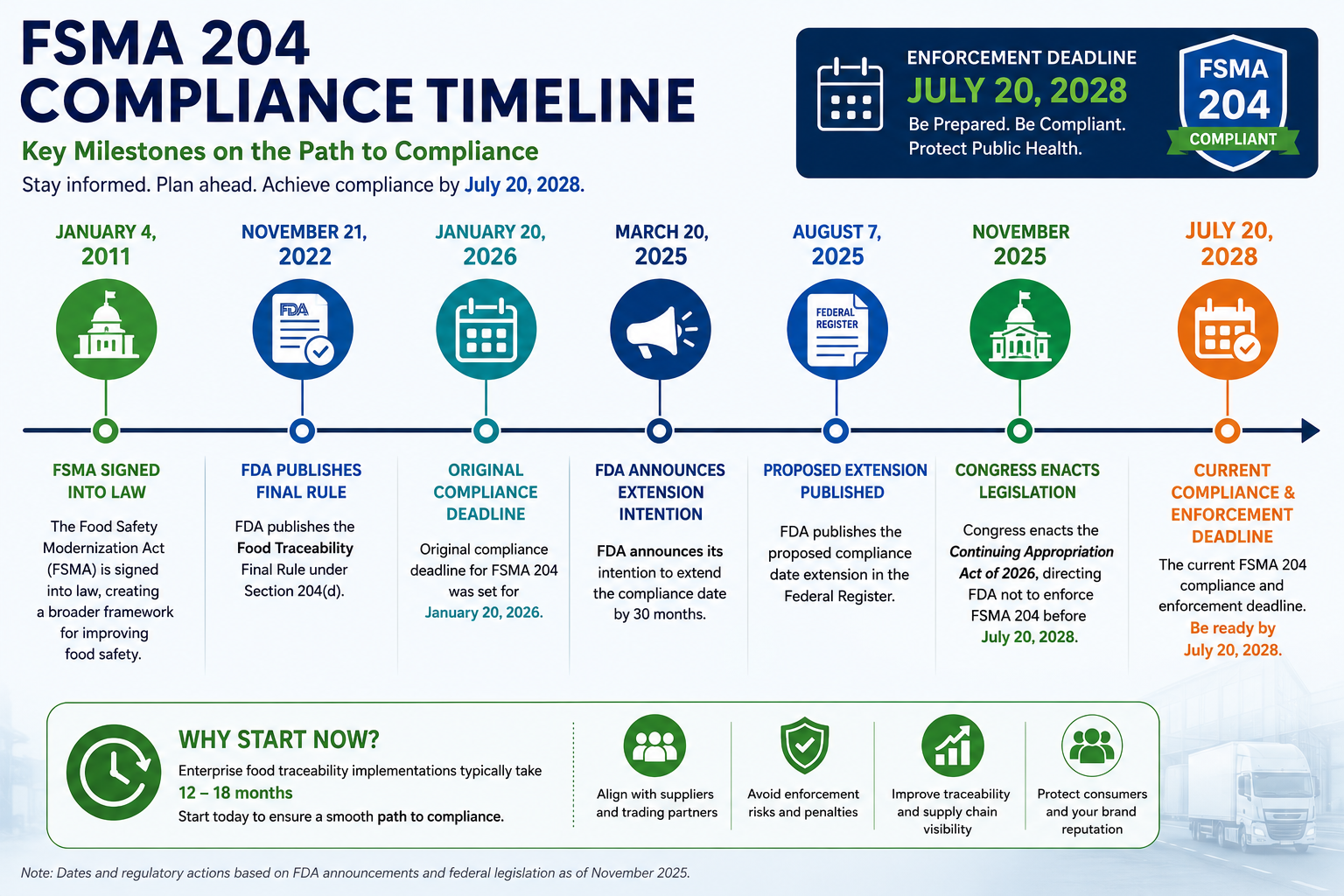
FSMA 204 timeline — from the 2011 FSMA law to the July 2028 enforcement deadline
The FSMA 204 news compliance date is July 20, 2028 which is the FDA enforcement deadline for FSMA 204 compliance. The FSMA 204 deadline gives food manufacturers, processors, distributors, and other covered entities additional preparation time but the rule requirements themselves remain unchanged.
Here's the FSMA 204 timeline:
- January 4, 2011: FSMA compliance date was signed into law, creating a broader framework for improving food safety practices.
- November 21, 2022: FDA publishes the Food Traceability Final Rule under section 204 (d).
- January 20, 2026: Original FSMA 204 compliance deadline.
- March 20, 2025: FDA announces its intention to extend the compliance date by 30 months.
- August 7, 2025: FDA publishes the proposed compliance date extension in the Federal Register.
- November 2025: Congress enacted the Continuing Appropriation Act of 2026, directing FDA not to enforce FSMA 204 before July 20, 2028.
- July 20, 2028: Current FSMA 204 compliance and enforcement deadline.
The extension is not a reprieve. Enterprise food traceability implementations typically run 12 to 18 months for a mid-sized operation, and that assumes clean data, willing supply chain partners and a clear implementation plan.
Businesses starting preparation in mid 2026 face similar urgency as organisations that were preparing for the original January 2026 deadline. Many major food retailers and foodservice distributors have already incorporated FSMA Rule 204- style traceability requirements into suppliers expectations and sourcing standards, with some deadlines arriving before July 2028.
Who Does FSMA 204 Apply To- Covered Entities and Exemptions
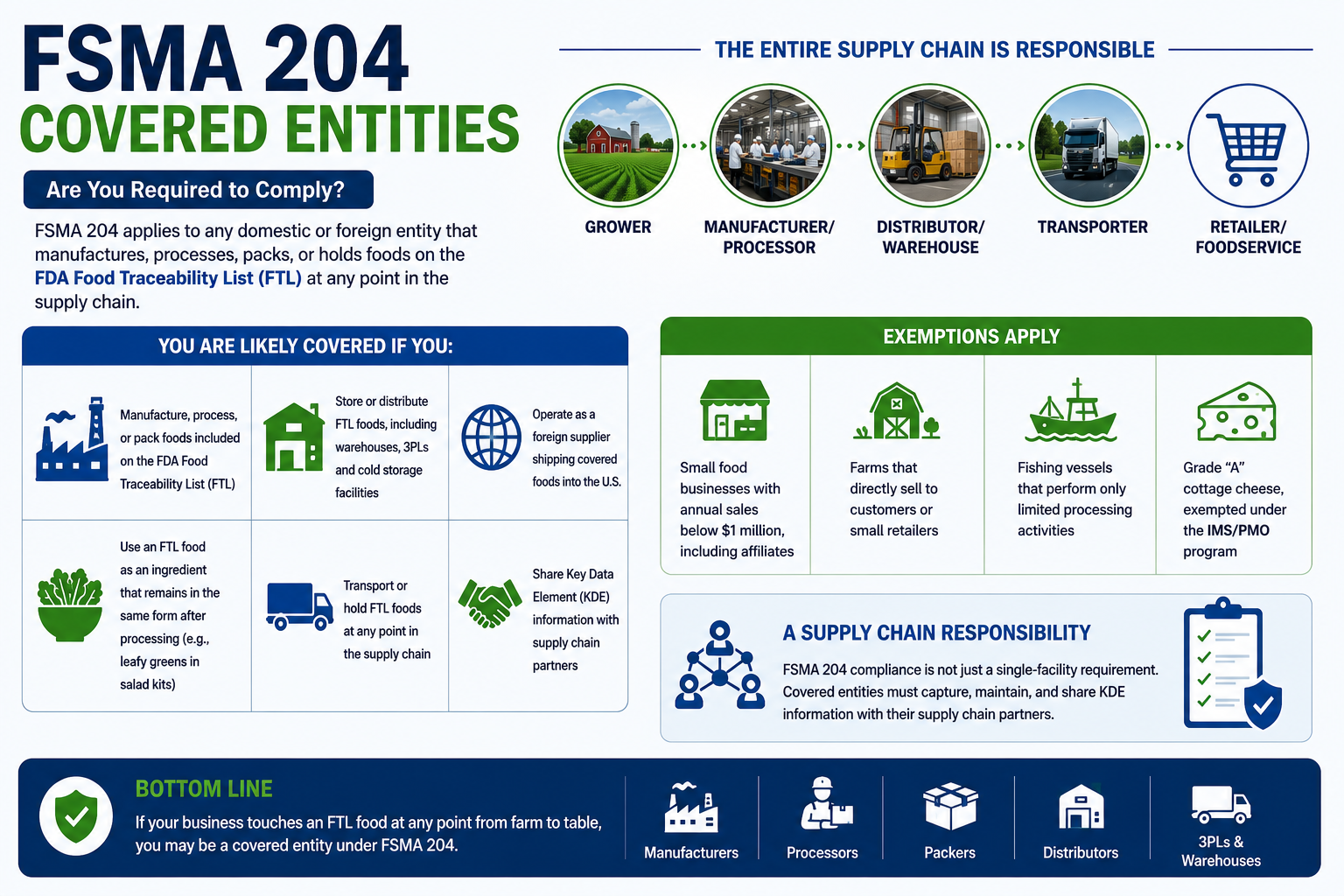
FSMA 204 covered entities across the food supply chain — manufacturers, processors, packers and distributors
FSMA Rule 204 applies to any entity, domestic or foreign that manufactures, processes, packs or holds foods that appear on the FDA Food Traceability List (FTL). If your operation handles an FTL food at any point in the supply chain, you may be subject to FSMA 204 compliance requirements.
You are likely covered if your business:
- Manufacturers, processes, or packs foods included on the FDA Food Traceability List
- Stores and distributors FTL foods, including warehouses, third-party logistics providers (3PLs) and cold storage facilities.
- Operates as a foreign supplier shipping covered foods into the US
- Uses an FTL food as an ingredient and the food remains in the same form after processing, such as fresh leafy greens used in a salad kit.
However, not every business is subject to the same FSMA 204 compliance requirement, certainly exemptions applies that include:
- Small food businesses with annual sales below $1 million, including affiliates
- Farms that directly sells to customers or small retailers
- Fishing vessel that performs only limited processing activities
- Grade "A" cottage cheese, which FDA exempted under the IMS/PMO program.
One of the essential points a lot of businesses miss: FSMA 204 compliance is a supply chain responsibility, not only a single-facility requirement. The covered entities must share Key Data Element (KDE) information with supply chain partners.
FSMA 204 Food List- Which Foods Are Covered
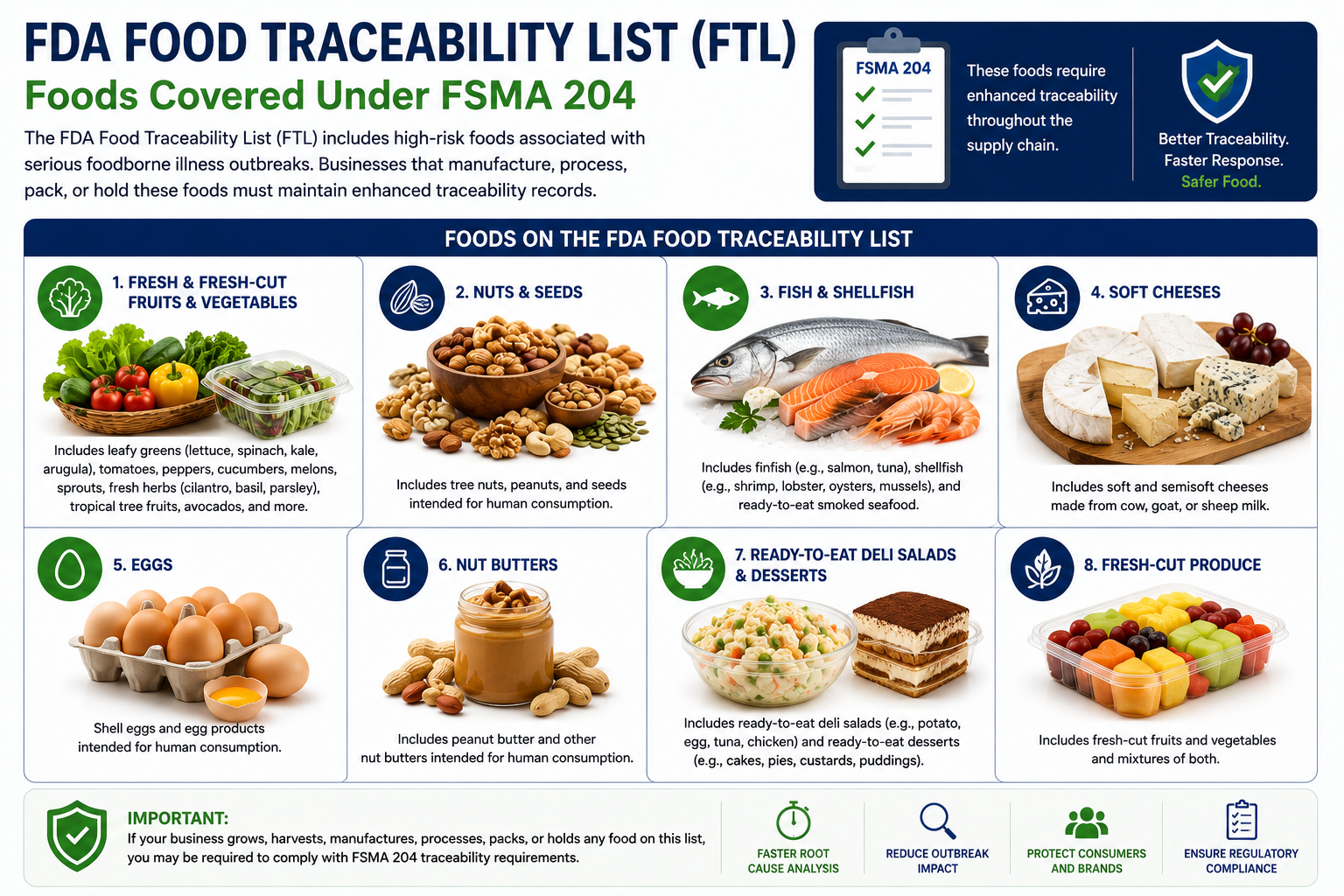
The FDA Food Traceability List — high-risk foods requiring enhanced recordkeeping
The FDA Food Traceability list (FTL) identifies the specific foods subject to FSMA Rule 204's enhanced record keeping requirements. These foods are considered higher risk based on public health history and have been connected with critical food borne illness outbreaks where faster traceability could have reduced harm.
The FSMA 204 food list includes specific categories of foods that require additional traceability records throughout the supply chain. Businesses reviewing the FSMA 204 list should first determine whether they handle any of these covered food categories:
| Food Traceability Lists | Description |
|---|---|
| Fresh and fresh-cut fruits and vegetables | Includes tomatoes, leafy greens such as lettuce, spinach, arugula, and kale, fresh herbs such as cilantro, basil and parsley, melons, sprouts, peppers, cucumbers, tropical tree fruits, avocados and others. |
| Nut and seed butters | Includes all nut butters and seed butters covered under the Food Traceability List FSMA. |
| Fresh shell eggs | Includes fresh shell eggs requiring enhanced traceability records. |
| Cheeses other than hard cheeses | Includes soft cheese and cottage cheese. Grade "A" cottage cheese was exempted in 2026 under the IMS/PMO program |
| Ready-to-eat deli salads | Includes deli salads manufactured at processing facilities. |
| Seafood | Includes fresh and frozen finish, smoked finish, crustaceans, mollusks and raw bivalve mollusks |
| Fresh-cut produce | Includes fresh-cut fruits and vegetables that fall under the FDAs traceability requirements. |
One important FSMA 204 traceability rule businesses should understand: if an FTL food is used as an ingredient and remains in the same form,the finished product is generally still subject to the rule. For example, fresh leafy greens added to a salad kit remain covered. But if the ingredient is transformed during processing, like leafy greens cooked into a soup, the by-product is generally not covered.
FSMA 204 Requirements- KDEs, CTEs and 24-Hour Rules
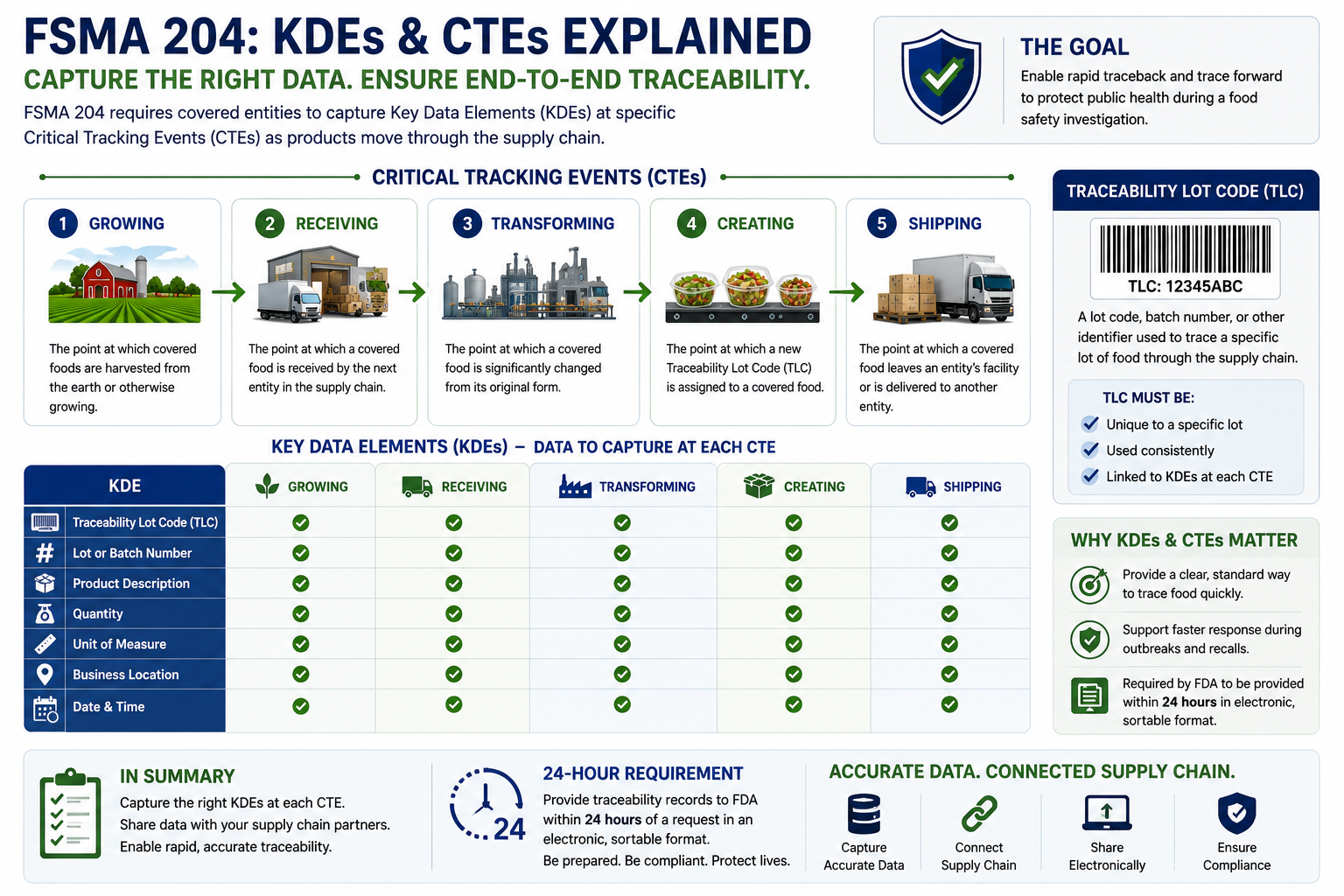
Critical Tracking Events and Key Data Elements required under FSMA 204
The FSMA Rule 204 has three core technical requirements: assign a Traceability Lot Code (TLC) at the right events, capture (KDEs) Key Data Elements and produce all required records to the FDA in an electronic, sortable format within 24 hours of a request.
Understanding these requirements is essential for business to prepare for FSMA 2024 compliance because the rule is not only about creating a complete traceability record that shows where a covered food came from, how it moved through the supply chain, and who handled it at each step.
Critical Tracking Events (CTEs): When You Need to Capture Data
Critical Tracking Events are the key points where businesses must record information under the FSMA traceability rule.
These events include:
- Growing: For farms producing foods on the FDA Food Traceability List, information must be captured during growing and harvesting activities.
- Receiving: When a facility receives a covered food from a supplier, it must record details about the product, supplier and receiving location.
- Transforming: When a covered food is changed into another product, businesses must capture traceability information.
Example: Processing fresh tomatoes into salsa. - Creating: When a new covered food product is produced at a facility, the business must document the required traceability details.
- Shipping: When a covered food leaves a facility, businesses must capture shipment-related information to maintain visibility across the supply chain.
Key Data Elements (KDEs): The Information You Must Record
KDEs, or Key Data Elements under FSMA 204 requirements, are the specific details businesses need to capture at each Critical Tracking Event.
The required information includes:
- Traceability Lot Code (TLC): A unique identifier assigned to a specific lot of covered food that allows businesses to track its movement.
- Product description: These include details like product name, quantity, unit of measure, commodity and variety.
- Location description: The facility names and address where the tracking event occurred.
- Date of the event: When the growing, receiving, transforming, creating or shipping activity happened.
- Supplier or receiver information: It contain the details of the company proving or receiving the product, including name, address and phone number,
- Shipping information: For shipping events, businesses must record the TLC for each covered food in the shipment along with reference document type and number.
Altogether these KDEs create a traceable record that allows businesses and regulators to follow a product's journey through the supply chain.
The 24-Hour Rule: Why Digital Traceability Matters
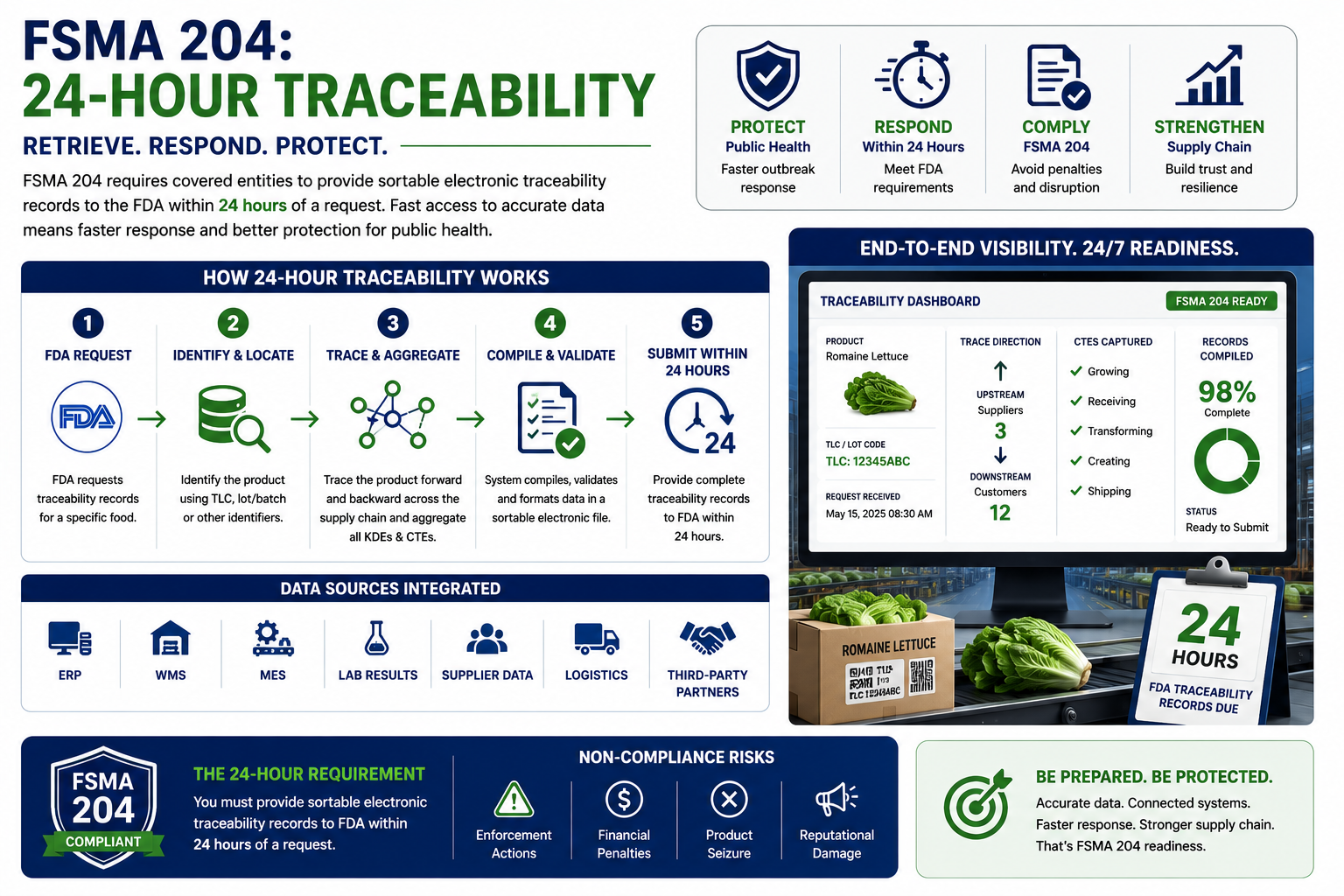
How 24-hour electronic traceability response works under FSMA 204
One of the most challenging parts of the FSMA 204 regulation is the requirement to provide traceability records quickly when requested by the FDA.
If the FDA requests records during an investigation or inspection, businesses must provide them in an electronic, sortable format within 24 hours. While the rule technically allows paper records, this requirement makes paper-based systems and disconnected spreadsheets difficult for most operations.
In operational terms: every time a covered food moves through your facility when it arrives, when it is processed, and when it ships and you need a documented record of what it was, how much moved, where it happened, when it happened, and who sent or received it. That record needs a unique code, and all information must be easy to find and export within 24 hours.
Building effective FSMA 204 traceability processes helps businesses meet regulatory requirements while improving supply chain visibility and recall readiness.
FSMA 204 Traceability Plan — What You Must Document
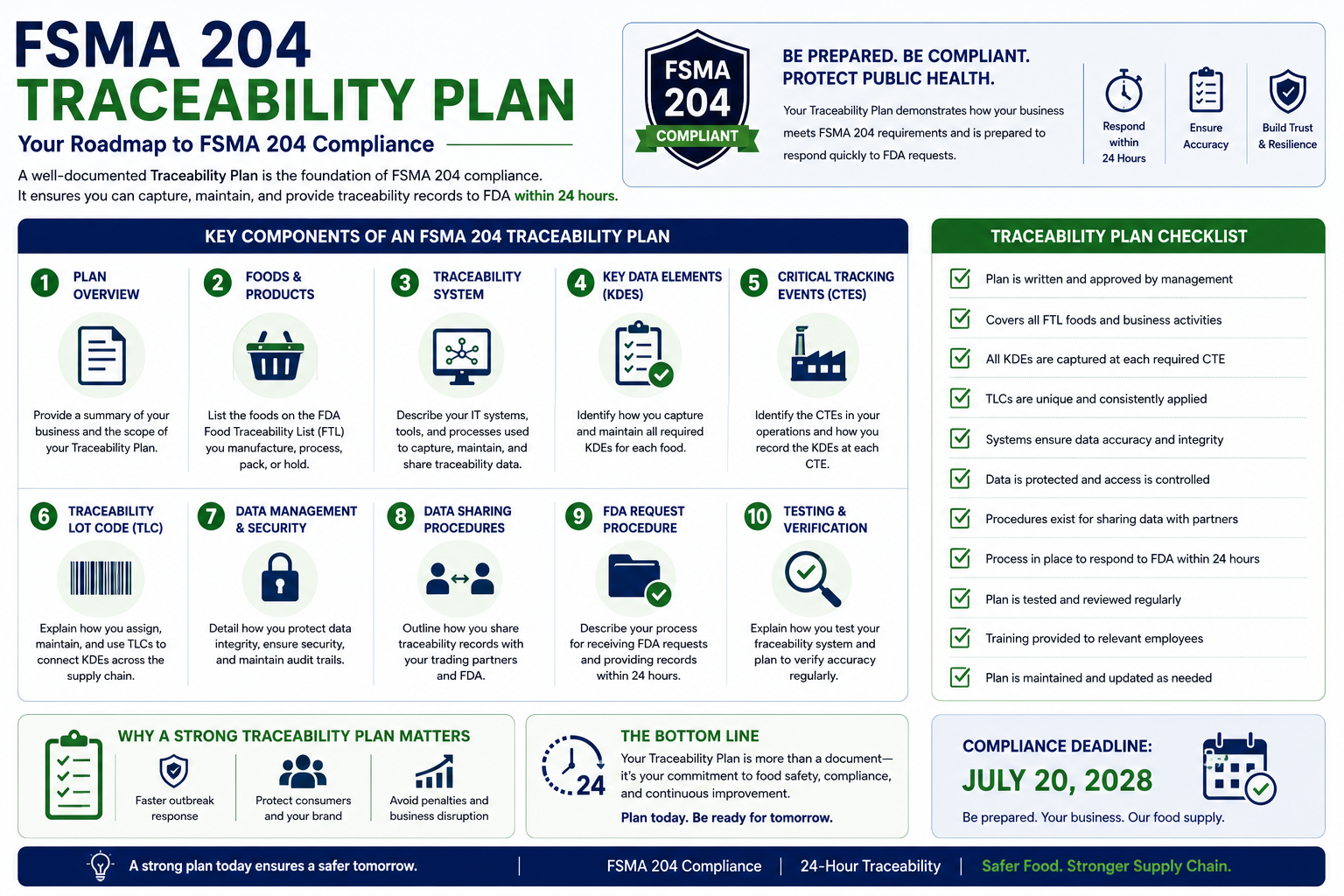
The written Traceability Plan — often the first document an FDA inspector requests
Beyond capturing KDEs at CTEs, FSMA Rule 204 requires covered entities to maintain a written Traceability Plan, a document that explains how your operation implements the rule's requirements. Maintaining this plan is a key part of FSMA 204 compliance and is separate from keeping traceability records.
A compliant Traceability Plan should include:
- A description of the foods your business handles that appear on the FDA Food Traceability List (FTL)
- The Critical Tracking Events (CTEs) that occur within your operation for each covered food
- The Key Data Elements (KDEs) you capture at each CTE
- A description of how your business assigns Traceability Lot Codes (TLCs)
- A designated point of contact for FDA traceability inquiries
Take this document as your operational FSMA 204 checklist. It should clearly explain how your business meets the FSMA 204 requirements and support your broader FSMA food safety plan.
The Traceability Plan must be kept current. If your product mix, processes, or supply chain partners change, the plan should be updated to reflect those changes.
Most importantly, the FSMA Traceability requirements Plan is often the first document an FDA inspector will request. If your operation cannot produce a current, written plan during an inspection, you may be considered non-compliant and even if your traceability records are otherwise complete.
Why the 2028 Extension Is Not a Reason to Wait
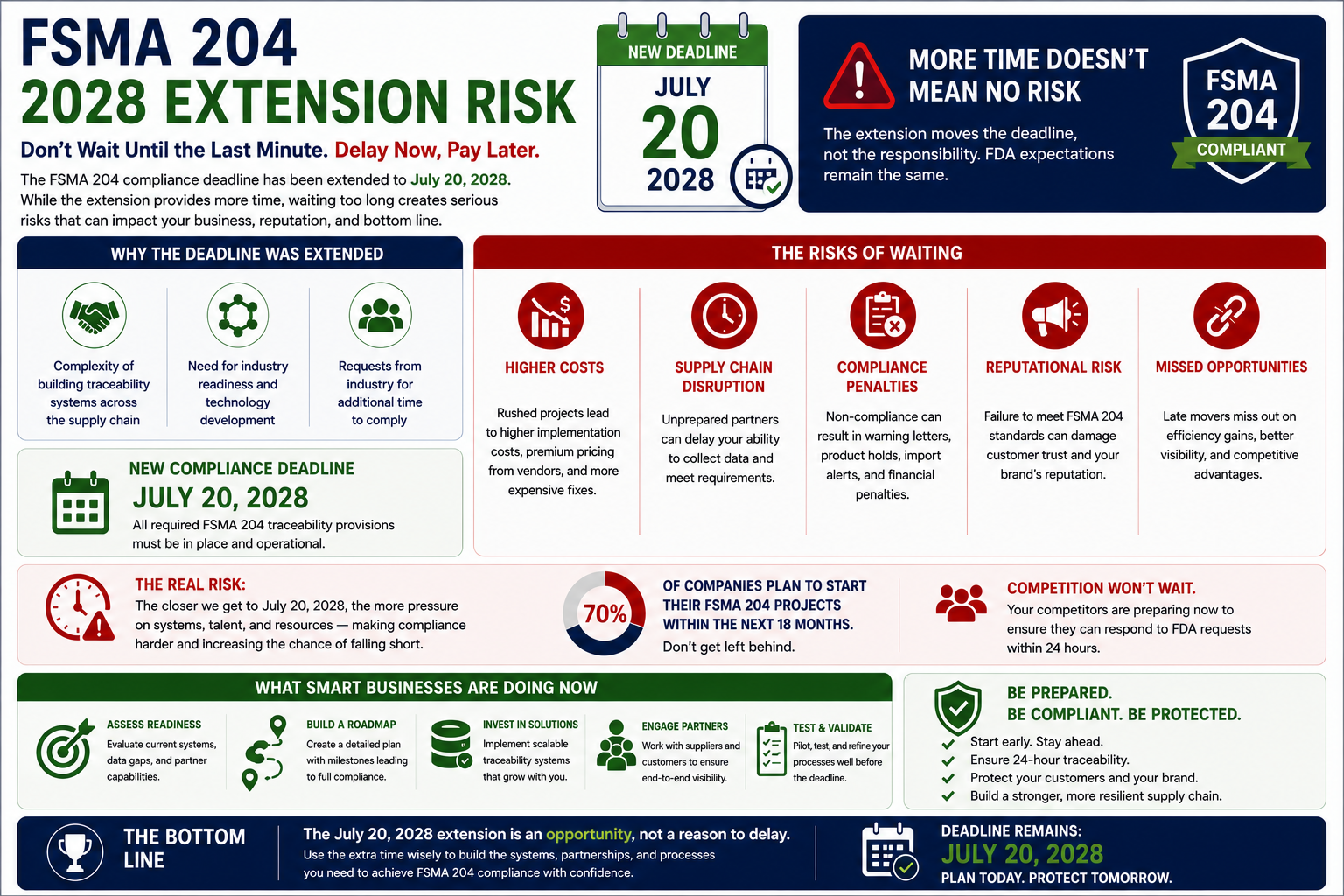
Implementation timelines make the 2028 extension less generous than it looks
A 12 to 18 month implementation timeline for a mid-size food manufacturer means operations starting FSMA 204 implementation in mid-2026 have approximately the same urgency as businesses preparing for the original January 2026 deadline. Companies that wait until 2027 will be implementing new traceability processes under significant time pressure, leaving little room for the supply chain coordination that FSMA 204 compliance requires.
Here are three reasons businesses should not treat the deadline extension as a reason to delay:
Implementation Takes Longer Than Expected
Building a compliant traceability system involves more than updating software. Supply chain partner alignment, data standardization, ERP integration, process changes, and employee training all take time. Even one missing Key Data Element (KDE) from an upstream supplier can prevent an otherwise complete traceability record from meeting FSMA 204 requirements.
Retailers and Foodservice Customers Are Not Waiting for 2028
Many major food retailers and foodservice distributors have already incorporated FSMA 204 traceability requirements into supplier contracts and sourcing standards, with implementation timelines that begin well before July 2028. Suppliers that cannot provide compliant Traceability Lot Codes (TLCs) and KDE records risk losing business long before FDA enforcement begins.
The Rule Has Not Changed
The extension affects only the enforcement date, not the rule itself. The requirements for KDEs, CTEs, Traceability Plans, and the 24-hour response remain exactly the same. Starting early gives businesses time to improve processes, test systems, and strengthen FSMA readiness without rushing implementation.
The manufacturers most likely to achieve FSMA 204 compliance by July 2028 are those that began preparing in 2025 or 2026. Businesses that treat the extension as a pause may find themselves trying to compress 18 months of implementation work into just a few months in 2027.
How to Implement FSMA 204 Compliance — A Practical Starting Framework
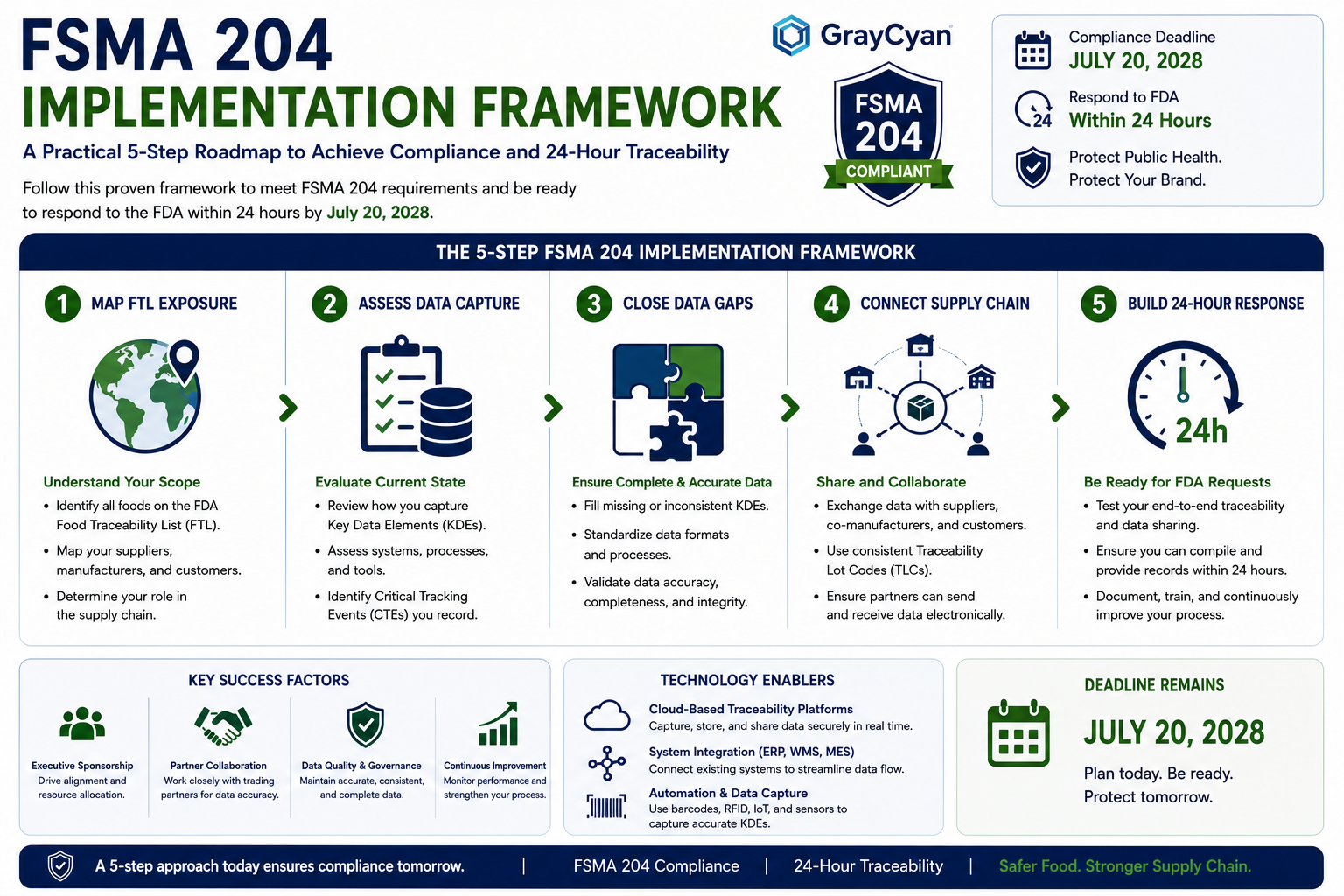
A practical five-step framework for FSMA 204 implementation
FSMA Rule 204 compliance is a data management project, not just a regulatory checklist. The core challenge is not understanding what the rule requires. The requirements are well defined. The challenge is building a system that captures the right data at the right moments, connects it across supply chain partners, and makes it retrievable in an electronic, sortable format within 24 hours.
A practical FSMA 204 implementation framework includes five key steps:
Identify every product you handle that appears on the FDA Food Traceability List. For each covered food, map the Critical Tracking Events (CTEs) that occur within your operation, including receiving, transforming, creating, and shipping.
Review whether you're capturing all required Key Data Elements (KDEs) at each CTE. Most businesses already record information such as lot codes and quantities but often miss details like reference document numbers, location identifiers, or designated points of contact required for FSMA 204 compliance.
Evaluate whether your existing ERP, warehouse management system (WMS), or production software can capture the missing KDEs. For most manufacturers, FSMA 204 software doesn't mean replacing existing systems which means extending them. The goal is to capture traceability data within the tools your teams already use instead of building a separate compliance database.
Your traceability records are only as complete as the KDE data your suppliers provide. Work with upstream suppliers and downstream customers to align data-sharing processes before compliance gaps become operational issues.
Run regular traceability drills by selecting a lot and generating a complete electronic, sortable report within 24 hours. If your team cannot produce the required records during a practice exercise, they are unlikely to meet FDA expectations during an actual investigation.
For most mid-market food manufacturers, FSMA 204 implementation does not require replacing an ERP. It requires connecting traceability data with existing lot tracking and inventory records while adding the KDE fields that current systems may not capture.
GrayCyan supports this approach through middleware integrations with platforms such as NetSuite, SAP, Epicor, Acumatica, Fishbowl, and Odoo, helping manufacturers accelerate FSMA 204 compliance checklist without disrupting existing operations.
How GrayCyan Helps Food Manufacturers Prepare for FSMA 204
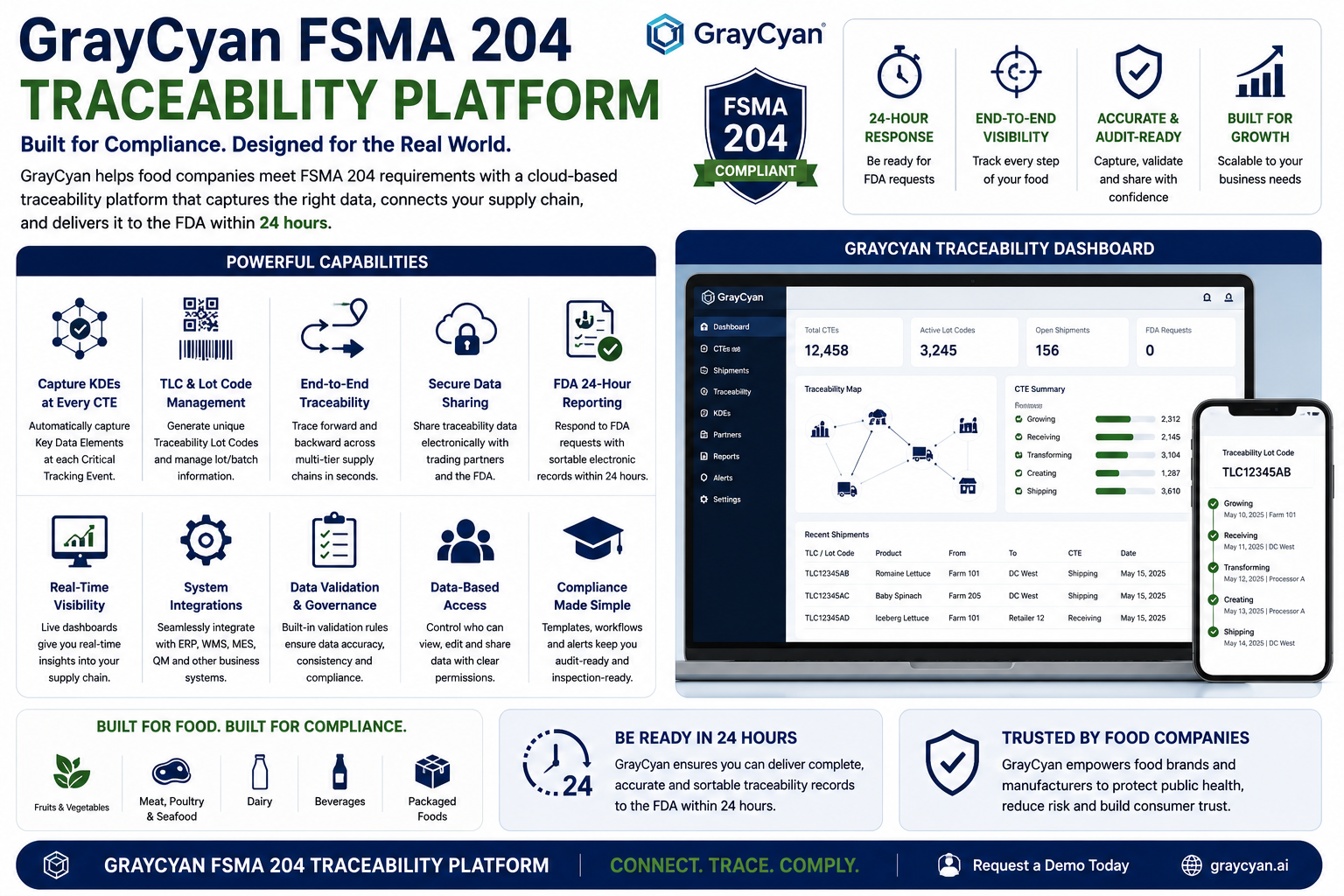
GrayCyan's ERP-integrated compliance automation for FSMA 204 traceability
FSMA 204 compliance is not just about collecting more data but it also capturing the right data automatically as products move through production. GrayCyan does not sell off-the-shelf FSMA 204 software. Instead, we build custom traceability systems for food manufacturers and CPG brands that integrate with existing ERP platforms and generate FSMA 204 consulting services traceability records during normal operations.
This means:
- KDEs are captured automatically at each Critical Tracking Event (CTE) during production instead of being entered manually afterward.
- Traceability records are written back to existing ERP systems such as NetSuite, SAP, Epicor, Acumatica, Fishbowl, and Odoo through API-based middleware without replacing your current platform.
- The 24-hour response requirement is built into the workflow, allowing compliant electronic reports to be generated in minutes rather than assembled from multiple spreadsheets during an audit.
- Compliance documentation is created during production, not reconstructed before an FDA inspection.
GrayCyan has already deployed compliance automation for a USDA-regulated meat processor, where batch records, smoker logs, and lethality evidence are generated automatically during each production run. As a result, audit response time dropped from 2–3 days to under 60 seconds.
FSMA 204 compliance requires the same data infrastructure as operational traceability. Manufacturers that invest now gain stronger supply chain visibility, faster recall response, and improved retailer confidence regardless of when FDA enforcement begins.
Frequently Asked Questions- FMSA 204 Deadline 2028
Ready to Start Your FSMA 204 Compliance Implementation?
If your operation handles foods on the FDA Food Traceability List, the July 20, 2028 deadline is closer than it appears once implementation timelines are considered. Building compliant traceability systems requires time to align suppliers, configure existing ERP systems, capture missing KDEs, and validate your 24-hour response process.
GrayCyan's AI Readiness Assessment helps identify where your traceability data currently resides, which KDE gaps need to be addressed, and the most practical implementation path based on your existing ERP and operational workflows.
Schedule a Strategy Call