
ERP AI Automation for Manufacturing: No ERP Replacement Required
Your ERP is built to record business activity; it keeps track of purchase orders, inventory movements, production updates, invoices and everything else that your team has already completed. This record is important but it does not tell you what needs attention next or where work is about to slow down.
Schedule a strategy call→ Featured ›
 Featured ›
 Client
 Featured ›
 Featured ›
 Featured ›
 Partner
 Member
 Featured ›
 Featured ›
 Featured ›
 Featured ›
 Featured ›
 Featured ›
 Featured ›
 Featured ›
 Featured ›
 Featured ›
 Featured ›
 Featured ›
Why ERP Alone Isn't Enough
Most manufacturers witness the same operational gaps on a daily basis. Inventory shortages often appear in ERP reports only after production has already stopped waiting for materials. One or two employees spend hours moving information between the ERP, scheduling software, quality systems, and spreadsheets because those systems do not communicate effectively with one another.
Also, reporting takes far longer than it should because data has to be gathered from multiple sources before it can be analyzed by someone else. Even routine handoffs about workflow still depend on someone copying and pasting information from one application to another. This is where ERP AI makes a practical difference. Instead of replacing the system that already manages your operations, it adds intelligence on top of it so that your team spends less time chasing information and more time acting on it.
GrayCyan adds the AI layer to the ERP you already run, without replacing it, reconfiguring it or requiring new hardware. Whether you use NetSuite, SAP, Epicor, Acumatica, Microsoft Dynamics, Odoo, Infor, Fishbowl or another ERP connected through APIs or middleware, we work with the systems you already have in place.
As part of our AI ERP approach, we connect information across your business, automate repetitive workflows, and help teams respond faster using the data already inside your operation. You can also explore our manufacturing AI solutions to see how AI supports production, quality, procurement and engineering beyond the ERP itself.
In the next section, we'll look at the areas where ERP automation delivers measurable improvements on the factory floor, and where AI can solve problems that traditional ERP systems were never designed to handle.
Where Manual ERP Slows the Factory Floor
Even the best manufacturing ERP cannot remove manual work on its own. Most delays happen between systems, departments, and people. Information already exists, but it still needs someone to enter it again, check it or move it from one application to another. That is where ERP automation and AI workflow automation delivers the biggest improvements:
Manual Data Entry
Each day, operators enter information that already exists somewhere else. Production counts move from paper floor sheets into the ERP. Quality inspection results are copied from handwritten forms into spreadsheets.
Suppliers send invoices as PDFs that someone has to review before entering them into the system. Each extra step takes time, and every manual entry creates another opportunity for mistakes.
With AI, structured information is captured at the source and written directly into the right ERP fields. The need for repeated data entry is greatly reduced, and teams spend less time correcting avoidable errors.
Errors Move Too Slowly
An inventory discrepancy in the warehouse management system may not appear inside the ERP until the overnight sync is complete. By the next morning, production had already planned work around materials that physically left the warehouse hours earlier. Therefore, small data gaps quickly become production delays.
Using ERP AI, real-time anomaly detection compares information across connected systems and flags discrepancies as they happen. Teams can investigate and correct problems before they interrupt production.
Approvals Get Stuck
Purchase order approvals, engineering change orders, and invoice expectations often sit in email inboxes waiting for someone's attention. The ERP records the final approval, but it rarely shows who is holding up the process or how long a request has been waiting.
AI workflow agents route approvals automatically, notify the right people, escalate overdue requests, and keep every action visible inside the ERP. Instead of chasing approvals, managers can focus on keeping work moving.
Reporting Takes Too Long
Operations teams often wait hours, or even days, for reports that combine ERP, MES, and quality data. Since the ERP cannot automatically combine information from every connected system, requests are passed to the BI team, who already have a queue of competing priorities.
With AI for ERP, managers can ask questions in plain English such as "Show delayed suppliers by plant" or "which production orders failed quality inspection this week?" The AI retrieves live data and delivers an answer in seconds.
One Person Knows How Everything Connects
Many manufacturers depend on one or two experienced employees who understand how the ERP, inventory software, shipping systems, quality tools, and spreadsheets all fit together.
When those people are unavailable, routine work slows down. If they leave the business, valuable operational knowledge leaves with them.
GrayCyan builds AI-powered middleware that captures those integration rules and workflow logic, allowing systems to communicate consistently without depending on one individual's experience.
The result is a more reliable operation that continues to run smoothly even as teams change.
What ERP AI Actually Means in 2026, Hype vs. Reality
Almost every major ERP vendor now promotes its platform "AI-powered." In many cases, that means built-in-automation, predefined workflows, or dashboards with predictive features. Those tools can be useful, but they are only one part of the picture. Manufacturers evaluating AI in ERP systems are often shown impressive demonstrations that do not reflect the day-to-day reality of running a plant.

Functionality Built Into the ERP Itself
Many platforms now offer features such as demand forecasting, invoice matching, anomaly detection, and conversational search.
These capabilities work well when master data is accurate and consistent. They can improve specific finance or supply chain tasks, but they usually stay within the boundaries of the ERP.

Adding AI on Top of ERP Data
This is where many manufacturers see greater value. Instead of looking at ERP information in isolation, AI connects data from the ERP, MES, WMS, CRM, quality systems, and other operational tools.
That shared data layer makes it possible to analyse information across departments, answer questions in plain language, and identify issues that would otherwise remain hidden.

Workflow AI Agents
Rather than simply displaying information, these agents gather data from multiple systems, analyse it, recommend the next action, and in some cases carry out routine tasks after human approval.
This reduces repetitive work while keeping people in control of important operational decisions.
One point is worth keeping in mind that AI does not fix poor operational data. If your ERP contains inconsistent units of measure, duplicate supplier records, or bills of materials that are out of sync, AI will work with that same information and produce unreliable results.
That is why every GrayCyan ERP AI engagement begins with an AI Readiness Assessment. Clean, connected data is the foundation for every successful AI project regardless of the technology being used.
How GrayCyan's ERP AI Layer Works, The Architecture
Many manufacturers assume that adding AI means replacing their ERP or making major changes to the way it works. That is not how GrayCyan approaches ERP AI.
GrayCyan does not modify your ERP. Instead we build a governed AI layer that sits on top of it, reading data, triggering workflows, and writing back results through API and middleware connections.
Your existing ERP continues to operate as the system your business relies on, while the AI layer handles repetitive work, connects disconnected systems, and delivers faster operational insights.
One example is our Fishbowl ERP case study, where an AI-powered middleware layer reduced manual data entry by 85 percent, cutting daily data entry from approximately 12 hours to less than 2 hours without replacing the ERP.
12 Hours → Under 2 Hours
The same connected data layer also supports RAG AI knowledge systems, allowing teams to search ERP records, engineering documents, and operational information from a single interface instead of switching between multiple systems.

Your ERP Remains the System of Record
Whether your business runs Oracle, SAP, Epicor, NetSuite, Microsoft Dynamics, Odoo, or another manufacturing ERP, it continues to manage transactions, inventory, purchasing, production, and financial records exactly as it does today.
There is no need to replace the platform or interrupt day-to-day operations. The ERP remains the trusted source of business data.

Unified Data and Middleware
The next layer connects your ERP with systems around it, including MES, WMS, quality management software, shipping platforms, CRMs, and even spreadsheets where operational data still exists.
API connections and middleware allow information to move between systems in near real time instead of relying on overnight data transfers. This creates a consistent view of operations across the business.
AI Automation and Workflow Agents
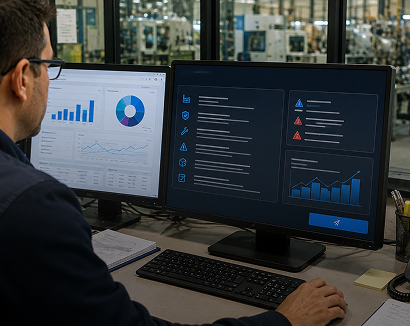
Once the data is connected, AI workflow agents can begin handling routine operational tasks. They capture information from source systems, generate reports, route approvals, identify unusual activity, and notify the right people when exceptions occur.
Trust is essential when introducing ERP AI into manufacturing. GrayCyan's approach is ready-first by default. Every automated action is recorded with a complete audit trail, and every approval workflow keeps a person in the loop whenever a critical decision needs to be made. This allows manufacturers to automate confidently while maintaining operational control.
ERP AI by Platform, Netsuite, SAP, Epicor, Acumatica and More
Most manufacturers already have an ERP in place, and the decision is rarely about switching systems. It is about making the current system more useful.
GrayCyan's ERP AI layer is designed to work with any ERP that supports API access or middleware integration. The goal is simple, extend what you already have instead of replacing it.
NetSuite AI, GrayCyan + NetSuite
NetSuite includes built-in AI features such as TextEnhance, basic forecasting, and automated categorisation in finance workflows. These tools work well when data is clean and processes are standardised, especially in accounting and order management.
Where they reach their limit is across operations that extend beyond the ERP. Most mid-market manufacturers need visibility across production systems, warehouse tools, and quality data, not just financial records.
GrayCyan adds a cross-system data layer that connects NetSuite with MES, WMS, and other operational tools. This enables natural language queries, unified reporting, and workflow automation across departments, not just within finance.
SAP AI, GrayCyan + SAP
SAP offers AI capabilities through Joule, SAP AI Core, and embedded predictive tools across supply chain and manufacturing modules.
These features are powerful, but they often require significant data preparation and configuration before they deliver practical value in mid-market environments.
Many SAP users do not fully activate these capabilities because of setup complexity and data standardisation requirements. GrayCyan provides an AI layer that works alongside SAP, connecting it to surrounding systems and delivering usable insights earlier in the implementation cycle.
This helps manufacturers see value without waiting for full enterprise-wide AI deployment.
Epicor AI, GrayCyan + Epicor
Epicor Kinetic is widely used in manufacturing environments for shop-floor control, production scheduling, and operational tracking. However, native AI functionality within Epicor is still limited in scope.
GrayCyan extends Epicor by adding analytics, natural language reporting, and workflow automation across production and quality processes. This helps teams move from static reports to real-time operational visibility.
Acumatica AI, GrayCyan + Acumatica
Acumatica's open API architecture makes it well suited for external AI integration. While it has fewer embedded AI features compared to larger ERP platforms, its flexibility allows manufacturers to build advanced capabilities on top of it.
GrayCyan uses this flexibility to connect Acumatica with MES, WMS, CRM, and other operational tools. The result is a unified data layer supported by AI-driven reporting and workflow agents that operate across the entire manufacturing environment.
Microsoft Dynamics, Odoo, Infor and Fishbowl
GrayCyan works with Microsoft Dynamics 365, Odoo, Infor, Fishbowl, and other ERP systems used across mid-market manufacturing and distribution. If the system has API access, it can support an AI layer.
In one Fishbowl ERP implementation, GrayCyan's middleware reduced manual data entry by 85 percent for a distribution manufacturer.
The same architecture is applied across other ERP environments, allowing teams to reduce repetitive work while improving data accuracy and reporting speed.
ERP AI Use Cases That Work in Manufacturing Right Now
Most manufacturers do not need theoretical AI. They need specific problems solved inside daily operations. AI workflow automation inside ERP systems work best when it targets repetitive tasks, reporting delays, and disconnected data flows that already exist in production environments.

Automated Data Entry and ERP Syncing
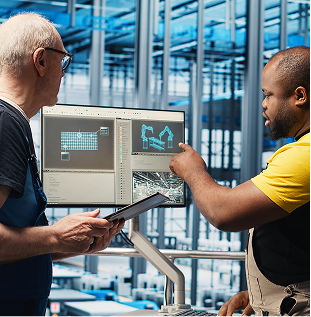
AI can capture structured information directly from source systems such as shop floor inputs, supplier emails, co-packer reports, and quality inspection records.
Instead of retyping or reconciling this data manually, it is written directly into ERP fields. This removes one of the most time-consuming parts of ERP usage, manual re-entry between systems. In a Fishbowl ERP implementation, this approach helped reduce daily manual data entry from around 12 hours to under 2 hours.
Natural Language ERP Reporting
Operations teams often rely on analysts or BI tools to answer basic production questions. AI changes this by allowing users to query ERP data in plain language, such as "show delayed purchase orders by supplier this week."
The system pulls live data from ERP records and returns structured answers in seconds. This reduces dependency on reporting queues and allows supervisors and plant managers to make faster operational decisions.

Workflow Automation for Approvals and Handoffs
Approval processes are one of the most common bottlenecks in ERP environments. Purchase orders, engineering change orders, and invoice exceptions often sit in inboxes without visibility or tracking.
AI agents can automatically route these approvals, escalate delays based on rules, and log every step inside the ERP. This removes uncertainty around where work is stuck and reduces the time spent chasing approvals across departments.

Cross System Anomaly Detection
Manufacturing data is rarely stored in one place. ERP, WMS, and MES systems often operate in parallel without real-time alignment. This creates blind spots where issues are only discovered after they affect production.
AI continuously compares data across systems to detect mismatches early, such as inventory discrepancies, BOM inconsistencies, or supplier delays. Instead of finding these problems the next day, teams can act before production is impacted.

ERP Knowledge Systems, RAG AI
Many operational questions are not just about numbers, but about context. Engineers often need to search through ERP records, drawings, specifications, and SOP documents to find the right information.
With RAG AI in manufacturing, ERP data and supporting documents are indexed into a searchable system. Engineers and operators can retrieve answers in seconds instead of manually searching across multiple platforms or folders.
Client Results, ERP AI in Practice
ERP AI only matters if it changes how work gets done on the floor and in back-office operations. The results below come from manufacturers who kept their existing ERP systems and added an AI layer on top.

SKU, BOM & Sales-Order Automation
A distribution manufacturer using Fishbowl ERP struggled with heavy manual entry across purchasing, inventory updates, and order processing. Data was being re-entered multiple times across different systems, which slowed down fulfillment and created frequent inconsistencies.
After implementing an ERP AI layer, daily manual data entry dropped from roughly 12 hours to under 2 hours. Automated workflows handled PO imports, data syncing, and reconciliation across systems. This improved order processing speed across the full fulfillment cycle.
Engineering Proposals Automated
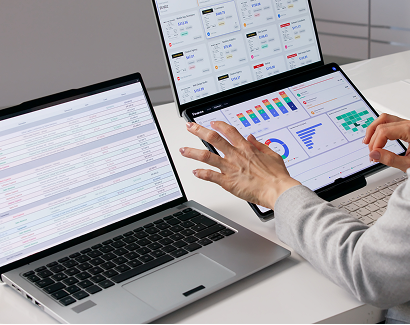
Engineering and operations teams were spending hours assembling ERP data into usable reports for proposals and project planning. Information existed in the system, but it had to be manually extracted and structured before it could be used.
With AI workflow automation layered on top of the ERP, reporting time dropped from around 8 hours to about 30 minutes. The AI system automatically pulled ERP data, structured it for engineering proposals, and reduced the dependency on manual report building. This workflow was identified during the ERP data review phase as a high impact opportunity before implementation began.
Both examples show the same pattern. Neither client replaced their ERP, instead they improved it by adding intelligence on top of the systems they already trusted.
How GrayCyan Implements ERP AI, 4 Step Process
GrayCyan's ERP AI implementation starts with operational reality, not a software demo. Every engagement is built around how your factory actually runs, where work slows down, and where data breaks between systems.
First workflow typically live within 30 to 60 days, deployed alongside live production with no shutdown required.
ERP and Data Readiness Assessment
We begin by mapping your ERP setup, connected systems, and the way data moves across your operation. This includes reviewing data quality, identifying integration gaps, and understanding where manual work still exists between systems.
The goal is to identify the highest leverage opportunity before any development starts. You get a clear go or no go recommendation so there is no guesswork about feasibility or ROI. You can also use our AI Readiness Assessment to begin this process.
Unified Data Layer
Once priorities are defined, we connect your ERP with surrounding systems such as MES, WMS, QC tools, CRM platforms, and shipping software. This is done through API connections and middleware.
Data is standardised and synced so information flows between systems in near real time. This creates a reliable operational data foundation that AI can actually work with, instead of fragmented reports pulled from separate tools.
AI Workflow Agents and Automation
We then deploy AI agents focused on specific workflows such as data entry, reporting, approvals, and anomaly detection. Each agent is built with a defined scope and clear business rule.
Every action includes an audit trail, and critical decisions always include a human approval step. The first workflow typically goes live within 30 to 60 days, depending on system complexity and data readiness.
Monitoring, Governance and Expansion
After deployment, we monitor accuracy, system performance, and workflow impact. Governance dashboards track how the AI layer is being used and where improvements are needed.
You retain full ownership of the system, including platform configuration and data logic. There are no ongoing licensing fees tied to what has been built. Once the first workflows prove value, the system is expanded into other departments and processes.
You get to keep your ERP and we just add what it is missing.
Frequently Asked Questions, ERP AI for Manufacturing
Bring Us Your ERP. We'll Make It Intelligent
Tell us which ERP you run and where your team is losing time. We'll show you what an AI layer on top of your existing system looks like using your actual workflows and data, not a generic software demonstration.
One of the GrayCyan's Fishbowl ERP clients reduced daily manual data entry from approximately 12 hours to under 2 hours without replacing their ERP. The same practical approach can be applied to other manufacturing environments.
Not sure if your data is ready? Take our AI Readiness Assessment.