Predictive Intelligence

Predictive Intelligence and AI Automation for Manufacturing and B2B Operations

No new software. No new hardware. No additional headcount.

GrayCyan turns logs, records, and operational data into early alerts, automated reports, and actionable summaries, using the systems your business already relies on.

Assess Your AI Maturity Now

Definition

What Is Predictive Intelligence? Core Definition and Applications

Most operations already generate the data they need to prevent delays, quality issues, and reporting bottlenecks. The problem is that these signals stay buried across ERP systems, emails, spreadsheets, production logs, and business applications until someone has time to review them.

GrayCyan builds predictive intelligence and AI automation systems that continuously analyze this operational data, identify emerging risks, generate actionable summaries, and automate routine decision support. The result is earlier visibility, faster responses, and less manual work, all while using the systems your business already relies on.

Most manufacturing and B2B operations are reactive. Problems usually appear in reports after they have already affected production, customer delivery or profitability. A shipment is delayed, a quality issue reaches a customer, or a scheduling conflict forces overtime before anyone realizes there was an early warning hidden in the data.

Predictive intelligence is the use of AI to analyze operational data, including production logs, ERP records, quality reports, maintenance history, emails and business communications, to identify what is likely to happen before it becomes a costly issue. Instead of simply reporting past events, predictive AI continuously looks for patterns that indicate emerging risks or opportunities.

The technology behind predictive intelligence is AI automation. Rather than asking employees to constantly monitor dashboards or review spreadsheets, AI continuously reads operational data, connects information across systems, and delivers alerts, summaries, or recommended actions automatically.

Reciting Problems → Catching Them Early

Every solution is designed around your existing data, workflows and operational processes, without requiring new software, new hardware, or additional headcount.

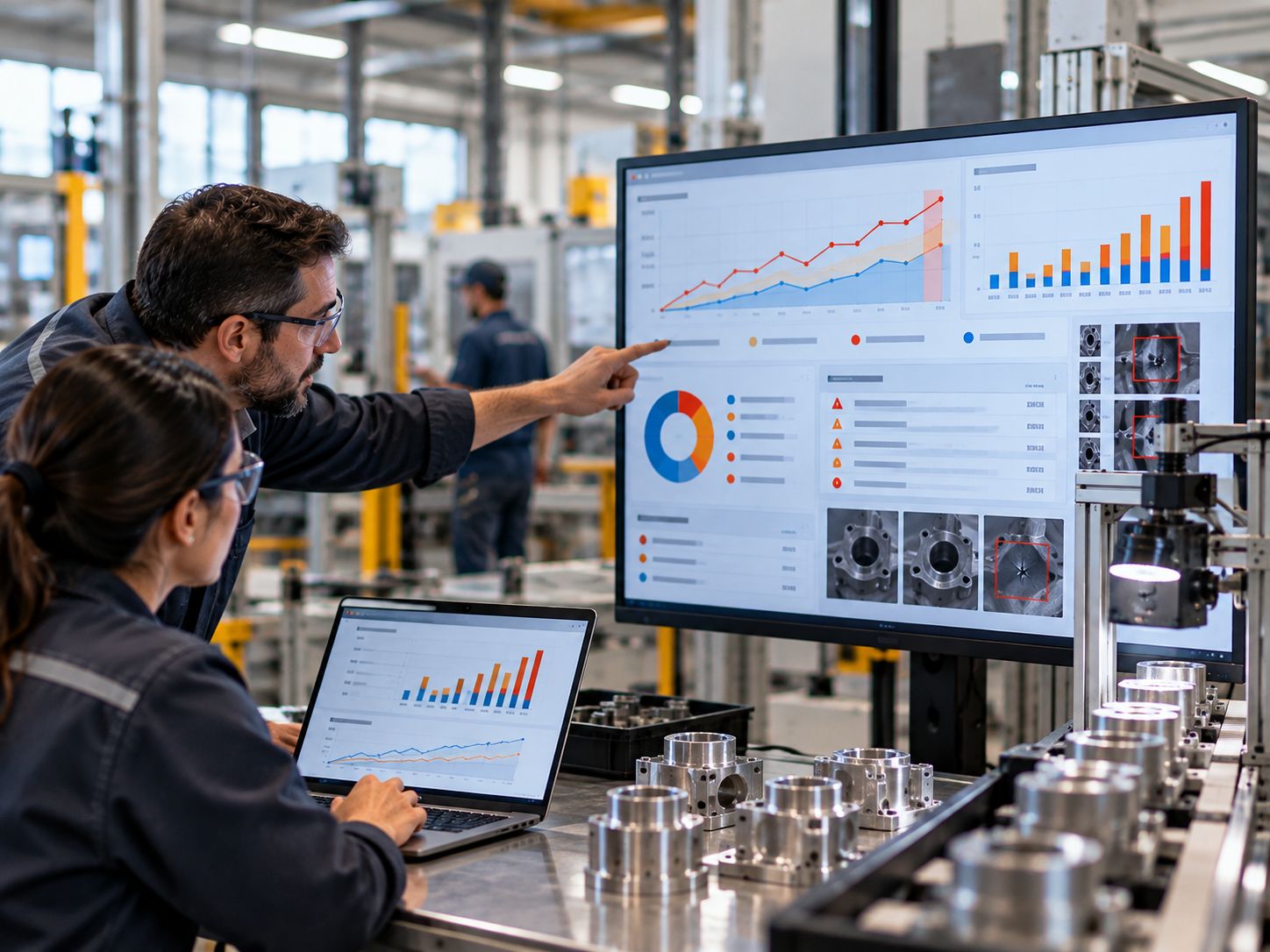
Equipment and quality risks flagged before they interrupt production
Early Warning

Issues Caught Before Production Stops

Identifying equipment and quality issues before they interrupt production.

Instead of a problem surfacing in a report after it has already affected output, the signal reaches the right person while there is still time to act.

Automated shift summary generated without manual data collection
Reporting

Summaries Without Manual Collection

Generating automated shift summaries, operational reports, and performance updates without manual data collection.

The reporting cycle that used to consume hours every week runs on its own.

Anomaly detection across ERP, MES, WMS, CRM and quality platforms
Anomalies

Detection Across Connected Systems

Detecting anomalies across connected systems such as ERP, MES, WMS, CRM, and quality management platforms.

Patterns that no single system would surface on its own become visible once the data is connected.

Trends in scheduling, inventory and supplier performance surfaced early
Trends

Recognising Shifts Early Enough to Respond

Recognizing trends in scheduling, inventory, supplier performance, and production capacity so teams can respond earlier.

The change is visible while it is still a trend, not once it has become a disruption.

The Problem

Operational Data Exists, But Nobody Is Acting on It Fast Enough

Modern organizations process constant inputs: emails, forms, logs, tickets, orders, schedules, scans, and updates. The challenge is not the data, it's the time-consuming manual work required to interpret it, update systems, and respond before issues escalate.

01

Monitor Continuously

Monitor operational activity continuously for emerging risks.

02

Generate Automatically

Generate summaries, alerts, and reports automatically.

03

Detect Across Systems

Detect patterns and anomalies across multiple business systems.

04

Trigger Before It Grows

Trigger workflows and recommended actions before problems grow.

All of this happens inside your current tools and systems, with no additional software or hardware required. This is what GrayCyan's AI automation services deliver: intelligence applied directly to the systems your team already runs, instead of introducing another platform for employees to learn.

Manufacturing

Predictive Intelligence for Manufacturing: Early Signals, Faster Interventions

Manufacturing teams already collect enormous amounts of operational data. Machine logs, maintenance records, quality inspections, production schedules, ERP transactions, and operator notes all contain signals about what is happening across the plant. The challenge is connecting those signals quickly enough for people to act before a small issue becomes a larger operational problem.

Maintenance logs and usage history flagging emerging equipment risk
Maintenance

Early Maintenance and Downtime Indicators

Reads logs and usage history to flag emerging equipment risks.

This is predictive maintenance AI applied at the operational data layer. Rather than relying on new sensors or expensive hardware upgrades, GrayCyan analyzes maintenance records, ERP data, MES logs, and existing equipment history to identify patterns that often appear before failures occur. Maintenance teams gain earlier visibility without changing the equipment already on the floor.

Recurring quality issues summarised with root causes
Quality

QC Pattern Recognition and Summaries

Identifies recurring quality issues and surfaces root causes with clear summaries.

AI anomaly detection continuously reviews production data, inspection records, and quality logs to identify patterns that may otherwise go unnoticed. Instead of handing quality teams hundreds of rows of raw data, the system produces structured summaries that explain where issues are emerging and what trends deserve immediate attention.

Labour and capacity constraints highlighted before the schedule breaks
Scheduling

Smarter Scheduling Inputs

Highlights labour, supply, or capacity constraints before schedules break.

Instead of discovering a scheduling conflict on the morning production is due to begin, predictive intelligence highlights the constraint 24 to 48 hours earlier. Operations managers can adjust staffing, material availability or production priorities before delays affect downstream work.

Cost-impacting scrap and delay trends surfaced automatically
Trend Detection

Scrap, Defect and Delay Trend Detection

Surfaces cost-impacting patterns and inefficiencies.

Weekly defect reports and operational summaries often require hours of manual data collection. GrayCyan automates this reporting process by continuously monitoring production data, identifying recurring trends, and generating reports that give operations managers clear visibility without adding extra reporting work to anyone's day.

Impact: More predictable production, faster interventions, and clearer planning. Learn more about our manufacturing AI solutions and how predictive intelligence fits into your existing operation.

Let's
Talk

No new sensors. No new platform.

The signals are already in your maintenance records, ERP data and MES logs. Tell us which one is costing you the most.

Book a Discovery Call
B2B Services

AI Automation for B2B Services: Less Coordination Overhead, Faster Decisions

Manufacturing is only one part of the operational picture. Many B2B organizations spend just as much time coordinating information between departments as they do delivering products or services. Sales, project management, finance, customer support, and operations all depend on accurate information moving quickly between people and systems.

01

Automated Forecasting and Reporting

Creates dashboards, weekly updates, and metric summaries automatically.

AI automation replaces the manual reporting cycle that often consumes hours every week. Instead of collecting data from multiple systems, formatting spreadsheets, building presentation decks, and emailing updates to leadership, the system generates reports automatically and distributes them to the right stakeholders on schedule.

02

Proposal and Documentation Support

Drafts project summaries, statements of work, renewals and client reports on demand.

Generative AI automation reduces proposal preparation from hours to minutes by using information already stored in your CRM, ERP, project management tools, and previous client engagements. Teams spend less time recreating documents and more time reviewing and refining them.

03

Ticket Classification, Routing and Escalation

Sorts and summarizes support requests and routes them to the right people.

Incoming requests are automatically classified by urgency, topic, and department. AI generates a concise summary of each request before routing it to the appropriate team, eliminating the manual triage process that slows support queues and internal service requests.

This capability works alongside GrayCyan's AI workflow agents, allowing routine processes to move automatically while keeping people involved whenever approvals or exceptions are required.

04

Lead Scoring and Client Insight Detection

Identifies account churn risk and recommends next steps based on patterns.

Predictive intelligence connects directly with your CRM to analyze engagement history, response times, communication patterns and account activity. When customer behavior begins to change, the system highlights accounts that may require attention before they become lost business.

This gives sales and account management teams more time to strengthen customer relationships and respond proactively.

Impact: Faster turnarounds, fewer dropped tasks, and better use of team bandwidth.

Supply Chain

Predictive Intelligence for Supply Chain: Visibility Before Disruption

Supply chain disruptions rarely happen without warning. Supplier lead times begin to change, purchase order confirmations slow down, inventory starts drifting from actual stock levels, and customer order patterns shift long before production feels the impact. The challenge is recognizing those signals early enough to respond.

01

Supplier Delay Detection

AI monitors purchase order confirmations, historical delivery performance, lead time changes, and supplier reliability to flag vendors that may fall behind schedule. Instead of learning about a delay when materials fail to arrive, procurement teams receive early warnings five to ten days in advance, giving them time to adjust purchasing plans or secure alternative supply.

02

Inventory Drift Alerts

Small inventory discrepancies often grow into larger operational issues when they remain unnoticed. GrayCyan compares ERP inventory records against warehouse management data in real time, flagging mismatches as soon as they appear instead of waiting for overnight reports or scheduled audits.

03

Demand Signal Monitoring

Customer demand changes gradually before it becomes obvious in production planning. AI continuously reviews order velocity, backlog trends, and customer communication patterns to identify changes in demand early, allowing production teams to adjust schedules and capacity before bottlenecks develop.

GrayCyan connects your existing ERP, WMS, and supplier data to build supply chain predictive intelligence without replacing any existing platform. This approach is especially valuable for food and CPG supply chains and other manufacturing AI solutions where operational visibility directly affects production performance.

Before and After

Predictive AI vs Reactive Operations

Many organizations already have the operational data they need to work proactively. What they lack is a system that continuously monitors that data, identifies patterns, and alerts the right people before problems grow. That is the difference between reactive operations and predictive AI.

Reactive OperationsPredictive AI
Equipment fails unexpectedly Maintenance risks are flagged up to 48 hours before failure based on historical log patterns
A quality issue is discovered after three production runs Defect patterns are identified after the first production run, with root cause summaries generated automatically
A scheduling conflict is discovered on the morning production begins Capacity constraints are highlighted two days earlier, with suggested scheduling adjustments
Weekly operational reports require four hours of manual work AI generates and distributes reports automatically before the Monday operations meeting
Customer churn is identified only after an account is lost CRM activity patterns identify at-risk accounts weeks before cancellation becomes likely

Every one of these outcomes is powered by data your operation already generates. GrayCyan connects that information to AI systems that continuously monitor, summarize, and act on operational signals before they become business problems.

What It Enables

What Predictive Intelligence and AI Automation Enables

Predictive intelligence and AI automation help organizations move beyond simply collecting operational data. They continuously analyze information, identify meaningful patterns and support faster, more informed decisions across manufacturing, B2B services and supply chain operations.

  • Detect operational issues before they become costly disruptions.
  • Automate reporting and routine decision support.
  • Surface trends and anomalies across connected business systems.
  • Reduce manual administrative work.
  • Help teams respond faster with better operational visibility.

Manual Monitoring → Higher-Value Work

Give your team earlier visibility, faster decisions, and more time to focus on higher-value work instead of manual monitoring and reporting.

Client Results

Results You Can Expect

These are measurable outcomes from manufacturers and B2B organizations that implemented GrayCyan's predictive intelligence and AI automation systems: faster operational reporting, earlier identification of production risks, reduced manual administrative work, improved decision-making across teams, and better visibility into operational performance.

Engineering reporting workflow automated after an operational readiness review
Reporting Automation
0%
Faster Reporting

Access Industrial

Reporting automation was identified as the highest-value predictive AI opportunity during the initial operational readiness review.

By automating proposal generation and reporting workflows, reporting time was reduced from eight hours to approximately thirty minutes, allowing engineering staff to focus on customer work instead of document preparation.

ACCESS INDUSTRIAL
Delivery coordination automated to remove manual growth bottlenecks
Delivery Coordination
0X
Client Growth

Kaizenify

AI automation of delivery coordination and internal workflows removed the manual bottlenecks that were limiting growth.

Teams were able to support significantly more client work without increasing administrative overhead.

KAIZENIFY

GrayCyan continues to build predictive intelligence, workflow automation, and operational AI solutions for manufacturers and B2B organizations where legacy systems, fragmented data, and manual processes create unnecessary operational delays. The focus is always on measurable business improvements rather than technology for its own sake.

Let's
Talk

Which report eats four hours of your week?

That is usually the first thing worth automating. We will map it against the data you already collect.

Book a Discovery Call
How to Choose

How to Choose a Predictive Intelligence Service for Your Operation

Most organizations looking for predictive intelligence services are not comparing a single provider. They are trying to understand what they actually need before investing in a solution. The right approach depends less on the AI itself and more on how well it fits your operational environment. Here are four questions worth asking before choosing a predictive intelligence partner.

01

Does It Work With Your Existing Data?

Many predictive AI solutions expect clean, structured datasets that have already been prepared for machine learning. Manufacturing and B2B operations rarely work that way.

Valuable information is spread across ERP exports, maintenance logs, emails, spreadsheets, quality records, and production reports. The right solution works with the data your operation already generates instead of requiring months of preparation.

02

Does It Require New Software or Hardware?

Introducing another platform means additional implementation time, employee training, and long-term licensing costs.

GrayCyan's approach focuses on connecting intelligence to your existing systems so your team continues working in the tools they already know while AI handles the analysis behind the scenes.

03

Is It Designed for Your Industry?

A predictive intelligence system built for retail or digital marketing will not understand batch records, BOM revisions, HACCP documentation, engineering drawings, or production scheduling.

Manufacturing and B2B organizations benefit from solutions designed around operational processes rather than generic business workflows.

04

Who Owns the System After Implementation?

Some AI vendors require customers to stay on proprietary platforms with recurring subscription fees and limited control over future development.

GrayCyan builds custom predictive intelligence and AI automation services that become part of your operation. You own the solution, your data remains under your control, and your future roadmap is not tied to a software vendor.

If you are unsure where your organization stands today, our AI Readiness Assessment provides a practical starting point before any implementation begins.

Frequently Asked Questions: Predictive Intelligence and AI Automation

What is predictive intelligence and what are its core applications?
Predictive intelligence uses AI to analyze operational data and identify patterns that suggest future issues or opportunities. Common applications include predictive maintenance, automated operational reporting, anomaly detection across business systems, and trend analysis for production, supply chain, and workforce planning. The goal is to help teams act earlier using information they already collect.
What is the difference between predictive AI and reactive AI?+
Reactive AI responds after an event has already occurred, such as generating reports or answering questions based on historical information. Predictive AI continuously analyzes incoming operational data to identify emerging trends, detect anomalies, and alert teams before issues affect production, quality, or customer service.
What are AI automation services and what do they include?+
AI automation services combine artificial intelligence with business workflows to reduce manual work and improve operational efficiency. They can automate reporting, document generation, workflow routing, anomaly detection, maintenance alerts, customer communication, and operational summaries while working alongside existing ERP, CRM, and production systems.
How do you choose predictive intelligence software for manufacturing?+
Start by evaluating whether the solution works with your current systems and operational data. It should support manufacturing workflows, integrate with ERP and production platforms, require minimal disruption, and provide measurable operational improvements rather than simply generating dashboards or reports.
How can predictive intelligence tools integrate with CRM systems?+
Predictive intelligence connects to CRM platforms through APIs or existing integrations to analyze customer activity, communication history, sales opportunities, and account behaviour. It can identify declining engagement, highlight accounts that require attention, generate customer summaries, and recommend follow-up actions before revenue is affected.
What are the benefits of predictive intelligence for supply chain optimization?+
Predictive intelligence helps organizations identify supplier delays, inventory discrepancies, and changing demand patterns before they affect production schedules. Earlier visibility allows procurement, planning, and operations teams to adjust proactively instead of responding after disruptions have already occurred.
What are the common challenges when adopting predictive intelligence?+
The biggest challenges are fragmented data, inconsistent data quality, legacy systems, and unclear priorities for where AI should be applied first. Successful implementations begin with understanding the operational workflow and existing data rather than selecting technology before defining the business problem.
How does predictive maintenance AI work for manufacturers?+
Predictive maintenance AI analyzes maintenance records, equipment history, production logs, and operational data to identify patterns that often appear before equipment failures. This allows maintenance teams to schedule repairs earlier, reduce unexpected downtime, and improve asset availability without necessarily adding new sensor infrastructure.
Does GrayCyan's predictive intelligence service require new software or hardware?+
No. GrayCyan's approach is designed around the systems your organization already uses. Our predictive intelligence solutions connect to existing ERP, MES, WMS, CRM, quality management platforms, and operational databases, minimizing disruption while improving visibility across the business.
How is GrayCyan's predictive intelligence service different from enterprise AI automation platforms?+
Enterprise automation platforms provide software that organizations configure internally. GrayCyan delivers custom predictive intelligence systems designed around your specific operational workflows, data sources, and business objectives. Rather than asking you to adapt your processes to a platform, we build solutions that fit the way your operation already works.
Let's
Talk

Ready to See What Predictive AI Can Do for Your Operations?

Access Industrial reduced reporting time from eight hours to just thirty minutes after GrayCyan identified reporting automation as the highest-value opportunity during its operational readiness review. That opportunity was identified before a single AI system was built, demonstrating the value of understanding the operation before recommending technology.

Whether your goal is earlier maintenance alerts, automated reporting, supply chain visibility, or smarter operational decision-making, GrayCyan builds predictive intelligence solutions around your existing systems and workflows.

Assess Your AI Maturity Now

See how predictive AI fits into manufacturing operations

Predictive Intelligence & AI Automation

What Is Predictive Intelligence? Core Definition and Applications

Most manufacturing and B2B operations are reactive — problems appear in reports after they have already affected production, customer delivery, or profitability. Predictive intelligence is the use of AI to analyze operational data to identify what is likely to happen before it becomes a costly issue. GrayCyan builds these systems specifically for manufacturers and B2B organizations, designed around your existing data and workflows — without requiring new software, new hardware, or additional headcount.

🔍

Identifying Issues Before They Become Blockers

Equipment and quality risks flagged before they interrupt production — using maintenance records, ERP data, and existing logs.

📋

Turning Unstructured Activity Into Clear Summaries

AI generates automated shift summaries, operational reports, and performance updates without manual data collection.

🔄

Automating Reporting and Coordination

Anomaly detection across connected ERP, MES, WMS, CRM, and quality management platforms — automated alerts and workflows.

📈

Highlighting Trends Business Leaders Can Act On

Scheduling, inventory, supplier performance, and capacity trends recognized early so teams can respond before disruption occurs.

All of this happens inside your current tools and systems — with no additional software or hardware required. Intelligence applied directly to the systems your team already runs.

Manufacturing

Predictive Intelligence for Manufacturing — Early Signals, Faster Interventions

Manufacturing teams already collect enormous amounts of operational data. Machine logs, maintenance records, quality inspections, production schedules, ERP transactions, and operator notes all contain signals about what is happening across the plant. The challenge is connecting those signals quickly enough to act before a small issue becomes a larger operational problem.

⚙️

Early Maintenance & Downtime Indicators

Reads logs and usage history to flag emerging equipment risks. Predictive maintenance AI applied at the operational data layer — analyzing maintenance records, ERP data, MES logs, and equipment history to identify patterns that often appear before failures occur. No new sensors or hardware required.

🔍

QC Pattern Recognition & Summaries

Identifies recurring quality issues and surfaces root causes with clear summaries. AI anomaly detection continuously reviews production data, inspection records, and quality logs. Instead of hundreds of rows of raw data, the system produces structured summaries explaining where issues are emerging and what trends deserve immediate attention.

📅

Smarter Scheduling Inputs

Highlights labour, supply, or capacity constraints before schedules break. Instead of discovering a scheduling conflict on the morning production is due to begin, predictive intelligence highlights the constraint 24 to 48 hours earlier — allowing adjustments before delays affect downstream work.

📊

Scrap, Defect & Delay Trend Detection

Surfaces cost-impacting patterns and inefficiencies. Weekly defect reports that required hours of manual data collection are automated — continuously monitoring production data, identifying recurring trends, and generating reports that give operations managers clear visibility without adding extra work to anyone's day.

Impact

More predictable production, faster interventions, and clearer planning — using the operational data your facility already generates every shift.

48 hrs
Earlier constraint visibility
Scheduling conflicts and capacity issues surfaced 24–48 hours before production is affected
❌ Reactive
✅ Predictive AI
Equipment fails unexpectedly
Maintenance risks flagged up to 48 hrs before failure
Quality issue found after 3 production runs
Defect pattern identified after first run with root cause summary
Scheduling conflict found morning of production
Constraint highlighted 2 days earlier with suggested adjustments
Weekly reports require 4 hrs manual work
AI generates and distributes reports automatically
See Manufacturing AI Solutions →
B2B Services

AI Automation for B2B Services — Less Coordination Overhead, Faster Decisions

Many B2B organizations spend just as much time coordinating information between departments as they do delivering products or services. Sales, project management, finance, customer support, and operations all depend on accurate information moving quickly between people and systems. GrayCyan's AI automation services reduce that administrative workload by automating repetitive coordination tasks, generating documentation, and helping teams make decisions faster.

2X
Client Growth — Kaizenify
AI automation of delivery coordination and internal workflows removed the manual bottlenecks limiting growth — supporting significantly more client work without increasing administrative overhead.

Where B2B Coordination Time Gets Recovered

Automated report generation — no manual data assembly
Proposal drafts in minutes — not hours
Support ticket classification — automatic routing
At-risk account alerts — before revenue is affected
Workflow handoffs — no dropped tasks between teams
📈

Automated Forecasting & Reporting

AI automation replaces the manual reporting cycle that consumes hours every week. Instead of collecting data from multiple systems, formatting spreadsheets, and emailing updates, the system generates reports automatically and distributes them to the right stakeholders on schedule.

📝

Proposal & Documentation Support

Generative AI reduces proposal preparation from hours to minutes by using information already stored in your CRM, ERP, project management tools, and previous client engagements. Teams spend less time recreating documents and more time reviewing and refining them.

🎫

Ticket Classification, Routing & Escalation

Incoming requests are automatically classified by urgency, topic, and department. AI generates a concise summary of each request before routing it to the appropriate team — eliminating manual triage that slows support queues and internal service requests.

🎯

Lead Scoring & Client Insight Detection

Predictive intelligence analyzes engagement history, response times, communication patterns, and account activity. When customer behavior begins to change, the system highlights accounts that may require attention — before they become lost business.

Impact

Faster turnarounds, fewer dropped tasks, and better use of team bandwidth — without adding headcount or introducing new platforms for employees to learn.

Supply Chain

Predictive Intelligence for Supply Chain — Visibility Before Disruption

Supply chain disruptions rarely happen without warning. Supplier lead times begin to change, purchase order confirmations slow down, inventory starts drifting from actual stock levels, and customer order patterns shift long before production feels the impact. The challenge is recognizing those signals early enough to respond. GrayCyan builds predictive intelligence solutions that connect your ERP, WMS, supplier records, and operational data to identify these trends before they become production problems.

Supplier Intelligence

Supplier Delay Detection

AI monitors purchase order confirmations, historical delivery performance, lead time changes, and supplier reliability to identify vendors that may fall behind schedule. Instead of learning about a delay when materials fail to arrive, procurement teams receive early warnings 5–10 days in advance — giving them time to adjust purchasing plans or secure alternative supply.

Inventory AI

Inventory Drift Alerts

Small inventory discrepancies often grow into larger operational issues when they remain unnoticed. GrayCyan compares ERP inventory records against warehouse management data in real time, flagging mismatches as soon as they appear — instead of waiting for overnight reports or scheduled audits that discover problems too late for easy correction.

Demand Signals

Demand Signal Monitoring

Customer demand changes gradually before it becomes obvious in production planning. AI continuously reviews order velocity, backlog trends, and customer communication patterns to identify changes in demand early — allowing production teams to adjust schedules and capacity before bottlenecks develop and customer commitments are missed.

GrayCyan connects your existing ERP, WMS, and supplier data to build supply chain predictive intelligence without replacing any existing platform. This approach is especially valuable for food and CPG supply chains and other manufacturing operations where operational visibility directly affects production performance.

What Predictive Intelligence Enables

What Predictive Intelligence & AI Automation Enables

Predictive intelligence and AI automation help organizations move beyond simply collecting operational data. They continuously analyze information, identify meaningful patterns, and support faster, more informed decisions across manufacturing, B2B services, and supply chain operations.

🔔

Detect Issues Before Disruption

Operational issues identified before they become costly disruptions — using data your systems already generate every day.

📋

Automate Reporting & Decision Support

Routine reporting and decision support automated — freeing teams from manual data collection and weekly update cycles.

🔗

Surface Trends Across Connected Systems

Anomalies and trends surfaced across ERP, MES, WMS, CRM, and quality management platforms — connected, not siloed.

⏱️

Reduce Manual Administrative Work

Hours spent on manual data bridging, report formatting, and coordination tasks recovered and redirected to higher-value work.

👁️

Respond Faster With Better Visibility

Teams respond faster with better operational visibility — moving from reactive responses to proactive interventions.

🎯

Consistent, Reliable Early Detection

AI monitors continuously — not only when someone has time to review a dashboard. Signals are never missed because of bandwidth.

The goal: Give your team earlier visibility, faster decisions, and more time to focus on higher-value work — instead of manual monitoring, report generation, and reactive firefighting.

Trusted by business leaders across manufacturing

Trusted by Industry Leaders

We help small and mid-sized teams automate daily work, improve accuracy, and reclaim time, without changing their existing systems.

Automate daily operations. Improve accuracy. Save time. All within your existing systems.

How to Choose

How to Choose a Predictive Intelligence Service for Your Operation

Most organizations looking for predictive intelligence services are not comparing a single provider. They are trying to understand what they actually need before investing in a solution. The right approach depends less on the AI itself and more on how well it fits your operational environment. Here are four questions worth asking before choosing a predictive intelligence partner.

01

Does It Work With Your Existing Data?

Many predictive AI solutions expect clean, structured datasets that have already been prepared for machine learning. Manufacturing and B2B operations rarely work that way — valuable information is spread across ERP exports, maintenance logs, emails, spreadsheets, and production reports. The right solution works with the data your operation already generates instead of requiring months of preparation before any value is delivered.

02

Does It Require New Software or Hardware?

Introducing another platform means additional implementation time, employee training, and long-term licensing costs. GrayCyan's approach focuses on connecting intelligence to your existing systems so your team continues working on the tools they already know while AI handles the analysis behind the scenes — minimizing disruption and avoiding additional vendor dependencies.

03

Is It Designed for Your Industry?

A predictive intelligence system built for retail or digital marketing will not understand batch records, BOM revisions, HACCP documentation, engineering drawings, or production scheduling. Manufacturing and B2B organizations benefit from solutions designed around operational processes rather than generic business workflows that have been adapted for industrial environments.

04

Who Owns the System After Implementation?

Some AI vendors require customers to stay on proprietary platforms with recurring subscription fees and limited control over future development. GrayCyan builds custom predictive intelligence systems that become part of your operation. You own the solution, your data remains under your control, and your future roadmap is not tied to a software vendor's pricing decisions.

Not Sure Where Your Organization Stands Today?

GrayCyan's AI Readiness Assessment provides a practical starting point before any implementation begins — identifying where predictive intelligence can deliver the highest value in your specific operational environment.

Assess Your AI Maturity Now

Ready to see what predictive AI can do for your operations?

Frequently Asked Questions

Frequently Asked Questions: Predictive Intelligence & AI Automation

Predictive intelligence uses AI to analyze operational data and identify patterns that suggest future issues or opportunities. Common applications include predictive maintenance, automated operational reporting, anomaly detection across business systems, and trend analysis for production, supply chain, and workforce planning. The goal is to help teams act earlier using information they already collect.

Reactive AI responds after an event has already occurred — generating reports or answering questions based on historical information. Predictive AI continuously analyzes incoming operational data to identify emerging trends, detect anomalies, and alert teams before issues affect production, quality, or customer service. The practical difference is whether your team learns about a problem while there is still time to act or after the damage is already done.

AI automation services combine artificial intelligence with business workflows to reduce manual work and improve operational efficiency. They can automate reporting, document generation, workflow routing, anomaly detection, maintenance alerts, customer communication, and operational summaries — while working alongside existing ERP, CRM, and production systems without requiring new platforms.

Start by evaluating whether the solution works with your current systems and operational data. It should support manufacturing workflows, integrate with ERP and production platforms, require minimal disruption, and provide measurable operational improvements rather than simply generating dashboards. The right solution builds on the data your operation already generates instead of requiring months of data preparation before value is delivered.

Predictive intelligence connects to CRM platforms through APIs or existing integrations to analyze customer activity, communication history, sales opportunities, and account behavior. It can identify declining engagement, highlight accounts that require attention, generate customer summaries, and recommend follow-up actions before revenue is affected — giving sales and account management teams earlier visibility into relationship health.

Predictive intelligence helps organizations identify supplier delays, inventory discrepancies, and changing demand patterns before they affect production schedules. Earlier visibility allows procurement, planning, and operations teams to adjust proactively instead of responding after disruptions have already occurred. Supplier delay warnings 5–10 days in advance give teams enough lead time to secure alternative supply or adjust production plans.

The biggest challenges are fragmented data, inconsistent data quality, legacy systems, and unclear priorities for where AI should be applied first. Successful implementations begin with understanding the operational workflow and existing data rather than selecting technology before defining the business problem. GrayCyan's AI Readiness Assessment addresses these challenges before any build begins.

Predictive maintenance AI analyzes maintenance records, equipment history, production logs, and operational data to identify patterns that often appear before equipment failures. This allows maintenance teams to schedule repairs earlier, reduce unexpected downtime, and improve asset availability — without necessarily adding new sensor infrastructure. GrayCyan's approach uses data already in existing CMMS and MES platforms.

No. GrayCyan's approach is designed around the systems your organization already uses. Predictive intelligence solutions connect to existing ERP, MES, WMS, CRM, quality management platforms, and operational databases — minimizing disruption while improving visibility across the business. No new hardware is required and no additional software platforms need to be learned by your team.

Enterprise automation platforms provide software that organizations configure internally. GrayCyan delivers custom predictive intelligence systems designed around your specific operational workflows, data sources, and business objectives. Rather than asking you to adapt your processes to a platform, GrayCyan builds solutions that fit the way your operation already works — and transfers full ownership to you at engagement completion.

Ready to See What Predictive AI Can Do

Ready to See What Predictive AI Can Do for Your Operations?

Access Industrial reduced reporting time from eight hours to just thirty minutes after GrayCyan identified reporting automation as the highest-value opportunity — before a single AI system was built. Whether your goal is earlier maintenance alerts, automated reporting, supply chain visibility, or smarter operational decision-making, GrayCyan builds predictive intelligence solutions around your existing systems.

No new software or hardware required
Works with your existing ERP, MES, WMS, and CRM systems
Full client ownership at engagement completion
Start with AI Readiness Assessment before any build begins