STAGE 3:
Connected AI Systems

AI agents that collaborate, execute, and adapt across your entire operation.

Partners, Mentions and Clients
logos

GrayCyan Leading the Conversation

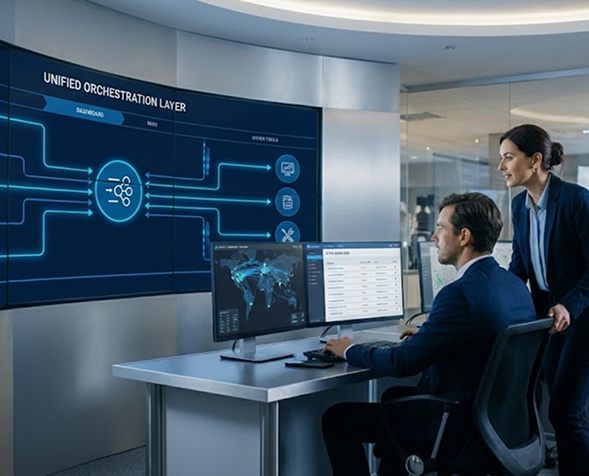
Stage 3 is where AI becomes an operational layer across your entire business. Multiple Agentic AI Systems collaborate across ERP, CRM, WMS, EMR, SIS, and other tools. Workflows span departments and platforms, coordinated through shared logic and governance controls. 

AI not only executes processes — it orchestrates outcomes across systems, adapts to live signals, and ensures alignment between teams. Human oversight remains available, with built-in explainability and escalation paths.

This is where clarity, speed, and orchestration come together.

What Stage 3 Looks Like In Practice

AI agents share context across systems, communicate across departments, and complete end-to-end processes spanning multiple platforms.

A disruption detected in one system can trigger coordinated updates in procurement, production, logistics, sales, and reporting.

Decisions are no longer confined to a single workflow. AI orchestrates system-wide responses aligned to defined goals.

At this stage, AI becomes a full-time collaborator, not just an assistant.

What AI Delivers at This Stage

Agentic AI Systems coordinate multiple workflows, data sources, and teams to execute end-to-end processes across systems. They monitor live signals, apply governance rules, validate outputs, and adapt execution paths as conditions change. Escalation to human decision-makers occurs automatically when uncertainty, risk, or compliance requirements demand oversight.

Stage 3 introduces Connected AI Systems.

Multiple Agentic AI Systems coordinate across workflows and platforms.

AI executes goal-driven processes across departments, adapts to live signals, and escalates when human oversight is required.

This is organization-level intelligence.

rectangle 21 (23)

End-to-End Process Execution by Coordinated AI Agents

Agentic AI Systems execute complex processes across departments and tools.
  • Coordinate multiple Workflow AI Agents toward a defined outcome
  • Execute multi-step processes without manual sequencing
  • Maintain progress across long-running or multi-team operations

System-Wide Orchestration Across ERP, CRM, EMR, SIS, LMS, and Other Tools

Agentic AI Systems operate above individual workflows.
  • Align execution across core systems and shared tools
  • Maintain a consistent operational state across platforms
  • Reduce breakdowns caused by fragmented system ownership
rectangle 21 (22)
rectangle 21 (21)

AI Systems That Detect, Adapt, and Escalate Based on Live Signals

Agentic AI Systems respond dynamically to changing conditions.
  • Monitor real-time signals, thresholds, and exceptions
  • Adapt execution paths as inputs change
  • Escalate to humans when risk, uncertainty, or judgment is required

Autonomous Packet Assembly, Reporting, and Communication

Agentic AI Systems generate and distribute outputs as part of execution.
  • Assemble reports, packets, summaries, and communications automatically
  • Ensure outputs are complete, validated, and system-ready
  • Reduce manual compilation across departments
rectangle 21 (20)
rectangle 21 (19)

Real-Time Collaboration Between Departments Through Shared Logic

Agentic AI Systems synchronize teams through a shared operational model.
  • Coordinate actions across departments using common rules and context
  • Ensure teams operate from the same version of truth
  • Reduce delays caused by misalignment or missing information

Continuous Optimization and Fine-Tuning

Agentic AI Systems improve execution over time.
  • Monitor outcomes, bottlenecks, and recurring exceptions
  • Refine logic, thresholds, and routing based on observed performance
  • Support ongoing optimization without constant redesign
rectangle 21 (18)

Life Before AI vs. Life After AI

Before

ai agent orchestration
Teams struggle with coordination across systems and departments
ai agent orchestration
Leadership relies on lagging reports and manual summaries
ai agent orchestration
Staff spend hours ensuring systems are updated and synce
ai agent orchestration
Missed handoffs, duplicated work, and reactive decisions are common
ai agent orchestration
Small delays snowball into bottlenecks across teams

after

ai agent orchestration
Agents collaborate across systems to keep operations flowing
ai agent orchestration
Reports, summaries, and audits are generated before they’re requested
ai agent orchestration
Updates propagate in real time across platforms (CRM, ERP, EMR, LMS)
ai agent orchestration
Workflows evolve and scale without manual redesign
ai agent orchestration
Leaders act early, based on live insights, not after problems arise

Life Before AI vs. Life After AI

Before

ai agent orchestration
Systems operate in silos.
ai agent orchestration
Manual syncs delay execution.
ai agent orchestration
Leadership reacts to lagging reports.

Before

ai agent orchestration
Agents collaborate across systems.
ai agent orchestration
Updates propagate in real time.
ai agent orchestration
Workflows scale without redesign.
ai agent orchestration
Leaders act using live operational insight.

Trusted by business leaders across healthcare, manufacturing & B2B services.

Trusted by Industry Leaders

We help small and mid-sized teams automate daily work, improve accuracy, and reclaim time, without changing their existing systems.

Automate daily operations. Improve accuracy. Save time. All within your existing systems.

Signs You Are in Stage 3

You’ve likely reached Stage 3 if:

Stage 3 is where AI becomes a true operational layer.
ai agent orchestration

AI agents execute end-to-end workflows across systems with minimal supervision

ai agent orchestration

Systems remain synchronized without manual reconciliation

ai agent orchestration

Reports and documentation generate automatically and propagate across platforms

ai agent orchestration

Leadership receives proactive visibility into performance and risks

ai agent orchestration

Operational adjustments occur based on live data signals

rectangle 21 (17)

What This Stage Enables Next

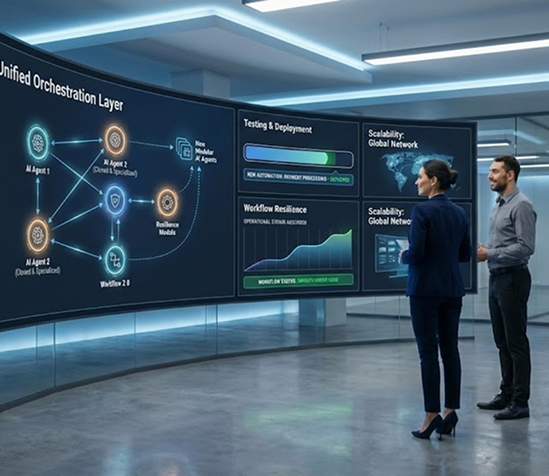
Stage 3 organizations have the foundation for continuous AI evolution:

  • New automations are easy to test and deploy
  • Agents can be cloned, improved, and specialized
  • Business resilience increases as AI absorbs operational strain
  • Teams move faster with less interruption

Ready to build your AI roadmap?

We’ll help you identify the right use cases, assess readiness, and prioritize real-world value.
Scroll to Top