STAGE 1:
Foundational Intelligence

Build clarity, reduce manual work, and prepare your operation for AI
Partners, Mentions and Clients
logos

GrayCyan Leading the Conversation

Stage 1 is where organizations begin transforming scattered information into structured, reliable, and actionable data. At this stage, AI supports teams through automation and structured assistance — but it does not make decisions.

If your teams spend time searching for files, re-entering information into systems, drafting repetitive documents, or manually coordinating tasks, you are in the right stage. Foundational Intelligence removes everyday friction by organizing information and accelerating task execution.

This stage builds a strong operational baseline. AI prepares, structures, drafts, and summarizes — while humans remain responsible for all approvals and decisions.

What Stage 1 Looks Like In Practice

AI begins supporting your team by organizing information, drafting routine outputs, and ensuring updates happen cleanly and consistently inside your systems.

At this stage, AI does not evaluate trade-offs, choose next steps, or approve actions. It enhances execution speed and data clarity while humans retain full control over workflow decisions.

At this stage, your teams are no longer the bottleneck. AI moves the work forward with minimal handholding.

What AI Delivers at This Stage

Stage 1 brings AI directly into everyday work to improve how teams access information, create outputs, and work with data.

AI enhances productivity and data reliability without taking ownership of workflows or decisions. Outputs are deterministic and bounded by predefined instructions. Human teams remain responsible for interpreting results, making judgments, and initiating next steps.

Stage 1 enhances productivity and data reliability.

AI extracts, structures, drafts, and flags inconsistencies — but it does not initiate workflows or make operational decisions.

This stage builds clarity and prepares you for Workflow Intelligence.

rectangle 21 (4)

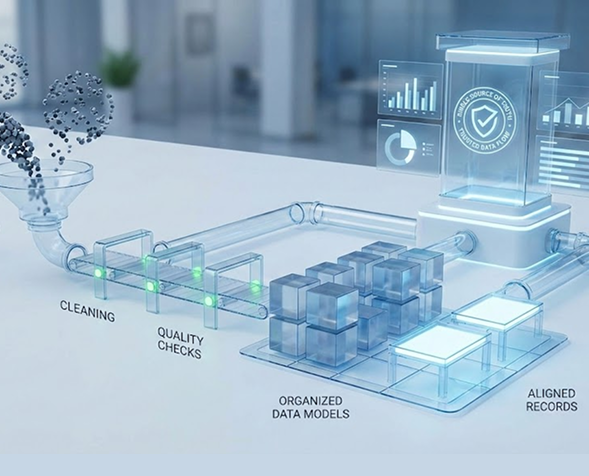
Clean, Structured, and Reliable Operational Data

AI turns scattered, unstructured information into usable, organized data.
  • Extracts and structures information from documents, emails, PDFs, and internal tools
  • Improves clarity, consistency, and usability of operational data
  • Creates reliable inputs without changing how systems or processes run

Accurate Drafts, Summaries, and Reports in Seconds

AI dramatically reduces the time spent creating routine outputs.
  • Generates drafts, summaries, reports, and documentation on demand
  • Converts raw inputs into clear, readable formats
  • Accelerates knowledge work while keeping humans fully in control
rectangle 21 (1)
rectangle 21 (2)

Consistent Updates Across CRM, ERP, EMR, SIS, and Other Tools

AI helps teams keep information aligned across systems.
  • Prepares structured updates for multiple tools
  • Reduces repetitive copy-paste work and formatting errors
  • Supports consistency without automating execution or decisions

Instant Access to Files, Answers, and Past Information

AI makes institutional knowledge easy to find and reuse.
  • Answers questions using internal documents, policies, and templates
  • Surfaces the right file, version, or reference quickly
  • Reduces time spent searching across inboxes, folders, and shared drives
rectangle 21 (3)
rectangle 21 (5)

Error Reduction Through Automated Checks and Validation

AI helps catch issues before work is finalized.
  • Flags missing fields, inconsistencies, or basic logic gaps
  • Improves accuracy in drafts, reports, and data preparation
  • Reduces rework without enforcing workflow rules

Reduced Coordination Overhead

AI simplifies collaboration by improving context and clarity.
  • Generates summaries for handoffs and internal updates
  • Reduces back-and-forth clarification and follow-ups
  • Helps teams stay aligned without managing execution
rectangle 21 (6)
rectangle 21 (7)

A Solid Foundation for Workflow Automation

Stage 1 prepares organizations for deeper AI adoption.

  • Improves data quality and documentation readiness
  • Familiarizes teams with AI-assisted work
  • Establishes the baseline required for Stage 2 and Stage 3 capabilities

Life Before AI vs. Life After AI

Before

ai maturity assessment
Teams search across emails, folders, and systems to find the “latest version”
ai maturity assessment
Information lost in PDFs, emails, scanned documents, and handwritten notes
ai maturity assessment
Repetitive drafting of proposals, reports, summaries, and responses
ai maturity assessment
Manual updates to CRM, ERP, EMR, SIS, or other systems
ai maturity assessment
Follow-ups, reminders, and coordination handled manually
ai maturity assessment
Managers rely on tribal knowledge instead of real-time clarity

after

ai maturity assessment
Emails, scans, forms, and logs become structured and searchable instantly
ai maturity assessment
Workflow AI Agents summarize documents, calls, notes, and surface key insights
ai maturity assessment
Routine documents (intake summaries, shift logs, proposals, updates) are auto-drafted
ai maturity assessment
Fields updated across platforms without manual effort
ai maturity assessment
Agents route messages, track tasks, and send structured daily summaries
ai maturity assessment
Managers access clean operational snapshots on demand

Trusted by business leaders across healthcare, manufacturing & B2B services.

Trusted by Industry Leaders

We help small and mid-sized teams automate daily work, improve accuracy, and reclaim time, without changing their existing systems.

Automate daily operations. Improve accuracy. Save time. All within your existing systems.

Signs You Are in Stage 1

You might be in Stage 1 if:

Stage 1 is where clarity and operational stability begin.

ai maturity assessment

Data lives in emails, PDFs, spreadsheets, and paper

ai maturity assessment

Information is inconsistent or duplicated across tools

ai maturity assessment

Updates across systems are mostly manual

ai maturity assessment

Teams struggle to get accurate visibility

ai maturity assessment

Documentation and reporting take too long

ai maturity assessment

Leaders rely on manual collection to understand operations

rectangle 21 (8)

What This Stage Enables Next

Once your data is structured, updates flow cleanly, and outputs are generated automatically, you’re ready for:
Stage 2: Workflow Intelligence & Process Automation

AI begins coordinating multi-step processes across teams and systems.

Ready to build your AI roadmap?

We’ll help you identify the right use cases, assess readiness, and prioritize real-world value.
Scroll to Top