STAGE 2:
Workflow Intelligence & Process Automation
GrayCyan Leading the Conversation
- Forbes Council
- February 6, 2026
How Manufacturers Use AI To Drive Efficiency Through Smarter Automation
- Entrepreneur
- January 22, 2026
Meet the Immigrant Entrepreneur Rethinking AI in Manufacturing for U.S. Companies
- Small Business Currents
- February 25, 2026
AI for Small Manufacturers: Boosting Throughput and Saving Time Without Breaking the Bank
- Selling in the Age of AI
- January 16, 2026
Selling in the Age of AI - Episode 28: Nishkam Batta
- No Jitter
- February 26, 2026
Invisible AI: Why the next phase of UC adoption may be quieter
- Beta.news
- March 4, 2026
New scorecard allows manufacturers to assess the benefits of AI before implementing
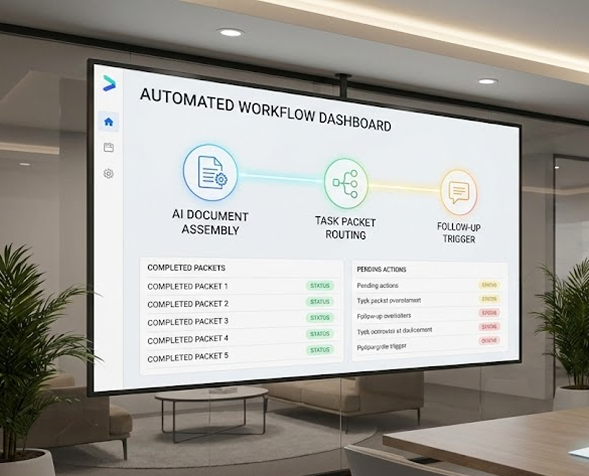
Stage 2 is where operational AI shifts from information preparation to active workflow execution within a defined system. With reliable data in place, Workflow AI Agents now handle multi-step processes, apply predefined logic, and make routine decisions inside a single platform such as ERP, CRM, EMR, or SIS.

AI can approve low-risk actions, route tasks, escalate exceptions, and move workflows forward without constant human follow-up. Cross-system orchestration is not yet the focus. At this stage, intelligence operates within system boundaries.
This stage doesn’t replace people. It ensures their work flows smoothly and systems talk to each other reliably.
What Stage 2 Looks Like In Practice
AI handles tasks that require gathering information, validating it against rules, preparing outputs, and triggering the next steps inside a structured workflow.
Workflow AI Agents evaluate conditions, apply thresholds, and choose actions within defined guardrails. Humans oversee outcomes and manage exceptions, but routine operational decisions are automated.
Manufacturers
- Generates RFQs, PRs, and vendor requests automatically when thresholds or triggers appear
- Schedules production or maintenance based on usage patterns or job status
- Reconciles PO → GRN → Invoice flows with validation
- Prepares shift updates, quality summaries, and weekly reports
B2B Services
- Automatically generates onboarding documents and client materials
- Drafts proposals and follow-ups based on prior interactions
- Triages and routes service tickets or client issues to the right team
- Triggers invoice generation or CRM updates after service completion
Healthcare (Administrative Workflows)
- Prepares full prior-authorization packets from scattered documents
- Updates EMRs, billing systems, and scheduling tools from a single input
- Assists with revenue cycle coordination and cross-checks billing data
- Converts visit data and forms into structured outputs for admin and coding
Education
- Generates admission packets from submitted applications and uploaded files
- Validates completeness of enrollment documents and forms
- Updates SIS, LMS, and communication tools in sync
- Automates reminders, follow-ups, and student engagement workflows
- Triggers welcome messages, ID creation, and access provisioning after admission
At this stage, your teams are no longer the bottleneck. AI moves the work forward with minimal handholding.
What Stage 2 Looks Like In Practice
At Stage 2, AI moves beyond assistance and begins making decisions within a defined system.

Workflow AI Agents gather inputs, validate information, apply rules, and trigger the next step automatically — inside ERP, CRM, EMR, SIS, or another single platform.

AI now evaluates conditions and acts within guardrails.
Manufacturers
- Generate RFQs when thresholds are met.
- Reconcile PO → GRN → Invoice flows with validation.
- Schedule production or maintenance based on usage signals.
AI applies predefined logic and moves workflows forward automatically.
B2B Services
- Draft onboarding documents.
- Route tickets to the right teams.
- Trigger invoice creation and CRM updates after service completion.
Routine operational decisions are automated inside the system.
Healthcare
(Administrative Only)
- Assemble prior-authorization packets.
- Cross-check revenue cycle data.
- Trigger status updates automatically.
- AI evaluates and advances workflows within defined boundaries.
Education
- Validate enrollment documents.
- Sync SIS and LMS records.
- Trigger onboarding communications automatically.
- AI now owns structured processes inside the system.
At this stage, your teams are no longer the bottleneck. AI moves the work forward with minimal handholding.
What AI Delivers at This Stage
At Stage 2, AI moves beyond assistance and begins executing workflows inside one system. Workflow AI Agents track progress, apply business logic, trigger next steps, and ensure processes move forward correctly. Routine decisions such as routing, approvals within thresholds, and escalation are automated. Humans focus on oversight and exception handling.
AI agents execute multi-step workflows and make routine decisions inside one system.
Humans oversee results and manage exceptions.
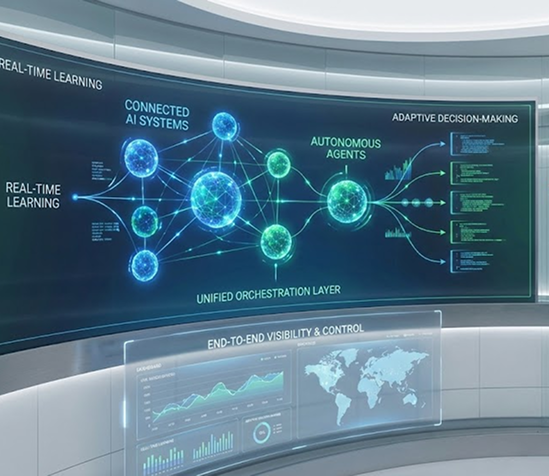
Cross-system orchestration is introduced at Stage 3.
Process Automation Triggered by Events, Statuses, or Inputs
- Respond to events, form submissions, system updates, or status changes
- Trigger the next step without manual follow-ups
- Keep workflows moving without constant human coordination
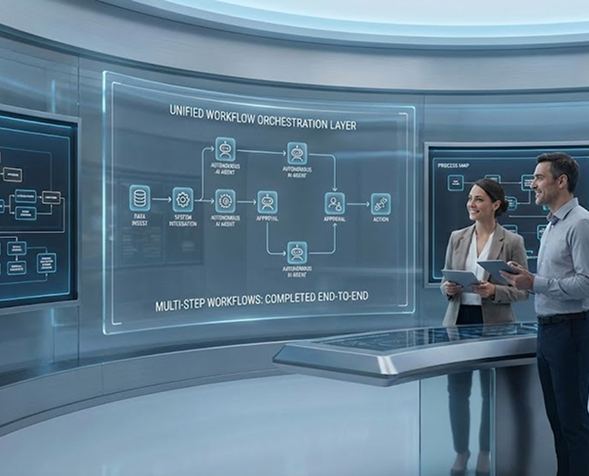
AI Agents That Complete Multi-Step Workflows End-to-End
- Track progress across multiple steps
- Ensure required actions happen in the correct sequence
- Escalate or pause when approvals, inputs, or exceptions arise
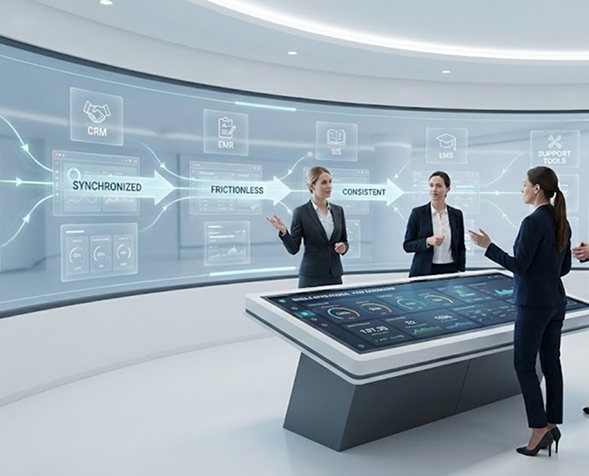
Workflow Alignment Across ERP, CRM, EMR, SIS, LMS, and Support Tools
- Maintain consistency between records and workflow state
- Reduce breakdowns caused by disconnected tools
Automated Documentation, Packets, and Task Follow-Ups
- Create documentation, packets, summaries, and task updates automatically
- Send follow-ups and reminders where work happens
- Reduce missed steps and incomplete handoffs
Routine Decisions Supported by Intelligent Triggers
- Apply predefined rules, thresholds, and logic
- Route work, escalate issues, or request review when needed
- Maintain consistency while keeping humans in control
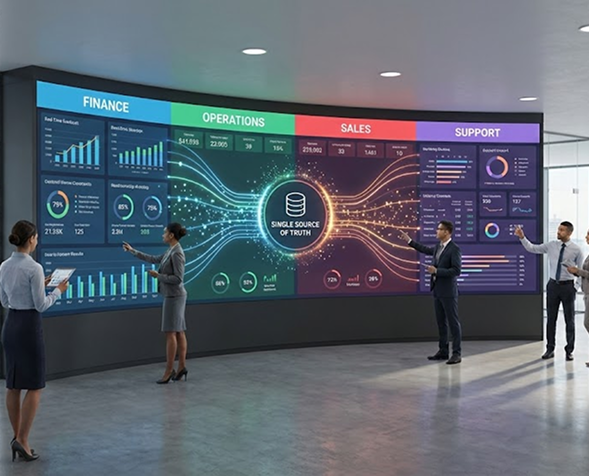
Real-Time Data Sync and Updates Across Departments
- Update records as work progresses
- Ensure teams see the same status across systems
- Reduce errors caused by stale or incomplete information
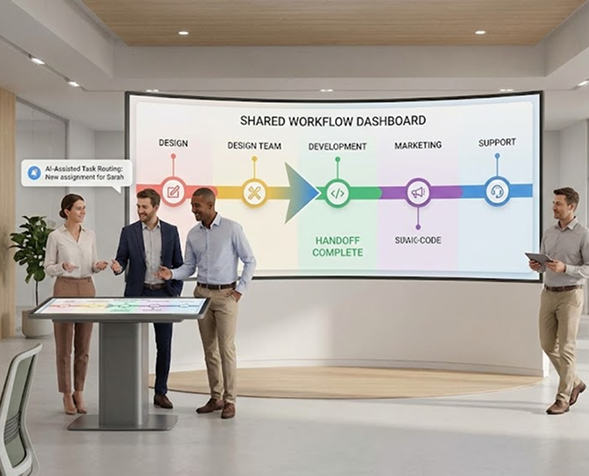
Smooth Handoffs and Coordination Between Teams
- Prepare context-rich handoff summaries
- Route tasks to the right owner at the right time
- Reduce back-and-forth and execution delays
Life Before AI vs. Life After AI
Before
after
Life Before AI vs. Life After AI
Before
after
Trusted by business leaders across manufacturing
Trusted by Industry Leaders
We help small and mid-sized teams automate daily work, improve accuracy, and reclaim time, without changing their existing systems.
Automate daily operations. Improve accuracy. Save time. All within your existing systems.
90%
faster reporting
Engineering proposals automated
Access Industrial cut proposal prep from 8 hrs → 30 mins, improving accuracy and client trust.
2X
client growth
SaaS scalability achieved
Kaizenify doubled its customer base after full-stack rebuild and AI integration.
80+
hours saved / month
Manual work eliminated
United City Yachts automated lead assignments, reclaiming staff time and reducing missed deals.
5M+
content items indexed
AI knowledge agent deployed
LivingLies transformed a static site into a searchable legal intelligence hub.
100%
system uptime
Post-migration stability restored
Family Office Access overcame failed builds and launched a secure investor-founder platform.
85%
reduction in manual data entry
ERP middleware automation
Fishbowl ERP cut daily manual entry from ~12 hrs to under 2 hrs, created a unified data workflow, and accelerated order processing with automated PO imports, syncing, and reconciliation.
3X
higher perceived response quality
Emotion-aware AI governance layer
LovingIs.ai aligned multiple LLMs with ethical safeguards to deliver safer, family-friendly AI interactions.
Signs You Are in Stage 2
You’re likely in Stage 2 if:
Stage 2 is where speed, consistency, and automation begin delivering exponential gains.
Most data is clean, searchable, and structured
AI already handles simple summaries or outputs
Teams still manage coordination manually
There’s friction in keeping systems updated in sync
Processes span multiple departments but aren’t yet fully automated