

AI doesn’t need five years of experimentation to prove its worth. When deployed with precision, it can pay for itself within the first month. The organizations that succeed early share one trait: they treat AI not as an experiment, but as an investment tied directly to measurable business outcomes.
This section is your playbook, a set of strategies and proof points showing how to make AI deliver immediate, bankable results.
Leaders often ask: “Where do I start?” The answer isn’t with a moonshot. The fastest ROI comes from targeting pain points with visible costs—places where manual work, long cycle times, or poor customer experience eat away at margins.
1. Start Small, Aim Big
Start by identifying a single process that handles a large volume of work and carries a significant cost,such as delivery route planning, contract review, or customer support. Focus on solving that one problem first.
Example:
UPS’s ORION system (On-Road Integrated Optimization and Navigation) began as a focused AI initiative in logistics. By optimizing delivery routes in real time, ORION has reduced total miles driven by over 100 million per year, saving around 10 million gallons of fuel and hundreds of millions of dollars in operating costs annually. What started as a pilot has become a cornerstone of UPS’s global logistics strategy and a major source of competitive advantage.
2. Measure From Day One
Before launching any AI project, establish clear baseline metrics such as time per task, cost per transaction, and error rates. This ensures that ROI is measured through real before-and-after results, not assumptions.
Example:
JPMorgan Chase’s Contract Intelligence (COiN) platform was built to deliver measurable ROI from day one. The AI system reviews thousands of complex legal and loan documents in seconds—work that previously consumed an estimated 360,000 hours of manual effort each year. By quantifying time saved, improving accuracy, and reducing legal risk, COiN has become a proven example of how AI can deliver substantial business value in large-scale financial operations.
3. Align with Finance, Not Just IT
The AI projects that earn buy-in fastest are the ones your CFO can rally behind. Prove they reduce processing costs by 20% or boost revenue by 10%, and it’s no longer just innovation—it’s smart business.
Example:
At JPMorgan, the COiN initiative was positioned as a cost-efficiency program, not a technology pilot. By clearly showing savings in billable hours and compliance costs, it gained long-term funding and executive support—making AI a permanent part of the bank’s operations strategy.
4. Design for Scale
Build your first AI use case so it can scale. When it works in one part of the business, use the same playbook to roll it out across teams and regions.
Example:
UPS’s ORION success wasn’t limited to one region. After proving its value in select markets, the company expanded the system globally, integrating live traffic, weather, and vehicle telemetry data. The same AI architecture is now being adapted for fleet maintenance and emissions tracking—further amplifying ROI across the business.
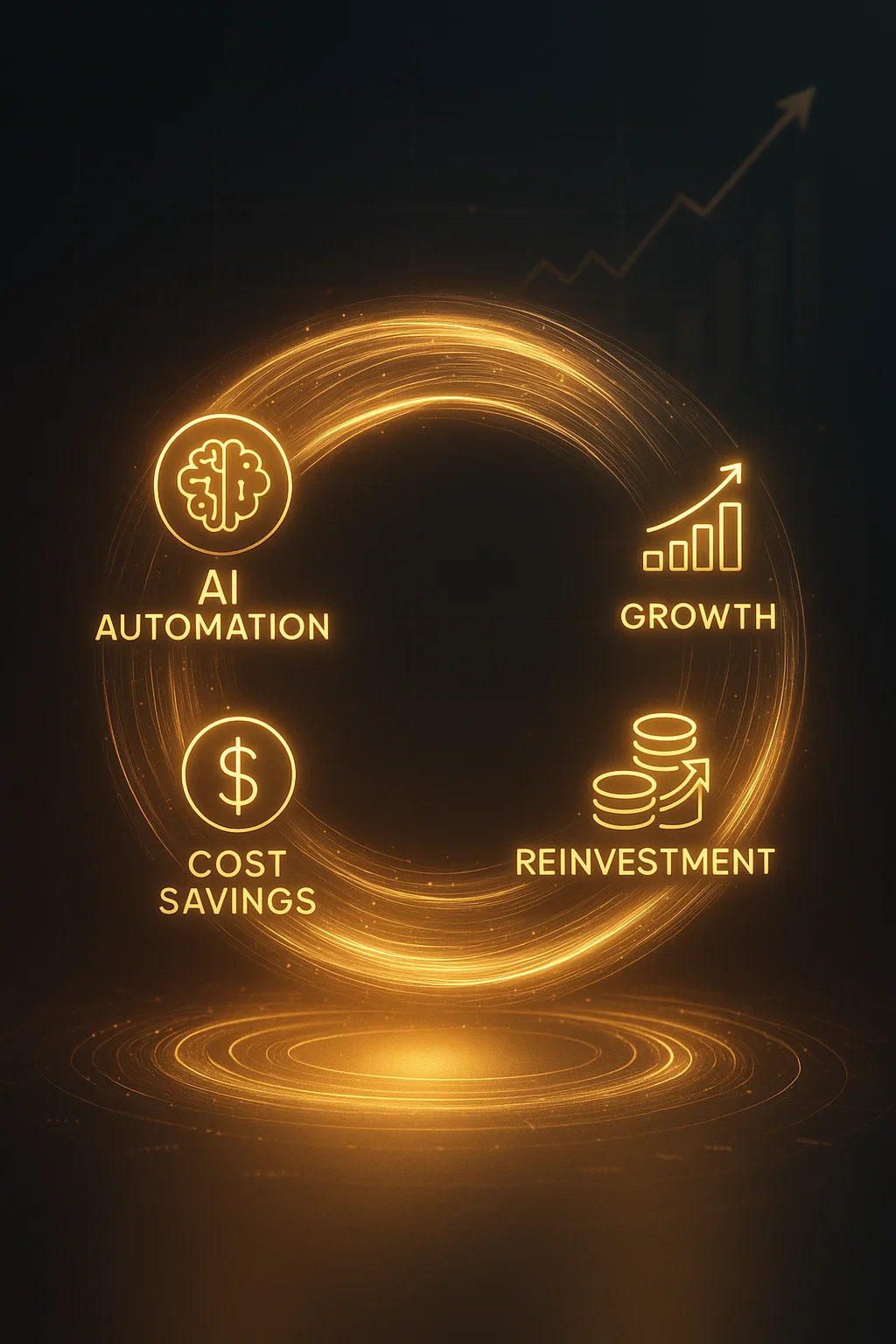
Result: The Pay-for-Itself Cycle
When companies start small, track real results, bring finance on board, and design for scale, the payoff comes quickly. UPS and JPMorgan have shown that AI can start paying for itself in just a few months, not years. Those early wins don’t just save money—they build confidence, attract more investment, and set the stage for lasting, sustainable growth.
Finance teams know the pressure all too well: tight deadlines, endless spreadsheets, and constant demands to deliver accurate forecasts while cutting costs and reducing risk. For years, that meant long nights, manual number-crunching, and tough decisions made with limited data. Now, AI is changing the game by bringing speed, accuracy, and confidence to financial forecasting.
The Challenge
Forecasting cycles used to stretch over weeks, relying on fragmented data and manual inputs that often led to costly mistakes. Errors in projections could cascade through budgets, supply chains, and investment plans, costing millions in inefficiencies. Finance leaders needed a way to modernize forecasting—without losing human judgment.
The AI Transformation
Leading enterprises have started using AI-powered forecasting and planning tools that blend real-time data with predictive analytics. These systems don’t replace finance professionals—they make them faster, sharper, and more strategic.
Coca-Cola partnered with Microsoft to integrate AI across its global operations, including demand forecasting and supply-chain planning. The collaboration has helped improve forecasting accuracy and efficiency in pilot markets—showing that smarter predictions can directly translate into stronger business results.
Shell is committed to integrating AI across its operations, using machine learning, computer vision, and simulation tools to optimize energy workflows and drive innovation.
HSBC now operates more than 600 AI applications across functions such as fraud detection, customer service, risk management, and operations. The bank views AI as a strategic lever in areas like treasury and payments. Although neither organization has publicly disclosed detailed metrics for financial forecasting, the scale of their AI adoption demonstrates a shared commitment to using intelligent automation to enhance operational efficiency.
The Measurable Impact
AI has already started delivering tangible gains for finance operations across industries:
Metric | Typical Outcome |
Forecasting Speed | Cycle times reduced by 30–50%, thanks to automation and real-time data integration. |
Accuracy Improvement | Predictive models have improved forecast accuracy by 15–25% in most enterprise deployments. |
Operational Savings | Companies report multi-million-dollar savings annually from improved budget allocation and reduced rework. |
Strategic Focus | Finance teams now spend more time on analysis and planning, and less on data reconciliation. |
The Human Advantage
This isn’t about replacing analysts with algorithms; it’s about giving them better tools.
AI takes over the tedious number-crunching, allowing finance professionals to focus on what truly matters: interpreting the story behind the numbers, spotting trends early, and advising leadership with confidence.
As one CFO at Shell noted, “AI hasn’t replaced our finance team—it’s made them more strategic. We’re faster, more accurate, and more aligned with the business than ever before.”
The Takeaway
Companies like Coca-Cola, Shell, and HSBC have proven that AI in finance is no longer experimental; it’s essential. Smarter forecasting delivers faster decisions, greater accuracy, and measurable ROI. By combining human expertise with intelligent automation, finance teams are turning data into one of their most powerful strategic assets.

AI isn’t just cutting costs; it’s redefining how organizations operate, respond, and grow. From customer support to internal productivity, companies are using AI to achieve faster response times, higher satisfaction, and measurable returns across multiple business functions.
The Challenge: Rising Costs, Slower Responses, and Burnout
Across industries, teams struggled with mounting inefficiencies:
Customer support departments were overwhelmed by long wait times, inconsistent service quality, and high agent turnover.
Internal teams spent 40–60% of their time on low-value tasks like data entry, scheduling, and repetitive documentation.
Employee burnout have been rising, while customer satisfaction (CSAT) scores were flat.
Both challenges shared a common thread — time lost to manual work that AI could handle better.
The AI Solution: Intelligent Automation for Customers and Employees
Forward-thinking enterprises began to view AI not as a cost saver but as a business accelerator.
Vodafone uses its AI-powered chatbot (e.g. TOBi / SuperTOBi) to handle routine queries and deploys agent-assist tools (e.g. SuperAgent) to support agents with more complex issues. The bot passes context and summaries to human agents, helping them respond faster and more accurately.
PwC, on the other hand, deployed AI productivity copilots across consulting teams, automating documentation, summarizing client reports, and streamlining scheduling.
Both initiatives shared a strategic goal: to eliminate low-value work, free up human capacity, and drive measurable ROI.
The Results: Efficiency Meets Experience
Metric | Impact Achieved |
Service Costs | Up to 30% reduction through automation and AI routing. |
Customer Satisfaction (CSAT) | +8–15 point increase driven by faster, more consistent resolutions. |
Resolution Time | Cut from hours to minutes via automated self-service and smart triage. |
Employee Productivity | 20–30% gains in output per employee without expanding headcount. |
Retention & Morale | 10–20% higher retention among both customers and employees, as teams offload repetitive work and focus on meaningful tasks. |
The Strategic ROI
By integrating AI into both external customer touch points and internal workflows, companies like Vodafone and PwC demonstrate that:
AI can simultaneously reduce operational costs and enhance satisfaction.
Productivity gains don’t require larger teams — just smarter tools.
The same AI principles that elevate customer experience can unlock massive talent efficiency.
These organizations transformed what were once cost centers into growth engines, showing that AI’s real ROI lies not in replacement — but in empowerment.
The Takeaway
The first year of AI doesn’t need to be experimental. With a clear playbook and measurable goals, enterprises can achieve:
Double-digit ROI on both cost savings and productivity,
Happier customers and employees, and
Faster growth, fuelled by automation that thinks and scales.
Leaders who view AI as a strategic business lever, not a science project, will define the next era of competitive advantage.